Home » 2015 (Page 2)
Yearly Archives: 2015
Waiting for Grace
Grace came from nowhere, caught me unawares, like when you’re sitting in a park totally engrossed in your whodunit and suddenly there’s a delicious aroma of baking bread, yeast and dough with overtones of garlic and perhaps the gentle bubble of melting cheese, sizzling oil and fat, and you wonder what else is in the pizza topping, book totally forgotten, and you remember that you haven’t had breakfast yet, only a cup of coffee and you came out of the house to run a couple of errands on a Saturday morning, wandered into a bookstore on the way home and found this book someone had raved about, bought it on impulse and sat down to read and then were lost in the murder mystery. Life’s something like that. Creeps up on us. The best lives are lived mostly unplanned. Correction! The best lives are planned and then lived with so many deviations from the plan so that we ultimately arrive at a destination more perfect than we could ever have imagined. Life is as perfect as you make it to be. No great secret here. It’s what you make of it. I know that. You know that. So how do I imbue Grace with that knowledge without preaching?
Yes, Grace! There’s me on that metaphorical park bench, reading the metaphorical whodunit of life and then, like the waft of baking pizza smells, Grace sneaks into the corners of my mind, invades it with tendrils of soft enticement and then I’m completely lost, I have to type, to search, to pin down this elusive character who beckons with so much mystery. What is Grace made of? How did she come to be? She has certain powers; powers that she herself is not aware of, perhaps. So how does she comes to know her own power? Is she humbled by it? Do they, these powers, make her over-confident and over-reach herself?
So for a frenzied three months, I sat down and typed. I typed in the morning and I typed in the evening, sometimes late at night I woke up with a vision and I was Grace seeing the answer to a puzzle, a mystery. Who poisoned the harmless old lady’s friendly Jack Russell terrier? And why? And why was the old lady so sure the poisoning was deliberate? What a shock to find that on this idyllic, almost paradisical, island! It was an island in the South China Sea near Hong Kong, very hot, very steamy, and the writing was like an outpouring from a fever of the brain. But somewhere in the soul of the scribe sits a heart of ice that dissects and says, no, no; this is implausible, this cannot be true. But life is like that! Life often cannot be true, and yet these things do happen. Take the disappearance of MH370, for instance; the best aviation brains and experts in the world still cannot deduce what happened, or how; until recently, a bit of wreckage was washed ashore that perhaps will provide some conjecture of the truth. But a novel does not have this luxury. And so the fevered search for the soul of Grace continued.
More about Grace in the next post…
The Great Learning Gap

Sugata Mitra’s new study summarised in the TES here suggests that self study on the internet can boost a child’s performance by seven years. Basically, 8 and 9 year olds studied GCSE content online before being examined three months later in examination conditions. They were successful. It sounds astounding, but it’s true. And actually I don’t think it’s that surprising. To me, this is not a study about the power of the internet. It’s a study about the power of children.
Despite what the traditionalists may tell you, kids teach themselves stuff all the time. And they retain it too. The problem for us as teachers is that too often we don’t find out what it is they know because we have already decided we’ll tell them when we’re ready. And the other is that often the stuff they’ve learned is not what’s on our syllabus. It may be that…
View original post 801 more words
Salaam Bombay come to Life.
“What one is in life is sometimes really a matter of when someone loves you, when someone cares for you or gives their life for you.”
This quote is from Amin Sheikh’s book “Life is Life: I am because of you.” A true story. An autobiography of a street child who made good in Bombay/Mumbai. He ran away from home at the age of five to escape an abusive stepfather. He lived on the streets for several years, until he was taken in by an NGO called Snehasadan.

Amin Sheikh: the world is his oyster at age 35
Today, he has his own travel company, has written an autobiography and intends to start a cafe. As an aside, he is also doing everything he can to ensure that other homeless children do not have to go through what he himself went through. He concludes his book with these words. “That was my life and my journey. I have come a long way but I have a long way to go. To do much more than all I have done so far. To give back to life and share with people, to stand for all those other Amins in the world.”
Buy the book. All proceeds from the book will be used to help young children get an education and find employment after they turn 18. He currently takes care of 8 kids, 4 boys and 4 girls. To know more, see his own blog at http://iambecauseofyou.com/
Four Levels of Leadership

Image courtesy Guardian.com
Great leadership is an elusive quality that we all think we recognise when we see. It takes hindsight and history to set a final seal of approval on an individual’s greatness as a leader. Among the many ways of looking at leadership, here are four classes or levels of leadership, in ascending order of quality. To which one do you belong?
I Did It: The most common type of leader belongs to the ‘I did it’ school and cements a reputation by constantly highlighting his/her own role and the positive accomplishments that result. This is probably the most common and the most rudimentary form of leadership. The vast majority of political leaders in the world today fall into this category.
S/He Did It: With more experience, maturity and personal growth, a few managers stop managing and become true leaders. In such cases, all members of a team have no hesitation in acknowledging that the group’s successes are a reflection of the values imbued by its head. After a task is successfully accomplished, the team gives the leader credit and says, “S/he did it.”
We Did It: There is a subtler form of leadership that stresses inclusivity, strives to bring out the best in people, and is cloaked in benevolence. The benevolence may be skin deep or may go deeper than that. In either case it is more effective than the first two levels. Anyone fortunate enough to work in an organization with this kind of leadership identifies completely with the tasks to be accomplished and takes ‘ownership’ in the best sense of the word.
I Did It: At the highest level, however, the world of leadership comes back to the ‘I,’ but in a completely non-egoistic sense. This is the spiritual I that embodies and identifies with the whole world. There is no need for the presence of a leader. Every single one of these exalted I’s is a member of a team; within an organisation, within a country, within the world. The I that reaches this state is truly a universal I. In order to reach this level, we need to take charge of ourselves, each one of us individually. And when we do, we will also become exemplary followers, of the kind that all visionary organisations and societies need. There is a ‘circle of life’ philosophy at work here, a spiritual component, to this level of leadership. This is a level worth aspiring to, and is the only kind of leadership that can change the course of the world.
International Relations Based on Fear
Whatever happened to Domino Theory? Way back in the 1950s, the world was recovering from World War II. News coverage was not as intensely 24/7 as it is today. Nevertheless, the world was still a nervous place less than a decade after the great war, with its aftermath still evident in many parts of the world. In 1954, when General Giap decisively defeated the French at Dien Bien Phu, US President Eisenhower brought forth the “falling domino” principle that had been accepted wisdom in foreign policy circles for several years. According to this theory, once Vietnam fell to the Communists, then the neighbouring countries of Laos, Cambodia and Thailand would fall like dominoes and also become communist.

Once Vietnam became Communist, other nations in Indo-China would fall like dominoes….
The wisdom of hindsight shows that this did not happen. The North Vietnamese were merely fighting for their independence. They had no desire to become satellites of either Russia or China. The US wasted thousands of lives of its own young men (not to mention the terrible toll of Vietnamese lives) in a vain effort to stop dominoes falling. In the process, the US dropped over 2.7 millions tons of ordnance on neighbouring Cambodia, more bombs than the Allies used in all of World War II. This bombing gives Cambodia the doubtful distinction of being the most heavily bombed country in history. See this Yale University link for more detail. http://www.yale.edu/cgp/Walrus_CambodiaBombing_OCT06.pdf (short excerpt below).
The still-incomplete database (it has several “dark” periods) reveals that from October 4, 1965, to August 15, 1973, the United States dropped far more ordnance on Cambodia than was previously believed: 2,756,941 tons’ worth, dropped in 230,516 sorties on 113,716 sites. Just over 10 percent of this bombing was indiscriminate, with 3,580 of the sites listed as having “unknown” targets and another 8,238 sites having no target listed at all. The database also shows that the bombing began four years earlier than is widely believed—not under Nixon, but under Lyndon Johnson. The impact of this bombing, the subject of much debate for the past three decades, is now clearer than ever. Civilian casualties in Cambodia drove an enraged populace into the arms of an insurgency that had enjoyed relatively little support until the bombing began, setting in motion the expansion of the Vietnam War deeper into Cambodia, a coup d’état in 1970, the rapid rise of the Khmer Rouge, and ultimately the Cambodian genocide.
Fast forward to 2015. The current fear that ISIS, a cruel and aggressive Islamist group, will take over the region is unfounded. There are too many opposing interests, not least the Kurds, who will fight to ensure that this does not happen. Kudos then to President Obama for admitting that “we don’t yet have a complete strategy” for dealing with ISIS. This is an honest answer, for there is no cogent strategy to deal with this convoluted situation. The world should be thankful there is no new domino theory in place, no covert plan for “carpet bombing” the region based on fear of falling dominoes. Progress of sorts, perhaps.
Small is Beautiful
Ernst F. Schuhmacher made the phrase famous with his book of the same title and its thought-provoking subtitle: economics as if people mattered.
Pawel Wembley’s photographs of the minuscule make us look at everyday things in nature in a completely different light. The underside of a leaf, a close up of a flower in bloom, the down on a caterpillar’s hair. For more stunning images of nature’s miniatures brought to light, see his pages of images at the URL below.
https://www.google.com/+PawelWembley
Here are a couple of low-resolution samples of Pawel’s superb photos. Most of them were taken on walks through the woods on an island in the South China Sea.


We are all Immigrants
The more I read about the history of man, the clearer it becomes that we all, without exception, once came from somewhere else. That’s quite a thought, and a deceptively simple truth, really. So why are prosperous countries in Southeast Asia turning away thousands of Rohingya refugees from their shores? Why are the prosperous countries of Europe turning away the boatloads of refugees from North Africa? Is it because we in these countries have become too rich to share? The New Testament story of the widow’s mite is well known. Have middle class people in middle class countries become too rich to care?
During the 1971 Bangladesh war, when ten million refugees streamed over the border into India, I heard a story about the beggars of Calcutta. This resembles the ‘widow’s mite’ story of Jesus in the New Testament. In 1971, seeing the desperate plight of the Bangladesh refugees, the beggars of Calcutta sent a delegation to the municipal corporation requesting that their weekly free meal be redirected to the poor people in the refugee camps instead.
Is this story true? I can find no documentation of this tale, but my own experience of the kindness of strangers in poorer parts of the world convinces me that it is. For armchair travellers, here is a link to milestones from the “Out of Eden” walk, an attempt to relive mankind’s journey through the ages.
Two Old Friends
No, this is not a short story. I met two old friends yesterday, to the left of the path to the Power Station Beach on Lamma, both of whom I hadn’t met in years. The first was a Greater Coucal (centropus sinensis), also known as the crow pheasant. Its haunting call is heard everywhere on this island, so there must be scores of them here if not hundreds, but this is the first time in two years that I’ve seen one. Here’s a link to a YouTube video that someone posted from Thailand.
The second was a bittern, whose European cousin I used to frequently meet among the reeds at the edge of a pond on the outskirts of Vienna, usually in late autumn. Here’s a mobile camera photo of the bittern that may be distinguishable if you can enlarge it on your screen.
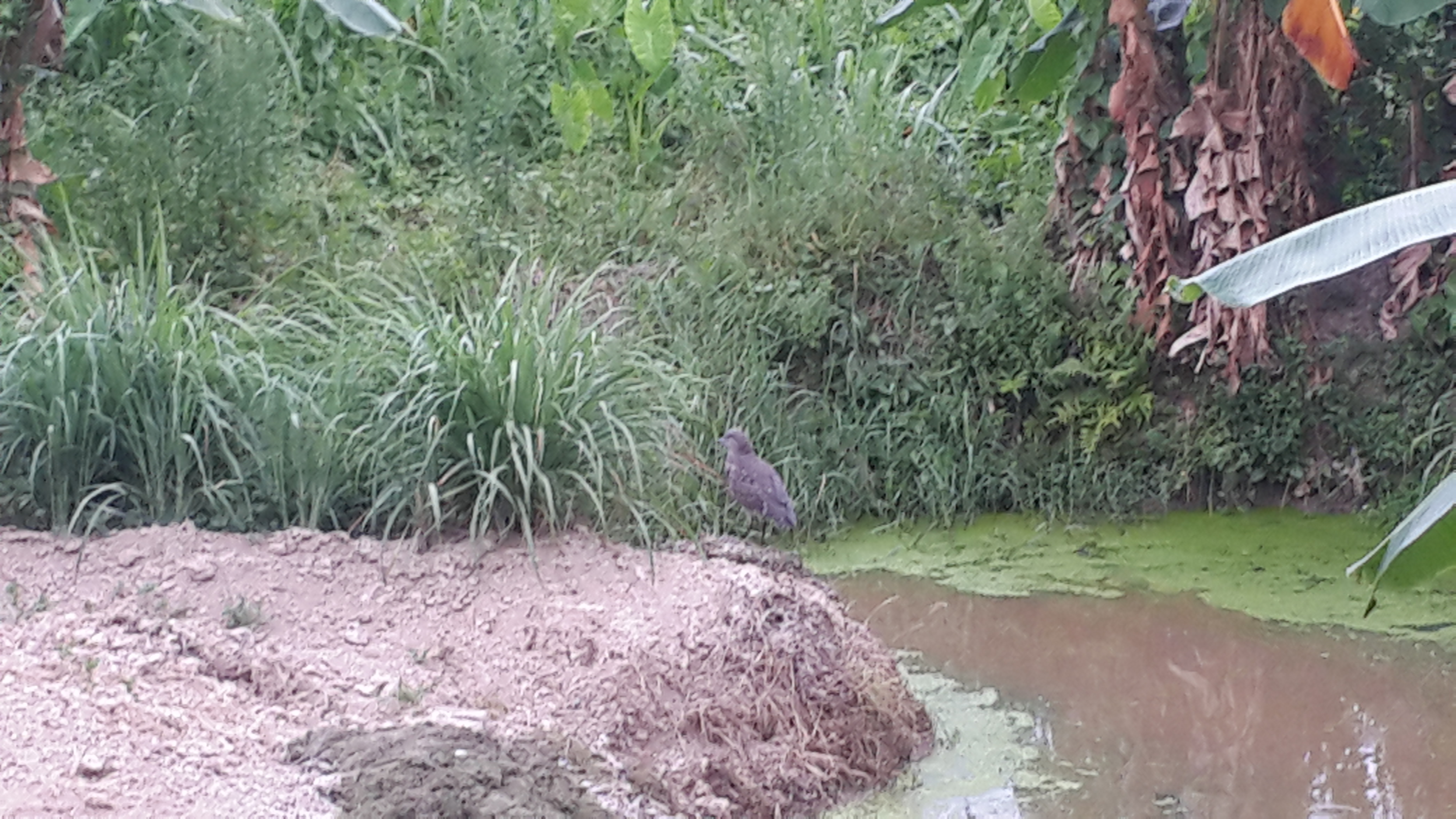
Bitterns are facing habitat loss worldwide
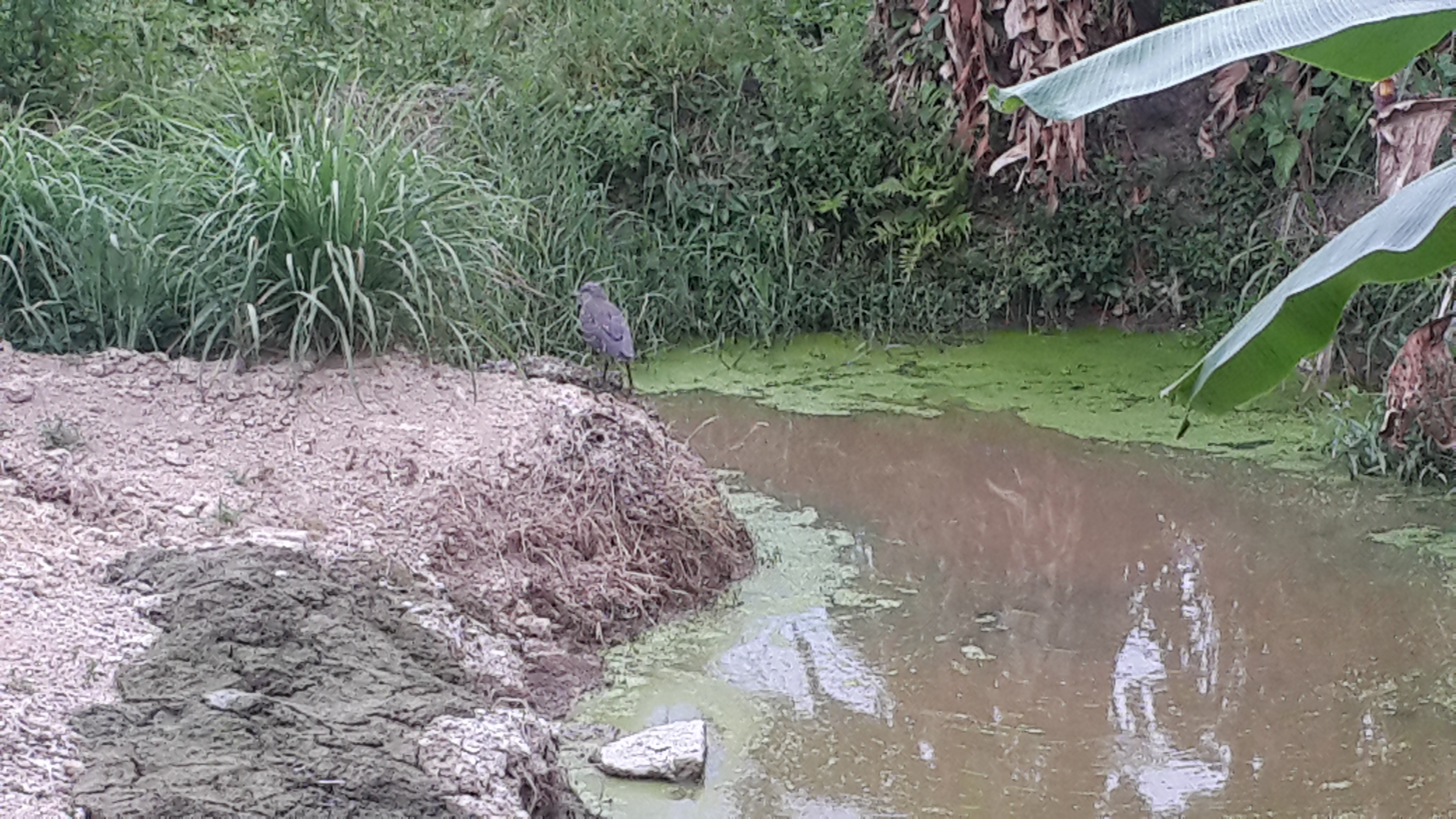
Bitterns, and thousands of other species, are being endangered by habitat loss, so it looks like rethinking ‘development’ may be an idea whose time has finally come.
Nature’s Bounty

Hundreds of these large orange blossoms strewn on the path to the beach from a tree overhead. The nameless profligacy of Nature’s bounty. Surely the earth has enough for all if we use its resources wisely.

Indian Khanna grows in profusion beside a walking trail on the outlying islands.
My apologies for the long delay in posting, but I am privileged to be truly living in a state of grace. More on that in the next blog!
Quick Renewable Energy Update
The 103GW of capacity added by renewables last year (2014) equals the energy generating capacity of all 158 nuclear power plant reactors in the USA.
…Wind, solar, biomass and waste-to-power, geothermal, small hydro and marine power contributed an estimated 9.1% of world electricity generation in 2014, up from 8.5% in 2013. This meant that last year the world electricity system emitted 1.3 gigatonnes of CO2 – roughly twice the emissions of the world’s airline industry – less than it would have if that 9.1% had been produced by the same fossil-dominated mix generating the other 90.9% of world power.
“Once again in 2014, renewables made up nearly half of the net power capacity added worldwide” says Achim Steiner, UN Under-Secretary-General and Executive Director of UNEP.
from Environmental Research Web, 2 April 2015
 aviott