Sudarshan’s Gift: A short story about a novel
Way back in 1982, industrialist Clive Sinclair was at the height of his business career. The Sinclair ZX Spectrum was among the first and most successful mainstream home computers in the world, ultimately selling more than 5 million units world wide. Clive Sinclair is credited with launching the UK IT industry and products like the Spectrum and its successors earned him a knighthood. In that same year, he instituted a literary prize, the Sinclair Prize for Fiction, to be awarded to an unpublished manuscript of social or political significance. Two of the five judges (including the Chairman) thought that a novel called ‘Chasing Cursors’ by an unknown Indian author was the clear winner. The other three judges demurred, saying the novel was of no social or political significance. They took the problem to Clive Sinclair, who threw some additional money into the pot and said the novel in question should be given a special award. The Sinclair Prize ultimately was awarded to an author whose book about battling the apartheid regime in South Africa was clearly of great social and political significance. ‘Chasing Cursors’ won special mention for merit and was awarded a small cash prize.
Since this is a short story, a long story is omitted here about two literary agencies (one in the UK and the other based in the US) seeking a publishing home for ‘Chasing Cursors’ in its new avatar of ‘Sudarshan’s Gift.’ According to the agencies, the manuscript was rejected by more than four hundred publishers on four continents over the next ten years. In 1999, a new e-publishing venture called Online Originals picked it up for their list of e-books to be sold online in pdf or PDA formats (Anyone remember the Palm Pilot, the Psion or Apple’s Newton?).
Publisher David Gettman, convinced of the book’s literary merit, nominated it for the Booker Prize in that year, perhaps the first ever submission of an e-only book for the prize. The Prize committee rejected the nomination, on the grounds that the author had changed nationality since the book was written, was no longer a Commonwealth citizen, and hence could not be considered for the prize. Fast forward to 2015 when publishing rights revert to the author and it now appears as a paperback and Kindle edition on Amazon. Here are headlines from the 8 reviews of the books so far.
Powerful, lasting story….. Heartwarming….. a Lesson in Love and Tolerance….. Intriguing….. Such a gift is pure….. A Well-Written Tale….. A journey through India and the human heart.…. Great Storytelling ….
The re-publication of Sudarshan’s Gift and its first appearance in paperback has meant that the appearance of “Grace in the South China Sea,” has been delayed by several weeks. More about Grace in the next blog.
The Life of the River

The source of the Wien River in Lower Austria. Image courtesy Werauchimmer
Perhaps it is the sweeping power of the iconic waltz composed by Johann Strauss the Younger, that most people associate the Danube with Vienna. In actual fact, the Donau flows along the north-eastern periphery of the city and the river that runs through its heart, from West to East is the Wienfluss, a 34 kilometer-long stream that gives Vienna its name in German, Wien. Although the stream is often overlooked, its catchment area lies in hilly country to the west of the city, so in case of heavy rains, its level can rise very quickly. Despite this risk, the stream is normally so placid that the city has built a concrete bicycle path along its dry bed beside the water. In 2009, the stream’s depth rose by 1 meter in just 10 minutes during a rainy spell. The stream becomes a raging river and its water flow has been known to increase more than 2000 fold (from the normal 200 liters per second to 450,000 per second).
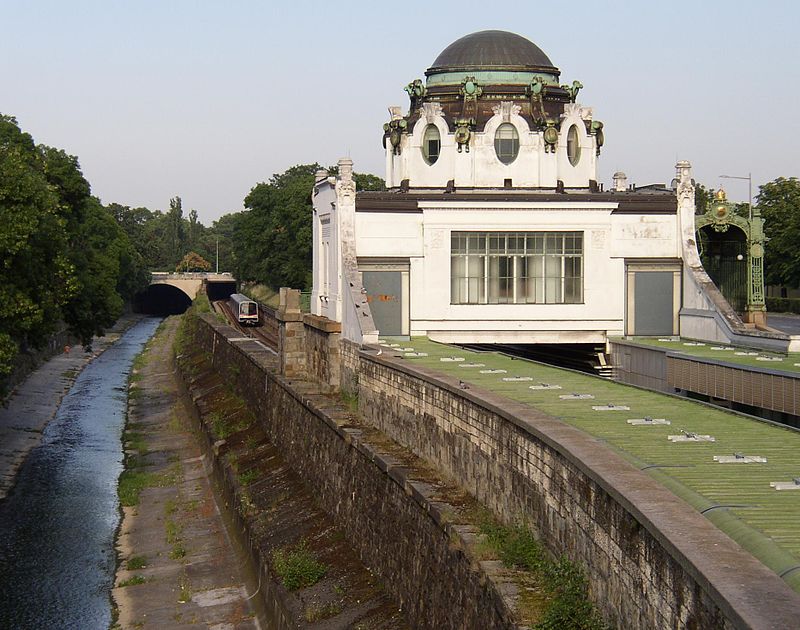
The river is covered up and flows underground from Hietzing in Vienna’s 13th district… (Image by Doris Anthony)

…and emerges into the open again where it joins the Donaukanal near Schwedenplatz.
Cycling west along the bicycle path, the stream flows along a paved channel with very little vegetation. At the outskirts of the city, the paved channel is wider and attempts have been made to naturalise the banks and dismantle some stretches of paving. Immediately, the stream takes on character. A profusion of plants, reeds and trees have taken root along its banks in the space of a few years. It’s amazing how quickly life has returned to this stretch of river, how the river meanders once man-made constraints are removed. There are more birds and, presumably, insects and other forms of small animal life in the new undergrowth beside the stream.
Seeing this changed stream evoked the thought that perhaps the life of this small river was a metaphor for all of us, for the rivers of our lives. How many of us are locked into barren channels, afraid of change; perhaps stuck in a 9 to 5 rut, afraid to break free or change jobs, trapped by the need for money to feed a family, or fearful of unemployment, of abandonment; the reasons are endless. There is something wrong with a world awash in industrial and consumer goods, where food is wasted while millions starve, where millions are unemployed and those that have jobs are more overworked than ever. So here again, without going into the interminable discussions of classical economists, of trade flows or balance-of-payments, is a river metaphor for our lives. A meandering life will indubitably be richer. If we dare to break free, life will become richer, more full of meandering turns, with lots of unexpected surprises certainly, but we will be better equipped to cope with surprises.
Thoughts along these lines reminded me of a book by Mark Boyle entitled “The Moneyless Man,” a courageous year-long experiment in living without money. I highly recommend buying this book, but if you don’t want to commit to buying the book just yet, take a look at the book-length sequel, “The Moneyless Manifesto,” which is available free online at the link below.
Moneyless living by choice is a form of grace. I will return to the other Grace, the one in the South China Sea, in my next blog.
Waiting for Grace
Grace came from nowhere, caught me unawares, like when you’re sitting in a park totally engrossed in your whodunit and suddenly there’s a delicious aroma of baking bread, yeast and dough with overtones of garlic and perhaps the gentle bubble of melting cheese, sizzling oil and fat, and you wonder what else is in the pizza topping, book totally forgotten, and you remember that you haven’t had breakfast yet, only a cup of coffee and you came out of the house to run a couple of errands on a Saturday morning, wandered into a bookstore on the way home and found this book someone had raved about, bought it on impulse and sat down to read and then were lost in the murder mystery. Life’s something like that. Creeps up on us. The best lives are lived mostly unplanned. Correction! The best lives are planned and then lived with so many deviations from the plan so that we ultimately arrive at a destination more perfect than we could ever have imagined. Life is as perfect as you make it to be. No great secret here. It’s what you make of it. I know that. You know that. So how do I imbue Grace with that knowledge without preaching?
Yes, Grace! There’s me on that metaphorical park bench, reading the metaphorical whodunit of life and then, like the waft of baking pizza smells, Grace sneaks into the corners of my mind, invades it with tendrils of soft enticement and then I’m completely lost, I have to type, to search, to pin down this elusive character who beckons with so much mystery. What is Grace made of? How did she come to be? She has certain powers; powers that she herself is not aware of, perhaps. So how does she comes to know her own power? Is she humbled by it? Do they, these powers, make her over-confident and over-reach herself?
So for a frenzied three months, I sat down and typed. I typed in the morning and I typed in the evening, sometimes late at night I woke up with a vision and I was Grace seeing the answer to a puzzle, a mystery. Who poisoned the harmless old lady’s friendly Jack Russell terrier? And why? And why was the old lady so sure the poisoning was deliberate? What a shock to find that on this idyllic, almost paradisical, island! It was an island in the South China Sea near Hong Kong, very hot, very steamy, and the writing was like an outpouring from a fever of the brain. But somewhere in the soul of the scribe sits a heart of ice that dissects and says, no, no; this is implausible, this cannot be true. But life is like that! Life often cannot be true, and yet these things do happen. Take the disappearance of MH370, for instance; the best aviation brains and experts in the world still cannot deduce what happened, or how; until recently, a bit of wreckage was washed ashore that perhaps will provide some conjecture of the truth. But a novel does not have this luxury. And so the fevered search for the soul of Grace continued.
More about Grace in the next post…
The Great Learning Gap

Sugata Mitra’s new study summarised in the TES here suggests that self study on the internet can boost a child’s performance by seven years. Basically, 8 and 9 year olds studied GCSE content online before being examined three months later in examination conditions. They were successful. It sounds astounding, but it’s true. And actually I don’t think it’s that surprising. To me, this is not a study about the power of the internet. It’s a study about the power of children.
Despite what the traditionalists may tell you, kids teach themselves stuff all the time. And they retain it too. The problem for us as teachers is that too often we don’t find out what it is they know because we have already decided we’ll tell them when we’re ready. And the other is that often the stuff they’ve learned is not what’s on our syllabus. It may be that…
View original post 801 more words
Salaam Bombay come to Life.
“What one is in life is sometimes really a matter of when someone loves you, when someone cares for you or gives their life for you.”
This quote is from Amin Sheikh’s book “Life is Life: I am because of you.” A true story. An autobiography of a street child who made good in Bombay/Mumbai. He ran away from home at the age of five to escape an abusive stepfather. He lived on the streets for several years, until he was taken in by an NGO called Snehasadan.

Amin Sheikh: the world is his oyster at age 35
Today, he has his own travel company, has written an autobiography and intends to start a cafe. As an aside, he is also doing everything he can to ensure that other homeless children do not have to go through what he himself went through. He concludes his book with these words. “That was my life and my journey. I have come a long way but I have a long way to go. To do much more than all I have done so far. To give back to life and share with people, to stand for all those other Amins in the world.”
Buy the book. All proceeds from the book will be used to help young children get an education and find employment after they turn 18. He currently takes care of 8 kids, 4 boys and 4 girls. To know more, see his own blog at http://iambecauseofyou.com/
Four Levels of Leadership

Image courtesy Guardian.com
Great leadership is an elusive quality that we all think we recognise when we see. It takes hindsight and history to set a final seal of approval on an individual’s greatness as a leader. Among the many ways of looking at leadership, here are four classes or levels of leadership, in ascending order of quality. To which one do you belong?
I Did It: The most common type of leader belongs to the ‘I did it’ school and cements a reputation by constantly highlighting his/her own role and the positive accomplishments that result. This is probably the most common and the most rudimentary form of leadership. The vast majority of political leaders in the world today fall into this category.
S/He Did It: With more experience, maturity and personal growth, a few managers stop managing and become true leaders. In such cases, all members of a team have no hesitation in acknowledging that the group’s successes are a reflection of the values imbued by its head. After a task is successfully accomplished, the team gives the leader credit and says, “S/he did it.”
We Did It: There is a subtler form of leadership that stresses inclusivity, strives to bring out the best in people, and is cloaked in benevolence. The benevolence may be skin deep or may go deeper than that. In either case it is more effective than the first two levels. Anyone fortunate enough to work in an organization with this kind of leadership identifies completely with the tasks to be accomplished and takes ‘ownership’ in the best sense of the word.
I Did It: At the highest level, however, the world of leadership comes back to the ‘I,’ but in a completely non-egoistic sense. This is the spiritual I that embodies and identifies with the whole world. There is no need for the presence of a leader. Every single one of these exalted I’s is a member of a team; within an organisation, within a country, within the world. The I that reaches this state is truly a universal I. In order to reach this level, we need to take charge of ourselves, each one of us individually. And when we do, we will also become exemplary followers, of the kind that all visionary organisations and societies need. There is a ‘circle of life’ philosophy at work here, a spiritual component, to this level of leadership. This is a level worth aspiring to, and is the only kind of leadership that can change the course of the world.
International Relations Based on Fear
Whatever happened to Domino Theory? Way back in the 1950s, the world was recovering from World War II. News coverage was not as intensely 24/7 as it is today. Nevertheless, the world was still a nervous place less than a decade after the great war, with its aftermath still evident in many parts of the world. In 1954, when General Giap decisively defeated the French at Dien Bien Phu, US President Eisenhower brought forth the “falling domino” principle that had been accepted wisdom in foreign policy circles for several years. According to this theory, once Vietnam fell to the Communists, then the neighbouring countries of Laos, Cambodia and Thailand would fall like dominoes and also become communist.

Once Vietnam became Communist, other nations in Indo-China would fall like dominoes….
The wisdom of hindsight shows that this did not happen. The North Vietnamese were merely fighting for their independence. They had no desire to become satellites of either Russia or China. The US wasted thousands of lives of its own young men (not to mention the terrible toll of Vietnamese lives) in a vain effort to stop dominoes falling. In the process, the US dropped over 2.7 millions tons of ordnance on neighbouring Cambodia, more bombs than the Allies used in all of World War II. This bombing gives Cambodia the doubtful distinction of being the most heavily bombed country in history. See this Yale University link for more detail. http://www.yale.edu/cgp/Walrus_CambodiaBombing_OCT06.pdf (short excerpt below).
The still-incomplete database (it has several “dark” periods) reveals that from October 4, 1965, to August 15, 1973, the United States dropped far more ordnance on Cambodia than was previously believed: 2,756,941 tons’ worth, dropped in 230,516 sorties on 113,716 sites. Just over 10 percent of this bombing was indiscriminate, with 3,580 of the sites listed as having “unknown” targets and another 8,238 sites having no target listed at all. The database also shows that the bombing began four years earlier than is widely believed—not under Nixon, but under Lyndon Johnson. The impact of this bombing, the subject of much debate for the past three decades, is now clearer than ever. Civilian casualties in Cambodia drove an enraged populace into the arms of an insurgency that had enjoyed relatively little support until the bombing began, setting in motion the expansion of the Vietnam War deeper into Cambodia, a coup d’état in 1970, the rapid rise of the Khmer Rouge, and ultimately the Cambodian genocide.
Fast forward to 2015. The current fear that ISIS, a cruel and aggressive Islamist group, will take over the region is unfounded. There are too many opposing interests, not least the Kurds, who will fight to ensure that this does not happen. Kudos then to President Obama for admitting that “we don’t yet have a complete strategy” for dealing with ISIS. This is an honest answer, for there is no cogent strategy to deal with this convoluted situation. The world should be thankful there is no new domino theory in place, no covert plan for “carpet bombing” the region based on fear of falling dominoes. Progress of sorts, perhaps.
Small is Beautiful
Ernst F. Schuhmacher made the phrase famous with his book of the same title and its thought-provoking subtitle: economics as if people mattered.
Pawel Wembley’s photographs of the minuscule make us look at everyday things in nature in a completely different light. The underside of a leaf, a close up of a flower in bloom, the down on a caterpillar’s hair. For more stunning images of nature’s miniatures brought to light, see his pages of images at the URL below.
https://www.google.com/+PawelWembley
Here are a couple of low-resolution samples of Pawel’s superb photos. Most of them were taken on walks through the woods on an island in the South China Sea.


We are all Immigrants
The more I read about the history of man, the clearer it becomes that we all, without exception, once came from somewhere else. That’s quite a thought, and a deceptively simple truth, really. So why are prosperous countries in Southeast Asia turning away thousands of Rohingya refugees from their shores? Why are the prosperous countries of Europe turning away the boatloads of refugees from North Africa? Is it because we in these countries have become too rich to share? The New Testament story of the widow’s mite is well known. Have middle class people in middle class countries become too rich to care?
During the 1971 Bangladesh war, when ten million refugees streamed over the border into India, I heard a story about the beggars of Calcutta. This resembles the ‘widow’s mite’ story of Jesus in the New Testament. In 1971, seeing the desperate plight of the Bangladesh refugees, the beggars of Calcutta sent a delegation to the municipal corporation requesting that their weekly free meal be redirected to the poor people in the refugee camps instead.
Is this story true? I can find no documentation of this tale, but my own experience of the kindness of strangers in poorer parts of the world convinces me that it is. For armchair travellers, here is a link to milestones from the “Out of Eden” walk, an attempt to relive mankind’s journey through the ages.
Two Old Friends
No, this is not a short story. I met two old friends yesterday, to the left of the path to the Power Station Beach on Lamma, both of whom I hadn’t met in years. The first was a Greater Coucal (centropus sinensis), also known as the crow pheasant. Its haunting call is heard everywhere on this island, so there must be scores of them here if not hundreds, but this is the first time in two years that I’ve seen one. Here’s a link to a YouTube video that someone posted from Thailand.
The second was a bittern, whose European cousin I used to frequently meet among the reeds at the edge of a pond on the outskirts of Vienna, usually in late autumn. Here’s a mobile camera photo of the bittern that may be distinguishable if you can enlarge it on your screen.
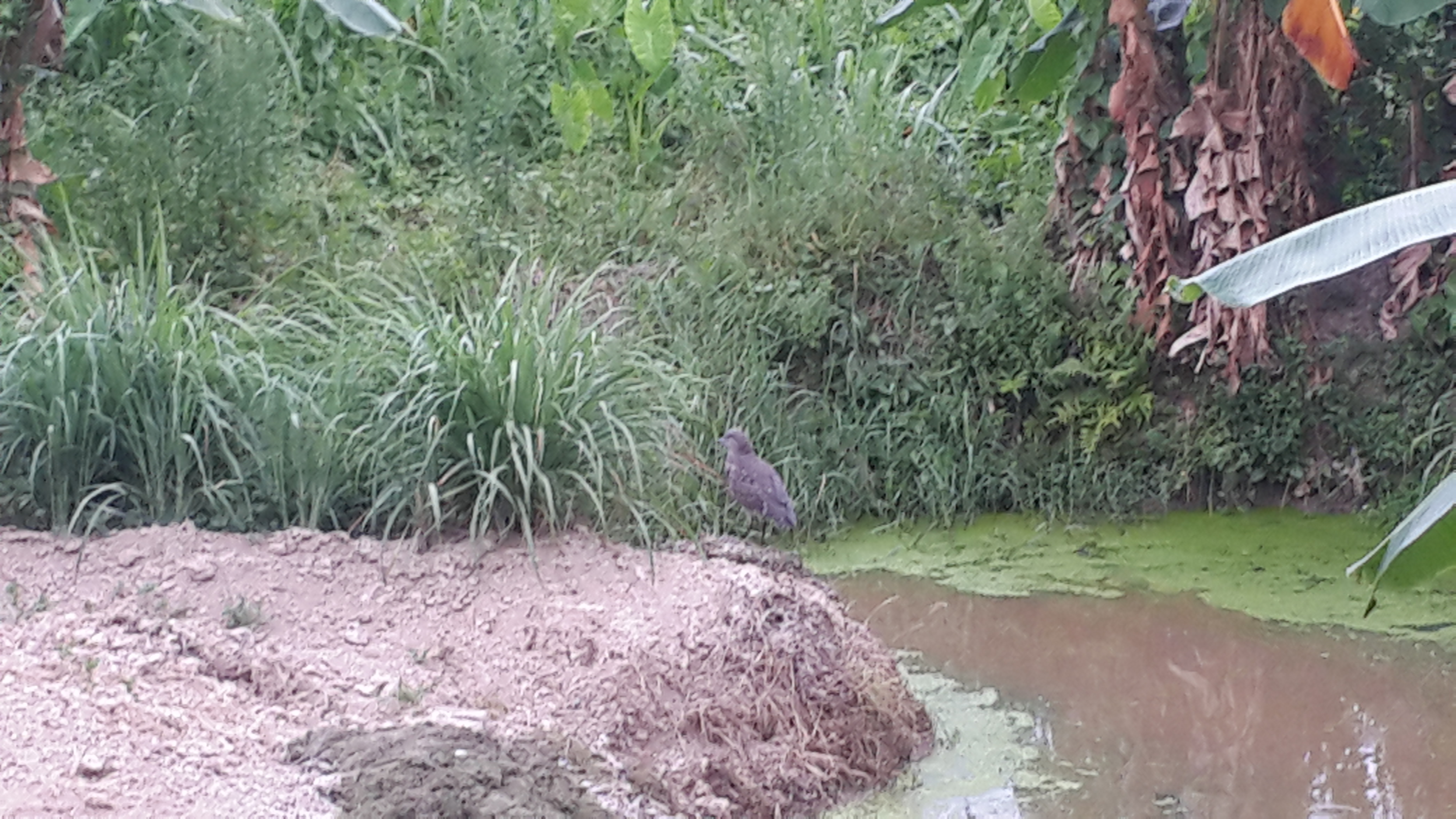
Bitterns are facing habitat loss worldwide
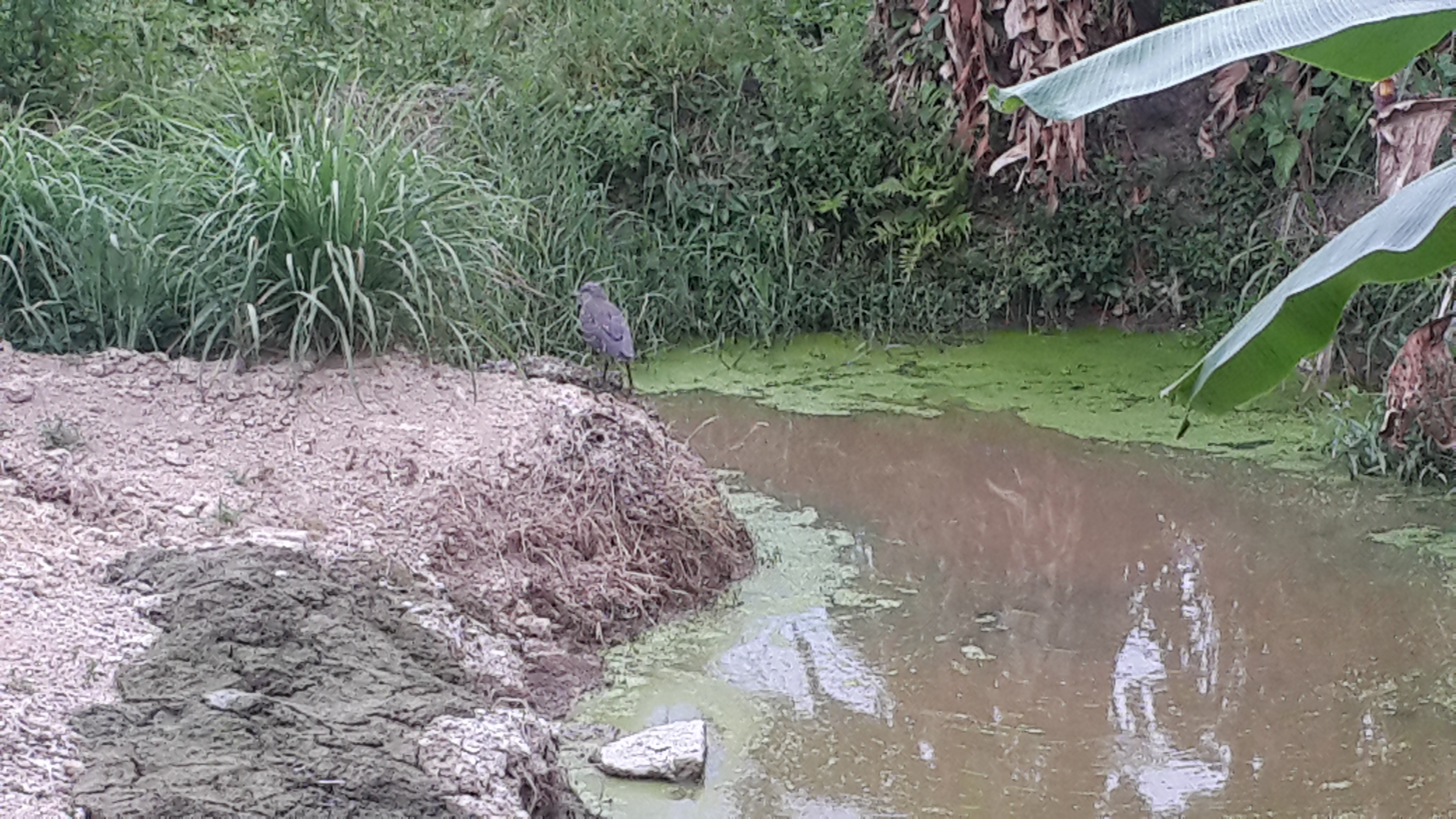
Bitterns, and thousands of other species, are being endangered by habitat loss, so it looks like rethinking ‘development’ may be an idea whose time has finally come.
Latest Posts
-

December 2021 Newsletter
Originally posted on The Forest Way: A photo essay Most wonderful wishes and best regards to all, for the start of a fresh, healthy, environmental…
-

A Tree Planting Update
I begin this post with an apology. I have posted only sporadically this past year, and the reason is not Covid as one might think.…
-
The Standoff explained: Modi government vs. Indian Small Farmers
The is basically a battle for the future of Indian agriculture. It is also a battle of two opposing philosophies: Small is Beautiful vs. Big…
-

The True Source of Wealth
Many years ago an economist friend told me to invest in stock index funds rather than property. He pointed out charts comparing property prices and…
 aviott