Home » Posts tagged 'culture' (Page 8)
Tag Archives: culture
Books are Bad for You.
I can imagine a conversation with friends who think it’s crazy to say that books are bad for your health. What a self-destructive statement for a writer to make; a writer whose three books have recently received more than a dozen positive reviews (see author page on Amazon) But it’s true. In different parts of the world, at different times, books have proved harmful to their authors, as well as to their owners and readers. The Index Librorum Prohibitorum was published in 1559 by the Pope and listed books deemed heretical, blasphemous or simply lascivious and were therefore banned. Various editions of the Index were published in later years. The 20th and the last edition was published as late as 1948 and it was only abolished in 1966 by Pope Paul VI. Probably the most famous victim of the Index was Giordano Bruno who was burned at the stake in Rome in 1600 although admittedly, to the Inquisition, his principal crimes were not his writings but his heretical skepticism of many Catholic beliefs including the Virgin Mary and the trinity.
Closer to our time, in the 20th century, the list of books banned by Nazi Germany in the 1930s was long and included the literature of Marxism, Communism, pacifism, democratic writings and, of course, works by Jewish authors. During the cultural revolution in China between 1966 and 1976 a man who later became my close personal friend was sentenced to years in labor camp simply for being a mathematician with a small private library of books. His principal crime perhaps was to know more than the young Red Guards who conducted his trial, spat at him and made him walk around for months with a dunce cap on his head.
Even these relatively recent incidents of the 20th century seem to have faded from a public mind that is drowning in information but starved of meaning. Precisely the reason why much of the world is reacting with demonstrations of outrage (rightly so) at the murders of 12 journalists in Paris while largely ignoring (sadly so) the massacre of 2000 people in Baga village in Nigeria where more than a million people have been internally displaced by Boko Haram’s violence.
Boko Haram can be most literally translated as “books are bad for you,” where Boko means books, literature, the printed word, the world of ideas; and Haram means impure or unclean. Boko Haram’s primitive ideology thrives in the absence of the world’s collective outrage that would force local leaders to take more forceful action to stop this cancer from spreading. This is a cancer that can unleash a civil war and spread to several neighbouring countries; Cameroon, Chad and Niger. This is no longer only a Nigerian problem. In the age of globalisation, this is a problem for the world.
Here is a link to the website of the Quilliam Foundation, an organisation that exists to fight the battle of ideas that lies at the roots of modern religious extremism, which is a form of theocratic fascism. Listen also to an interview with Maajid Nawaz, the co-founder of Quilliam who, as a former radical Islamist, is eminently qualified to talk about the topic. For those who despair at the directions that religious fundamentalism is taking the world, listening to the talk will be 43 minutes well spent. Thanks to Larry Willmore for his Facebook post drawing my attention to the talk.
See more of this author here
Facebook for the Gods: Phads and Puppets
William Dalrymple, in his fine book “Nine Lives” writes about the Phad singers of Rajasthan. As in traditional arts and crafts everywhere, the few remaining Phad singers and puppeteers are struggling to find audiences and sustain their livelihoods. There is a great danger that these rich traditions will soon be lost. Performances for tourist groups can help these artists survive, but to be really appreciated, the audiences need to be educated about the background to these stories (which are well-known to most traditional rural audiences) and this happens only with the most knowledgeable tourists, such as academics or researchers studying language and culture.

Pabuji ki Phad: Image courtesy Rajasthan Textiles
The Phad is a religious scroll painting of deities, a kind of a portable temple. As representations of the divine, these Phads, or painted scrolls, are treated with great reverence by the Bhopas (traditional singers) who carry them from village to village and fair to fair. The bhopas are bards, singers of epics, and perform prodigious feats of memory. The most popular epic is that of Pabuji. In the old days, when this 4000 line courtly poem was recited from beginning to end, something that rarely happens today, it took a full five nights of eight-hour performances to complete the narration. The art of the bhopa was handed down in families, from father to son. Sadly, the bards with their traditional accompanying musical instruments, called Ravannahatta, are disappearing from both town and country today.
Another dying art tradition is that of puppetry performances. Scholars believe that the tradition is thousands of years old. The puppets are called “kathputli” and fashioned from fabric, wood, wire and threads. In a desperate attempt to attract foreign tourists, puppeteers have “dumbed down” their elaborate plays based on the classic Indian epics, and developed contemporary five-minute local variations that neither do justice to the original, nor do they attract the tourists as they are meant to do. As Janis Joplin presciently sang in the 1960s, the sentiment behind Lord, can I have a Mercedes-Benz and the pursuit of material wealth has eclipsed the spiritual quest even in this land of 33 million gods.* There are several standard figures in the line-up of modern Rajasthani puppets. One of them is called Anarkali, who is modelled as a temptress and courtesan.
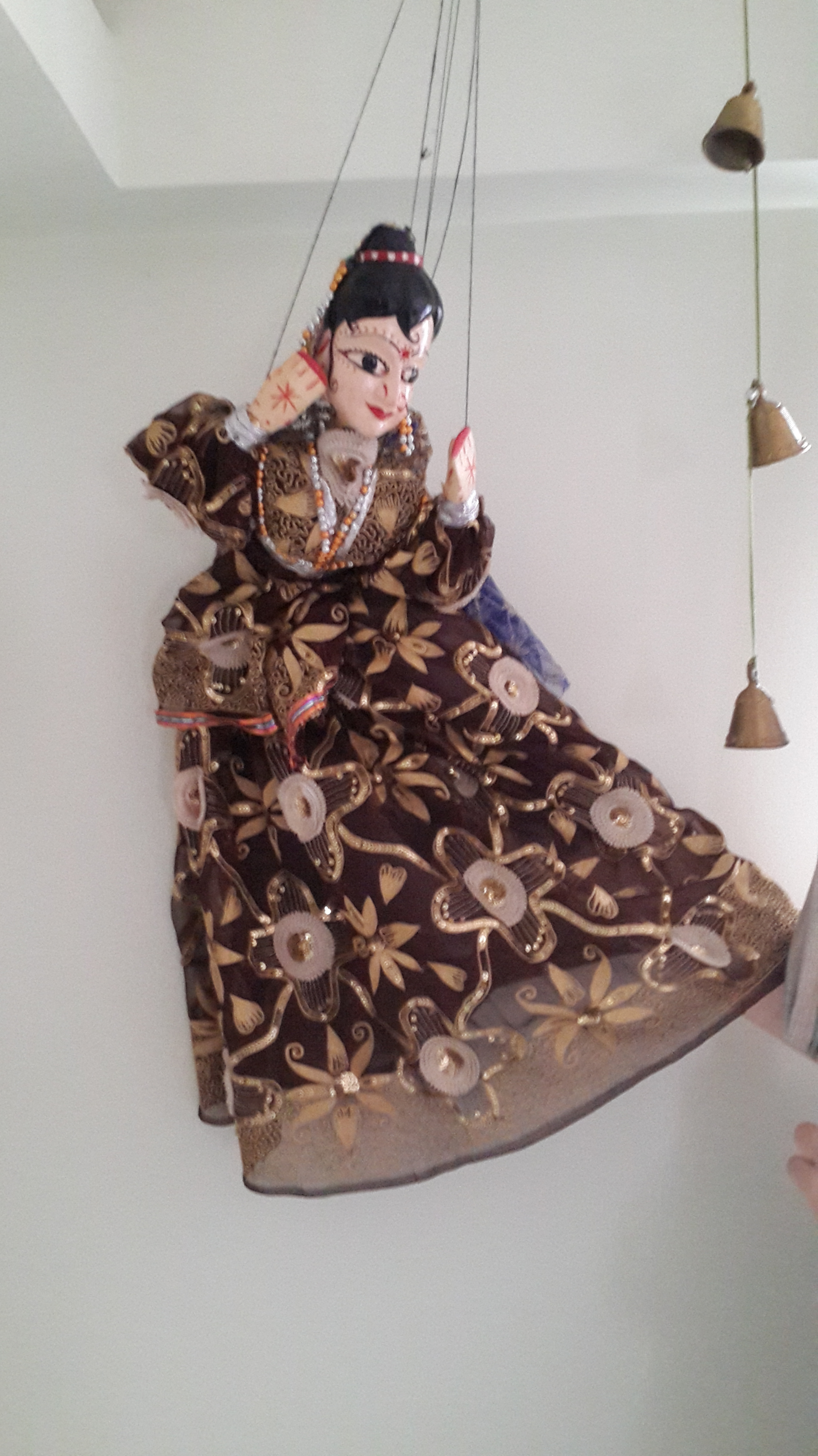
Anarkali: The temptress at her seductive best
The second standard modern puppet figure is a Rajasthani version of Michael Jackson, who struts his stuff on the portable wooden stage and manages a passable moonwalk. The highlight of this 2-minute skit is when he raises his detachable head.

Michael Jackson disguised as a Rajput
The third modern set piece is a snake charmer and his cobra, which begins to chase him around the stage after initially swaying to the charm of the flute in the background. Another character who often appears is a demure bride who suddenly is flipped over and becomes a male singer. Sometimes these puppets are handled with considerable skill, all the while accompanied by an ektara, a single stringed violin, and a shrill-voiced male singer who speaks through a bamboo reed.

Yin..

…and Yang
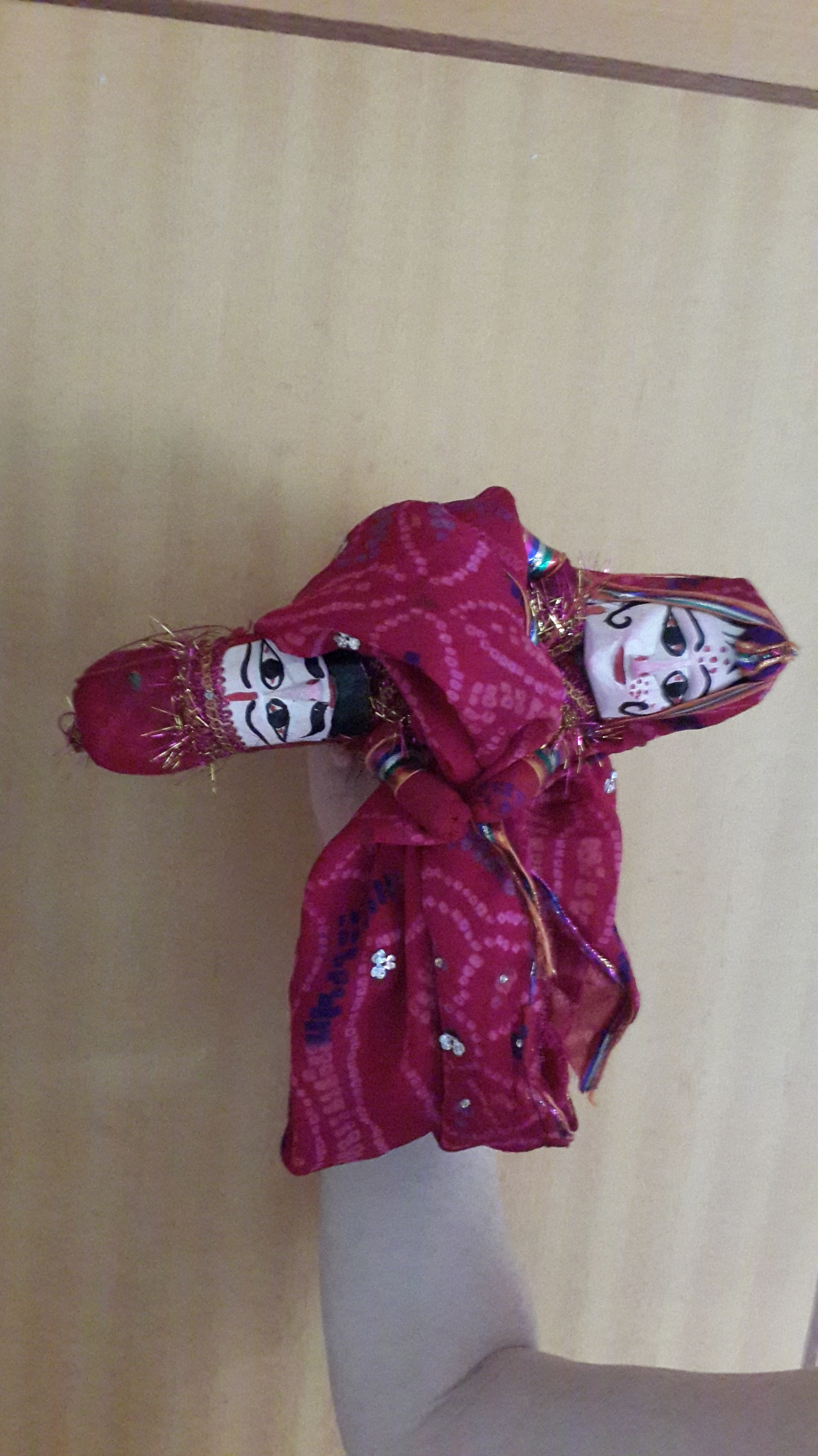
…or a bit of both.
*The figure of 33 million was pulled out of a hat after many discussions of the number of gods, where the count ranged from 3000 to 330 million, the last figure based on the reasoning that almost every third person in the country has his or her own personal deity. This seemed rather far fetched, but it is true that in every small village and town there are local version of the principal gods and lesser deities of the Hindu pantheon. If it all seems too foreign and confusing, look at it this way. There is but one god, Brahma, the creator of all things, and all the numerous deities are but one way of approaching him, just as Catholics pray to their favourite saint to intercede for them before the one God.
 aviott