Home » Posts tagged 'politics' (Page 3)
Tag Archives: politics
Breaking News – the news is broken
Most media outlets seem to operate under the principle that bad news is good news or alternatively, good news is not news. They may be right, in terms of profitability. But they are definitely wrong, in terms of the collective well-being of humanity. This blog is not dependent on readership or advertising revenues, so it can afford to print good news without fear of losing its readership. So here for a start is good news from the energy front.

Floating solar photovoltaic facility outside Nagoya producing power for Apple supplier. Image: courtesy Clean Technica
All of the electricity used by two of the world’s largest corporations, Apple and Google, were from renewable sources by the end of 2017. This is a remarkable achievement, considering that each of these companies uses more electricity than many small nations, not least to power immense data centers scattered around the world. So now, if you have worries about the amount of personal data Facebook & Co. are collecting about you because of their opaque terms of usage, rest assured that they’re not polluting the planet in the bargain.
But seriously, there’s lots of impressive news in the energy area alone. Here’s a chart, courtesy of National Resources Development Center, showing how prices have come down for major clean energy technologies.

Chart from NRDC: click to enlarge
Since clean energy is one of the basic requirements for human development, there’s not much stopping world-wide implementation, is there? Capital for investment? It’s increasingly concentrated in the hands of a few–rich corporations and rich individuals. So are we ordinary mortals totally helpless? No, not at all. But we have to make smart choices as customers. We can enrich our lives, and the planet in the process, by getting off the mindless consumption lifestyle that the glossies would have us aspire to.
In one hour, the earth receives more solar energy than the world uses in one year. Now that’s good news and worth repeating, even if its not new. So why are companies producing more dirty diesel cars and building more fossil fuel power plants? Because switching technologies means moving out of comfortable niches of expertise that would otherwise become useless; it would mean new investments, experimenting with new technologies, and why should they take all these risks when customers are flocking to buy new models anyway? As engine size and horse power of new automotive offerings increase, so do their profits, and they see even less reason to invest in new technologies. It’s only we, the customers, who can break this vicious cycle.
English speaking news readers tend to digest information from an overwhelmingly anglocentric or eurocentric point of view. Hence I was not surprised recently to hear a friend accuse the Chinese of polluting the planet when actually, despite (or perhaps because of) a totalitarian regime, they are doing more to clean up the earth than any other nation. For example, the southern Chinese city of Shenzen alone runs a fleet of 16,000 (yes, thousand) electric buses; more than the rest of world combined. So while air quality in Beijing might be abysmal, this past winter, particulate pollution was 50% less than in the previous year. This from no less a source than the US Embassy in Beijing! One reason for the lower levels of pollution might be that China installed more than 53 GW of solar power in 2017.
The above facts don’t make me an apologist for an autocratic government where power is increasingly concentrated at the top. This is undoubtedly a very worrying tendency, one that is being seen in several other large countries like India, Russia, Turkey, China and the United States. In the US case, its robustly democratic political system has been hijacked by corporate lobbies. Nevertheless there is good news coming from each of these countries, and I will try to highlight these bright spots in future posts.
See this author’s page at Amazon.com to read more of his work.
A Georgian ode to Austria
In June last year I wrote a blog entitled “Living in Limbo–A Streetside Portait” about a man who stands outside the local supermarket and sells the Augustin newspaper. He’s a refugee from Georgia and used to teach philology back home. I cannot communicate well enough with him to know why he had to leave his home. Perhaps he’s a political refugee and is reluctant to talk about it. Today he handed me a story, photocopied from an old edition of the Augustin. Since his German is very halting, I presume someone translated it for him. Whatever the case, the writer comes across as intelligent, well-read and sensitive, and the story deserves a wider audience. Hence I’ve translated it into English and posted it here. I hope you enjoy his story. I’ll simply call the writer Wassili.

Georgian Mountains. Image: courtesy Wikimedia Commons
The Man and the Mountain
I’m no longer a stranger here now. I feel I’m in familiar surroundings. I have many acquaintances who call me by name when they talk to me, which pleases me no end. No one knew me in those days, when an elderly man, Herr F., invited me to his villa. He was eighty years old, but still active and full of joie de vivre. His energy would have put many a younger man to shame. His villa was near Neustadt. He called the Augustin office one day to ask for ‘permission’ to take me to Neustadt. He arrived at the Augustin office in his car to pick me up at the appointed time. This was a great honour to me; such a great honour that it was embarrassing.
I remember another occasion when I felt such embarrassment; it was a very cold day. I had no gloves and I was selling newspapers. I noticed someone staring, and then approach me holding out a pair of gloves, obviously intending to give them to me. I refused, pretending I was not cold, but that was wrong. It’s normal for Austrians to look at strangers, but I only understood much later that it’s even more embarrassing to refuse warmth and gestures of goodwill.
Herr F and I drove in his car. It was an old Ford, but very well maintained. He was in high spirits. We joked and laughed a lot. He showed me his villa. Then he took me out to lunch at a restaurant in the mountains. We ate well and drank a little. Herr F was the first person in Austria who reminded me of the words of the 12th century Georgian poet Schota Rustaweli who said: Never forget the duty of friendship to a friend who shows you his heart, for all paths are open to him.
Several days passed before Herr F. came to see me again. “Wasil,” he said, laughing. “You’re Stalin. And I’m Hitler.”
“No Herr F. That’s impossible. The two of them didn’t like each other. They were enemies. We, however, like and respect each other.” Herr F. smilingly agreed. He knew who Stalin was. I’d spoken about him that day at lunch in the mountains. Stalin was Georgian, from Gori. This place is known for its delicious apples and its Stalin Museum. Many foreigners think Stalin was Russian and when they learn he was Georgian, they come to visit the museum.
I haven’t seen Herr F. for several months now. I’m now selling the Augustin at another location. I have neither his telephone number nor his address in Vienna. What do I know about this man who gave me, a stranger arrived in Vienna, such a memorable day? Who knows if he is in trouble, and if so, how I can help him? Who knows where he is now? Perhaps he’s busy and no longer remembers this simple newspaper seller.
There are perhaps many people who think like me. Perhaps the mountain also thinks so; the mountain that rises five hundred meters in front of me, and spends its time thinking. When no one comes to me to buy a newspaper for a long time, the mountain and I look at each other. I think of the time I worked in a school, with a book in one hand, und taught children Georgian language and literature. Now I’m learning to live, or rather, learning how not to be a stranger in a land where I must live.
Sometimes in autumn the mountain is covered in fog– and it seems to be thinking. Just as I do. A big mountain can think more than the small one can. People are like that. The more they think, the more the fog bothers them. I’m talking about the mountain that stands before me. There are vineyards on its flanks, but I see no one there. I wonder how anyone can produce wine on such steep slopes. Georgia too is a land of mountainous vineyards. Grapes grow there too; grapes that are nurtured like children.
In the country where I was born and grew up, one can see mountains, precursors of the Caucasus. I visited these mountains often in my childhood. I went alone, sat down somewhere under a bush, and looked down fondly at my village, loving every single settlement as far as I could see. You small Austrian alpine mountain, I think. It’s your fault that I’m homesick at the sight of you. I love you too. Even though I’ve not known you so well, I love you from a distance. There will come a time when I’m closer to you. For then, if you allow me, I’ll look on your fields and meadows from above, just as I did as a child, silently and wordlessly turning to the land I used to say: I love you, Georgia! With the greatest respect then, I would then humbly say: I love you, Austria.
See this author’s page at Amazon.com to read more of his work
The Power of Compassion
Met an unusual individual in Vienna last night. Spare 17 minutes to watch this video of his TED Talk from 2012. You won’t regret it. Of course it was more inspiring to meet him in person.
Feedback welcomed.
Words to Ponder

pederastrian zone -(pe.der.astri.an zone) child molesters on the internet
trumpet – (trum.pet) presidential proclamations of alternative facts
maybe – (may.be) current state of Brexit negotiations
pingterest – (ping.ter.est) Chinese views of disputed territories in South China Sea and Doklam
modify – (mod.if.y) religious fundamentalism in India
Al Jarreau – (al jar.oh) late jazz singer of Qatar?
merken – (merk.en) German (as in, remember me?)
macro – (mak.ro) big French cheese
killing fields – (kill.ing fields) Duterte’s Philippines
Gabon – (gab.on) ongoing discussion about who really won the last election
sod it – (sod.it) Saudi views on women’s rights
Zumba – (zum.ba) popular South African dance
A School Playground with no Women
As parents, we all have a duty to find out what happens to our children in school. We have to protect weaker children from school bullies who might otherwise terrorize their juniors.
Imagine the school bully unchecked after a playground fight. “You,” he shakes a menacing fist at a defiant runt. “Don’t dare talk back to me again, or else…” he pulls a knuckle duster from his pocket and shoves it in the little boy’s face. “Or else you’ll have a bloody lip…” The little boy, whose name is Cutter, looks around to the smirking head boy sitting on the playground fence for support, but the head boy says nothing and does not move.
“I’ll see he doesn’t talk back to you.” stammers another little boy, whose name is Kurshid. The bully shrugs, looking out of the corner of his eye at the head boy sitting on the fence. He remembers that some time ago, the head boy came to Kurshid’s aid when another bully smacked him on the head, took away all his marbles, and kicked him out of the playground. On that occasion, to everyone’s surprise, the head boy beat the bully to pulp and had him expelled from the school. Everyone knew the head boy had done this because he liked Kurshid’s marble collection.
“Now be good boys,” says the harried teacher, who knows the boys don’t respect his authority in the least. “Be nice. Don’t all gang up on the smallest because he won’t play with you,” he says, shrugs, and turns away, knowing the fighting will start again as soon as his back is turned. Meanwhile the sadistic head-boy sits on the fence and smirks gleefully. He’s just sold a knuckle duster to the biggest bully on the playground and can’t wait to see it in action.
There are no female teachers present. This scenario is playing on the world stage. Here are the real players in this drama.
Cutter – al-Thani clan, Qatar
Kurshid – Emir of Kuwait, mediator
School bully – Crown Prince Mohammed bin Salman, Saudi Arabia
head boy – Donald Trump, United States
another bully – Saddam Hussain
marbles – oil
harried teacher – UN
knuckledusters – US arms sales to Saudi Arabia
Other key actors offstage:
chief hoarder of marbles – China
school clown – Kim Jong Un
neighborhood dope dealer – Putin
anxious parents -Rest-of-the-world
A few weeks ago, the Guardian newspaper published a list of 13 demands made by Saudi Arabia and friends. Qatar is to comply with all of them within ten days, or else… (see https://goo.gl/KDdkeP)
Dismantling Democracy
“Will no one rid me of this turbulent priest?” King Henry II allegedly muttered in frustration. Although not a direct order, four of his knights rode to Canterbury and killed Thomas Becket. This happened in 1170 AD.

St. Thomas Becket. Image, courtesy bio.com
History repeats itself. Eight hundred and forty-seven years later, an impetuous, ignorant president mutters similar words about a troublesome special counsel. Whereupon, several of his knights, who are now called Republicans, unsheathe their swords, which are now verbal (although these republicans insist upon their inalienable right to own and carry arms), and begin a character assassination of the special counsel and his team.
Meanwhile, around the world, despots and dictators clap their hands with glee, knowing that a powerful global champion of human rights has suddenly lost its teeth. This A-Z of dictators and would-be despots ranges from Syria’s Assad to Zimbabwe’s Robert Mugabe, their alphabet-soup stock strengthened by people like Duterte, Erdogan, Lukashenko, Kim Jong-Un, Putin, Saudi Arabia’s ruling elite, Xi Jinping, and Yogi Adityanath.
Are we to simply sit around, watch helplessly and do nothing? Reflect on this, try to look beyond the superficialities of news headlines, think about what you, as an individual, can do. Here are three points from a recent Forbes article by political commentator Jim Powell that are worth noting.
- Aspiring dictators sometimes give away their intentions by their evident desire to destroy opponents.
- There’s no reliable way to prevent bad or incompetent people from gaining power.
- Ultimately, liberty can be protected only if people care enough to fight for it, because everywhere governments push for more power, and they never give it up willingly.
As two Emery University academics warn in their article “The Psychology of Dictators: Power, Fear, and Anxiety” With regard to dictators, one particular trait that consistently stands out as relevant is narcissism. Narcissistic individuals have a “greatly exaggerated sense of their own importance” and are “preoccupied with their own achievements and abilities.
And… More recent work shows that, after a negative evaluation, narcissistic people will demonstrate greater aggression even to individuals unrelated to the feedback.
https://www.anxiety.org/psychology-of-dictators-power-fear-anxiety
Carbon Countdown Clock

Image:courtesy usgs
Ah, Trump. Has pulled the world’s second largest greenhouse gas emitter out of the Paris Accord. Was promised. Was to be expected. The one campaign promise that this prevaricating president did keep. The Guardian newspaper has usefully provided an online carbon countdown clock to show the world how time is running out. I believe Trump’s action might provoke the rest of the world to come together to save our common future.
https://interactive.guim.co.uk/embed/aus/2017/carbon-embed
Click on the link above to see how much time we have left.
Serious Comedians – Giving voice to Lions
An East African proverb. Until the lion learns to speak, every story will glorify the hunter. As with lions in the savannah, so too in human affairs. History is written by the victorious. As far as I know, contemporary Gauls did not write histories of Caesar’s conquests. My early school textbooks were published during colonial times and spoke of the Indian Sepoy Mutiny of 1857. A few years later, my history books reflected the views of a self-governing nation and called it The first war of Indian independence. Similarly, a history text used by children in a Francophone African country began: nos ancêtres, les Gaulois, étaient grands et blonds.
Moving forward to today, a modern nation confronts the semantic shenanigans of a prevaricating president, one who heads the world’s largest military and nuclear strike force. He threatens to destabilize the world, and frequently expresses the desire to overthrow constitutional guarantees of freedom of speech. Freedom of speech is a relatively recent tradition in our human history; a tradition that gives voice to lions. Research insights into the value of biodiversity show that ecological variety is absolutely imperative to the long-term ecological survival of our planet.
A time of instant communication is also a time of instant miscommunication, so many people no longer know where to turn for the truth. Official news agencies tend to broadcast the voice of the hunter, but where do lions tell their side of the story? Leonine voices are emerging from unexpected corners of television and the internet. The new lions are stand-up comedians, and they are emerging in every politically repressed country, from American to Turkey to Zimbabwe. Perhaps North Korea is the only country in the world where the only comedian still standing up is its great leader himself. In several countries that recently show signs of tending towards dictatorship, the leaders are becoming unwitting comedians in the mold of Kim Jong-Un.

Image courtesy the warmonger report.
It’s time for us consumers to realize how serious these jokes are. Time to sit up, stop laughing and act.
A Retirement Present (or) How Corrupt is India?
This is a true story. Names have been suppressed in order to protect the identity of individuals involved, even though the events described here happened two decades ago.
Prologue: He had arrived with his wife in India from another country in order to adopt a child. For reasons that do not concern us here, the couple had decided to go it alone, rather than through one of the agencies that acted as intermediaries for the prospective adoptive parents in their home country. They had been through a series of interviews with psychologists, and their domestic situation had been thoroughly vetted by social workers in the home country before they were given an official seal of approval as suitable adoptive parents.
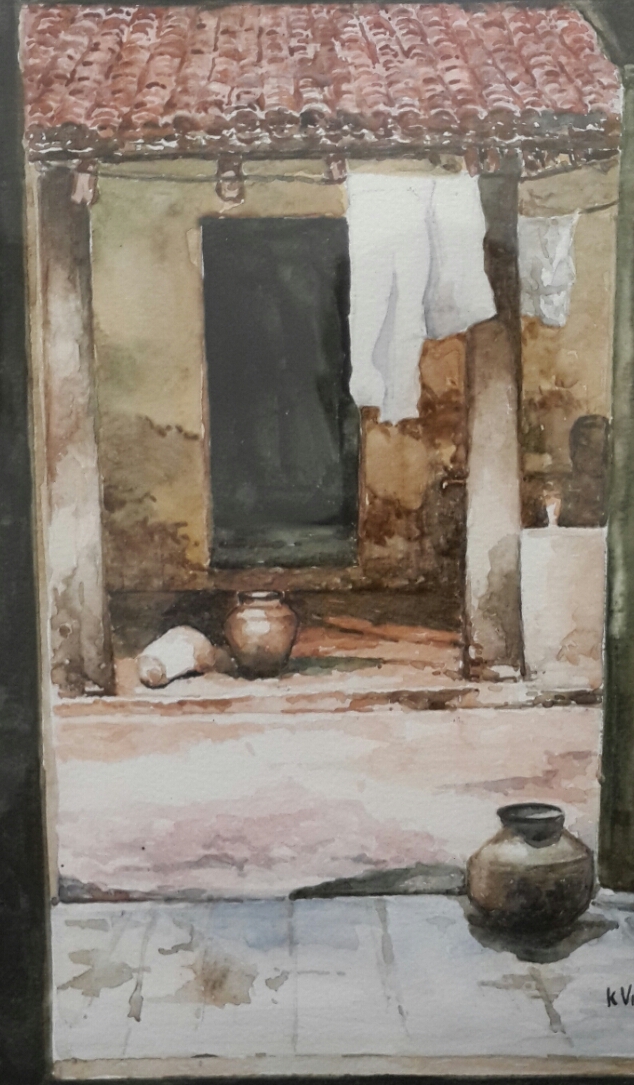
Inner courtyard, Chennai. Watercolor by Vikram Varghese.
The Story: Armed with this preliminary paperwork, the prospective parents began to read up about adoption laws in India. Friends told them of informative TV documentaries that they should watch. One such documentary was particularly painful to watch, since it highlighted the worst malpractices that occurred in various parts of India. They accepted the contents as the unvarnished truth, since it was after all produced by a British documentary film maker of high repute. After the prospective parents had completed their due diligence, they decided to narrow their search to the four southern states of India. Kerala was eliminated as an option early on when they discovered that foreign adoptions were not permitted here. They travelled to cities in two of the other three states before they finally decided to further narrow their search to Madras (Chennai today) the capital of the state of Tamil Nadu, where they had contacted several organizations.
Going simply by gut feel, they eliminated the first two institutions they visited. The people in charge either seemed untrustworthy and shifty-eyed, or the institution seemed too affluent (were they selling children abroad for profit, and if so, how did the children come up for adoption?). There is no absolute certainty in life, but they wanted to be as sure as possible before they made their choice.
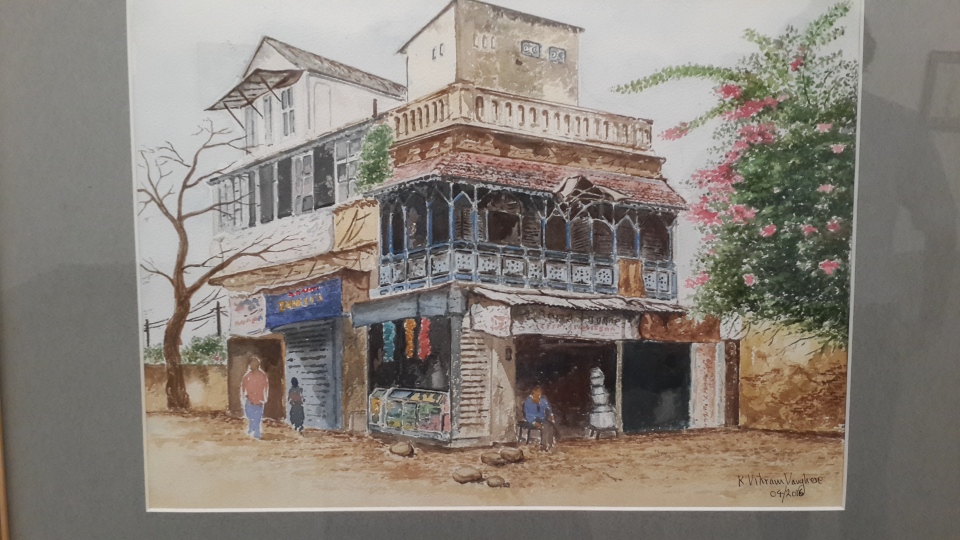
Old homes become highrises. Watercolor by Vikram Varghese
Their third visit was to an organization that was run by a foundation of some sort. The Director of the place was soft-spoken, was dressed elegantly but not ostentatiously, was obviously well educated, and from her name they could infer that she was a Muslim. They were given a tour of the place and met the matron in charge of the crèche, who spoke reasonable English. The matron wore a white cotton sari with a blue border, a pendant in the shape of a cross, and a name tag with a Christian name. Half a dozen women in colorful saris tended to the twenty or thirty infants in the crèche. Some of them wore bindi on their foreheads. The people working in the orphanage seemed like a friendly microcosm of India, with people of at least three faiths working together in harmony, so they decided to apply to this institution.
Back in her office, the Director was firm and clear. As foreigners, they came into the third and lowest category of adoptive parents. First preference was given to Indian nationals living in India. Second came Indian nationals living abroad. Foreign nationals came third in priority and could only adopt children who were not chosen by the first two. This usually means, she concluded, that the child you might get for adoption will be a dark-skinned female. Indian parents usually prefer to adopt boys or light skinned girls.
The couple returned to their home country and three months later, had a phone call. As always happens, the long-awaited news came out of the blue. There was a child available for adoption. A female child, with a very dark complexion that was a year old and had not been adopted by Indian parents. Come to India, and be prepared to stay for 2 or 3 months till the paperwork gets done. They arrived in Chennai, were fortunate to stay in a private home instead of a hotel, so were allowed to bring their new daughter home from the orphanage with them till the adoption formalities were completed. They had six weeks to complete all the legal paperwork before the High Court closed for its 2-month summer recess. To paraphrase Longfellow, the mills of the legal system in India grind exceedingly small and they grind exceedingly slowly. With the result that, three days before the High Court closed for summer recess, they still had 28 stamps, seals and signatures to gather from various offices before the adoption was complete and legal. This number of attestations, they were told, normally takes about a month to procure. A huge setback! They had to get back to their jobs in ten days. They could not take the child with them, which meant she would have to go back to the orphanage for three months, an emotional catastrophe, considering how quickly she had bonded with the adoptive parents. To the child, going back to the orphanage would be like a second abandonment, a betrayal of trust that would undoubtedly deepen whatever emotional scars she already carried. In desperation the father cast about for someone, anyone, who could help speed up the process. An acquaintance told him of a Mr. Fixit, someone who might manage the impossible.
Mr. Fixit was slim, mustachioed, dressed in khaki trousers, white bush shirt and black leather shoes; the kind of non-uniform worn by off-duty policemen and government clerks. He heard the whole story from the distressed adoptive father.
“I’ll do it. Give me five thousand rupees, half in advance. And one thousand for expenses.” he said. There was no time for character evaluations or trustworthiness assessments. There seemed to be no choice. The father handed over 3500 rupees. “Wait in the court, in front of the judges’ chambers, for the next three days.” And with that, Mr. Fixit disappeared.
The father did as he was told. It was the end of April, approaching the hottest season of the year, the “Agni Natshatram – fire star” days of May, so he waited in the shade of a banyan tree that grew in the high court grounds. Merely breathing in the heat was exhausting, so he sat on a nearby bench whenever he could, rising hopefully whenever he saw a file carrying clerk emerge from the judges’ chambers. Courts closed at 5 pm, as the blazing heat of the day began to wane. Mr. Fixit appeared an hour after the court closed on the first evening, triumphantly waving a sheaf of papers. “I got the first six today!” Six down, twenty-two to go. In two days. It seemed impossible at this rate.
“Don’t worry. It’s difficult, but not impossible,” Mr. Fixit reassured.
Day two. Another long day’s fretful waiting, hopping impatiently from sun to shade to bench. Too anxious to eat lunch, impatiently gulping water at noon to quench a raging thirst, too nervous to move away even to a toilet. What if there were last minute questions and he was not there to answer them? At the end of day two, Mr. Fixit emerged again from the labyrinth. “I got the next seven today.” Was there a trace of despondent weariness in his face? Hard to tell. “Tell me you can do it,” the father rasped anxiously. “Yes, yes. Leave it to me.” Thirteen down, fifteen to go.
Would it help to offer more money? Mr. Fixit hesitated, thought for a minute. No, he said. This is more than enough.
Day three. The tension was unbearable. Fatigue settled in waves, batted away by bouts of anxiety. Another eight-hour day, mostly on his feet, moving from sun to shade to bench, with an occasional walk around the courtyard. He saw Mr. Fixit move between offices, sometimes empty handed, at others clutching an ever growing sheaf of papers. Finally, a few minutes past 5 pm. Closing time, and the beginning of the two month summer break. It would break his heart to have to drop the little girl back to the orphanage, unclasp those trusting fingers that twined around his thumb every time he entered the room. But there was no chance that the man could have done it. Not here; not with this kind of bureaucracy. Mr. Fixit approached him at ten minutes past five. He held the sheaf of papers, and there was exhaustion and a touch of despondency in his step.
“And?”
“Sir, I tried. I’m still trying.”
“What is there to try? I’ll give you the rest of the money I owe.”
“No, sir. You do not pay till I finish the job.” Then he explained. “I got up to stamp number 22 by 3 pm today. And then, the clerk who has to sign number 23 was not at his desk. He retires today, his last day of work after 30 years of service in the High Court and he’s been out at farewell parties all afternoon. No one could find him. So I contacted all the others, number 24 to 28 and told them about your case. They all said they will wait in their offices till I find the missing clerk to put his seal. So now you come with me sir. We’ll go and wait for him.”
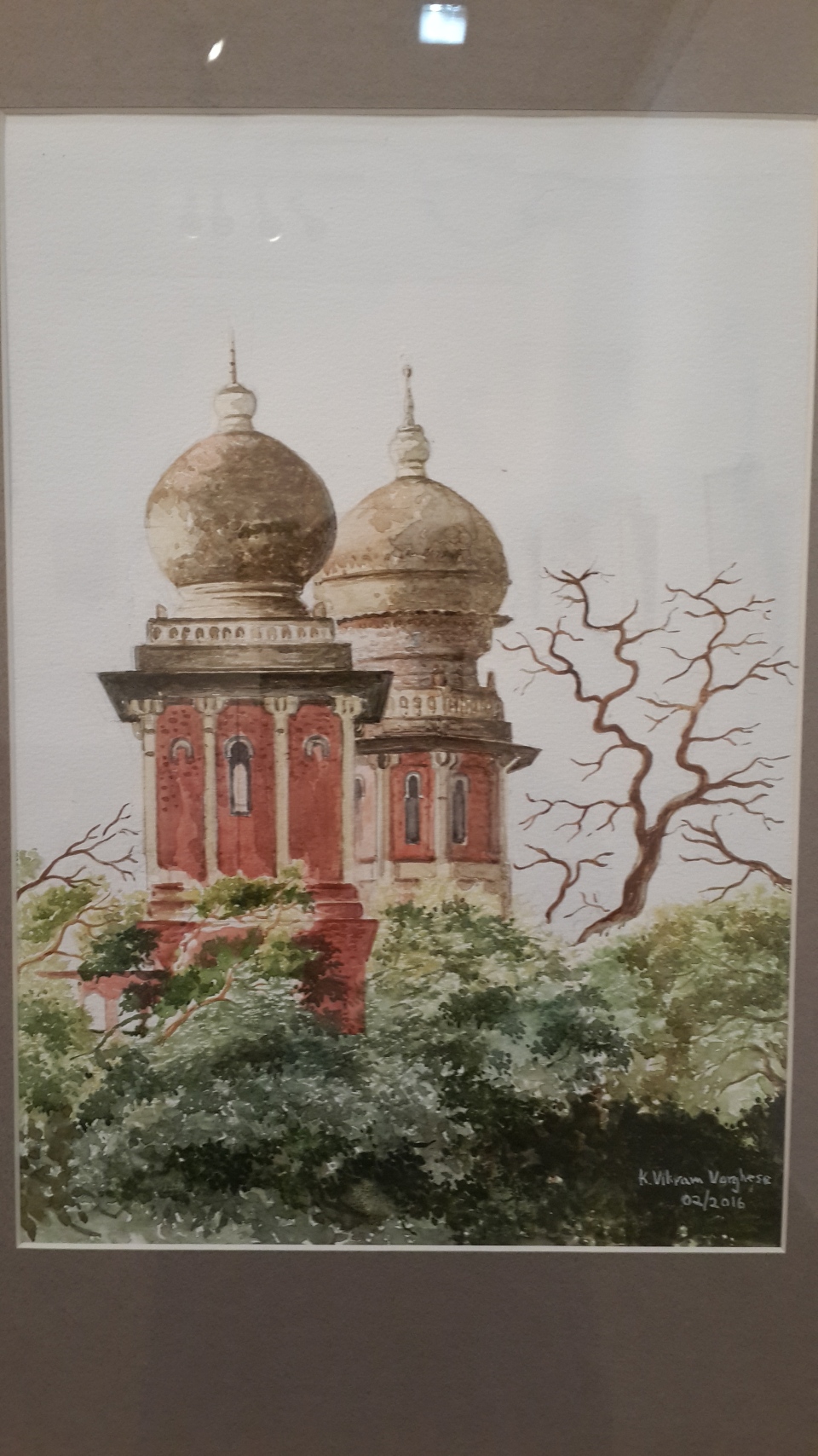
High Court building, Chennai, Indo-Saracenic architecture. Watercolor by Vikram Varghese
I walked into the rooms with Mr. Fixit, unbelieving. The High Court clerical offices were like government offices all over India, relics of the British raj, corridors lined with steel almirahs bulging with case notes, dockets, files tied with string, pages of brown and yellowing papers held together with office clips or rusting staples. From one empty desk to the next. A few clerks were packing up their desks, carting away most of their personal possessions before the long summer recess. One desk was still piled with papers, on top of which lay several gift-wrapped presents, a paper plate with a half-eaten bonda and chutney, a glass of cold tea.
“This man,” Mr. Fixit indicated the desk, “is still out celebrating. He should be back soon.” They pulled up chairs and waited for ten minutes in the now deserted hall. Finally a short smiling man appeared, with crumbs of cake or pakora on his three day growth of beard and looked inquiringly at the two men. “Yes?” Mr. Fixit rose to his feet and began to explain.
“Yes, yes, yes. I know about the case. Five people told me at the farewell party. This is the gentleman?” He looked long and hard at the stranger. The father leapt nervously to his feet, and instinctively reached for his wallet. The clerk looked at Mr. Fixit and beckoned with imperious crooked fingers.
“The papers.” He grabbed the papers, signed on the last page, took two separate seals from his draw, inked both on a worn pad and stamped the paper with loud bangs. “There!” After the days of waiting, the father was beside himself with gratitude, even though the man was merely doing his job. He took out his wallet. The clerk stopped him with a quick gesture.
“Sir. I want no money from you. After thirty years of service in this court, on my last working day, what a retirement present you have given me! It is a privilege to see what my stamp on a paper means to someone. Keep your money sir, and thank you for giving me the chance to do one good deed before retirement. I wish for your daughter a life full of God’s blessings.” The clerk was beaming now, a dark cherub with a three-day growth of beard and crumbs on his face. But there was only time for hurried thank you, thank you’s before Mr. Fixit dragged the father to other offices where clerks number twenty-four to twenty-eight impatiently waited, almost an hour after closing time, seals and signatures at the ready. At all of these desks, the by-now delirious father offered money but met with the same response. “No sir. You are doing a good deed. We wish for your daughter to have a good life.” The last four stamps, seals and signatures were obtained in ten minutes, probably an all-time record for any High Court in India. At precisely one minute to six, Mr. Fixit handed the papers to the father with a flourish.
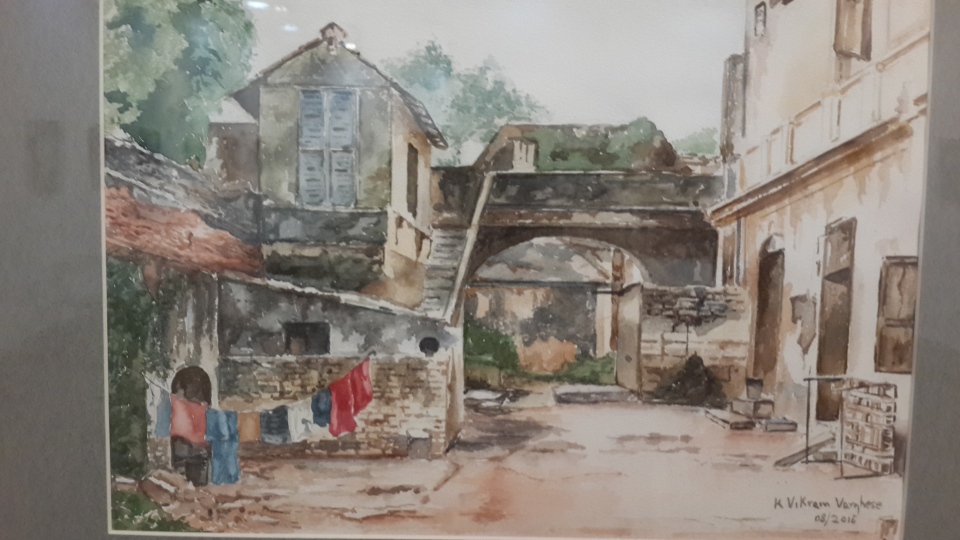
Disappearing Dwellings, Chennai. Watercolor by Vikram Varghese
Epilogue: A few days later the parents visited the orphanage with their newly adopted daughter to wish the staff good-bye. The child was kissed and hugged and caressed by all the staff and finally they sat down for a chat with the Director, the child seated in her lap playing with a pendant. The parents expressed their gratitude to the Director and to the foundation that ran the orphanage, remarking on how well it was run, contrary to their expectations, especially after having seen the TV documentary a few months ago.
“Wait a minute. A documentary? Was it by so-and-so?”
“Yes it was.”
“Interesting! He came here, you know, two years ago, while he was filming. He looked around the place. I told him, why don’t you show something of this place? Why not show a good institution? Not just the bad ones. But he wasn’t interested. They left without taking a single photo of this place.
Corruption: How corrupt is India? I honestly don’t know, having spent twenty-seven years in this country without paying a single bribe. I know someone, a fairly successful businessman, who claims never to have paid a bribe during his entire working career. I know many more, equally successful, who say it’s impossible to do business here without greasing palms all along the way.
Which is true? Both narratives are equally true. Transparency International ranks India 79th on its 2016 index of the most (or least) corrupt countries in the world. India’s close neighbors in this index are Brazil, China, and Albania. I have no idea how corrupt China is, but I do know that China’s infrastructure is far superior to India’s and things seem to work far better there than they do in India. However, in the worldwide rush to industrial prosperity, chasing the American dream (with, perhaps, the exception of Bhutan), I fear the world is losing its soul.
Is this single-minded rush to wealth (and exploitation of the earth) the reason why so many amoral leaders seem to come to power in America and other countries around the world? If so, I begin to think that this country (India) has something unique to offer the world. I think back to the incident at the High Court and dozens of other random acts of kindness and grace that I experienced and accepted unthinkingly, as a matter of course. Today I feel that there is some deep spring of spirituality among its people that has nothing to do with religion, but is a product of time and space, centuries of invasion, centuries of adaptation and forgiving. So perhaps, despite its low ranking on the Transparency International index, the soul of India can show the world the way ahead in the turbulent and troubling years to come.
All watercolors pictured above by Chennai-based artist Vikram Varghese.
In a nutshell, (or) A Nut in a Shell
Where to begin? Needless to describe the sense of loss and dismay as a gracious, thoughtful, highly intelligent family man is replaced by a blustering, orange-hued womanizer who seems to have no respect for anything other than power, wealth and glitter. For better or for worse, the US has been regarded as the leader of the democratic world for much of the last century. In this role, it attracted some of the best and brightest of the world’s young to its universities. They stayed on after graduation, started businesses that thrived and helped make the US the global business and financial powerhouse that it is today. Much of that lustre, also called soft power, has been lost in the past decade, ever since the US began its war on terror and the futile armed incursions in the Middle East.

Image: courtesy wikimedia commons
 aviott