Home » Posts tagged 'renewable energy' (Page 4)
Tag Archives: renewable energy
Fuel from Seawater: a conversation with my grandfather
My grandfather died in 1962 at the age of 76, so the heading is merely a hook to underline the passage of time and relativate (verb?) the content of this posting. If the idea of making fuel from seawater seems preposterous, try to picture the news as seen through my grandfather’s eyes. I was fortunate to go on many long walks with him before he died. I was in my early teens then, and he was in his seventies. My grandfather was a retired physician, a surgeon. He was born in 1888, as a subject of Queen Victoria, and at the time of his death, India had become an independent republic. He studied at the Madras Medical College, an institution that the then governor of the East India Company, named Yale, was instrumental in developing in the late 1600s. Thirty years later around 1720, Elihu Yale was the benefactor of another college on another continent, also a British colony at the time. Yale College and University were subsequently named after him. My grandfather proudly told me that one of his mentors at Madras Medical was Dr. Muthulakshmi Reddy, who was among the first women graduates of medicine in the world, and certainly the first Indian woman to do so, at a time when women were not allowed to join medical colleges in Britain.
As a freshly qualified young surgeon in the early 1900s my grandfather was 24 years old when the world’s first radio distress signals at sea began to come from the Titanic in April 1912. During his lifetime, he experienced the birth of wireless radio transmission, saw the first motion pictures, watched telephones become a part of everyday life, began to use antibiotics to ward off post-operative infections, and flew in Mr. de Havilland’s new-fangled Comet jetliner. So what would he have made of the news that the US Navy will power ships with fuel made after extracting carbon dioxide from seawater or that a University-based research group has perfected a solar cell that produces electricity from sunlight with conversion efficiencies of upto 43%? As a comparison, the solar cells that are commonly seen on rooftop arrays today have efficiencies ranging from 10 to 18%. I believe he might have been surprised, but would have quickly taken the news in his stride. After the monumental changes witnessed in his lifetime, the two developments above might seem to be fairly insignificant. But these technologies are potential game changers. Here’s why.
With efficiencies of over 40%, utility scale solar farms become feasible and cost effective, producing electricity at prices below that of conventional power plants. To make fuel from seawater, carbon dioxide and hydrogen are first extracted from it using a catalytic converter. This mixture is then converted by polymerisation to longer chain hydrocarbons which are the building blocks for a range of fuels of different grades for ships, cars and aircraft. The entire process is carbon neutral because the carbon used for combustion is extracted from the environment. Too good to be true? At the moment, yes. The process is roughly at the stage where the Wright brothers’ heavier-than-air flying machine was in the early 1900s.
http://www.usatoday.com/story/news/nation/2014/04/13/newser-navy-seawater-fuel/7668665/
In the link below, it states that we are 60% towards cost-effective utility scale solar power. Cells with almost three-fold efficiency gains will produce electricity at lower cost than conventional plants today.
http://www.energy.gov/articles/us-utility-scale-solar-60-percent-towards-cost-competition-goal
Clean and green vs. might and blight Many acquaintances who are not averse to renewables but are still captive to the current energy paradigm, remark that wind and solar farms take up too much space and that too many windmills or panels are a blot on the landscape. But so are open cast mines, oil wells, fracking sites and many of the other wonderful extractive technologies that power much of the world today. Just because they are tucked away in remote places does not make them any less environmentally destructive. The images below speak for themselves.


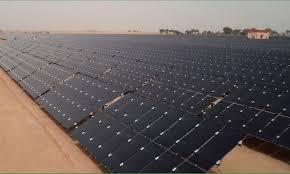 Which brings me back to my grandfather. World population doubled in his lifetime, but there were still large chunks of virgin territory around the globe. Today there are 7.2 billion of us around and it behooves us to tread lightly on this planet and conserve what we can of its considerable beauty. We owe it to our children and grandchildren, if not to ourselves.
Taking the Wind out of Superstorms
Traditional electricity generating power plants burn fossil or nuclear fuels and are massive chunks of infrastructure that take years or decades (in the case of nuclear plants) to build, cost billions of dollars, and then are in place to produce power for 50 years or more. They are gigantic investments in building and capital that cannot be lightly dismissed or shut down (i.e. we are locked-in to this technology for several decades). The people who control these massive infrastructures are rich and powerful and have often worked very hard to bring these projects to fruition. They (and their company’s shareholders) are, very understandably, not easily persuaded that their life’s work belongs to a changing (and soon to be outdated) paradigm; that of large, centrally controlled power plants, burning fossil fuels to provide reliable electricity for all in the neighbourhood. Instead, the growth of renewable technologies, especially wind and PV solar, means that you and I can conceivably have backyard or rooftop systems that can provide all the electricity we consume. Right now, these systems are unaffordable to most of us because the homes we live in were designed in an era of low-cost energy and take little advantage of passive design to minimise energy use. So at the moment, established wisdom and societal inertia still favour the old paradigm. The economics of renewables vary wildly depending on government regulations in different countries around the world.
Mark Jacobson is professor of civil and environmental engineering at Stanford University and has spent the last 20+ years developing computer models of different energy technologies and their effects on emissions, air pollution and climate. Based on his extensive modelling work and studies, he says that wind, water and solar power (WWS) can be scaled up in cost-effective ways to meet our energy demand; in his words, a “smart mix” of of renewable sources can do the job. Because the wind blows during stormy conditions when the sun does not shine and the sun often shines on calm days with little wind, combining wind and solar can go a long way toward meeting demand, especially when geothermal provides a steady base and hydroelectric can be called on to fill in the gaps (Scientific American, 2010). In 2010, Jacobson and co-author Mark deLucchi postulated in 2 articles, published in the journal Energy Policy, that the world of 2030 could be powered by renewables alone. A daunting task, but here’s why it could be done.
In May 1961, the president of a nation announces that his country will put a man on the moon by the end of the decade. Despite doubts that this can be done, both civil society and all branches of government align together to achieve the goal, just 8 years and 2 months after the announcement. The key to this achievement was alignment, unthinkable in today’s US, polarised as it is between two mutually antagonistic parties. Similarly, the WWS global energy strategy proposed by Jacobson is doable, provided there is sufficient alignment between nations that these goals are desirable and doable. Another stumbling block in the path of international alignment are the corporations (and the powerful people who run them) that are locked-in to fossil fuel technologies mentioned in the first paragraph above.
Jerome Dangerman is a thoughtful Dutchman who has worked in energy companies and academia, and has studied the problem of technological lock-in. He suggests a way out of the impasse lies in making shareholders pay for environmental damage. With such measures, investments will flow towards companies that produce energy sustainably.
A recent study by Jacobson et al. also point to another, remarkable benefit of renewables. Large arrays of offshore wind turbines could significantly reduce storm surges and weaken hurricane damage to the extent that the billions of dollars of damage avoided are themselves a powerful economic argument for putting up these electricity generators, not counting the value of the electricity they produce.
References: Jacobson, Mark Z.; Delucchi, M.A. (November 2009).“A Path to Sustainable Energy by 2030” (PDF).Scientific American 301 (5): 58–65.
Mark Z. Jacobson and Mark A. Delucchi (30 December 2010). “Providing all global energy with wind, water, and solar power, Part I: Technologies, energy resources, quantities and areas of infrastructure, and materials”. Energy Policy.
Jerome Dangerman: http://www.ru.nl/businessadministration/@923898/pagina/
Taming Hurricanes with Arrays of Offshore Wind: http://mashable.com/2014/02/26/offshore-wind-weaken-hurricanes/
http://www.nature.com/nclimate/journal/v4/n3/full/nclimate2120.html
Note: Unfortunately, for copyright reasons, some of these articles are available only to subscribers
Social Cost of Carbon
Just published in September 2013, the results of a study with implications that are worth publicizing. After examining the true costs of electricity generation using carbon-based fuels, the article points out that the US (also true of most other countries) underestimates the costs of carbon pollution and climate change. Without properly accounting for pollution costs, natural gas appears to be the cheapest generation option for new power plants. The estimates here show that if environmental costs are taken into account, renewable sources of energy are already more cost effective than either natural gas, oil or coal.
The Social Cost of Carbon: Implications for modernising our (US) electricity system
Abstract: The US government must use an official estimate of the “social cost of carbon” (SCC) to estimate carbon emission reduction benefits for proposed environmental standards expected to reduce CO2emissions. The SCC is a monetized value of the marginal benefit of reducing one metric ton of CO2. Estimates of the SCC vary widely. The US government uses values of 11,33, and $52 per metric ton of CO2, classifying the middle value as the central figure and the two others for use in sensitivity analyses. Three other estimates using the same government model but lower discount rates put the figures at 62,122, and $266/ton. In this article, we calculate, on a cents-per-kilowatt-hour basis, the environmental cost of CO2 emissions from fossil fuel generation and add it to production costs. With this, we compare the total social cost (generation plus environmental costs) of building new generation from traditional fossil fuels versus cleaner technologies. We also examine the cost of replacing existing coal generation with cleaner options, ranging from conventional natural gas to solar photovoltaic. We find that for most SCC values, it is more economically efficient (from a social cost–benefit perspective) for the new generation to come from any of these cleaner sources rather than conventional coal, and in several instances, the cleanest sources are preferable to conventional natural gas. For existing generation, for five of the six SCC estimates we examined, replacing the average existing coal plant with conventional natural gas, natural gas with carbon capture and storage, or wind increases economic efficiency. At the two highest SCCs, solar photovoltaic and coal with carbon capture and storage are also more efficient than maintaining a typical coal plant.
Renewables: The Experts are often wrong…
The world’s newspapers have lately been filled with climate doom and gloom. Most reports are undoubtedly accurate and there is room for alarm. However, millions of forward-thinking, innovative, entrepreneurial brains have been at work, and many courageous investors have risked billions of their money in renewable energy. This side of the picture is not highlighted often enough. Here’s an attempt to redress the balance.
Environmental Research Web has the following comment about predictions made in the recent past:
…REN21 have produced a very timely review of renewables progress and prospects drawing on interviews with 170 energy experts around the world. It set the scene by reminding us that many past projections have been overtaken by reality: ‘the International Energy Agency in 2000 projected 34 GW of wind power globally by 2010, while the actual level reached was 200 GW. The World Bank in 1996 projected 9 GW of wind power and 0.5 GW of solar PV in China by 2020, while the actual levels reached in 2011, nine years early, were 62 GW of wind power and 3 GW of solar PV’.
Looking forward, in the interviews, most industry experts believed that the world could reach at least 30-50% shares of renewables long term. And some advocated 100% or near-100% futures. European experts cited higher shares just for Europe, with many saying that Europe could attain 50-70% shares.
See the link below for a full copy of the Renewable Energy Policy Network’s REN21 Global Futures Report, released in January this year.
http://www.ren21.net/REN21Activities/GlobalFuturesReport.aspx
 aviott