Home » 2016 (Page 2)
Yearly Archives: 2016
Monsoon Wedding
The wedding was in Kerala, a state in India whose advertising blurb labels it “God’s Own Country.” Argentinians and Brazilians also make rival claims to have been similarly favoured by the Creator, while each runs the others’ country down “Yeah, God gave your country everything, but then he created you people to compensate!” In the case of Kerala, the affable people of neighbouring Tamil Nadu harbor no such pretensions, laughingly noting that several million people from Kerala prefer to live with them rather than in their own home state. The wedding eve reception and reception were at holiday resorts at Kumarakom.
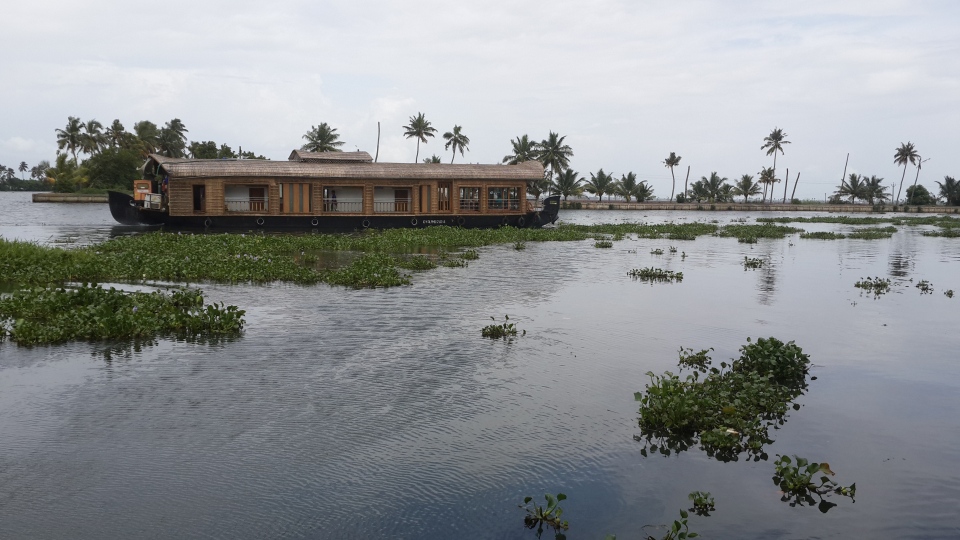
“Kettuvallam,” (Houseboat) on Vembanad lake amidst clumps of water hyacinth.
Kumarakom is situated on the banks of Vembanad lake, apparently the longest lake in India, whose wetland system covers an area of two thousand square kilometers. Much of Kerala’s claim to God’s bounty comes from the backwaters, large estuarine stretches of brackish water that gives rise to a very rich ecosystem. Part of the lake holds the fresh water that drains into it from several rivers, and this fresh water section is separated from the brackish portion by mudflats. The lake is at the heart of ‘backwater tourism’ in the state, with hundreds of “kettuvallams,” floating homes on motorized traditional boats. The riverboat network spans 200 km from north to south and the lake teems with giant prawns and several other types of freshwater fish.
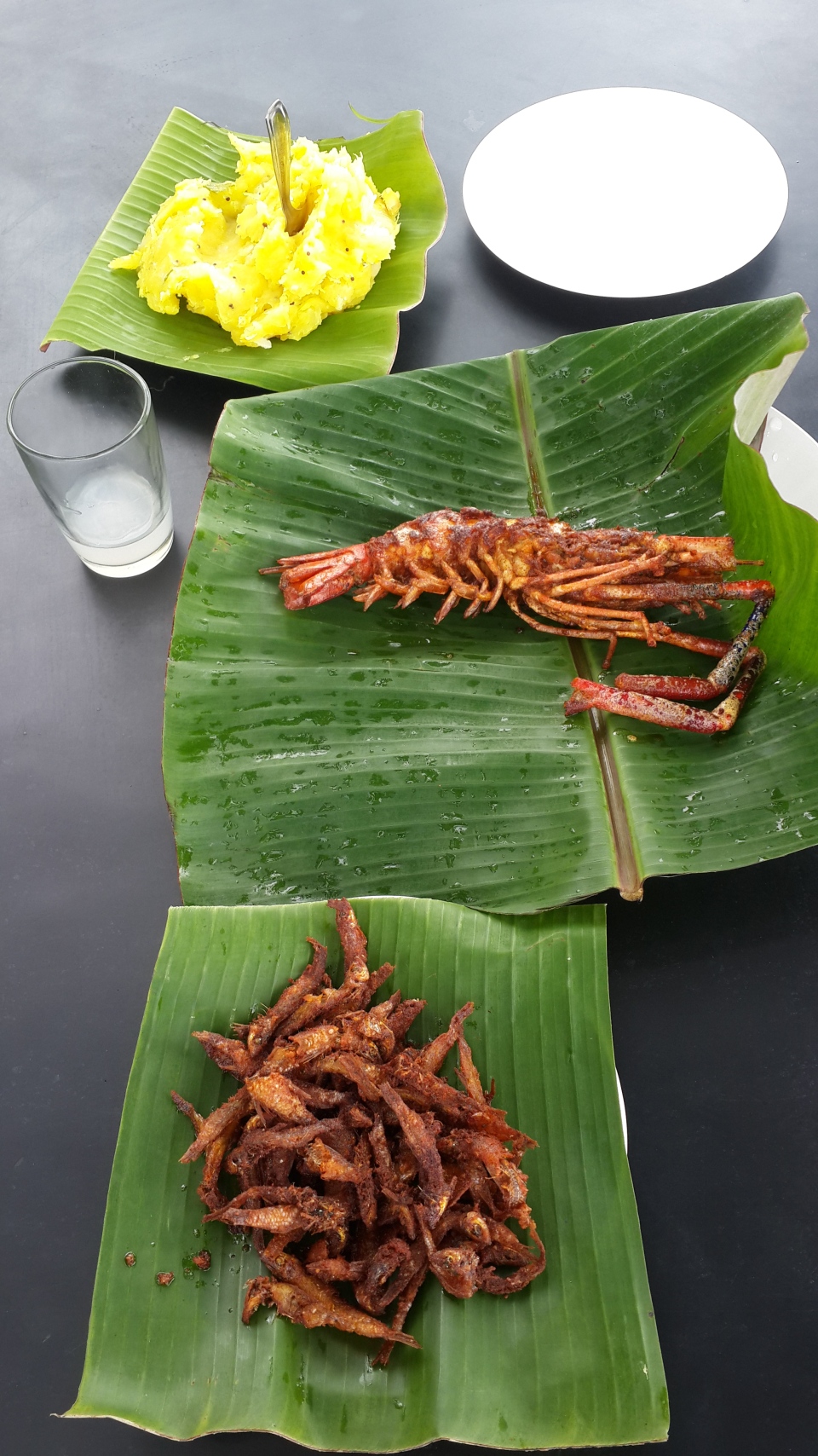
freshly prepared seafood lunch with tapioca and a glass of toddy

Fish await a fiery fry. Pearl spot, prawn and anchovies…
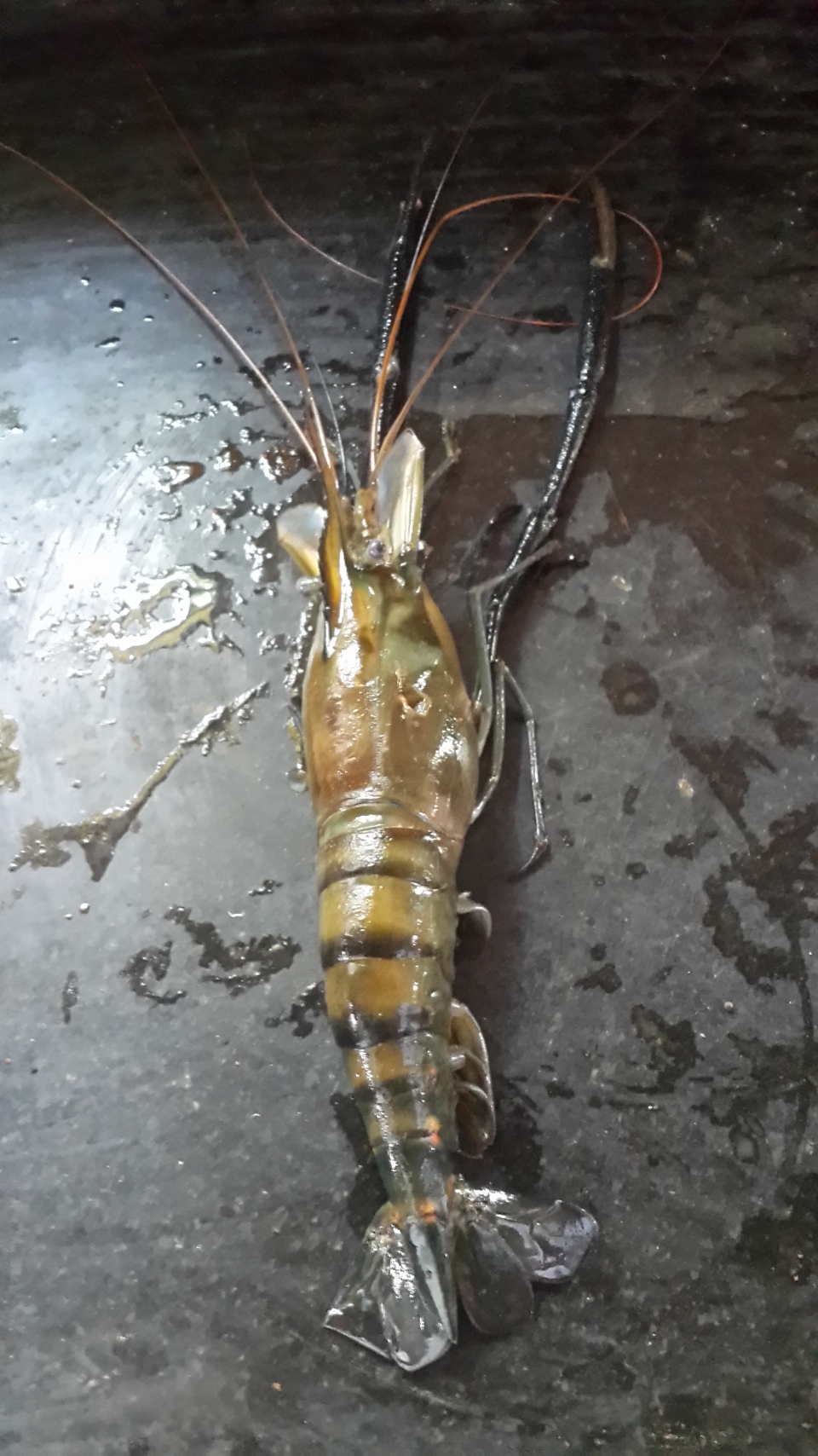
fresh caught prawn
Meanwhile, the bride and groom were happily united at a church in neighboring Kottayam town. It was a glorious wedding with guests travelling from around the world to attend. The groom wore a kilt, befitting his antecedents, and the bride wore a matching tartan sari, designed by the groom’s mother. All in all, a fitting Kerala wedding for the 21st century. The wedding photos belong in a family album rather than this blog, so none appear here. But if you ever are invited to a wedding in Kerala, my advice to you is, go!
For more by this author, see his Amazon page here or on Google Play
The Third Wave in American Politics
“We had all become used to the totalitarian system and accepted it as an unchangeable fact and thus helped to perpetuate it. [. . .] None of us is just its victim. We are all also its co-creators.” Vaclav Havel, Living in Truth, 1986.
Truth is a shape-shifting commodity and there are multiple truths about everything, depending on one’s point of view. As the old saying goes, where you stand on an issue usually depends on where you sit. That’s one reason why democracy’s so dangerous. People who sit still in one space usually see only a single truth regardless of the facts that are thrown at them.
In 1967 a high school history class in California started an experiment to study the rise of Nazism. The teacher, Ron Jones, organized the experiment because his students could not conceive how intelligent, well-educated people in Germany could have blindly followed a demagogue like Hitler. The process was simple. The teacher imposed minor authoritarian controls that were agreed upon with the students. Sitting postures were regulated and drills regularly carried out where they would have to be sitting correctly within five seconds. The rules were progressively tightened. The teacher had to be formally addressed as Mr. Jones every time they spoke to him. On the second day, more formalities were introduced, and a motto had to be repeatedly chanted by pairs of students. On the third day a salute was developed. It involved bringing the right hand to cup the right shoulder. Students were ordered to use this salute with one another whenever they met, even outside class. Outsiders were no longer allowed to enter the classroom, unless they were introduced by a member and agreed to salute with the “wave” salute. By the fourth day, bullying began. The symptoms became so worrying that Jones decided to break it off on the fifth day, Friday. By this time, the students had become so self-identified with the masquerade that they were emotionally devastated when Ron Jones made the announcement to end the experiment. See the link here for a description of the experiment in Ron Jones’ own words, written in 1972.
Ron Jones’ Third Wave experiment was followed by the week-long Standford Prison Experiment in 1971. The results of this experiment were, if anything, even more horrendous and you can read a Wikipedia description here. As in the school experiment, with very few exceptions, all students complied to create coercive prison conditions with increasing enthusiasm. Their ingrained sense of ethics seemed to decrease in inverse proportion to their enthusiasm, i.e. the more enthusiastic they became about the experiment, the less they seemed to care about the ethicality of their actions. They quickly lost their moral compass.

Footwear for the American Third Wave?
Reading news reports about Donald Trump’s increasingly outrageous statements and the support that he still seems to have among the electorate, it seems to this observer that the US has embarked on a dangerous trajectory that eerily resembles the shenanigans of the Third Wave. The original Third Wave experiment ended in the classroom. This one could end with a man with no moral compass in command of the world’s largest military. This has repercussions far beyond the US electorate.
For more by this author, see his Amazon page here.
Stephen Hawking and the Union Bank of Switzerland

What’s mine is yours-for a while.The sharing economy. Image:courtesy bmw-usa.
Unlikely bedfellows. Stephen Hawking and the Union Bank of Switzerland. But the world is a strange place, and might benefit from this unexpected partnership. On the website “Unlimited” thinkers ask questions about some of the most pressing issues facing the world today. As Hawking says in his introductory video entitled “What is the most important question you have ever asked yourself?” in launching the website, he uses the redolent phrase “cathedral thinking” to denote the modern equivalent of the grand buildings constructed as part of humanity’s attempt to bridge heaven and earth. Just like children, we have to learn to share…
I highly recommend watching Hawking’s four-minute introductory video before deciding for yourself whether the other links, essays and presentations are worth watching. The essay on the changing concepts of personal wealth and experience were especially relevant to me, because it describes a transition I have been personally making for the last two decades, especially in the last five years, when I’m absolutely convinced that young people today need a wealth of ‘learning experiences’ much more than ‘things.’
Of course, as a website sponsored by the UBS, it is perhaps unsurprising that most of the initial questions are about the nature of wealth, but the questions and the answers are philosophic enough to interest a wide range of readers.
For more by this author, see his Amazon web page here.
The Politics of Inclusion
If one reads the newspapers in Europe these days, it’s easy to imagine a world going unbalanced. Political chaos in Britain; the shock of Trump’s rise to political prominence in the US; the continued slaughter in Syria; the failed coup in Turkey; honor killings of women in the Middle East and South Asia; young girls kidnapped in the hundreds by a sinister cultish organization in Nigeria with hate and abhorrence of non-religious learning as its primary motivation; China flexing its military muscle in the South China Sea…the list goes on. The underlying cause of each of these symptoms is one and the same, the quest for economic power. In itself harmless, economic power, the accumulation of wealth, is such a basic human instinct that it was unquestioned long before Adam Smith came along to make it intellectually respectable.
What we should question, however, is the tendency of modern societies to equate development with wealth, and economic poverty with under-development. There will be conflict in the world as long as wealth accumulation is equated with development. No one wants to be under-developed, so development currently means increased exploitation of the world’s resources. Ultimately, it is the scramble for the world’s resources that fuels all the conflicts and emigrations we observe today. Interestingly, many of those people, mostly politically right-wing, who rage against immigrants these days invoke a past society free of injustice and racially pure. They forget, or are unaware that, for a species that genetically differs from a chimpanzee by only 1.3% of its genes, talk of racial purity is an absurd notion, absurd to the point of imbecility.
The politics of inclusion that most people yearn for, but don’t know how to create, actually begins with us. The process of inclusion begins with us, one person at a time. Perhaps that is why the process is so daunting, since we have to change ourselves first, before we begin to find the politics of inclusion that the majority of the world seems to be longing for. Check out this link to hear what geneticist David Suzuki has to say about modern economic thought.
For more by this author, see his Amazon page here.
Dam(n)ed Words
“In the beginning was the word,” the book of St. John begins, in the King James version. “And the word was with God and the word was God.”
An overflow of words. Image: courtesy youtube.com
In the Katha Upanishad (approximately 5th century BCE), OM is related to the first primeval sound and the creation of the Universe, in an eerie echo of modern physics and the sounds that presumably accompanied the Big Bang. However, this analogy cannot be drawn too far, since the word OM has multiple meanings and interpretations in the Upanishads and in Buddhist belief. The Huffington Post says “Om is also considered the mother of the bija, or “seed” mantras — short, potent sounds that correlate to each chakra and fuel longer chants (like, say, Om Namah Shivaya). Depending on who you talk to, it relates to either the third eye or the crown chakra, connecting us to the Divine. No wonder it is core to some Buddhist systems and other Indian religions. Some say it’s even among the sounds recorded in deep space — on NASA’s website, Earth itself sounds a bit om-y.”
Coming to the present day, which is our primary concern here, Lucia Graves writes in the Guardian (July 13th, 2016) “It used to be that you had to read between the lines to determine that Donald Trump was stoking racial resentments. And it used to be that the subjects of his racial animus were mostly immigrants. But now, increasingly, he’s casting a wider net and amping up his rhetoric.” Also in the Guardian of the same date, another headline says, “Labour’s Luciana Burger receives death threats telling her to ‘watch her back.'” Because she’s Jewish. Chilling news, seven decades after the horrors of the Shoah!
In Bangladesh, India and Pakistan, the language of intolerance has grown more strident in recent years, often drowning the voice of reason. The Islam of the Sufis seems to be disappearing from public discourse, and the all-embracing tolerance of Hinduism seems to be hardening at its edges. In the Middle East, the intolerant rhetoric of various groups has led to spectacular and bloody breakdown of civil society in the region.
The world as we know it began with words. Even so, the unraveling of our world and civilization as we know it, also begins with words. It begins with the language of the bigot, the language of the nationalist, the language of the religious fanatic speaking on behalf of God (presumption or megalomania?), the language of the intolerant, the language of politicians looking to increase their grip on power. In politics today, the language of intolerance seems to be gaining ground, becoming socially acceptable. Socially acceptable? That means us. That we accept it. Unless we emphatically refute it at every encounter. By casting votes, by speaking up, by voting with our feet. The last case scenario is, sadly, what prompts the widespread immigration we see today.
See more work by this author on his Amazon page here or on the Google Play store.
What’s going on in the world today?
Here’s a Sufi story to answer the question so many are asking these days, post-Brexit, pre-Trump, pan-ISIS, mass shootings; what’s going on in the world today?
“We have a word,” said the Sufi, “which sums all this up. It describes what we are doing, and it summarises our way of thinking. Through it you will understand the very reason for your existence, and the reason why mankind is generally speaking at odds. The word is Anguruzuminabstafil.” And he explained it in a traditional Sufi story.

Angur, by any other name…
Four men – a Persian, a Turk, an Arab and a Greek – were standing in a village street. They were travelling companions, making for some distant place; but at this moment they were arguing over the spending of a single piece of money which was all that they had among them.
“I want to buy angur,” said the Persian.
“I want uzum,” said the Turk.
“I want inab,” said the Arab.
“No!” said the Greek, “we should buy stafil.”
Another traveller passing, a linguist, said, “Give the coin to me. I undertake to satisfy the desires of all of you.”
At first they would not trust him. Ultimately they let him have the coin. He went to the shop of a fruit seller and bought four small bunches of grapes.
“This is my angur,” said the Persian.
“But this is what I call uzum,” said the Turk.
“You have brought me inab,” said the Arab.
“No!” said the Greek, “this in my language is stafil.”
The grapes were shared out among them, and each realised that the disharmony had been due to his faulty understanding of the language of others. (From: Idries Shah – The Sufis)
Perhaps now, more than ever, is the time for us to learn the language of “others,” and this involves two kinds of listening. This might also be a Sufi parable for the European Union.
For more by this author, see his Amazon page here.
Oceans of Lithium

Salar de Uyuni. Source: Wikipedia.en
Salar de Uyuni in Southwest Bolivia contains an estimated 43 % of the world’s easily recoverable lithium. Together with neighbors Chile and Argentina, the three countries contain 70% of the planet’s reserves. As most people are aware by now, the renewables revolution is gathering momentum, and the world needs lithium, lots of it. The people who follow these trends estimate that Tesla’s Gigafactory alone, when it comes into production, will double world demand for lithium, whose prices have shot up just in the last two months of 2015 (from US$ 6500 to 13,000 a ton in November/December). American, Japanese, Chinese and South Korean companies are already mining around 170,000 tons of lithium worldwide. The Argentinian salares, or salt flats, comprise thousands of square miles in the provinces of Catamarca, Jujuy and Salta. The Salinas Grandes in the latter province is estimated to be the third largest in the world. But the grand-daddy of them all is the Salar de Uyuni in Bolivia that stretches over 10,000 sq.km. To paraphrase Exupéry, Salar de Uyuni is made up of salt, salt salt, and more salt, to a depth of one meter or more. In addition to common salt (sodium chloride), the salars contain other useful chlorides; potassium, magnesium and lithium chloride. The estimated 9 millions tons of lithium contained in this salar, conveniently concentrated by natural evaporation, should be enough to power a global energy revolution or two, but at what cost? Bolivia has suspended mining operations after the local residents opposed it, and Chile is granting no new concessions. These are understandable steps, in the light of what economists call ‘the resource curse.‘ In a nutshell, the resource curse or the resource paradox is that often countries with non-renewable natural resources (like minerals and oil) tend to have lower economic growth and less democracy than countries with fewer natural assets.
Understanding the resource curse does not help the international battery industry or alleviate the world’s need for non-polluting sources of energy, however. The increasing price of lithium is driving research into methods of obtaining it from the most abundant source on the planet, the oceans. Industrial ecologist Robert Ayres confidently predicted to me more than a decade ago that we would get all the lithium we need from the ocean. “There’s billions of tons there,” he said. True, there is an estimated 230 billion tons of lithium in seawater, but at a concentration of 0.14 to 0.25 parts per million, I did not believe it possible to extract it in meaningful quantities at reasonable cost. Changed my tune this week.
Many companies worldwide have been experimenting with various reverse osmosis technologies (the same technology that’s most often used to desalinate seawater) to produce brine concentrates dense enough to make lithium extraction economical. Now there are reports of several companies in a dozen countries that envisage producing lithium from brine concentrates at prices ranging from $1,500 to 5,000 per ton. Here’s an article about one of them.
For more by this author, see his Amazon page here.
The Flood – after the vote on Brexit
The story below was written in 2010, long before the idea of Britain or Greece opting out of the EU was anywhere on the political horizon. The European Union is an unprecedented, brave and bold experiment by thirty-odd countries venturing into uncharted territory. Many economists have predicted that the experiment is doomed, and there is no shortage of possible reasons for failure.
Critics fail to recognise that any bold experiment can fail. For example, the dollar was chosen to become the monetary unit of the United States in 1785, nine years after the declaration of independence. The coinage act helped put together an organised monetary system in 1792. The Federal Reserve Act was passed only in 1913, organising a national banking system and a central bank, nearly one hundred and thirty years after the dollar was chosen as its currency. And this delay occurred in a vast country only slightly smaller than the area of the European experiment. Friends of mine have fiercely criticised the above comparison between the EU and the US. Of course they’re right. Unlike the EU, the US was a single political entity with a common government, it had a common language and a single currency. Nevertheless, the analogy is valid, despite limitations. Some of the problems faced by the federal union of US states in the past two centuries is similar to the divisive forces that plague the EU today.
Small wonder that populations in EU countries have misgivings about the wisdom of their leaders’ attempts to stabilise the common currency and dispute the need to support the economically weakest members of the union. The Flood is a parable on the need for myths to weld communities together. In the case of Europe, the common roots doubtless lie in ancient Greece and Rome, ironically two of the most economically troubled states in the current union.
The Flood

Image: courtesy YouTube
“Every culture that we know of has one,” said the professor in conclusion, as the electrically operated curtains in the auditorium silently parted and the audience blinked at the flood of grey, fogbound afternoon light. Professor Paravant fumbled for a moment with the switches that remotely controlled the power point projector and then looked up in preparation for questions. He stole a quick glance at his watch. Two thirty-eight! He’d been at it for fifty-seven minutes precisely, which was seven minutes longer than intended. Where had he lost those seven minutes? Two certainly, while waiting for the technician to correct a problem with the projection. But he had continued his talk while waiting for the glitch to be fixed and then had briefly run over the same ground when the slides appeared.
And the other five? He had digressed a bit over the possible alternative interpretations to the new archaeological finds in the Sahel. Yes, yes. He had certainly got into deep water over there. That was stupid, he said very severely to himself (not the least because it was an arid zone! he added to himself). You should not inject conjecture into your talks, at least, not at this stage when it is not supported by a sizeable body of circumstantial evidence. As for certainty, forget it. There is no certainty in our profession. Some theories are in phase with popular belief and some are not. Archaeological truth could perhaps be defined as current conjecture backed by circumstantial evidence and hallowed by the concurrence of many. Professor Paravant himself was constantly and keenly aware of this limitation, therefore his talk was loaded with hedged statements. But did this come across to his listeners? Had they heard him out in rapt attention, or was it merely silent boredom? He was never sure.
Professor Paravant shot his cuff and looked at his watch again, this time openly. “Any questions?” he asked looking up. The nervous conference organiser interrupted with half-raised hand and an apologetic glance at the visiting professor.
“Dr. Paravant, please forgive.” He raised his quavery voice and climbed to the first step of the podium. “Ladies and gentlemen, before the questions, please, I have an announcement to make. There’s been a small change in program. We’ll have the coffee break before the next session. Secondly, Professor Paravant has to catch the four o’clock flight to Brussels where he is to testify before the European Commission. So please understand that he can answer only a few questions. Shall we say, until two forty-five, Professor?”
“Until three, if you like,” said Paravant generously. “My luggage is already packed and waiting. If you could be so kind as to ensure that a taxi is available…”
“But of course, Professor. The faculty car will take you to the airport when you are ready to leave.”
“Very well, then.” He raised his head, stood with toes out, jacket pushed back and thumbs tucked into the waistband of his trousers.
“Questions? Questions?” he asked the still-blinking audience.
There was silence as the group of forty-odd academics looked at each other, wondering who was going to be the first to ask. This was a multi-disciplinary group, and although each of the attendees was a specialist in his (or her: there were six women present) own field, Paravant was the only archaeologist present.
“Professor Paravant,” this was one of the six women and she flushed as the entire auditorium turned to face the last row where she sat. “Professor Paravant, I have a question that’s unrelated to your talk today. When are you going to tell us about your finds in Northern Thailand and Cambodia?”
“Dear lady, I will talk about them when I have something to say. Right now we have no idea what we’re turning up at the site. We can only say that the artefacts are of enormous significance, all man-made, fashioned between five thousand five hundred and seven thousand years before our time.”
The organiser raised his hand for attention once again. “I must request you, ladies and gentlemen. Professor Paravant’s time here is very short. Please restrict your questions to today’s talk. Otherwise I know the professor will never catch the four o’clock plane, not even tomorrow’s four o’clock plane.” There was a murmur of polite laughter to greet this humorous sally, a murmur which almost drowned the protest: I only asked because no one else was saying anything, from the woman in the back row.
Paravant’s sharp ears picked up her protest, however, and he rapidly scanned the list of registered attendees that lay beside his notes on the lectern before him. “Dr. Clark,” he called to the woman in the back row. “You are Dr. Clark aren’t you? From… East African Uhuru University? I have your email address here on my list and I’ve made a note to send you a summary of findings till date as soon as I return to Thailand. Is that all right?”
“Oh, thank you. Very kind of you, Professor,” Dr. Clark flushed and beamed from the back row, completely won over by this unexpected kindness.
“Professor, I’d like to question your concluding remark. You said every culture that we know of has one. Now, I’m an anthropologist and specialise in theories of life in different cultures, the interface between myth and reality in various societies, do you see?’
“Yes, indeed,” said Professor Paravant, who did not.
“Now what I want to ask you is: how can you say that every culture has one? Did, for example, the tenth century kingdom of Mali have one? Did the late eighteenth century empire of Shaka in present day South Africa have one? Did the ancient Greeks have one?”
“Well,” said Paravant, rolling up his mental sleeves. He liked questions like these, ones he could get his teeth into and deal with specifics. “First, let me address the three concrete examples you have chosen. Briefly, the answers are: yes to the first and third, no to the second. But these one word answers need qualifications which I will provide before going on to answer the first part of your question, namely, how I can say that every culture has one?
“First, the kingdom of Mali. It was a flourishing empire from the early part of the ninth century onwards and lasted for more than two centuries until a combination of circumstances, chiefly world climatic and trade shifts, moved the focus of civilization on the continent southeastwards. They had a rich oral tradition, most of which is naturally lost, but some writings on clay tablets persist, which are conjectured to be a thousandth or even a millionth part of the original rich whole. Deducing from these, we find traces of the legend, minute indications of a great deluge, a cataclysmic event that occurred long before the kingdom of Mali was founded. This is your first example.
“For our second example you again chose Africa, the empire of Shaka. Now Shaka was a great general, one of the world’s great quintet, together with Alexander the Macedonian, Julius Caesar, Hannibal and Napoleon. He created an empire that was a fusion of many tribes, many language groups, many cultures. There was no cultural unity among the Zulu tribes for many decades after Shaka welded them together into a political whole. The oral traditions of the various tribes were completely lost, therefore it is impossible to state that the flood myth existed among the Zulu. But the converse is equally true. It is, by the same measure, impossible to prove that it did not exist among them. I personally believe it did, although I have no proof.
“Now your third example is straightforward. The answer is a simple, unqualified yes. We have hundreds of texts to fall back upon, a rich gleaning of writings from other sources as well, Persian, Latin and Arabic among others. Let me give you a concrete illustration. You all might know or have heard of Philemon and Baucis, Ovid’s charming story of an old couple who showed hospitality to the gods. This story is a variation of the flood myth…” Professor Paravant was firmly settled upon his theme and would have missed his plane had not his host, the conference organizer, interrupted at three o’clock.
“Excuse me, Professor. But I really think you must go.”
“Oh!” Paravant looked around him, then at his watch and gasped.
“My goodness. It’s nearly three. I must run. I will write to you,” he glanced up at the anthropologist. “You’re…?”
“I’m Thompson from Sussex.”
“Yes, Dr. Thompson.” Paravant made a mark on his conference list and fled from the room, leaving the participants sighing with relief and hurrying towards toilets and coffee.
More than two hours later, wedged between an overstuffed matron and a pimply youth on the plane to Brussels Professor Paravant found time to think about the conference he had just attended. He reached for the briefcase at his feet and pulled out a copy of the paper he had presented.
The Flood Myth: an analysis of its existence in cultures around the world. A myth is a traditional story originating in a preliterate society, the paper began. After defining myth and its principal characteristic (it continues to influence the thought and behaviour of people living in the present time), it went into scholarly detail about the finds of various expeditions and researchers through the centuries, principally in the nineteenth and the twentieth. He skimmed over the listing of the flood myth in various continents, knowing them all by heart; the Sumerian, Babylonian, Chaldean, Biblical, Roman, Greek, Persian, Chinese, Finno-Ugric, American Indian and Tamil.
Professor Paravant’s meditation upon myths was interrupted by the arrival of two flight attendants, the first with refreshing hot towels (which he welcomed) and the second with drinks and plastic-wrapped sandwiches, the usual airline fare (which he hated because, although not hungry, he ate and drank it all). However, he could meditate further while he chewed, and he did, until the plump woman on his right stood up to go to the toilet before the drinks had been cleared. Paravant stood in the aisle gingerly balancing both paper cups of hot liquid in his hands while she squirmed in emulation of a camel’s progress through the needle’s eye between seats. He was thus powerless to fend off the pimply youth’s attempts at conversation. The flight attendants were still busy serving food and brushed by with indignant glances. The indignant glances were slightly more welcome than the pimply youth’s topic of conversation. He had been to a football match between two rival national teams and tried to convey the violent emotion of the encounter to his captive audience. The Professor would have been much happier if he had kept his mouth shut and offered to hold the hot cup of tea.
The woman finally returned looking greatly relieved and plumped into her seat without so much as a word of thanks for the cup holding. Her ingratitude put Paravant in such a foul mood that he was unable to think constructively on the flood myth and this inability further worsened his mood. It was past ten by the time he collected his luggage, found a taxi and finally checked into his hotel, so he went straight to sleep without attempting to find a meal or prepare notes for the following day.
He was up late the next day and the shepherd from the European Commission arrived early, so after a very hurried breakfast Paravant was ensconced in the back seat of the chauffeur-driven limousine by eight. The shepherd was middle-aged. In place of a crook, he carried a bulging brief-case under his arm. Paravant’s entire week had been very rushed, so he’d not yet had time to read the briefs that they had sent him. However, he was also an eminent scholar quite accustomed to being asked profound questions on subjects he hadn’t prepared for, so he faced the forthcoming interview with equanimity.
Not so the shepherd who kept pulling official documents out of the brief case and hurriedly scanning them to refresh his memory. At one point in their journey across the city, he caught Professor Paravant’s eye and smiled.
“What do you think, Professor? What are you going to tell them?”
“About what?” The shepherd raised his eyebrows, marvelling at the professor’s acumen.
“Oh, nothing. I shouldn’t have intruded on your thoughts.”
“Now, really, do tell me. What am I going to tell who about what?”
“They told you, didn’t they?” asked the shepherd tentatively. Paravent generously gave him the right.
“Yes, they did. What am I going to tell who about what?”
“The cultural commission. What are you going to tell them about their question?”
”Which question?”
“Your prognosis on the cultural fallout to be expected after the European Union becomes a single political entity in 2020. What kind of national traumas can be expected? What are the possible consequences for the collective psyches of the various european nations? Which national clichés are most likely to survive, and which national traits can one expect to be aggravated after the merger, and so on?”
“Ah, was that the question?” asked Paravant, with a sigh of relief.
He stole a quick glance at his watch. With luck and a traffic jam, he might have thirty or forty-five minutes to prepare.
“That’s the only question I know of. If there was anything classified I wouldn’t know,” said the shepherd humbly. “I’m not eligible to know anything classified. Not yet, not for a year or two.”
“Of course not,” said Paravant, hoping to silence the shepherd by his lofty and detached manner. The ploy worked and for the next half hour, Paravant’s mind ground busily while he thought of what he could say about the cultural future to be expected for Western Europe in the years after complete economic and political fusion took place in 2020.
The building he was driven to was not the headquarters building, but one of the many subsidiary offices of the various commissioners which are scattered throughout the city of Brussels. The limousine pulled up at the nondescript entrance of a tall building and the shepherd alighted first.
“This way, if you please, Professor.”
The limousine slid away and Paravant followed his guide into the foyer of what looked like a large and busy hotel. The shepherd walked confidently to the bank of elevators and pressed a button marked AUTHORIZED PERSONNEL ONLY. Once inside they rode to the thirtieth floor and walked along a windowless, indirectly lit, crimson carpeted corridor to a door labelled CONFERENCE ROOM. He led the way into an outer office with three smartly dressed young women in almost identical white blouses and dark skirts, indicating the professor with a flourish.
“Professor Paravant,” he announced, “to testify before the joint cultural commission.”
“Ah yes,” said the petite brunette with the red-rimmed slash of a smile. “But you are early, Maurice. The commission meets only at nine-thirty.”
Maurice reddened. “The commission meets at eight forty-five!”
“Ah, you have forgotten. This week we have a new chairman. He is British, and wishes to begin at nine-thirty after his cup of tea.” Maurice crumbled and began to stammer apologies.
“No problem at all, Maurice,” Paravant beamed jovially at the EU underling. “If you could only arrange for me to have a desk in a quiet corner with a cup of coffee, I can use the time to go over my notes.” Maurice marvelled at the Professor’s grace and charm as he hastened to comply.
The commission sat at ten. They were a working group of cultural commissioners from twelve of the thirty one EU states (or was it thirty two this week?), and they treated Professor Paravant with great respect. The British commissioner was an erudite giant named Bartlett, an Oxbridge intellectual, who swallowed sentence endings to the point of unintelligibility.
“Right then, let’s get started, shall we?” he slurred. “Perhaps we can begin straightaway with questions to Professor, er…” he looked down at his notes, “Professor Paravant.”
“I would like,” said the German slowly, “to first hear Professor Paravant’s own synopsis before we go on to questions.”
“What do you say Professor?” asked Bartlett.
“I have no objection,” said Paravant pleasantly. “Perhaps one of you would care to put the question again so that I know exactly what you wish to know.”
“Didn’t you read the briefs we sent you?” asked Bartlett bluntly.
“Of course,” said Paravant, who had left them in the hotel room in the morning’s rush. “But we are going to dwell in the realm of conjecture for the next few hours, drawing on my knowledge of the past to make prognoses about the future. So it would help me to have a clear idea of your own perceptions of the dimensions of the problem.”
“Yes, yes. I see that,” said Bartlett. “And since I’m the chairman, I’m the one who should do it, I suppose… unless someone else here wants to.” There was deep silence. Paravant broke it cheerfully.
“It needn’t be too long, Mr. Chairman. Just a sentence or two will suffice.”
“The EU is going to eliminate all national barriers beginning in 2020, introducing a common passport, a single parliament, and so on. We already have the Euro which has, as of this week, been adopted by all thirty-one member countries.
“You know all this. The newspapers are full of it, with horror stories of the possible repercussions. Well the problem is this in a nutshell. How is some unemployed lad from Liverpool going to feel if the Merseyside is invaded by a bunch of Spanish speaking dandies in tight trousers? Cultural shock with bells on! We need to know how this boy’s going to react.”
“This is only a hypothetical question, Professor, not a likely probability. We’ll let it stand for the moment.” This was Jose Carreras, the Spanish commissioner, a tall man with a suffering El Greco face.
“Sorry, Carreras,” grinned Bartlett, who obviously wasn’t. “Didn’t mean to cast ethnic slurs. Let bygones be bygones. This is 2015 after all, and it’s time we forgot about the defeat of your armada four centuries ago.”
“Our armada was defeated by the winds off Falmouth, not by the British,’ said Carreras stiffly. “Your own historians write that when the storm arose that blew us off the map, the great Sir Francis Drake had only one round of ammunition left.”
“Gentlemen, I think I am ready to begin my scenario synopsis of the expected situation,” Paravant interrupted, now quite certain of what he was going to say. “There is a lot to be said in favour of preserving national identities even after the merger. Indeed, we can and must do everything in our power to encourage this. Going by past experience, once the process of integration is started, everything can be expected to proceed remarkably quickly. Integration will take place without a hitch, provided we allow for a period of cultural overflow and overlap. By this I mean a period of preparation to cope with different value systems and even workaday habits.” Through the corner of his eye he saw Bartlett and El Greco smile mockingly at one another.
“City dwellers in the EU countries are already truly cosmopolitan. The libraries of the great cities of Europe have for centuries garnered much of the wisdom of the world. Her museums are filled with treasures of art and culture from every corner of our planet. This immense cultural wealth has been cemented by the incredible fusion of art, music, film, entertainment and intellectual advance fuelled by the internet.”
“What does this have to do with 2020?’ slurred Bartlett impatiently.
“Everything and nothing. One the one hand, the exhibits from the museums are lifeless artefacts, showcases pure and simple. On the other hand, many of the objects displayed are symbolic of the internationalisation of knowledge. The scholar, for instance always knew that every single bit of technology available in eighteenth century Europe had already existed in eleventh century China, that the Greeks enhanced and transmitted the knowledge of ancient Egypt and that the Arabs translated, added to and handed down the wisdom of the Greeks to Europe in the Middle Ages.”
Constantin Anantapoulos, Costas, was of medium height with softly rounded features and reddish brown nut-thatch hair.
“Professor Paravant, forgive me for interrupting. You’re being impractical. These things happened hundreds or thousands of years ago and cannot have the immediate impact we need on the populations of our respective countries.”
“Yes,” agreed the Spaniard. “The Beatles, Elvis, Jay-Z, they all cross national and cultural boundaries today. There are others…’ he groped for names and found none.
“The Rolling Stones, Rod Stewart, Elton John…,’ Bartlett smiled expansively as he came to El Greco’s aid. “They all happen to be British.”
“Thank you for the examples,” said El Greco. “Costas is right, Mr. Paravant. We need examples from today, from our recent past and not from bygone ages.”
“There is a real danger in that approach, which I will point out to you presently. Apart from the fact that it is short-sighted and wrong. But if you restrict unifying examples to recent decades in the present century, then you are denying yourselves the chance to use the integrative powers of sublime music, to give just one example. Think of Bach, Beethoven, Mozart, Tchaikovsky, Smetana…”
“Wrong side of the fence, Paravant,” interrupted Bartlett briskly, wagging a school-masterish forefinger. “Tchaikovsky is a no-no. Beyond EU borders.’
“There you make the same mistake,’ protested Paravant with some heat. “It is just as dangerous to draw a dividing line in space as it is in time. The two questions I then put to you gentlemen are: how recent is recent, and where do we set the geographic boundaries?”
“Let’s say, within the physical confines of the European Union as we know it today and… the last two decades.” The Dutch commissioner Maartens spoke for the first time and looked around for approval. He was greeted by nods of agreement.
“All right, let’s start with physical boundaries.” Paravant adopted his most persuasive voice. “Where do we draw the line? If Tchaikovsky is out as an integrative factor because his birthplace is in Russia, then so are several Western cultural heroes. Pianist Vladimir Ashkenazy, Nobel Prize winning poet Joseph Brodsky, Mohammed Ali, who was the most popular public figure on the planet during his lifetime. The contemporary list is endless. Need I elaborate?’
“But we have to draw a line somewhere,” insisted Bartlett, speaking clearly for the first time that day. The sudden clarity startled the other eleven commissioners into agreement.
“Yes,” said Carreras. “We have to have these geographic boundaries. But what about time?’
“Equally impossible to find a sensible or logical cut-off point,” said Paravant stubbornly, although he knew the tide of opinion was turning against him. “If we can go back a half century to the Beatles, what is to stop us moving another quarter century back to Hitler’s time? Two decades before that lies the destruction of the first world war. And in the two centuries before that there were seven major wars between France and Britain alone.” There was silence round the table.
“The myths of bygone ages live on in us,” said Paravant softly, with a smile. “We need new myths for a brave new tomorrow, but myths are an oral tradition and take time to create. Yes, it takes time to create them even today, in the age of instant diffusion of knowledge through electronic means. For this reason, we will always need the old myths. If we want a unifying factor, gentlemen, we will have to go back through the ages, all the way back through the common history of mankind to the flood.”
The above story was published as part of The Ironwood Poacher and Other Stories in 2013. This parable seems more relevant than ever today. I sincerely hope Britain votes today to remain in the EU.
For more by this author see his Amazon page here.
The White Temple – Ajarn Chalermchai’s Dream
Fifteen kilometers southwest of Chiang Rai stands a surreal, snowy white temple. It is known as the Wat at Rong Khun, but tourists simply call it the white temple and flock there in the thousands. Entrance is free, from around 9 to 5 every day, and tourists arrive in groups, large and small, or privately in a taxi, as we did. Apart from its natural beauty spots, half of the most important tourist sites in Thailand are palaces and temples, or Wats. Some of the beautiful palaces have Wats attached to them, and some of the Wats look like beautiful palaces. So much so that a friend warned me, it’s easy to have your fill and get wat-ed out. So I was reluctant to make a detour to see another temple, but we heard so much about it that we decided to go.

The entrance to the temple over a small bridge
To begin with, the parking lot itself was dauntingly huge for such a small village so close to the Thai-Myanmar border. There were large groups of mostly Chinese and Thai tourists at the temple; smaller groups from a smattering of nearby Asian countries and a few Europeans. Picking up a free brochure available in several languages, one learns that the temple is a work in progress begun 16 years ago, that it was conceived and built by Ajarn Chalermchai Kositpipat, an artist who was born in Chiang Rai. “I want to be good and valuable to my country. I want to create arts in my own style and to develop Thai Buddhist arts to be developed internationally. I want people of all nations to come and admire my works, like when they want to visit the Taj Mahal or Angkor Wat.”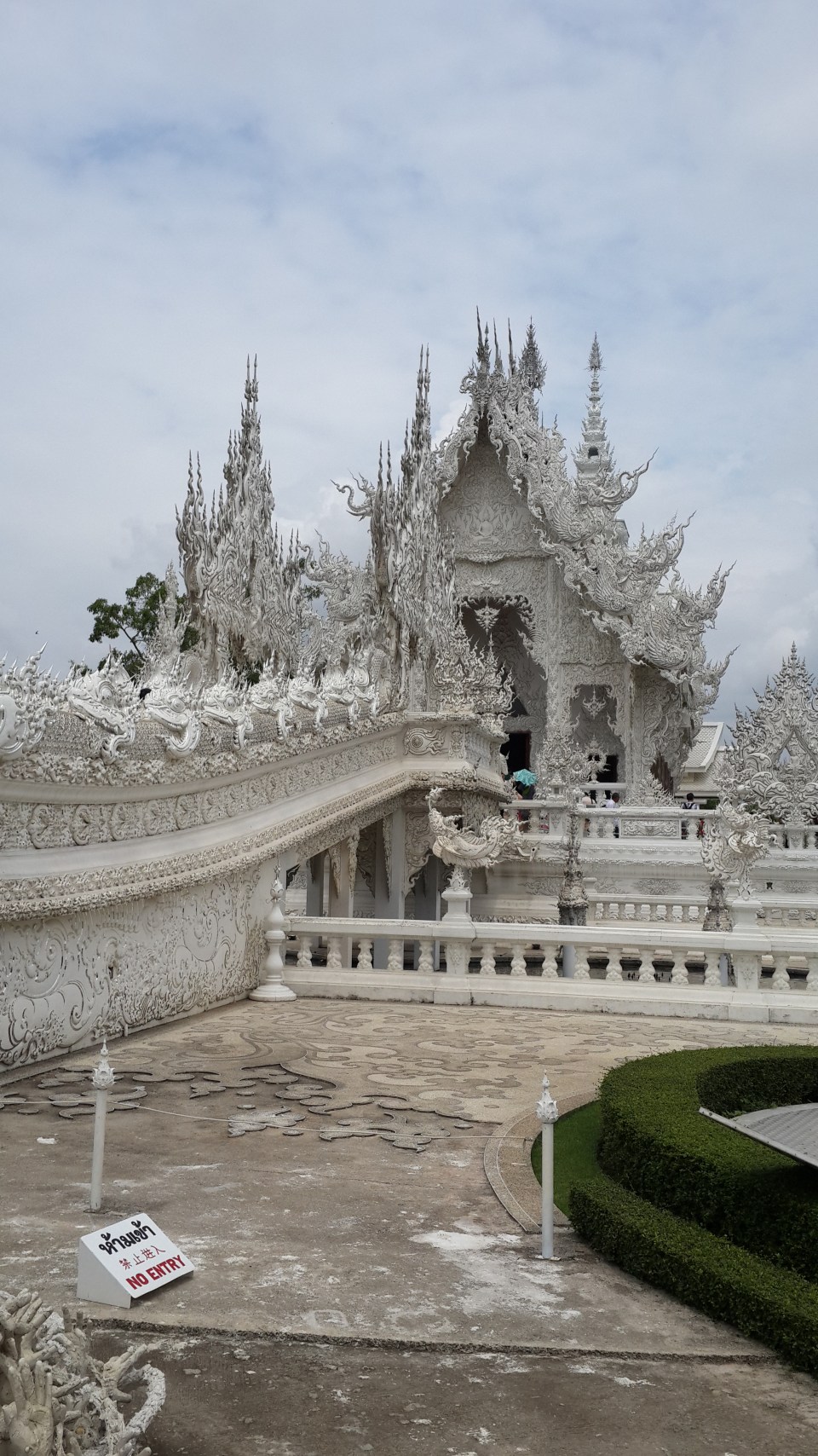

shapes reminiscent of mudras…
The art and architecture of the temple certainly is distinctly Thai. One sees shapes reminiscent of mudras made by the flowing hand movements of a Thai dancer. Chalermchai says he takes themes from ancient Thai murals, trying to create a modern synthesis that is recognizably and uniquely Thai. If the number of visitors is taken as a measure, then his ambition has certainly been realized. Within the temple are modern murals that face a statue of the Lord Buddha. “I want people to feel peace and happiness and to envision the kindness of the Lord Buddha to all beings,” says Chalermchai. “The mural shows the final conflict of the Lord Buddha’s own demon before he received enlightenment and freedom from immoral thoughts.” When asked about the images of George Bush and bin Laden in the demon’s eyes, the artist replies. “I want everyone to know that our world is being destroyed by those who crave to build weapons that kill. They segregate and therefore cannot find peace….”
Chalermchai expects to complete the temple in 90 years.He begins each day at 2 a.m. with an hour of meditation, then creates and sculpts. An artist whose wealth stems from the roughly 200 artworks he produced every year, he now devotes most of his time to the completion of the temple and currently produces around ten paintings a year. The entire site is kept spotlessly clean and supervised by zealous volunteers who ensure that tourists are modestly attired before they enter the temple. The toilets are guarded by a bronze hermaphrodite keeper.
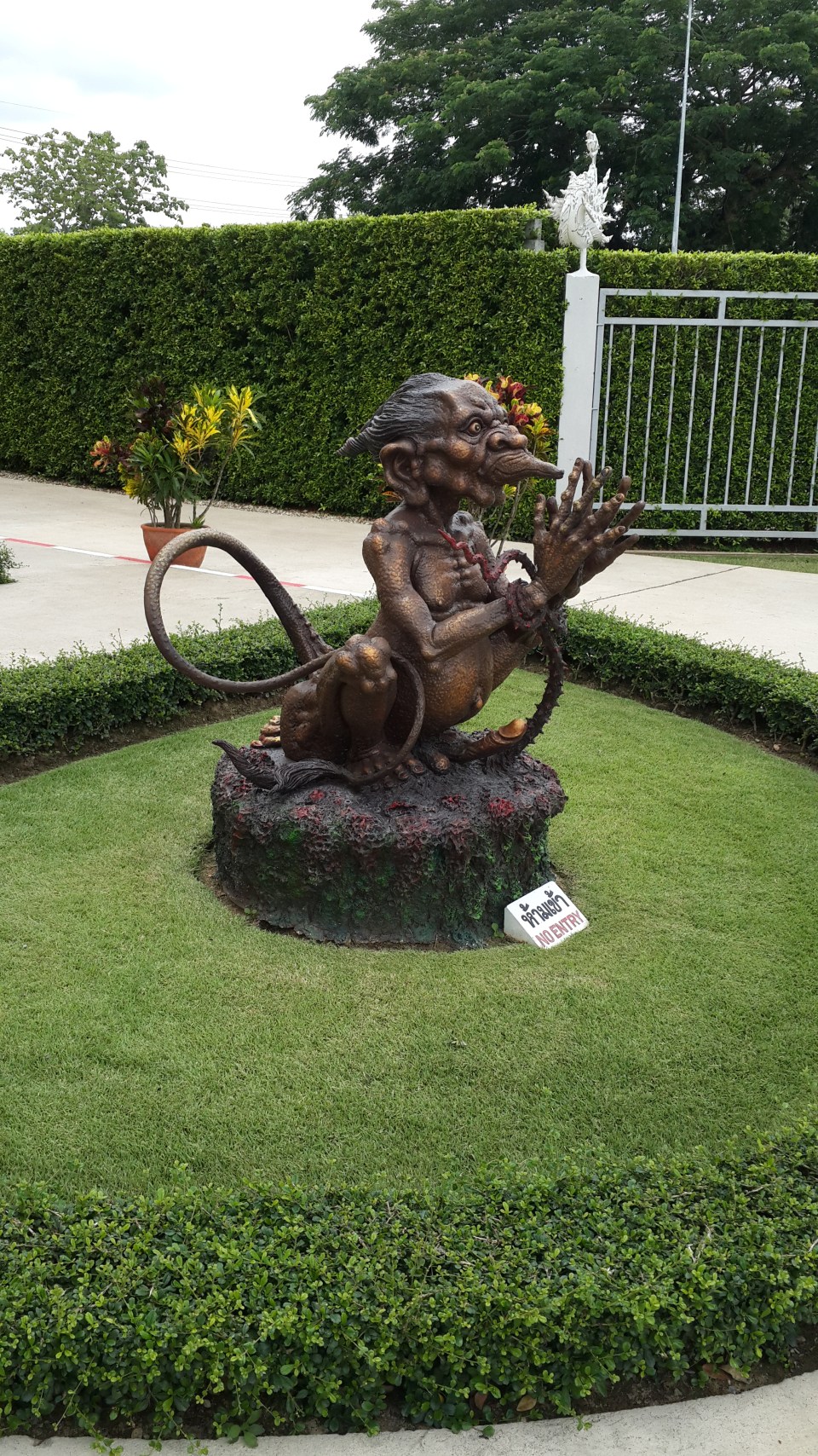
The bronze hermaphrodite custodian of the toilet, front…

…and rear
Concluding with the artist’s own words: “I want to discipline the mind to train me toward being a good person with clear thinking, speaking well and doing good deeds. We are all human and I want to give goodness to people. If we have love and forgiveness in our hearts, it will come out naturally. You need to practice patience before you can control your own mind.”

…I want to give goodness to people.
For more by this author, see his Amazon page here.
Living in Limbo – Streetside Portrait
I see this older man on every visit to the local supermarket. He notices me, because Vari and I are among the few people who park our bikes at the small stand and carry home all our shopping in bicycle saddle bags. He sells a newspaper, called the Augustin. The Augustin is an inclusive newspaper run by volunteers who have formed an association, a ‘verein’ that promotes tolerance and provides opportunity for marginalised members of society to earn a little money with dignity, selling issues of the paper on the streets. Not many people buy them.
My Augustin man is always well groomed, clean shaven and decently dressed. He stands by the bank of shopping trolleys outside the supermarket. Sometimes, when he sees an elderly lady fumbling with change to release a shopping trolley from the stand, he steps forward with a metal gadget from his pocket the size of a beer opener that releases a trolley. Some people take the trolley from him with a sideways glance or nod of acknowledgement. Sometimes not even that. A few people stop to talk to him. I bought an Augustin from him one day, as a gesture of support.
Last week he used his gadget with a flourish when I was entering the supermarket and presented me with a trolley. I stood and spoke with him for some time. He’s from Georgia, he said, and 62 years old, a professor of philology. He’s waiting for his papers to be processed. I’m not sure how much I can ask about why he’s here. He’s so dignified and reserved. Does he have family? Did he lose his job? Is he a political refugee? He’s not allowed to work, he said, and lives with the support of Caritas while waiting for his papers. Caritas is the catholic relief agency that does a lot of good work among refugees in Austria and elsewhere.
When I come home, I check the definition of philology in Wikipedia. Philology is the study of language in written historical sources; it is a combination of literary criticism, history and linguistics, it says. I read a beautiful poem by John Milton when I was a child. Seeing the unemployed philologist reminded me of it. It’s called, When I Consider How my Light is Spent.
When I consider how my light is spent
Ere half my days in this dark world and wide,
And that one talent which is death to hide
Lodg’d with me useless, though my soul more bent
To serve therewith my Maker, and present
My true account, lest he returning chide;
“Doth God exact day-labour, light denied?”
I fondly ask. But Patience to prevent
That murmur, soon replies: “God doth not need
Either man’s work or his own gifts; who best
Bear his mild yoke, they serve him best. His state
Is kingly. Thousands at his bidding speed
And post o’er land and ocean without rest:
They also serve who only stand and wait.”
For more by this author, see his Amazon page here.
 aviott