Home » deep ecology (Page 3)
Category Archives: deep ecology
Transportation: The Weight of Fear
Consider me. Or consider yourself. Presumably an average human being of average weight. These averages vary considerably in different parts of the world, from 60 kilos or less, to 90 kilos or more. Looking back at the various means of transport that I have commonly used in the past five decades, I made a list of their approximate weights for comparison. My own weight has changed (increased!) by 5 kilos during this period, from 75 to 80 kg.
Bicycle: Throughout my schooldays, I used a single speed bicycle to take myself (40 to 65 kg.) to school and back. I assume bicycles weighed around 25 kg. in those days. In any case, the means of transportation was around a third of my own body weight. I loved the song of the open road. Most days I arrived at school in a lather of sweat, but no one really bothered about that.
My first job was as a travelling salesman and the most efficient way to do this at the time was with a motorbike or scooter. Traffic congestion was not yet a problem in the 1970s to 90s. I loved the song of the open road. Most days I arrived at work or at a customer feeling dapper and cool, even though a bit windblown. The weight of the motor-scooter or motorbike I owned or rode at various times in this period varied from 130 to 150 kg. My own weight at this time was a svelte 75 kg.

250 cc Jawa 2-stroke motorcycle ca. 1972. Image, coutresy jawa.eu
From the late 70s to the 1990s my preferred mode of transport was a private car. I loved the song of the open road, although traffic was constantly increasing. Loved to drive long distances on holiday. Car weights varied from 840 kg (1976 first generation VW Golf) to 1400 kg (same model 25 years later) to 1700 kg (minivan). In spite of long distance holiday travel with family, 90% of the annual miles were clocked commuting to work and back. i.e. 1000s of kilometers with just one occupant. i.e. using 1400-1700 kg to transport 80 kg of human being. Forget the song of the open road! Most daily commutes were exercises in creeping through congested streets and highways, impatiently waiting to get to work or home.
From the early 2000s onwards, my thinking about the daily commute evolved (?) as follows. Car (1700 kg, 40 minutes), bus (kg irrelevant, 80 minutes), bicycle (16 kg., 70 minutes). The bicycle was definitely a step forward in efficiency and economy. It cost practically nothing, and also gave added health benefits, although I arrived in a lather at work, as I did in my school days, and had to repair to a toilet for a cat-wash and a change of clothes.
Around 2005, I began to yearn for pedal assist on my bicycle and began to look around for electric models. There were none available as far as I could see. Sometime in 2006, I found a German website on the internet that advertised an electric bicycle with a 1 year guarantee, a 7 kilo NiCad battery pack, and no range specifications. I was tired of a steep hill on my daily commute (36 km per day), so I ordered the bike sight unseen and two weeks later, took delivery of a giant cardboard carton with MADE IN CHINA printed on the sides. It weighed 32 kg with battery, had seven gears and was a real pain to carry up and down to the cellar where I stored it overnight.

Image courtesy Pedalandpower.com
But it did the job nicely. The hill was a problem no more. And the range was around 30 km. Unfortunately, NiCad batteries suffer from a memory effect, and I could not charge it in the office for the ride home, so I got minimal assistance on the dreaded hill with a fading battery.
Ah, the perfect solution! Sometime around 2008, I saw a beautiful 24-speed KTM with the cutest little Li-ion battery that was good for 60 kms of pedal-assist riding. By this time, I had moved homes and my daily commute had increased to 50 km. Here was the answer to my commuting problems. The KTM bicycle weighed 22 kg, I weighed 80 kg., and the electricity cost me around €0.30 for 100 km (30 cents). My friends considered the electric bike expensive. It was expensive, in bike terms, but in reality cost about as much as the annual service of the average 1700 kg. monster. Maybe that’s comparing apples and oranges, you say. But such comparisons are ok when you’re riding an apple, and have gotten rid of the orange. Needless to say, I sold the 1700 kg. monster and have lived happily ever after.
Nowadays people tell me, you can’t ride around on a bicycle at your age! It’s too dangerous to ride a bicycle in this murderous city traffic. True. But I wear a helmet and try to ride cautiously. I’m happy carrying my current 79 kg. on two wheels weighing 22 kg., and wouldn’t dream of carrying it in 1700 kg. as I used to do. The difference in weight (ca.1,678 kg) I like to think of as the weight of fear. That’s quite a lot of fear to carry around in one’s life. Best to get rid of it!
See this author’s page at Amazon.com to read more of his work
On Leeches, Jungle, Bliss and Beauty: things we have lost
I had the privilege of spending a week in a pristine rain forest in the northern Western Ghats with a handful of people best described as practitioners of deep ecology. Which means we moved about in the jungle in the least invasive manner humanly possible, on foot, leaving no footprints behind. On the contrary, it was the forest that left deep footprints in our memories. Here was a small segment of the planet that has been allowed to retain its wildness and its purity. It is still possible to drink water from these streams; pure, unfiltered, sweet; and we did, the whole week. Yes, there are leeches in paradise and my companions taught me to scrape them off with a fingernail from their tail end to dislodge them. “They have a right to live too, and we are the invaders in their habitat.” So-called primitive societies knew how to live in symbiosis with Nature, without the need to ‘conquer‘ it. Our modern civilization, with all its immense achievements, has ‘conquered‘ Nature and with climate change, we are currently witnessing the Pyrrhic depths of our victory.
In the forest, we bathed in rock pools and under waterfalls, luxuriating in Nature’s bounty. Birds, butterflies, trees, and insects were identified and added to lists in notebooks. Latin names of species and botanical names were bandied about freely among the group. “We use the Latin names as definitive identifiers, since local names vary widely, sometimes from one village to the next.” We tasted button-sized jamun fruit (Syzygium Jambulanum, a.k.a.Java Plum, Jambul, black plum, faux pistachier, jambolāo… see what I mean about variations in local and regional names?), mini jackfruits, a variety of Kokum (Garcinia Indica), a cousin of the cashew fruit from a young tree with cashew-like leaves, and the leaves of a tree that left a mildly sweet taste on our tongues when chewed (apparently used as an ingredient for weight loss by the health food industry). I was told about, but did not see, a tree, the underside of its leaves as rough as sandpaper, and used as such by forest tribes to smooth wooden implements and furniture.
We stood at dawn under the eaves of a hut and listened to the Malabar Whistling Thrush sing its daily morning ode to joy. As it sang, I was told that they love the rain and welcome the monsoon with redoubled full-throated vigor.

Malabar Whistling Thrush (also known as the naughty schoolboy)
I learned that, of the many species of colorful butterflies that flitted through the forests, the ones that flew fast and rarely sat still were usually a favored food of birds and insects that preyed on lepidoptera. Some beautiful specimens, on the other hand, hardly bothered to conceal themselves and were often seen lazily gliding down from the treetops to eye level, knowing they were toxic to most predators. Most spectacular among them was the Malabar Tree Nymph, Idea Malabarica. I had never before seen a butterfly glide so far with hardly a flutter of its wings.
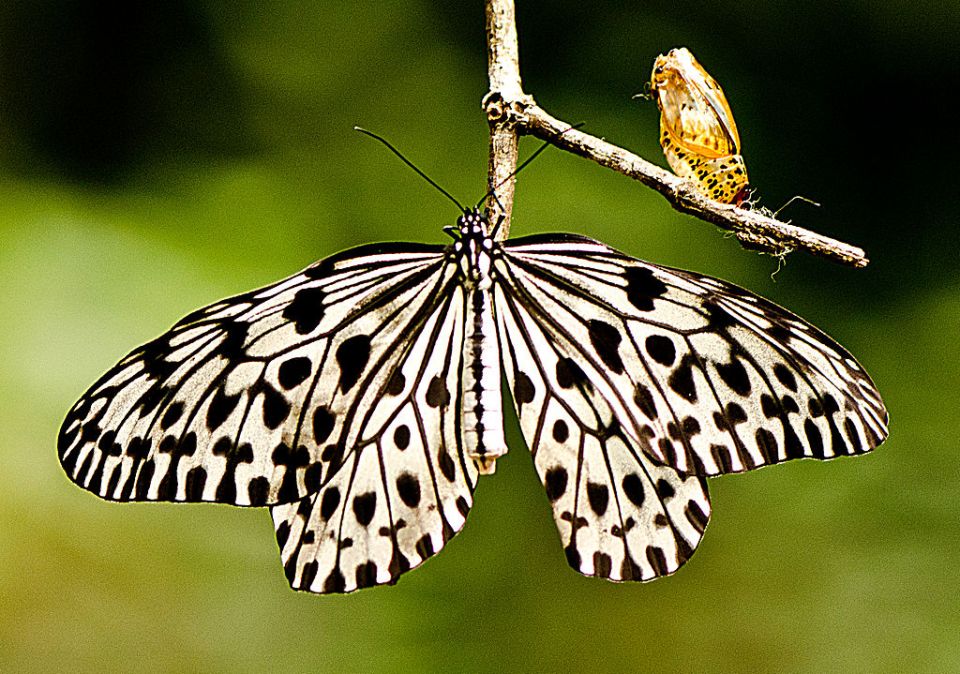
Malabar Tree Nymph – Idea Malabarica
The herpetologist in the group, a snake lover from childhood, thrust a hand into the undergrowth and brought it out to reveal a foot-long, slender green snake curled around his arm; a non-venomous vine snake. “Touch only its underbelly,” he cautioned. “Only predators touch a snake on its back and this causes them stress.” he gave us time to admire it for a few moments before allowing it to slide back into the undergrowth where it immediately became invisible again. A few moments later a metallic blue-black centipede wriggled across our path, looking for all the world like a shiny finished industrial product from Apple rather than a denizen of the wild. We respectfully watched it cross our path before continuing our walk.
While shy langurs leapt about among the topmost branches of the forest canopy, our guide showed us pale gray chalk-like lumps on the ground among the bushes. “Leopard scat,” he said. “There are several in this area, but they’re noctural and shy away from humans. I’ve not seen one in my two years here. There are sloth bears as well, but they too are very reclusive and we never see them” Just as well, since sloth bears, despite their name are very fast and can easily outrun humans.
In the evenings, there were more walks to look at the endless varieties of birds and trees, and we invariably ended up at woodland streams to bathe under a waterfall or soak in rocky pools, taking care not to pollute the water with soaps, creams or lotions. For cosmetic use, the woods provided us with wild aloe vera and a plethora of other medicinal plants I knew nothing about. On the way back to the hut that was our sleeping quarters, a few bits of sambrani were carefully scraped off the bark of a tree. Also known as benzoin resin, gum benzoin or gum Benjamin, it is used in perfumes, incense and medicines. Sambrani usage has a long tradition in India, and its sweet smelling smoke is used during pujas (religious ceremonies) and also in Christian churches to sanctify the communion service.

Nature’s bathtubs and showers: rocky pools and waterfalls
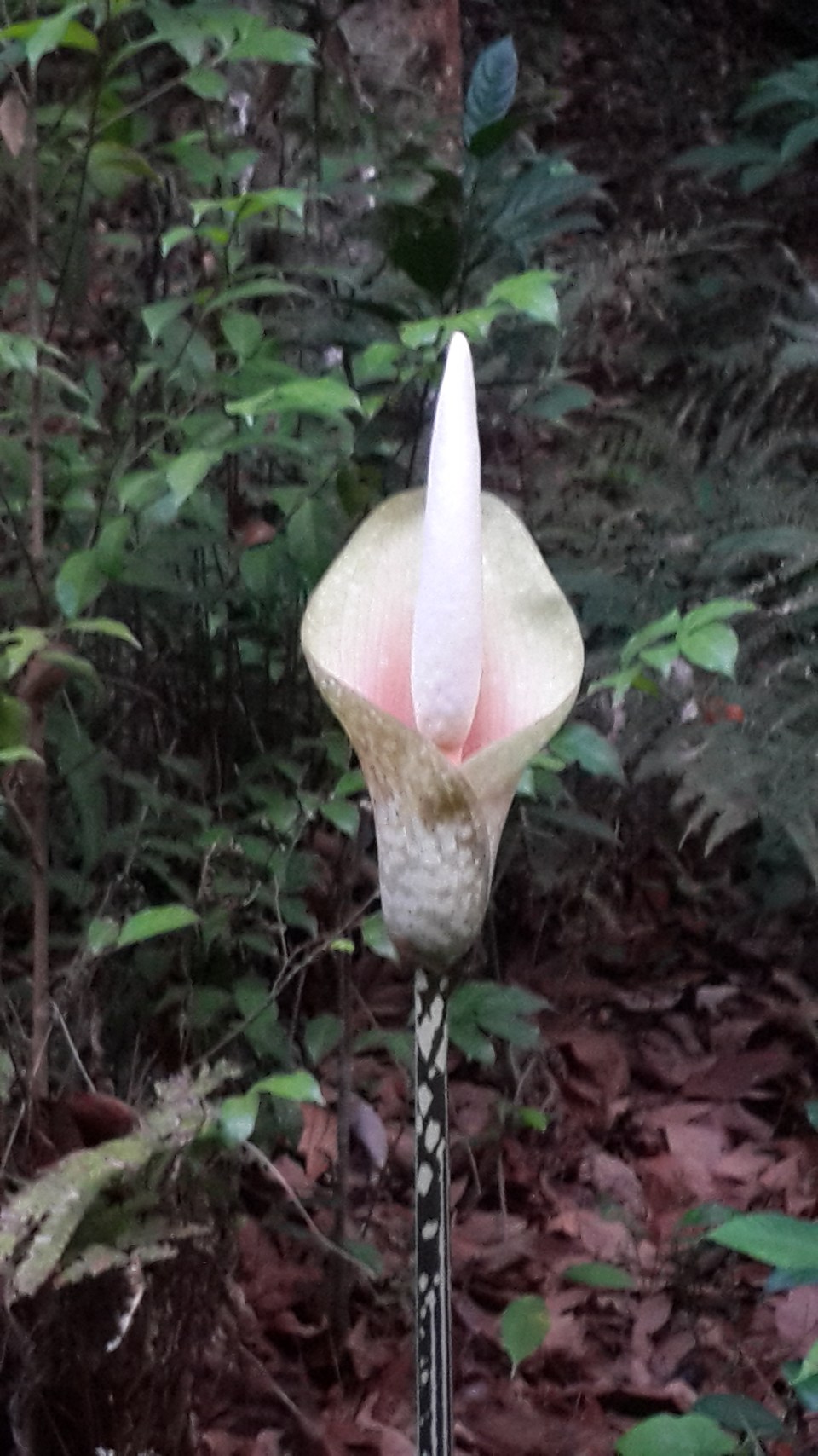
Standing 1 meter tall, this flower exudes a smell of rotting flesh when mature, thereby attracting insects that help pollinate it.
The week spent here was mind-expanding and humbling at the same time. How much knowledge have we lost in the race to industrial progress? How much intrinsic knowledge and wisdom of “uneducated peasants” have we ignored, simply because they had no diplomas on paper, no degrees from institutions of higher learning. After this week, I can’t help thinking, it is we urbanites who have lost out.
See this author’s page at Amazon.com to read more of his work
 aviott