Home » development (Page 4)
Category Archives: development
On Leeches, Jungle, Bliss and Beauty: things we have lost
I had the privilege of spending a week in a pristine rain forest in the northern Western Ghats with a handful of people best described as practitioners of deep ecology. Which means we moved about in the jungle in the least invasive manner humanly possible, on foot, leaving no footprints behind. On the contrary, it was the forest that left deep footprints in our memories. Here was a small segment of the planet that has been allowed to retain its wildness and its purity. It is still possible to drink water from these streams; pure, unfiltered, sweet; and we did, the whole week. Yes, there are leeches in paradise and my companions taught me to scrape them off with a fingernail from their tail end to dislodge them. “They have a right to live too, and we are the invaders in their habitat.” So-called primitive societies knew how to live in symbiosis with Nature, without the need to ‘conquer‘ it. Our modern civilization, with all its immense achievements, has ‘conquered‘ Nature and with climate change, we are currently witnessing the Pyrrhic depths of our victory.
In the forest, we bathed in rock pools and under waterfalls, luxuriating in Nature’s bounty. Birds, butterflies, trees, and insects were identified and added to lists in notebooks. Latin names of species and botanical names were bandied about freely among the group. “We use the Latin names as definitive identifiers, since local names vary widely, sometimes from one village to the next.” We tasted button-sized jamun fruit (Syzygium Jambulanum, a.k.a.Java Plum, Jambul, black plum, faux pistachier, jambolāo… see what I mean about variations in local and regional names?), mini jackfruits, a variety of Kokum (Garcinia Indica), a cousin of the cashew fruit from a young tree with cashew-like leaves, and the leaves of a tree that left a mildly sweet taste on our tongues when chewed (apparently used as an ingredient for weight loss by the health food industry). I was told about, but did not see, a tree, the underside of its leaves as rough as sandpaper, and used as such by forest tribes to smooth wooden implements and furniture.
We stood at dawn under the eaves of a hut and listened to the Malabar Whistling Thrush sing its daily morning ode to joy. As it sang, I was told that they love the rain and welcome the monsoon with redoubled full-throated vigor.

Malabar Whistling Thrush (also known as the naughty schoolboy)
I learned that, of the many species of colorful butterflies that flitted through the forests, the ones that flew fast and rarely sat still were usually a favored food of birds and insects that preyed on lepidoptera. Some beautiful specimens, on the other hand, hardly bothered to conceal themselves and were often seen lazily gliding down from the treetops to eye level, knowing they were toxic to most predators. Most spectacular among them was the Malabar Tree Nymph, Idea Malabarica. I had never before seen a butterfly glide so far with hardly a flutter of its wings.
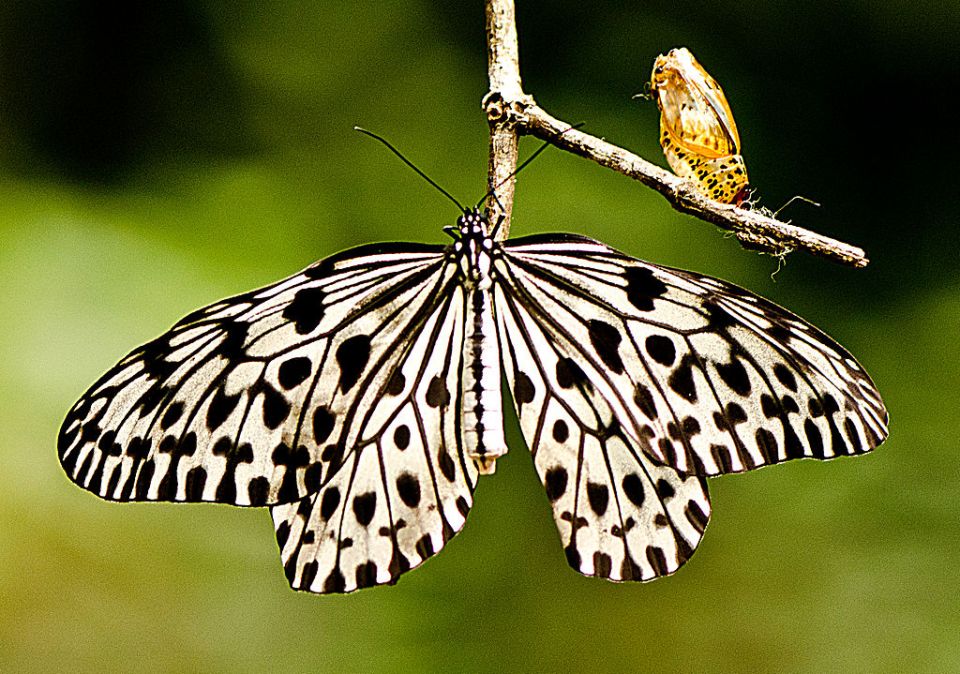
Malabar Tree Nymph – Idea Malabarica
The herpetologist in the group, a snake lover from childhood, thrust a hand into the undergrowth and brought it out to reveal a foot-long, slender green snake curled around his arm; a non-venomous vine snake. “Touch only its underbelly,” he cautioned. “Only predators touch a snake on its back and this causes them stress.” he gave us time to admire it for a few moments before allowing it to slide back into the undergrowth where it immediately became invisible again. A few moments later a metallic blue-black centipede wriggled across our path, looking for all the world like a shiny finished industrial product from Apple rather than a denizen of the wild. We respectfully watched it cross our path before continuing our walk.
While shy langurs leapt about among the topmost branches of the forest canopy, our guide showed us pale gray chalk-like lumps on the ground among the bushes. “Leopard scat,” he said. “There are several in this area, but they’re noctural and shy away from humans. I’ve not seen one in my two years here. There are sloth bears as well, but they too are very reclusive and we never see them” Just as well, since sloth bears, despite their name are very fast and can easily outrun humans.
In the evenings, there were more walks to look at the endless varieties of birds and trees, and we invariably ended up at woodland streams to bathe under a waterfall or soak in rocky pools, taking care not to pollute the water with soaps, creams or lotions. For cosmetic use, the woods provided us with wild aloe vera and a plethora of other medicinal plants I knew nothing about. On the way back to the hut that was our sleeping quarters, a few bits of sambrani were carefully scraped off the bark of a tree. Also known as benzoin resin, gum benzoin or gum Benjamin, it is used in perfumes, incense and medicines. Sambrani usage has a long tradition in India, and its sweet smelling smoke is used during pujas (religious ceremonies) and also in Christian churches to sanctify the communion service.

Nature’s bathtubs and showers: rocky pools and waterfalls
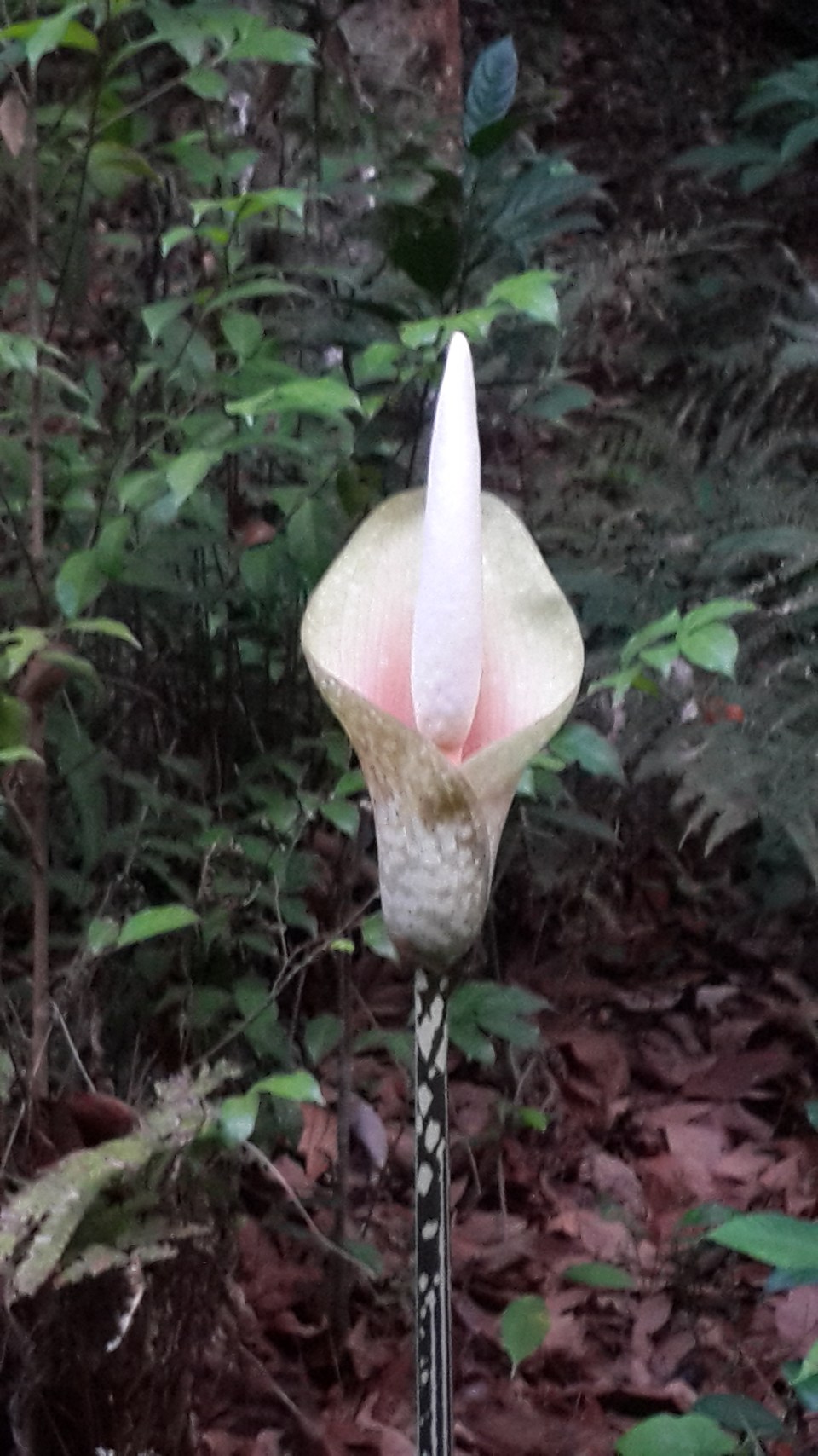
Standing 1 meter tall, this flower exudes a smell of rotting flesh when mature, thereby attracting insects that help pollinate it.
The week spent here was mind-expanding and humbling at the same time. How much knowledge have we lost in the race to industrial progress? How much intrinsic knowledge and wisdom of “uneducated peasants” have we ignored, simply because they had no diplomas on paper, no degrees from institutions of higher learning. After this week, I can’t help thinking, it is we urbanites who have lost out.
See this author’s page at Amazon.com to read more of his work
Finding the Right Words
I read a review of a new book called “Translating Happiness” that describes the emotional privileges enjoyed by people who speak more than one language. The idea of multi-lingual people leading richer lives has been expressed in many different ways by thinkers through the ages. A Chinese proverb (there’s a good Chinese proverb for every occasion!) says that Learning is a treasure that will follow its owner everywhere. A Spanish proverb puts it more strongly and says One who knows two languages is worth two. Roger Bacon calls knowing more than one language the gateway to wisdom.

Greenland Image: courtesy npr.org
In Smilla’s Sense of Snow, author Peter Hoeg has the main character explain in the book that the Inuit and most other Greenlanders have a much more nuanced and deeply intuitive feeling for the varied facets of snow and ice than the rest of the world. To prove this, Smilla says there are 28 different words in Greenlandic languages to describe snow in all its moods and varieties. Although the book is a very readable thriller, a scholarly article I found actually lists 128 words for snow in Greenlandic languages. This is surpassed by a BBC news report of a University of Glasgow study that claims the Scots have 421 different words for snow. Picturesque examples include feefle, “to swirl” and snaw-pouther, “fine, driving snow.” Here I see rich pickings for an academic study of differences between Greenlandic and Scottish use of wintry language.
People who live in island nations and speak only one language are often the quickest to admit how culturally impoverished they are. By that measure, the United States is a linguistic island, with the vast majority of its populace militantly indignant when they encounter people who don’t speak English. An otherwise intelligent and sensitive American acquaintance of mine who travelled abroad for the first time recently made so many derogatory remarks about European customs she encountered. What made her so indignant was that certain customs were different from what she was used to at home. Such people, however decent and well-meaning, are like snails carrying their houses on their backs. They need to ditch their shells and learn to travel light.
See this author’s page at Amazon.com to read more of his work
Climate Action Tracker
The Climate Action Tracker posts regular progress reports on how well various countries are doing to adhere to the Paris Agreements. It tracks emissions from 32 selected countries and the list of the good, the bad, and the ugly is quite surprising even to this seasoned watcher.
Only two countries are on track to fulfil the Paris goal, of limiting emissions to keep global temperatures from rising above 1.5 degrees C; Gambia and Morocco.
The second best choice made in Paris was, if not 1.5 degrees, then at the least 2 degrees C. Just 5 of 32 countries meet this target. Bhutan, Costa Rica, Ethiopia, India and Philippines. All of the remaining 25 countries fall into the category of emitters that will lead to a world of 3 degrees warming or more. See the original list here.
Of course this predicator of doom and gloom relies only on official government policies. The reality on the ground may be a bit different in many of the countries on the list. For example, despite their governments, a few cities, power companies and private individuals already find it cheaper to produce unsubsidised renewable energy, a trend that will speed up, just a cell phone sales did in developing country markets worldwide.
See this author’s page on Amazon.com to read more of his work
Unbroken News
Continuing the series on breaking news that deserves a bigger audience, here’s Bill Gates with a few facts about the world of today.
Today, more people are living healthy, productive lives than ever before. This good news may come as a surprise, but there is plenty of evidence for it. Since the early 1990s, global child mortality has been cut in half. There have been massive reductions in cases of tuberculosis, malaria, and HIV/AIDS. The incidence of polio has decreased by 99 percent, bringing the world to the verge of eradicating a major infectious disease, a feat humanity has accomplished only once before, with smallpox. The proportion of the world’s population in extreme poverty, defined by the World Bank as living on less than $1.90 per day, has fallen from 35 percent to about 11 percent.
See the full article from Foreign Affairs here.
See this author’s page at Amazon.com to read more of his work
Breaking News – the news is broken
Most media outlets seem to operate under the principle that bad news is good news or alternatively, good news is not news. They may be right, in terms of profitability. But they are definitely wrong, in terms of the collective well-being of humanity. This blog is not dependent on readership or advertising revenues, so it can afford to print good news without fear of losing its readership. So here for a start is good news from the energy front.

Floating solar photovoltaic facility outside Nagoya producing power for Apple supplier. Image: courtesy Clean Technica
All of the electricity used by two of the world’s largest corporations, Apple and Google, were from renewable sources by the end of 2017. This is a remarkable achievement, considering that each of these companies uses more electricity than many small nations, not least to power immense data centers scattered around the world. So now, if you have worries about the amount of personal data Facebook & Co. are collecting about you because of their opaque terms of usage, rest assured that they’re not polluting the planet in the bargain.
But seriously, there’s lots of impressive news in the energy area alone. Here’s a chart, courtesy of National Resources Development Center, showing how prices have come down for major clean energy technologies.

Chart from NRDC: click to enlarge
Since clean energy is one of the basic requirements for human development, there’s not much stopping world-wide implementation, is there? Capital for investment? It’s increasingly concentrated in the hands of a few–rich corporations and rich individuals. So are we ordinary mortals totally helpless? No, not at all. But we have to make smart choices as customers. We can enrich our lives, and the planet in the process, by getting off the mindless consumption lifestyle that the glossies would have us aspire to.
In one hour, the earth receives more solar energy than the world uses in one year. Now that’s good news and worth repeating, even if its not new. So why are companies producing more dirty diesel cars and building more fossil fuel power plants? Because switching technologies means moving out of comfortable niches of expertise that would otherwise become useless; it would mean new investments, experimenting with new technologies, and why should they take all these risks when customers are flocking to buy new models anyway? As engine size and horse power of new automotive offerings increase, so do their profits, and they see even less reason to invest in new technologies. It’s only we, the customers, who can break this vicious cycle.
English speaking news readers tend to digest information from an overwhelmingly anglocentric or eurocentric point of view. Hence I was not surprised recently to hear a friend accuse the Chinese of polluting the planet when actually, despite (or perhaps because of) a totalitarian regime, they are doing more to clean up the earth than any other nation. For example, the southern Chinese city of Shenzen alone runs a fleet of 16,000 (yes, thousand) electric buses; more than the rest of world combined. So while air quality in Beijing might be abysmal, this past winter, particulate pollution was 50% less than in the previous year. This from no less a source than the US Embassy in Beijing! One reason for the lower levels of pollution might be that China installed more than 53 GW of solar power in 2017.
The above facts don’t make me an apologist for an autocratic government where power is increasingly concentrated at the top. This is undoubtedly a very worrying tendency, one that is being seen in several other large countries like India, Russia, Turkey, China and the United States. In the US case, its robustly democratic political system has been hijacked by corporate lobbies. Nevertheless there is good news coming from each of these countries, and I will try to highlight these bright spots in future posts.
See this author’s page at Amazon.com to read more of his work.
A Million Cars at Sea
Ever wanted to go on an ocean liner? Cruise ship advertisements idealise the high life to be had on the high seas. What they never say is how much ships pollute. The average ship runs on low grade oil, which can be likened to a sludge that emits more particulate matter than a million cars; more sulfur than seven million cars. And that’s just one cruise liner!
Several Scandinavian ferries now run on hybrid diesel-electric systems but, as in most advances in electric propulsion these days, China is taking the lead, as a cargo ship with a 2.4 MWh battery pack launches in Guangdong. Ironically, the ship will be used to transport dirty coal!
A new all-electric cargo ship with a massive 2.4 MWh battery pack launches in China
Car makers have a problem. They don’t admit it yet. Or maybe they do admit it to themselves, although not in public. Why should they, when enough people are buying bigger cars? Global car sales in 2017 were close to 90 million vehicles in all categories, including SUVs and light trucks. That’s roughly 1 car for every 77 people. Less than 1% of these were electric. How many more cars do we need? Car companies are powerful entities that are in the business of selling dreams; dreams of freedom, of the joy of the open road, dreams of independence. The irony is that as we buy into the dream, we destroy the very foundation on which our dreams are based.
See this author’s page at Amazon.com to read more of his work.
Life After IIASA 1975-2013: Five Years On
February 2018 will mark five years after my retirement from IIASA. These five years have been full of new experiences, travel and writing. My wife and I have also attempted during this time to modify our lifestyle to be as carbon neutral as possible. Measures include living without a car, using a bicycle for shopping and public transport for travel where possible. Trips by air are unavoidable in the lifestyle we’ve chosen, and we’ve attempted to offset this carbon by buying solar panels for a farm school in India and a solar farm in Austria, 8 KW in all. These panels will apparently offset around 8 tons annually, but there’s still more to be done.
I first heard about sea level rise in a talk by paleo-climatologist Herbert Flohn at IIASA sometime in the late 1970s. At that time, many of the information requests that the IIASA library received were about global effects of a nuclear winter in the aftermath of nuclear war. Research themes changed quickly; interest moving to carbon dioxide emissions from fossils fuels, global warming, acid rain and stratospheric ozone.
In the intervening years, the reality of human-induced global warming has been accepted by all but the most ideologically blinkered societies worldwide. Travelling through parts of rural India soon after retirement in 2013, I saw repeated instances of people taking actions to adapt to climate change; water harvesting to compensate for unprecedented droughts, reforestation efforts; introduction of organic farming methods and drought resistant crops. I’d like to think that much of the credit for these adaptation and mitigation actions goes to studies by IIASA and other research institutions worldwide; scientific studies whose results filtered down over decades through the media and drew attention to these problems early on. There’s no way to prove this, and some of the water harvesting systems I saw were really ancient structures brought back into use. See more about that here
Efforts in 2015 and 2016 to help establish a rural education and vocation center failed for a very positive reason. The five acres of land (2 hectares) that had been donated to us for school use by a well-wisher is worth approximately € 300,000 (€65,000 per acre at today’s prices). The donated property was fertile agricultural land and classified as such. The local administrative authorities refused permission to reclassify the plot for use as a school and insisted that the land remain in use for agriculture. This was a positive outcome, because one of our reasons for this choice of location of a school was to prevent displacement of the rural population by expensive housing projects that would only benefit urbanites.
However the effort was not wasted. Since then our local partners have decided to build an organic farm on the land and use the experience gained to encourage the farming practices of communities in neighbouring villages. One function of this farm would be to develop markets for organic produce. We discovered several small companies in the area that offer free midday meals to their workers. They were happy to find a local supply of good vegetables. One enterprising factory owner offered his workers three free meals a day, sourcing all the vegetables from his own backyard. The vegetables he showed us were grown in plastic tubs lined with mats made of nutrient-rich hemp fibers. In fact, the method is so successful that he gives away growing kits free to any of his workers who want one for their own families’ use.
An encounter in early 2017 with a conservationist who runs a hatchery for Olive Ridley turtles on the sea coast near Chennai city led me to Tiruvannamalai, a town 200 km to the south-west. Here is an organic farm school where text-book sustainable living is practiced in the most lively and joyous manner possible. There are around 100 children in the school, ranging in age from 8 to 18. The links below will give an idea of activities at the school.
http://www.marudamfarmschool.org/
https://yourstory.com/2017/12/2-lakh-trees-ngo-regenerating-forest-tamil-nadu/
http://www.theforestway.org/greening/planting.html
In addition to organic farming, environmental conservation and education, the school also works with villagers in the surrounding countryside, reforesting the hill that dominates the temple town, planting around 15,000 trees a year. The school’s efforts inspired us (myself and a few friends in India) to help them become energy self-sufficient, adding 5 KW of solar panels to the three they already had. Together with battery backup, the school is now completely independent of the grid. (photo attached).
This activity led me to a thought. If IIASA’s work ultimately inspired these kinds of sustainability acts, what about IIASA’s own carbon footprint? IIASA’s alumni are scattered all over the world. What if we joined together, wherever we are, and worked to offset IIASA’s carbon emissions? Such actions would benefit our own communities, wherever we may happen to live. To kick-start this effort, I’ve decided to fund the planting of 1000 trees in 2018 through the farm school mentioned above. If each tree sequesters 25 kilos of carbon (as a rule of thumb, regardless of species), this would offset 25 tons of the Institute’s annual carbon emissions.
Should this be a formal organized effort? Readers’ suggestion welcomed here. All we would need is a virtual platform where one can document one’s own efforts and have a running tally. Ultimately the goal is to achieve carbon neutrality, not only for the Institute, but also for the communities in which each one of us lives. But, as for so many initiatives, IIASA could be a starting point.
On a personal note, the years since retirement have been very fulfilling. Thanks to my wife’s job, we were able to spend 2 idyllic years on an island paradise near Hong Kong. This provided background material for a work of fiction, Grace in the South China Sea. There are two sequels in the pipeline (The Trees of Ta Prohm, and Heartwood), to appear in 2018. Look for the earlier books and announcements on the Amazon author page here.
See this author’s page at Amazon.com to read more of his work.
The Woodpecker’s Tongue
I read an interview with Walter Isaacson (author of Steve Jobs’ biography, among other books) the other day. In it, he says: “I’ll just tell you something small. The tongue of a woodpecker is three times longer than the beak. And when the woodpecker hits the bark at ten times the force that would kill a human, the tongue wraps around the brain and cushions it.”
This information was so startling that I had to go and look it up. Sure enough, the description is accurate. Here are two illustrations, courtesy of Pinterest and Twitter, of the woodpecker’s incredibly long tongue and the way it cushions the brain.
Science has revealed so much of Nature’s secrets. Yet we can be sure that there as many hidden away, waiting to be discovered. Finding this bit of information about the woodpecker’s tongue so close to the beginning of the new year made me wonder what kind of lesson I could learn from it for 2018. Here is an analogy that seems to fit the bill.
We spend increasing amounts of time on social media. Information leaps at us with the rapid fire of a woodpecker’s beak rat-a-tat-ing into a tree. This selective information explosion damages our judgement and impairs our ability to separate fiction from fact. We humans need something to cushion ourselves from the damaging impact of a continuous stream of media inputs. In our case, the woodpecker’s tongue equivalent might be enhanced interactions with the real world; talking to people around us, to family, friends, acquaintances, and people in the society we live in.
I’ve spent a great deal of time on Facebook & Co. in recent years, assuming that these interactions were somehow deepening my ties to the real world. I have undoubtedly benefitted, by being able to keep in touch with friends and relatives living in far-flung corners of the world. Despite these real benefits, the truth has gradually dawned on me that I was becoming more of a consumer and less connected to the world. The perfidious effect of social media was perfectly illustrated a few years ago when a friend came to stay for a while with his wife and new-born baby. The friend was a keen amateur photographer, as eager to record every minute of his son’s life as any first-time parent. The Eureka moment came to me when I saw he was so busy taking and uploading photographs to Facebook that he was totally oblivious to the infant screaming for a long overdue nappy change. The screaming stopped only when the harried mother emerged from the kitchen to soothe and change the baby. This is the point when we need self-awareness to wrap around the endorphin-craving pre-frontal cortexes of our brain as tightly as the woodpecker’s tongue to guide us out of harm’s way.
Snow Farms and Ice Stupas for a Warming Planet
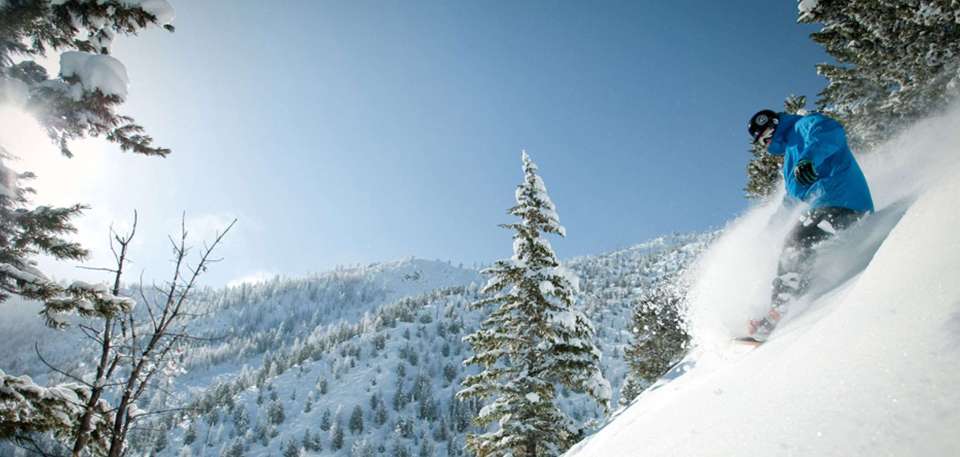
Image courtesy wintersportcompany.com
A recent article in a Salzburg newspaper talked about the bleak future for winter sports in Austria. As snow becomes ever scarcer on the lower slopes of alpine regions, those communities that rely on income from winter tourism are looking around for alternatives to keep their economies going. Ski trails are increasingly carpeted with artificial snow that serves the purpose but cannot compete with the magic delight of snowflakes from heaven. A custom that has gained traction in recent years is snow farming. In effect, the practice is very simple. Snow is piled up during winter months in convenient natural depressions called snow depots and covered with a mix of wood chips and sawdust. The depot is then blanketed with a white covering that further insulates the reserve and preserves up to 80% of the snow through the summer months. The heat of evaporation from the moistened wood chips actually helps cool the bulk of the snow reserve. Austrian snow harvesting programs are for the benefit of the tourism business, but in the high altitudes of Himalayan Ladakh, engineers and environmentalists are creating artificial ice stupas and glaciers as a survival mechanism to provide water for village communities in the spring and summer months.
When religious leaders step outside their core business of spiritual leadership and meddle in secular affairs, then perhaps they should take their cue from the Tibetan monk in the video above. True religion should promote harmony, protect nature and improve livelihoods instead of preaching. As can be seen from the video above, reverence naturally follows.
The Power of Place: Why we travel

Hermitage Museum. Image: courtesy travelrussia.com
On a visit to St. Petersburg many years ago (for an idea when, it was called Leningrad then), emerging from the Hermitage Museum and Winter Palace, eyes dazed and unfocussed after marvelling for two days at the sheer wealth of the collections, our official tour guide told us something that stayed in my mind ever since. You know, she said, St. Petersburg was always much more than the home of royalty. It was a natural home of the arts and literature. For example, after WWII and the total destruction of the city, with more than three million of its population either dead or displaced, the city was like a living tomb. Within a few years, the city was repopulated by uneducated peasants from the surrounding countryside. These new immigrants succumbed to the magic of the city and within a generation, Leningrad/St. Petersburg became a city of the arts and culture once more.
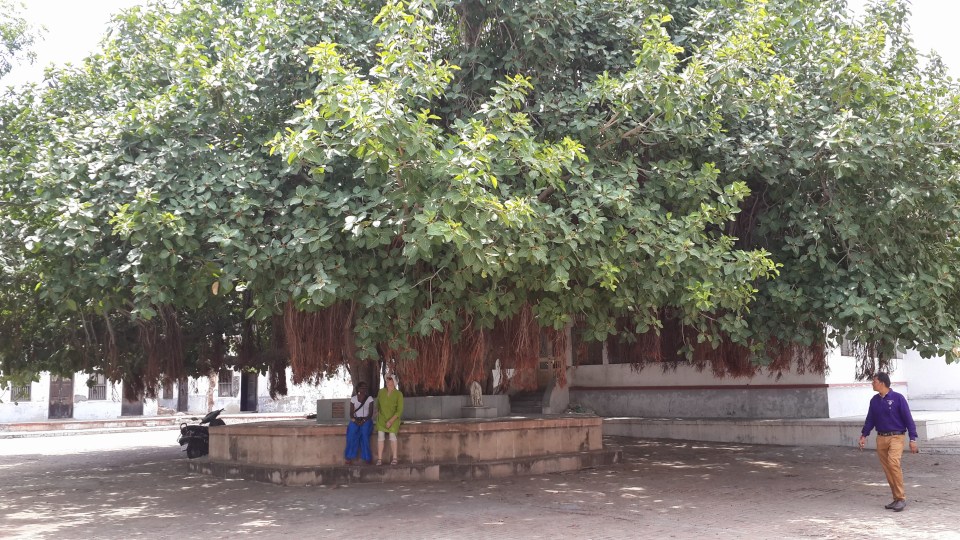
Sacred grove around an Indian temple
I can’t judge the accuracy of the tour guide’s information, but I understood what she meant. There are points on earth that are imbued with a power of place that are impossible to ignore. For example, I have walked through an ancient grove in southern Sweden and felt a certain reverence in that hushed spot. In India, temples are often perched on top of hills or mountains and exude a sense of spiritual calm. In northern Bali, near the small town of Bubunan, there is a spot near the sea where a a group of Tibetan monks suddenly turned up one day. When asked what they were doing, they said they were simply visiting an important location, where several powerful spiritual meridians intersect. The spot where they stood to meditate was a rock on an escarpment that looked out onto a beach with a curving shoreline. It was undoubtedly a picturesque and peaceful spot.
Perhaps this is why we travel. In search of our place in the greater scheme of things. This, and the unseen pull of far off places, is what has made the tourism industry one of the largest on the planet, with an annual turnover of eight trillion dollars. Food for thought, and a reminder to tread lightly as we travel.
 aviott