Home » history (Page 3)
Category Archives: history
Closing the Golden Door
Inside the Statue of Liberty, on a bronze plaque, a sonnet was engraved in 1903. A poem by Emma Lazarus, called “The New Colossus.”
Not like the brazen giant of Greek fame,
With conquering limbs astride from land to land;
Here at our sea-washed, sunset gates shall stand
A mighty woman with a torch, whose flame
Is the imprisoned lightning, and her name
Mother of Exiles. From her beacon-hand
Glows world-wide welcome; her mild eyes command
The air-bridged harbor that twin cities frame.
“Keep, ancient lands, your storied pomp!” cries she
With silent lips. “Give me your tired, your poor,
Your huddled masses yearning to breathe free,
The wretched refuse of your teeming shore.
Send these, the homeless, tempest-tost to me,
I lift my lamp beside the golden door!”
Over the century since the plaque was installed, the last five lines of the poem have become an intrinsic part of the US story. No longer. Donald Trump’s message is clear. The masses can huddle elsewhere, taking their yearning with them.
For more by this author, see his Amazon page, or Google Play here.
The Ineffable Sadness of Neutered Cats
The sugar cubes floated in my thickly creamed coffee before slowly dropping out of sight. This was a sequel to views of Klimt at the Upper Belvedere in Vienna, itself a sequel to a memorable week exploring inner landscapes of the soul.
There were two of them. They led happy lives, replete with feline fulfilment. They loved to purr and cuddle in bed with their humans in the night. They ate well. Always had food and drink served to them. They never went hungry. They seemed at peace with themselves and their world. There were vestiges of wildness in them still to remind you that, despite centuries of domestication, they were their own creatures, creatures of the wild; individuals. And yet, there was an edge missing. You could see it in their eyes. It was a mixture of sadness and resignation. I came to recognize this glance in the cats and my heart went out for what I had done to them. Years later, I saw a video of a woman who could communicate with animals including big cats, the world’s apex predators, and interpret them in anthropomorphic terms. This video changed my thinking about domestic pets. Having been sensitized by this new thinking, I began to see all the subtle forms of exclusion that are practised in societies around the world.
Most ancient cultures respected the natural world, seeing humans as an intrinsic part of it. At sometime in our collective past, we began to call ourselves civilized and parted ways intellectually with nature. This paid off for a few centuries, roughly until the end of the twentieth century. René Descartes famously declared humans to be the thinking species in the sixteenth century. We think, therefore we are (…superior to all other forms of life?). Science and technology have tamed the earth, have subdued nature to such an extent that, like in the Tweety and Sylvester cartoons, we are in danger of cutting off the branch on which we perch. Of course we don’t think of ourselves as prejudiced, but every time we turn away from a conversation with an unfamiliar “other” we practise a form of discrimination just the same. I noticed with a shock of recognition, the ‘sadness of cats’ on the faces of people in the news; in the gaze of a young woman going through the shipwreck of her marriage; in the face of a man devastated by war and conflict; in the catatonic resignation of a child dragged from the rubble of a bombed home. Where does all this violence begin?
It begins with the way we treat all sentient beings, not just our own kind. Gandhi allegedly said, more than a half century ago, the greatness of a nation and its moral progress can be judged by the way its animals are treated. Anthropologist Michael Thompson, in his 1979 book Rubbish Theory, explores the rise and fall in value of objects, depending on scarcity or abundance. He uses bakelite ashtrays as an example in the book. This early synthetic product of the 1930s was sold cheap, and now have become collectors items. Following from Rubbish Theory we should infer that, since animals in the wild have become a scarce commodity, we should value them highly. Conversely, with world population close to seven and a half billion, human life is cheap. Perhaps this is what we are seeing in international politics these days. But here is the paradox of human existence. If we subscribe solely to economic logic, we deny our humanity and diminish ourselves, sowing the seeds for our own ultimate destruction.
Rulers, kings and presidents come and go, but the earth will survive. However, humankind will not survive, if we continue to pursue only economic growth and ignore the unmistakeable signals that the planet continually sends us. Many of our leaders ignore it. It’s time to change those leaders. And here is another paradox of politics. We can change these leaders only if we change ourselves first.
For more by this author, see the links to other work on his Amazon page, or the Google Play Store
The Decline of the Rest.
 Oswald Spengler published the first volume of his two-volume life’s work, The Decline of the West, in 1918. Seventy-four years later, speaking at the Earth Summit, Rio de Janeiro in 1992, 41st US President George HW Bush, a decent man, declared, “The American way of life is not up for negotiation. Period.” This pre-emptive declaration by the leader of the world’s most powerful nation essentially castrated the noble intentions of the summit, to limit humankind’s exploitation of the earth’s resources to sustainable levels. The result of the Rio summit was Agenda 21, a non-binding, voluntarily implemented action plan for the 21st century. This was the paltry outcome of a nine-day meeting representing 172 countries attended by 116 heads of state, 2400 NGOs and 17,000 other representatives of indigenous peoples and ordinary ‘you and me’ types.
Twenty-one years after the US President’s declaration in Rio, the WWF designated the 20th of August 2013 as “Earth Overshoot Day;” the day that humanity has used as much renewable natural resources as the planet can regenerate in one year. In 2016, Earth Overshoot Day is estimated to have fallen on August 8th, after which date we’re drawing down the planet’s renewable resources for the rest of the year. Pity the poor planet! The American way of life is still not up for negotiation, and the rest of the world is rushing to catch up. If ever populous countries like China and India get there, the planet will be sucked dry and we’ll all have to follow Elon Musk to Mars! So are we condemned to a two-track planet where some countries (or some sections of society within countries) corner material resources and the rest go a-begging? This is the scenario being projected by right wing demagogues worldwide and this is the reason for their recent successes at the ballot box.
Economists and philosophers have tried to redefine human well-being to reflect planetary limits, most notably in recent years by Tim Jackson’s book Prosperity without Growth, which acknowledges that the current definition of economic success is fundamentally flawed. Prosperous societies today increasingly recognize that increased material wealth does not increase well-being. However, most people the world over, regardless of their economic condition, still aspire to some version of the American way of life. This aspiration is reflected in the respect automatically accorded to wealthy people in the world today. A look at the Who’s Who of practically any country includes the names of its wealthiest citizens, together with lists of eminent physicians, lawyers, sportspeople and so on.
Gandhi pithily articulated this state of affairs decades ago when he said: The world has enough for every man’s need but not for every man’s greed. For each according to her needs would be the ideal but, as always, messy reality intervenes. One man’s need is another man’s greed. So it is that millions of well-meaning, virtuous, affluent people the world over would never dream of giving up hard-won creature comforts for the sake of other planetary denizens who are less well off. The spiral of technology has historically been to continuously improve human life, and to continuously create problems at the same time. These problems in turn needed infusions of new technology to solve its problems. So right now, the choices seem to be to outer-planetary colonization, or to invest in defences (gated communities, wealthy enclaves, security guards, border walls) to hold on to material gains. Technology offers a third alternative. The idea of a sharing economy has recently gained a lot of traction. Who needs ownership when mobility and services are seamlessly available? Indeed, ownership becomes a bit of a burden in comparison to the convenience of superb services available on demand with little or no delay.

A gated community safely behind bars
Even if all this is achieved, humankind’s basic inner restlessness will ensure that we keep wanting more and better, with one eye on the people next door. Global contentment is a moving target. Enter mystic and philosopher Sadhguru and his lectures on inner engineering. His most memorable anecdote in the video (begins at minute 16) is a reminder that all is not lost in the midst of this doom and gloom if we can take the time to laugh at ourselves and the posturings that have brought us to this point.

Sadhguru, irreverent mystic
For more writing by this blogger, see his Amazon page here, or the Google Play Store
The Dice that lost a Kingdom
The grand epic of the Mahabharata tells of the war between two clans, the Pandavas and the Kauravas. The many stories in the book of tales, which are told in some 100,000 stanzas of classical Sanskrit verse are together 12 times the length of the entire Bible. I have read several different English translations of this stupendous work. Despite the sometimes stilted language of the translations I read, the sublime poetry and wisdom of this work invariably shine through. I have searched for years for the perfect translation, and found it at last on the internet. The tale in its entirety is so complex, with a huge cast of characters and so many different sub-plots, that I thought it impossible to ever write a summary that does justice to the tale. Until this discovery on the internet of a synopsis written by someone (or a collective) calling themselves Wm. Blake Fabricators. A Google search led me to someone called Richard Blumberg who is apparently based in Cincinnati. Kudos to Richard Blumberg, then, for writing the most readable and comprehensive synopsis of this monumental work; a synopsis that effortlessly conveys the essence of the stories in fluid prose. I have reproduced the Introduction from the website below, and copied the links to synopses of the other six major episodes, with an Afterword and a Bibliography. I’m convinced that readers of this page, and followers of this blog, will not regret the 20 minutes they might spend following the links below to read the rest of this fascinating story.

As played in the Mahabharata, 4-sided dice with numbers 1,3,4 and 6
It has been called the national epic of India, and it is that, in very much the same sense that the Iliad is the national epic of Classical Greece. The Mahabharata is the story of a great war that ended one age and began another. The story has been passed down to us in a classical canon of Sanskrit verses some 100,000 stanzas long; that’s about 12 times the length of the Western Bible. The best scholarly evidence indicates that the earliest layers of the epic were composed between 2500 and 3000 years ago. The text had reached pretty much its present form by about 300-400 C.E.
Mahabharata has also been called the Hindu bible. It is important at the outset to recognize that epic and bible are both Eurocentric terms. The former implies the kind of single-minded focus on the hero and his deeds that characterizes the stories that we Europeans learned as epics in our schooling. And the latter term implies a certain iconic status for the book in its society; our bible is not something we know so much as it is something we swear on. None of that is particularly true for the Mahabharata, although it is not completely false either. It just misses the point.
Epic and bible together imply an absolute division between the sacred and the profane – one pure fable and the other Holy Truth – that simply doesn’t exist in the Hindu vision. Our Eurocentric minds, trained in a Jahwist tradition of good and evil, true and false, demand that the story go into one slot or the other, and if it is too big, then we will reduce it to fit. The Hindu mind, I think, rather than force the story into any single category, conceives a story big enough to encompass all categories.
The Mahabharata itself says it quite positively.
What is found herein may also be found in other sources,
What is not found herein does not matter.
The Mahabharata contains virtually all the lore and legend of the Classical Hindu Tradition – which is also, in typical Hindu defiance of simple-minded historicity – very much a living tradition. Here are the great creation stories – Manu’s flood, the churning of the milk ocean, the descent of the Ganges. Here are the favorite myths and fairy tales. Here are the jokes. Here are the codes of law – moral, ethical, natural. One of the best things about the Mahabharata is its wonderful richness of episode and detail.
But Mahabharata is not a random collection of tales, like the Medieval gestes (to further prove the habit of thinking Eurocentrically). Every digressive bit of the Mahabharata is there to shed light on a central story. The core event of that story is the great battle that was fought on the field of Kurukshetra between the five sons of King Pandu and their allies on the one side and the hundred sons of King Dhritarashtra, with their allies, on the other side. The battle was the culmination of a long history of struggle and diplomatic maneuvering, and it involved virtually every tribal king and every powerful city-state in Central and Northern India at the time.
It was a tragic war, that pitted brothers against brothers, sons against fathers and uncles, brave noble men against brave noble men. And it was devastating. Nearly all of the best men died in the long battle. The Pandavas, the sons of King Pandu, survived, but there was no victory, for the war had destroyed the world that they knew, and the emptiness of what they had won colored the rest of their lives.
Now to say that the Mahabharata is the story of a great battle is to say that Hamlet is the story of an unsuccessful usurpation, or that Moby Dick is the story of a whale hunt. Hindu cosmology is sweeping, and the story of the Mahabharata war has cosmological significance, in that it marks the end of one yuga and the beginning of another. There are four yugas in every great cycle of existence, each one diminished from the one before. The yuga that ended with the Mahabharata war was the dvapara yuga – the age of heros, during which noble values still prevailed and men remained faithful to the principles and tasks of their castes. The age that follows the battle is the Kali yuga, the last age of the world; in it, all values are reduced, law becomes fragmented and powerless, and evil gains sway. We live in the Kali yuga.
The breadth of its vision is one of the things that makes the Mahabharata the best story I know. But there are other reasons. Mahabharata has a riveting plot and a compelling dramatic structure. Its characters are complex and real, with depth of personality that is unmatched in any other epical or biblical story I have heard. Finally, I have found the Mahabharata to be full of wisdom.
In the next few minutes, I am going to try to give you a sense of how the Mahabharata story goes.
Since the story has cosmic significance, its ultimate beginnings are lost in the mists of time and the minds of unknowable immensities; a wealth of family histories, myths, and fables lead up to the events that I will tell you about. I will jump into the story at a point where the succession to the kingship had come into question.

South Indian Temples as Guardians of Nature
I was talking to the knowledgeable Tamil Professor about the preservation of traditional knowledge of medicinal plants in south India in general and Tamil Nad in particular. One reason, he explains to me, is that temples have traditionally been the protectors and benefactors of trees in a locality. Every temple has a “Sthala Vriksham” or sacred plant for that temple. A recently published book (in Tamil) gives the local name, the botanical name, and the medicinal value, of nearly 60 temple plants in the state. For example, Patala – Stereospermum sauvealens, also known as Rose Flower Fragrant in English, Padari in Tamil and Podal, Parul, Padala… in various Indian languages is used to treat snake and scorpion bites and also neurological and hepatological conditions. Local names of other sacred plants are Poolai (Aerva Lenatea, or mountain knotgrass), Vanni (Prosopis spicigera, a plant of the pea family that is related to honey mesquite), Thillai (Excoecaria Agallocha, a mangrove species). Mangroves of Excoecaria Agallocha surround the ancient Thillai Chidambaram temple in Tamil Nadu.

Prosopis spicigera, Shami tree, ayurvedic treatment for intestinal parasitic worms…

Aerva Lanatea, used to treat kidney stones, Alzheimer, etc.

Thillai Chidambaram temple. Image courtesy Wikipedia
As someone who is allergic to the shrill lessons preached by adherents of some religions, it is very refreshing, in this ecologically endangered world, to see the practical and common-sense benefits of devotion.
For more by this author, see his Amazon page here or on Google Play
Monsoon Wedding
The wedding was in Kerala, a state in India whose advertising blurb labels it “God’s Own Country.” Argentinians and Brazilians also make rival claims to have been similarly favoured by the Creator, while each runs the others’ country down “Yeah, God gave your country everything, but then he created you people to compensate!” In the case of Kerala, the affable people of neighbouring Tamil Nadu harbor no such pretensions, laughingly noting that several million people from Kerala prefer to live with them rather than in their own home state. The wedding eve reception and reception were at holiday resorts at Kumarakom.

“Kettuvallam,” (Houseboat) on Vembanad lake amidst clumps of water hyacinth.
Kumarakom is situated on the banks of Vembanad lake, apparently the longest lake in India, whose wetland system covers an area of two thousand square kilometers. Much of Kerala’s claim to God’s bounty comes from the backwaters, large estuarine stretches of brackish water that gives rise to a very rich ecosystem. Part of the lake holds the fresh water that drains into it from several rivers, and this fresh water section is separated from the brackish portion by mudflats. The lake is at the heart of ‘backwater tourism’ in the state, with hundreds of “kettuvallams,” floating homes on motorized traditional boats. The riverboat network spans 200 km from north to south and the lake teems with giant prawns and several other types of freshwater fish.

freshly prepared seafood lunch with tapioca and a glass of toddy

Fish await a fiery fry. Pearl spot, prawn and anchovies…

fresh caught prawn
Meanwhile, the bride and groom were happily united at a church in neighboring Kottayam town. It was a glorious wedding with guests travelling from around the world to attend. The groom wore a kilt, befitting his antecedents, and the bride wore a matching tartan sari, designed by the groom’s mother. All in all, a fitting Kerala wedding for the 21st century. The wedding photos belong in a family album rather than this blog, so none appear here. But if you ever are invited to a wedding in Kerala, my advice to you is, go!
For more by this author, see his Amazon page here or on Google Play
The Third Wave in American Politics
“We had all become used to the totalitarian system and accepted it as an unchangeable fact and thus helped to perpetuate it. [. . .] None of us is just its victim. We are all also its co-creators.” Vaclav Havel, Living in Truth, 1986.
Truth is a shape-shifting commodity and there are multiple truths about everything, depending on one’s point of view. As the old saying goes, where you stand on an issue usually depends on where you sit. That’s one reason why democracy’s so dangerous. People who sit still in one space usually see only a single truth regardless of the facts that are thrown at them.
In 1967 a high school history class in California started an experiment to study the rise of Nazism. The teacher, Ron Jones, organized the experiment because his students could not conceive how intelligent, well-educated people in Germany could have blindly followed a demagogue like Hitler. The process was simple. The teacher imposed minor authoritarian controls that were agreed upon with the students. Sitting postures were regulated and drills regularly carried out where they would have to be sitting correctly within five seconds. The rules were progressively tightened. The teacher had to be formally addressed as Mr. Jones every time they spoke to him. On the second day, more formalities were introduced, and a motto had to be repeatedly chanted by pairs of students. On the third day a salute was developed. It involved bringing the right hand to cup the right shoulder. Students were ordered to use this salute with one another whenever they met, even outside class. Outsiders were no longer allowed to enter the classroom, unless they were introduced by a member and agreed to salute with the “wave” salute. By the fourth day, bullying began. The symptoms became so worrying that Jones decided to break it off on the fifth day, Friday. By this time, the students had become so self-identified with the masquerade that they were emotionally devastated when Ron Jones made the announcement to end the experiment. See the link here for a description of the experiment in Ron Jones’ own words, written in 1972.
Ron Jones’ Third Wave experiment was followed by the week-long Standford Prison Experiment in 1971. The results of this experiment were, if anything, even more horrendous and you can read a Wikipedia description here. As in the school experiment, with very few exceptions, all students complied to create coercive prison conditions with increasing enthusiasm. Their ingrained sense of ethics seemed to decrease in inverse proportion to their enthusiasm, i.e. the more enthusiastic they became about the experiment, the less they seemed to care about the ethicality of their actions. They quickly lost their moral compass.

Footwear for the American Third Wave?
Reading news reports about Donald Trump’s increasingly outrageous statements and the support that he still seems to have among the electorate, it seems to this observer that the US has embarked on a dangerous trajectory that eerily resembles the shenanigans of the Third Wave. The original Third Wave experiment ended in the classroom. This one could end with a man with no moral compass in command of the world’s largest military. This has repercussions far beyond the US electorate.
For more by this author, see his Amazon page here.
Stephen Hawking and the Union Bank of Switzerland

What’s mine is yours-for a while.The sharing economy. Image:courtesy bmw-usa.
Unlikely bedfellows. Stephen Hawking and the Union Bank of Switzerland. But the world is a strange place, and might benefit from this unexpected partnership. On the website “Unlimited” thinkers ask questions about some of the most pressing issues facing the world today. As Hawking says in his introductory video entitled “What is the most important question you have ever asked yourself?” in launching the website, he uses the redolent phrase “cathedral thinking” to denote the modern equivalent of the grand buildings constructed as part of humanity’s attempt to bridge heaven and earth. Just like children, we have to learn to share…
I highly recommend watching Hawking’s four-minute introductory video before deciding for yourself whether the other links, essays and presentations are worth watching. The essay on the changing concepts of personal wealth and experience were especially relevant to me, because it describes a transition I have been personally making for the last two decades, especially in the last five years, when I’m absolutely convinced that young people today need a wealth of ‘learning experiences’ much more than ‘things.’
Of course, as a website sponsored by the UBS, it is perhaps unsurprising that most of the initial questions are about the nature of wealth, but the questions and the answers are philosophic enough to interest a wide range of readers.
For more by this author, see his Amazon web page here.
The Politics of Inclusion
If one reads the newspapers in Europe these days, it’s easy to imagine a world going unbalanced. Political chaos in Britain; the shock of Trump’s rise to political prominence in the US; the continued slaughter in Syria; the failed coup in Turkey; honor killings of women in the Middle East and South Asia; young girls kidnapped in the hundreds by a sinister cultish organization in Nigeria with hate and abhorrence of non-religious learning as its primary motivation; China flexing its military muscle in the South China Sea…the list goes on. The underlying cause of each of these symptoms is one and the same, the quest for economic power. In itself harmless, economic power, the accumulation of wealth, is such a basic human instinct that it was unquestioned long before Adam Smith came along to make it intellectually respectable.
What we should question, however, is the tendency of modern societies to equate development with wealth, and economic poverty with under-development. There will be conflict in the world as long as wealth accumulation is equated with development. No one wants to be under-developed, so development currently means increased exploitation of the world’s resources. Ultimately, it is the scramble for the world’s resources that fuels all the conflicts and emigrations we observe today. Interestingly, many of those people, mostly politically right-wing, who rage against immigrants these days invoke a past society free of injustice and racially pure. They forget, or are unaware that, for a species that genetically differs from a chimpanzee by only 1.3% of its genes, talk of racial purity is an absurd notion, absurd to the point of imbecility.
The politics of inclusion that most people yearn for, but don’t know how to create, actually begins with us. The process of inclusion begins with us, one person at a time. Perhaps that is why the process is so daunting, since we have to change ourselves first, before we begin to find the politics of inclusion that the majority of the world seems to be longing for. Check out this link to hear what geneticist David Suzuki has to say about modern economic thought.
For more by this author, see his Amazon page here.
Dam(n)ed Words
“In the beginning was the word,” the book of St. John begins, in the King James version. “And the word was with God and the word was God.”
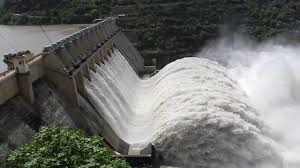
An overflow of words. Image: courtesy youtube.com
In the Katha Upanishad (approximately 5th century BCE), OM is related to the first primeval sound and the creation of the Universe, in an eerie echo of modern physics and the sounds that presumably accompanied the Big Bang. However, this analogy cannot be drawn too far, since the word OM has multiple meanings and interpretations in the Upanishads and in Buddhist belief. The Huffington Post says “Om is also considered the mother of the bija, or “seed” mantras — short, potent sounds that correlate to each chakra and fuel longer chants (like, say, Om Namah Shivaya). Depending on who you talk to, it relates to either the third eye or the crown chakra, connecting us to the Divine. No wonder it is core to some Buddhist systems and other Indian religions. Some say it’s even among the sounds recorded in deep space — on NASA’s website, Earth itself sounds a bit om-y.”
Coming to the present day, which is our primary concern here, Lucia Graves writes in the Guardian (July 13th, 2016) “It used to be that you had to read between the lines to determine that Donald Trump was stoking racial resentments. And it used to be that the subjects of his racial animus were mostly immigrants. But now, increasingly, he’s casting a wider net and amping up his rhetoric.” Also in the Guardian of the same date, another headline says, “Labour’s Luciana Burger receives death threats telling her to ‘watch her back.'” Because she’s Jewish. Chilling news, seven decades after the horrors of the Shoah!
In Bangladesh, India and Pakistan, the language of intolerance has grown more strident in recent years, often drowning the voice of reason. The Islam of the Sufis seems to be disappearing from public discourse, and the all-embracing tolerance of Hinduism seems to be hardening at its edges. In the Middle East, the intolerant rhetoric of various groups has led to spectacular and bloody breakdown of civil society in the region.
The world as we know it began with words. Even so, the unraveling of our world and civilization as we know it, also begins with words. It begins with the language of the bigot, the language of the nationalist, the language of the religious fanatic speaking on behalf of God (presumption or megalomania?), the language of the intolerant, the language of politicians looking to increase their grip on power. In politics today, the language of intolerance seems to be gaining ground, becoming socially acceptable. Socially acceptable? That means us. That we accept it. Unless we emphatically refute it at every encounter. By casting votes, by speaking up, by voting with our feet. The last case scenario is, sadly, what prompts the widespread immigration we see today.
See more work by this author on his Amazon page here or on the Google Play store.
 aviott