Home » philosophy (Page 4)
Category Archives: philosophy
The Power of Place: Why we travel

Hermitage Museum. Image: courtesy travelrussia.com
On a visit to St. Petersburg many years ago (for an idea when, it was called Leningrad then), emerging from the Hermitage Museum and Winter Palace, eyes dazed and unfocussed after marvelling for two days at the sheer wealth of the collections, our official tour guide told us something that stayed in my mind ever since. You know, she said, St. Petersburg was always much more than the home of royalty. It was a natural home of the arts and literature. For example, after WWII and the total destruction of the city, with more than three million of its population either dead or displaced, the city was like a living tomb. Within a few years, the city was repopulated by uneducated peasants from the surrounding countryside. These new immigrants succumbed to the magic of the city and within a generation, Leningrad/St. Petersburg became a city of the arts and culture once more.
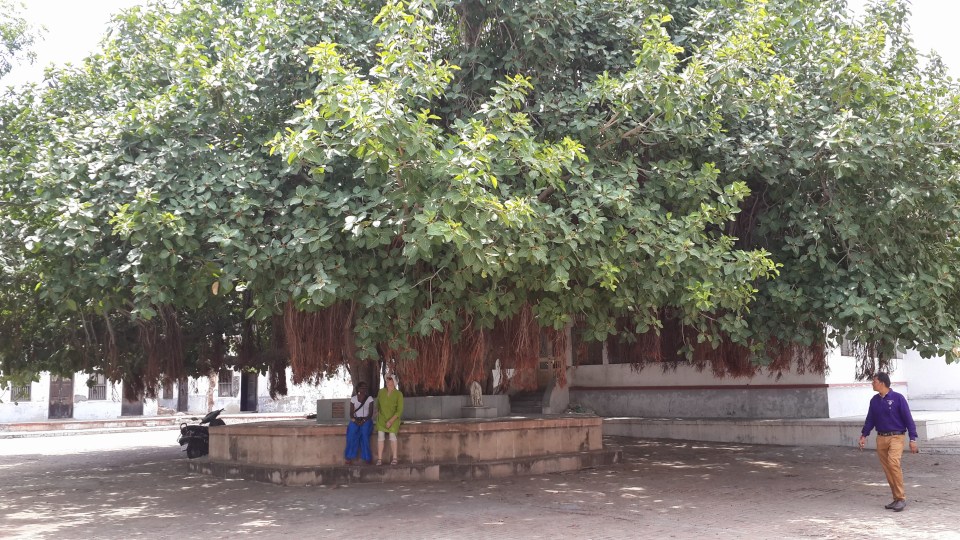
Sacred grove around an Indian temple
I can’t judge the accuracy of the tour guide’s information, but I understood what she meant. There are points on earth that are imbued with a power of place that are impossible to ignore. For example, I have walked through an ancient grove in southern Sweden and felt a certain reverence in that hushed spot. In India, temples are often perched on top of hills or mountains and exude a sense of spiritual calm. In northern Bali, near the small town of Bubunan, there is a spot near the sea where a a group of Tibetan monks suddenly turned up one day. When asked what they were doing, they said they were simply visiting an important location, where several powerful spiritual meridians intersect. The spot where they stood to meditate was a rock on an escarpment that looked out onto a beach with a curving shoreline. It was undoubtedly a picturesque and peaceful spot.
Perhaps this is why we travel. In search of our place in the greater scheme of things. This, and the unseen pull of far off places, is what has made the tourism industry one of the largest on the planet, with an annual turnover of eight trillion dollars. Food for thought, and a reminder to tread lightly as we travel.
Advice to a Billionaire
Michael Liebreich of Bloomberg New Energy Finance calls you one of three Black Swans in the world of energy and transportation this century; the other two being Fracking and Fukushima. You are often compared to Henry Ford, Thomas Edison, Nikola Tesla, the Iron Man, and shades of Einstein. You have advised Presidents. Heads of state visit your factories to see how they could improve the lives of their citizens. You stepped in without fanfare to donate money and provide power to a hospital in Puerto Rico after the devastation of Hurricane Maria. You issue audacious challenges to yourself and to others and sometimes miss deadlines, but ultimately deliver on your promises. Thousands, perhaps millions of people, speculate against you in the stock markets, hoping to make a quick profit from your failure. So far, they’ve been disappointed. But you put your money where your mouth is, so for every one of these speculative sharks, there are a thousand eager customers for your products and millions of well-wishers who hope you can help save the planet.
And yet you feel alone and unloved. You search for a soul mate and are willing to fly to the ends of the earth to find true love. You must know that love is like a butterfly. Be still and perhaps it will land on you. There are no guarantees, but the chances are infinitely greater if you cultivate stillness. And while you wait, exchange your loneliness for the wealth of solitude. As Hannah Arendt and Plato observed: Thinking, existentially speaking, is a solitary but not a lonely business.
As the father of five children, know also that their childhood is a precious and finite resource that you could use to your benefit and theirs. Childhood ends all too soon, so help them in whatever way you can to make good choices. You seem to have done so for yourself. In the meantime, millions of people around the world wish you well, as I do.
Sophia – Elon Musk’s fears come to life?
Elon Musk and Stephen Hawking have often said that AI is the greatest threat facing the world today. Here’s maybe an early example of what they worry about. Meet Sophia, the first draft of an uncannily human-like creation.
The Power of Compassion
Met an unusual individual in Vienna last night. Spare 17 minutes to watch this video of his TED Talk from 2012. You won’t regret it. Of course it was more inspiring to meet him in person.
Feedback welcomed.
Words to Ponder

pederastrian zone -(pe.der.astri.an zone) child molesters on the internet
trumpet – (trum.pet) presidential proclamations of alternative facts
maybe – (may.be) current state of Brexit negotiations
pingterest – (ping.ter.est) Chinese views of disputed territories in South China Sea and Doklam
modify – (mod.if.y) religious fundamentalism in India
Al Jarreau – (al jar.oh) late jazz singer of Qatar?
merken – (merk.en) German (as in, remember me?)
macro – (mak.ro) big French cheese
killing fields – (kill.ing fields) Duterte’s Philippines
Gabon – (gab.on) ongoing discussion about who really won the last election
sod it – (sod.it) Saudi views on women’s rights
Zumba – (zum.ba) popular South African dance
Dismantling Democracy
“Will no one rid me of this turbulent priest?” King Henry II allegedly muttered in frustration. Although not a direct order, four of his knights rode to Canterbury and killed Thomas Becket. This happened in 1170 AD.

St. Thomas Becket. Image, courtesy bio.com
History repeats itself. Eight hundred and forty-seven years later, an impetuous, ignorant president mutters similar words about a troublesome special counsel. Whereupon, several of his knights, who are now called Republicans, unsheathe their swords, which are now verbal (although these republicans insist upon their inalienable right to own and carry arms), and begin a character assassination of the special counsel and his team.
Meanwhile, around the world, despots and dictators clap their hands with glee, knowing that a powerful global champion of human rights has suddenly lost its teeth. This A-Z of dictators and would-be despots ranges from Syria’s Assad to Zimbabwe’s Robert Mugabe, their alphabet-soup stock strengthened by people like Duterte, Erdogan, Lukashenko, Kim Jong-Un, Putin, Saudi Arabia’s ruling elite, Xi Jinping, and Yogi Adityanath.
Are we to simply sit around, watch helplessly and do nothing? Reflect on this, try to look beyond the superficialities of news headlines, think about what you, as an individual, can do. Here are three points from a recent Forbes article by political commentator Jim Powell that are worth noting.
- Aspiring dictators sometimes give away their intentions by their evident desire to destroy opponents.
- There’s no reliable way to prevent bad or incompetent people from gaining power.
- Ultimately, liberty can be protected only if people care enough to fight for it, because everywhere governments push for more power, and they never give it up willingly.
As two Emery University academics warn in their article “The Psychology of Dictators: Power, Fear, and Anxiety” With regard to dictators, one particular trait that consistently stands out as relevant is narcissism. Narcissistic individuals have a “greatly exaggerated sense of their own importance” and are “preoccupied with their own achievements and abilities.
And… More recent work shows that, after a negative evaluation, narcissistic people will demonstrate greater aggression even to individuals unrelated to the feedback.
https://www.anxiety.org/psychology-of-dictators-power-fear-anxiety
Carbon Countdown Clock

Image:courtesy usgs
Ah, Trump. Has pulled the world’s second largest greenhouse gas emitter out of the Paris Accord. Was promised. Was to be expected. The one campaign promise that this prevaricating president did keep. The Guardian newspaper has usefully provided an online carbon countdown clock to show the world how time is running out. I believe Trump’s action might provoke the rest of the world to come together to save our common future.
https://interactive.guim.co.uk/embed/aus/2017/carbon-embed
Click on the link above to see how much time we have left.
Serious Comedians – Giving voice to Lions
An East African proverb. Until the lion learns to speak, every story will glorify the hunter. As with lions in the savannah, so too in human affairs. History is written by the victorious. As far as I know, contemporary Gauls did not write histories of Caesar’s conquests. My early school textbooks were published during colonial times and spoke of the Indian Sepoy Mutiny of 1857. A few years later, my history books reflected the views of a self-governing nation and called it The first war of Indian independence. Similarly, a history text used by children in a Francophone African country began: nos ancêtres, les Gaulois, étaient grands et blonds.
Moving forward to today, a modern nation confronts the semantic shenanigans of a prevaricating president, one who heads the world’s largest military and nuclear strike force. He threatens to destabilize the world, and frequently expresses the desire to overthrow constitutional guarantees of freedom of speech. Freedom of speech is a relatively recent tradition in our human history; a tradition that gives voice to lions. Research insights into the value of biodiversity show that ecological variety is absolutely imperative to the long-term ecological survival of our planet.
A time of instant communication is also a time of instant miscommunication, so many people no longer know where to turn for the truth. Official news agencies tend to broadcast the voice of the hunter, but where do lions tell their side of the story? Leonine voices are emerging from unexpected corners of television and the internet. The new lions are stand-up comedians, and they are emerging in every politically repressed country, from American to Turkey to Zimbabwe. Perhaps North Korea is the only country in the world where the only comedian still standing up is its great leader himself. In several countries that recently show signs of tending towards dictatorship, the leaders are becoming unwitting comedians in the mold of Kim Jong-Un.

Image courtesy the warmonger report.
It’s time for us consumers to realize how serious these jokes are. Time to sit up, stop laughing and act.
Drinking Cocanutta Wataa–a refreshing trend
As temperatures rise around the world (think summer, think global warming!), lip-smacking ads of frosted glasses of beer, cola or other carbonated drinks appear on billboards and media screens. Plying Indian roads on a motorbike in the approaching summer of 2017 has shown one refreshing (pardon the pun) trend in the soft drinks world. Roadside stalls increasingly tend to offer locally sourced products (fresh tender coconut, palm fruit, sugar cane juice, watermelon, lassi, buttermilk and various local juices) rather than the ubiquitous glass or plastic bottled offerings of multinationals. All this without the benefit of national ad campaigns. Environmentalists at work, common sense, or simple economics?
As Harry Belafonte famously sang, it’s good for your daughter too.
Poramboke – Singing the Tragedy of the Commons
The “Tragedy of the Commons” is a term applied to the problem of shared resources in societies. All over the world, resources that are shared by all its members (the commons, e.g. public grazing lands, ponds, lakes) are in danger of over-exploitation and long-term degradation. This is what is happening to the world’s air, the oceans, the world’s fresh water, and all the other public resources that we used to take for granted as a basic human right. The world’s common resources are under siege from mighty forces; industrial, economic, demographic. It does not seem right, it is not right, for us to say that all citizens of the world (and those as yet unborn) should not enjoy the same freedoms that we do. And yet we continue to consume more, in the name of increased prosperity and well-being. The Tamil word for commonly owned public land or wastelands is “poramboke.”
How much is enough? Short question. No easy answers. I have met many interesting people recently, who are searching and finding answers, each in their unique way. The video attached above is of south Indian Carnatic singer TM Krishna, along with other eminent musicians, singing the tragedy of the commons in a song with powerful, compelling lyrics.
Poromboke ennaku illai, poromboke unnaku illai, Poromboke ooruike, poromboke bhoomikku he sings
Poromboke is not for me, it is not for you. Poromboke is for the city, it is for the Earth.
These past 3 months, as I travelled in different parts of the Tamil country, I see a powerful re-awakening of traditional values, and I will try to document some of my observations in the coming weeks.
 aviott