Home » politics (Page 6)
Category Archives: politics
Molybdomancy
I started off intending to write about the Austrian New Year’s Eve custom of Bleigiessen and learnt several things today. First, the posh name for the practice is molybdomancy: the art of divining the future from the shapes of molten metal that is quickly thrown into cold water. Second, this is not only an Austrian custom, but is widely practiced in Germany and in the Nordic countries as well. Apparently in Finland, the practice goes by the name of uudenvuodentina and is quite popular. According to this source, the practice originated in ancient Greece and later travelled to the Nordic and Central European countries where the custom is still followed today, although the results are interpreted more in a spirit of fun rather than being taken seriously. No wonder the word molybdomancy has been quite forgotten!
Originally made from tin, nowadays bleigiessen sets are sold in the streets in the week preceding New Year in small bags consisting of half a dozen pieces of tin or lead alloy mixed with cheaper metal. The pieces are molded into shapes associated with good luck; horseshoes, pigs, chimneysweeps, toadstools or 4-leaf clovers. I bought a bag for New Year’s Eve and settled down with six of my nearest and dearest to see what 2015 has in store for us.

What 2015 has in store for the family.
As you can see, the results are outstanding! 2015 is going to be a wonderful year for the family; two of them will perform exceptional deeds, while the rest will be merely brilliant. I wish all my readers a similarly uplifting prognosis.
What 132 schoolchildren should teach us.
Two recent newspaper articles have been very troubling; one of them positively horrific. One hundred and forty-one people died, all but 9 of them children, in a Taliban attack on a school in Pakistan.
The picture below appeared on an online news site nearly two months ago. An Indian love story that could be the beginning of a fairy tale. She is 21, a Muslim, a student at a dental college. He is 24, an engineer, a non-practicing Hindu. They fell in love. Her parents had planned an arranged marriage for her. She did not want it. So Anshida secretly married the man she loved. And they lived happily ever after. Oops, no! Apparently there are enough people in her community willing to resort to violence in order to prevent inter-racial unions, and this couple has been forced to live under police protection ever since. Here is a link to an interview with the couple where Gautham says their only desire is to live in peace together and they might have to leave the country to do so.

Anshida and Gautham, in the Indian Express Nation online edition of November 12, 2014.
Einstein was apparently once asked to explain how radio worked and famously used the example of a long cat. You see, wire telegraph is a kind of a very, very long cat. You pull his tail in New York and his head is meowing in Los Angeles. Do you understand this? And radio operates exactly the same way: you send signals here, they receive them there. The only difference is that there is no cat. The explanation is not so simplistic as it sounds, since nerve impulses are also electrical impulses of a different kind. Now what has this got to do with the persecution of a loving young couple (don’t tell me there’s something wrong with love) and murder of 132 schoolchildren by religious fanatics?
Growing up in the south of India, I experienced Islam as a very benevolent religion of deep faith anchored in tolerance as epitomised by the work of Rumi and Hafez. I saw the following quote taken from the wall of a recently demolished house.

Translation from the Persian of a framed script in a South Indian Muslim household, around 1914
When I came across the apocryphal tale of Einstein’s explanation of how radio works, I realised that Islamic fundamentalist theologians have taken a step backwards in the 20th century and invented a real cat to interpret the gap between scripture and practice. And indeed, it is a cat that squeals horribly. I much prefer the Einsteinian version of an imaginary cat. Counter-progressive theologians have not yet disputed the efficacy of radio transmission without cats. I long for them to do the same in the case of the transmission and observance of religious beliefs. It is to be hoped that the murder of 132 children moves at least some of them to re-examine the dead certainties of their religious beliefs.
Terrorism and Climate Change: A Single Solution

Two thirds of the world’s electricity is generated by burning fossil fuels.
Much of the world’s wars and terrorism occur in the Middle East where, not so coincidentally, much of the world’s oil also originates. A lot of the world’s climate change problem (the majority of the world by now admits that there is a problem) is due to burning fossil fuels. In 2013, oil provided around 33% of global primary energy consumption* (i.e. energy contained in fuels used to generate electricity, heating, industry, transportation or other end users). This amounts to nearly 87 million barrels of oil per day. One third of this oil came from the Middle East.
The World Coal Association states that (in 2013): Coal provides around 30.1% of global primary energy needs, generates over 40% of the world’s electricity and is used in the production of 70% of the world’s steel. Coal is more democratically distributed around the world than oil, and there is not much likelihood of wars being fought over coal reserves. Coal is also a relatively “dirty” fuel and produces more CO2 (ca. 200) per unit of energy delivered than oil (ca. 150) or natural gas (117).
A listing of principal terror groups in the world includes ISIS, Boko Haram, Al-Shabaab, Al-Qaeda, Al-Nusra, Ansar al-Sharia, Hezbollah and Hamas. Al-Jazeera news notes that the United Arab Emirates published this week a list of 80 organisations worldwide, including the foregoing, that it formally identified as terrorists. Some of the organisations on that list perhaps do not belong there, but the larger point to be made in this article still holds. When great wealth flows from all parts of the world into the hands of a few, great disparities ensue; injustice and violence occur. The world needs to get off its greed for oil and move to renewable sources of energy. Of course the transition will be painful; but less disruptive than continued terror. Reduced global oil consumption can lessen the flow of disproportionate wealth that the world directs into the coffers of a few by 20 to 30% in the next ten years.
Is the transformation do-able within this time frame? The world’s experts are divided fairly equally between yes and no. Why? Because it hasn’t been done before. But here is an indirect answer. The Paris-based International Energy Agency (IEA) has revised its estimates for deployment of renewables worldwide upwards several times in the past decade. The forecasts made in 2002 for the year 2020 were exceeded by the year 2010. So perhaps the correct answer is not to be found among energy experts but in a quote from Spanish poet Antonio Machado (1875 – 1939) who said:
Caminante, no hay camino
Se hace camino al andar.
Traveller, there is no path
The path is made by walking.
Paraphrased less poetically into modern business-speak: walk the walk, don’t simply talk! We have to make choices as individuals before nations and governments follow in our footsteps.
*For more background, see Energy Trends Insider, with links to BP’s widely used Statistical Review of World Energy 2014. Oil accounted for 33 percent of all the energy consumed in the world in 2013. This amounts to 86.8 million barrels per day. Of this, roughly 32% came from the Middle East.
http://www.ren21.net/Portals/0/documents/activities/gfr/REN21_GFR_2013.pdf
A FRIWAFTT* essay about Hong Kong
This posting is a bit of a FRIWAFTT (as in fools rushing in…) about the ongoing standoff between the Occupy Central/Umbrella Revolution protests (dominated by young people) and the Hong Kong government (as a proxy for the Politburo Standing Committee of the Communist Party of China).
Economic newspapers over the past several years have pointed to the rising Gini coefficient of income distribution in China. Jonathan Kaiman, writing for the Guardian newspaper in July 2014 says that China’s “Gini coefficient, a widely used indicator of economic inequality, has grown sharply over the past two decades. A Gini coefficient of zero represents absolute equality, while one represents absolute inequality. About 20 years ago, China’s Gini coefficient for family net wealth was 0.45, according to the People’s Daily website, a Communist party mouthpiece, but by 2012 it had risen to 0.73.
According to some analysts, societies that have a Gini coefficient of more than 0.40 are at increased risk of widespread social unrest. Data from the OECD gives the US the highest Gini coefficient in the G7, after taxes and transfers, at 0.39, followed by the UK at 0.34 and Italy at 0.32.”
The website socialindicators.org.hk lists the Gini coefficients for Hong Kong in 1981 and in 2011 at 0.45 and 0.54 respectively. In 2012, the Chinese government refused to release the country’s Gini coefficient to the World Bank and the UN. Using data from six surveys conducted by five universities in China, University of Michigan sociologist Yu Xie estimates China’s Gini at around 0.55 in 2012, perhaps a more accurate figure than the 0.73 of the Guardian article cited above.
China’s leadership has proved to be extraordinarily astute and capable in walking the tightrope between managing its exploding economy and keeping a firm hold on political power in the years since Deng Xiaoping’s famous maxim “it doesn’t matter whether a cat is white or black as long as it catches mice.” From the point of view of the Chinese leadership, the Hong Kong protests could prove to be a heaven sent opportunity to experiment with ways to nudge the Gini downward on the island before attempting to repeat the exercise on the mainland. If this long-term positive scenario plays out, then one should expect more turbulence in Hong Kong over the short to medium term while the necessary political nudging and jostling takes place.
*The author applies the FRIWAFTT label (fool rushing in where angels fear to tread) to himself since he is neither an economist nor an expert on Hong Kong affairs, but merely an observer with strong opinions that one is thankfully free to express in Hong Kong.
Wake up, world. China is changing.
The recent pro-democracy protests in Hong Kong have undoubtedly triggered change in China, according to Han Dongfang, a 1989 Tiananmen activist who now works in Hong Kong as a radio commentator. Since the gist of my post today comes from articles by other authors, a few acknowledgements are in order. First of all, thanks to Larry Willmore and his “Thought du Jour” blog posting on Hong Kong, reproduced in full (text in italics) below.
Secondly, thanks to Joe Studwell for his sensible and measured op-ed, published in the Financial Times of 7th October, on where the focus of the protests should lie (What Hong Kong needs is not a strategy that backs Xi Jinping, the Chinese president, into a corner, but one that resonates with his own mindset. This is why the protesters should refocus on Hong Kong’s tycoon economy, and the anti-competitive, anti-consumer arrangements that define it.) Anyone interested in Hong Kong should read the whole editorial!
And third, thanks to Han Dongfang and Quartz digital magazine for “advice from a 1989 activist.”
Joe Studwell is a freelance journalist based in Cambridge (UK). His latest book is How Asia Works: Success and Failure in the World’s Most Dynamic Region(Grove Press, 2013). He blogs at joestudwell.wordpress.com/.
Mr Studwell writes from the political left, so overlooks two features of Hong Kong that illustrate the paucity of free markets. First nearly half the population lives in public housing. Second, anyone with a Hong Kong ID is eligible for subsidized medical care in public facilities. There are 41 hospitals and 122 outpatient clinics run by the government’s Hospital Authority (HA), but only 13 private hospitals.
Echoes of a Million Mutinies: Hong Kong Day 5
VS Naipaul, in his prescient book, A Million Mutinies Now, published in 1990, painted a pointillist portrait of India, a country on the brink of an economic revolution. In it, he described the lives of scores of people from all walks of life; high and low, peasants and urban sophisticates, politicians and professionals. Based on these interviews, he showed a multi-hued society on the cusp of economic revolution. The economic revolution did come to pass in India, and is still taking place, with periodic stutters caused by many of the factors he mentions in his book; religion, caste, corruption, gender bias, or ethnic and linguistic divides.
Meanwhile China has raced ahead economically, leaving its equally populous Asian rival in the dust and smog of its success. Some political theorists surmise that democratic institutions are a natural outgrowth of economic prosperity. If so, China is ripe for the emergence of democratic institutions, nowhere more so than in Hong Kong, which has several decades of stellar growth rates and high living standards behind it. The generation of young people leading the sit-ins have grown up in a prosperous country with unrestricted freedom to travel. They have seen the world and now are impatient with the Chinese Communist Party’s attempt to dictate terms of the “One Country, Two Systems” policy promised by Deng Xiaoping in the early 1980s. Under this principle, there would be only one China, but distinct regions such as Hong Kong, Macau and Taiwan could continue with their own capitalistic and political systems while the rest of China used the socialist system. Walking through some of the barricaded streets of Hong Kong on October 2nd, day 5 of the “Occupy Central” movement (now also called the Umbrella Revolution because of the wall of unfurled umbrellas that were used to deflect the pepper spray that police initially used against the strikers), I was reminded by posters telling protesters to stay calm and avoid violence, that today was Gandhi’s birthday.
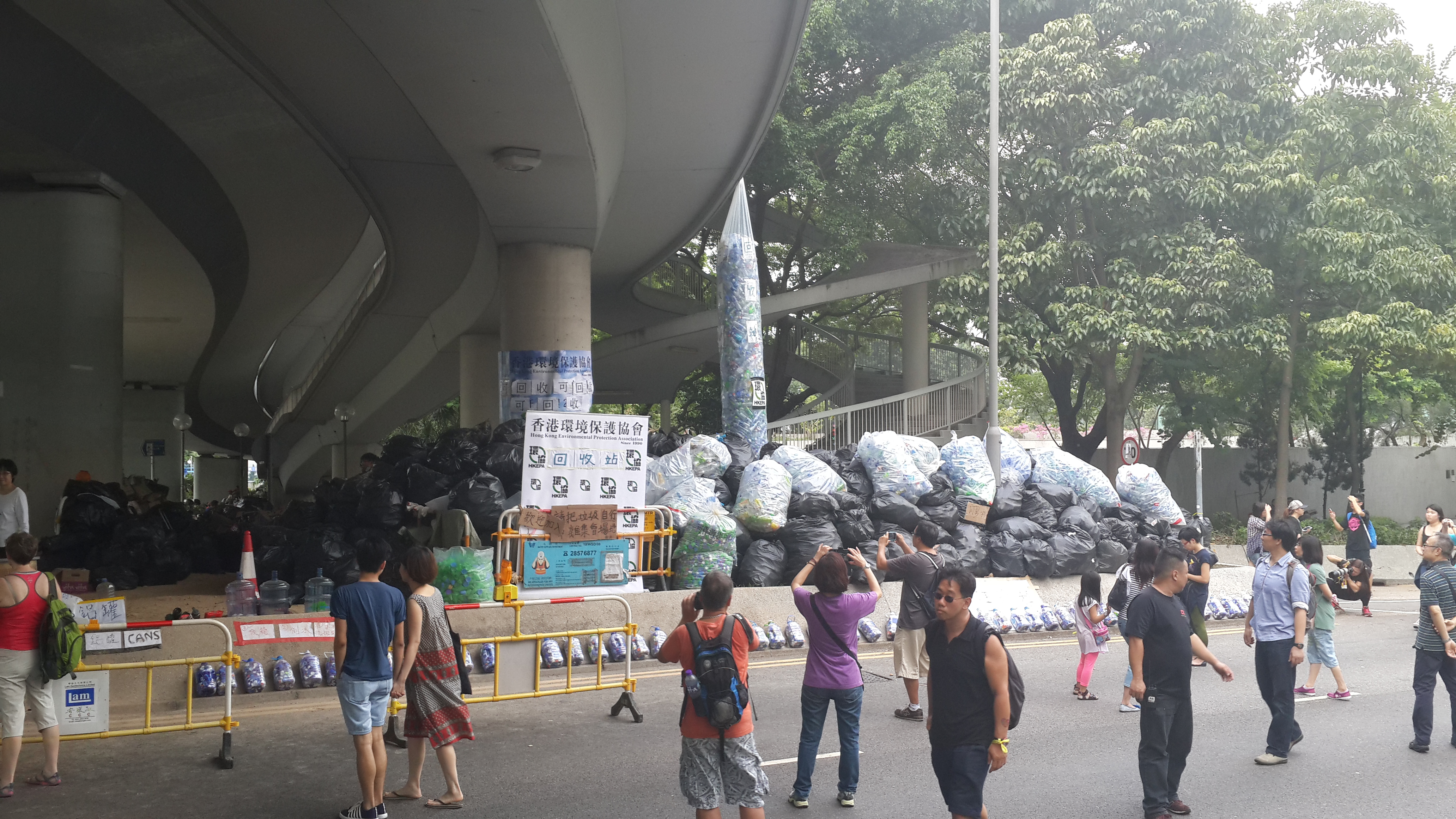
Recycling: part of Hong Kong’s revolution
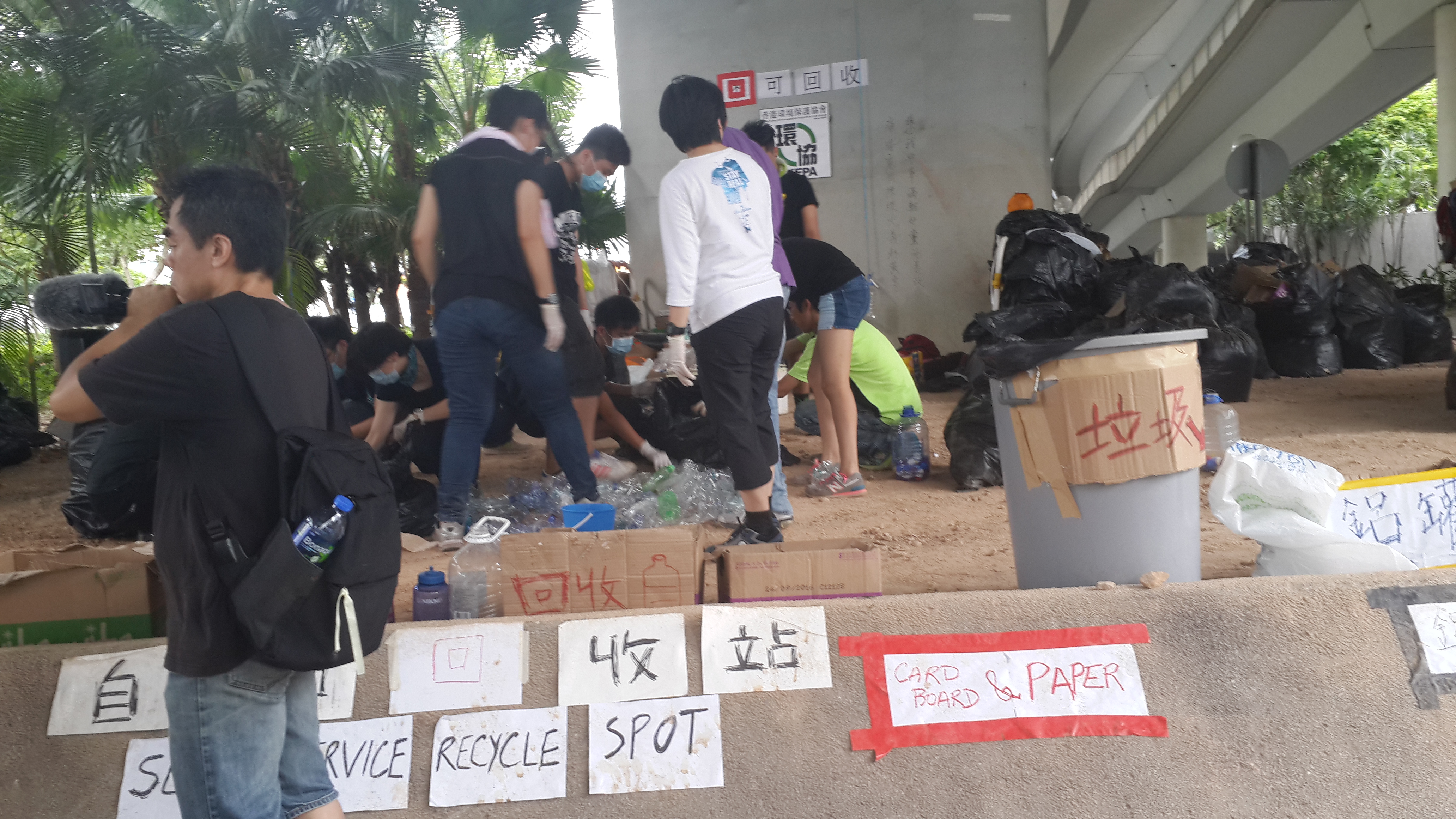
Recycling: part of Hong Kong’s revolution
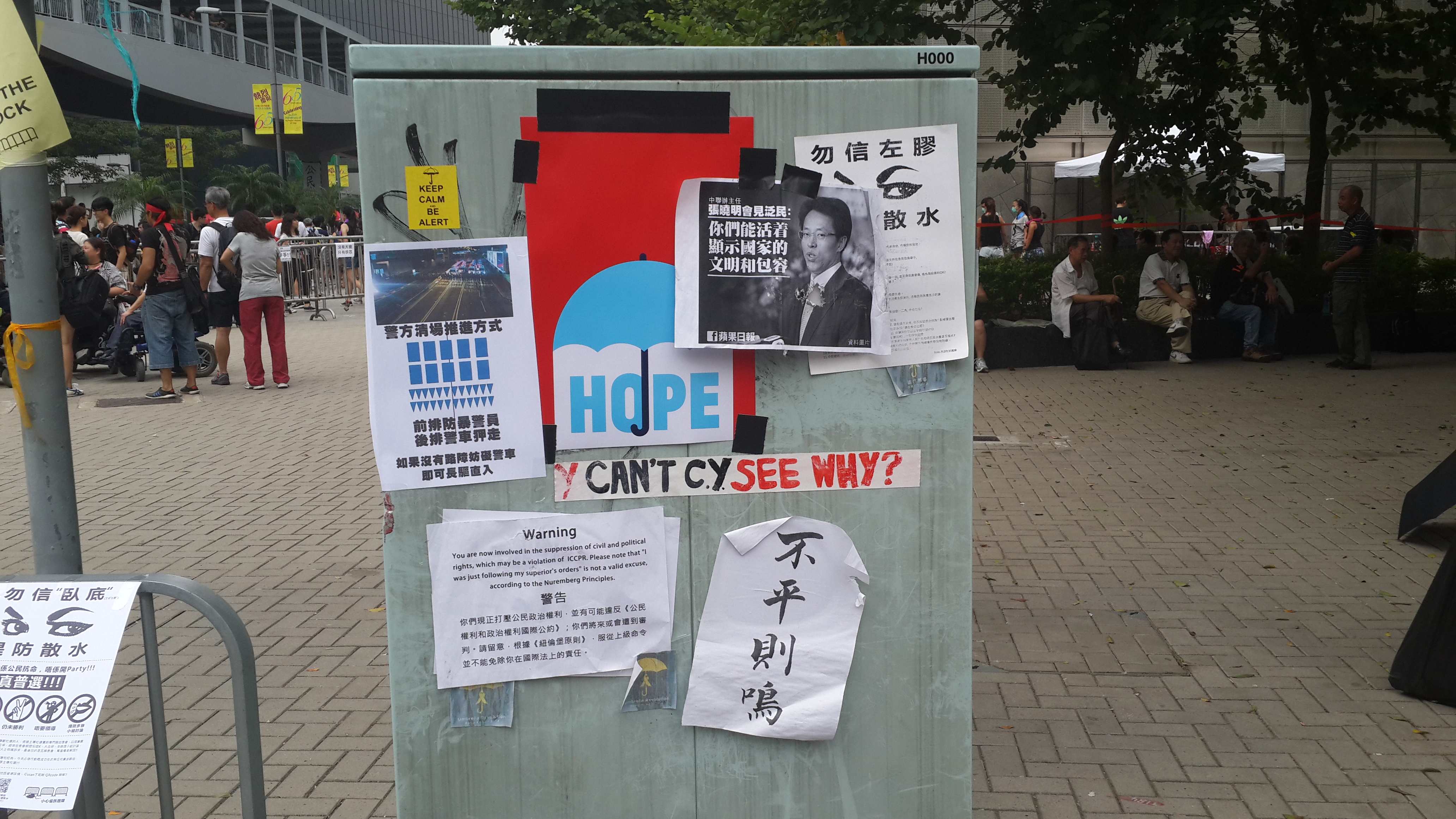
CY Leung is the head of the governing Legislative Council…
Two busloads of armed and uniformed policemen arrived in unmarked buses while we were passing by the police headquarters on Lockhart Road. At the nearby Legislative Council complex, the path was barred by a a solid phalanx of policemen behind barriers. A crowd of people stood opposite the barriers, and waited and watched, continuing their vigil. The atmosphere was very calm, with a few anxious faces in the crowd. A man walked around handing out surgical filter masks in anticipation of possible police action. Some young people sat cross-legged on tarpaulins, mats or flattened cartons, chatting in groups, reading or simply resting. A father squatted beside his son, visibly proud, arm around the boy’s shoulders, deep in conversation. A family sat together sharing a picnic. One girl was obviously immersed in her homework. Jason Ng, a Hong-Kong born lawyer, writer, pro-democracy activist and blogger, spent several hours after work helping students with their homework. Jason writes: There is a renewed sense of neighborhood in Hong Kong, something we haven’t seen since the city transformed from a cottage industry economy to a gleaming financial center…. This is the Hong Kong I grew up in. See his blog at http://www.asiseeithk.com/ for more of his posts and in-depth accounts.

Larger crowds today, probably on account of the holiday.
It was a sultry afternoon. A young man and woman walked past us in opposite directions, spraying people with a welcome cooling mist of water from pump spray flasks. A knot of people stood in front of the Hong Kong Shanghai Bank Corporation, listening to a young man dressed in black T-shirt and trousers speak passionately in Cantonese. Most of the listeners were older, his parents’ generation, and they heard him speak with avid interest. One old man stood beside him eyes squeezed tightly shut to suppress tears, his mouth twisted in a grimace of pain.
We got home at 8 in the evening, moved by what we had seen, and wondering where all this would end. On the news, the Communist Party was making threatening noises, in typical fashion blaming foreigners for fomenting what is very clearly a home-grown protest. I searched for literature that documents societies moving from dictatorship to democracy and found this deeply insightful paper by former Harvard professor Gene Sharp. Here is the link.
http://www.iran.org/humanrights/FromDictatorship.pdf
The most important insight I gained from a quick reading of the above paper is Sharp’s idea of permission, where he explains that for a dictatorship to work, large segments of the population must give tacit permission for this to happen. What we are seeing in Hong Kong these days is the withdrawal of this permission to dictate. I wish for millions to support this courageous and peaceful protest in Hong Kong.

Meanwhile, a Black-capped Lori feeds undisturbed in the nearby Edward Youde Aviary
Hong Kong, Occupy Central: Day 3
This is a remarkable revolution and although there are a few older leaders associated with the movement, the overwhelming impression on the streets is of a protest organized and led by the young, mostly students in their teens and early twenties. They are all polite, disciplined and determined. Meanwhile, many of the older generation, the parents and grandparents of the youth on the streets, remember the wrath of Beijing in 1989 at Tiananmen Square, and tremble at home in fear. On Day 2 of the demonstration, a remarkable thing happened. The police over-reacted to the peaceful demonstrators and tried to clear the field using tear gas and pepper spray against the young people. Within hours, many of these cautious older people were out on the streets, protesting the use of force against their children.
I spoke to a well-dressed young woman, who was among the demonstrators. She said she left her office from time to time during the working day and joined the crowds for an hour or two in a gesture of solidarity. A few companies apparently gave their employees tacit approval to join in the demonstrations if they wished instead of coming to work.
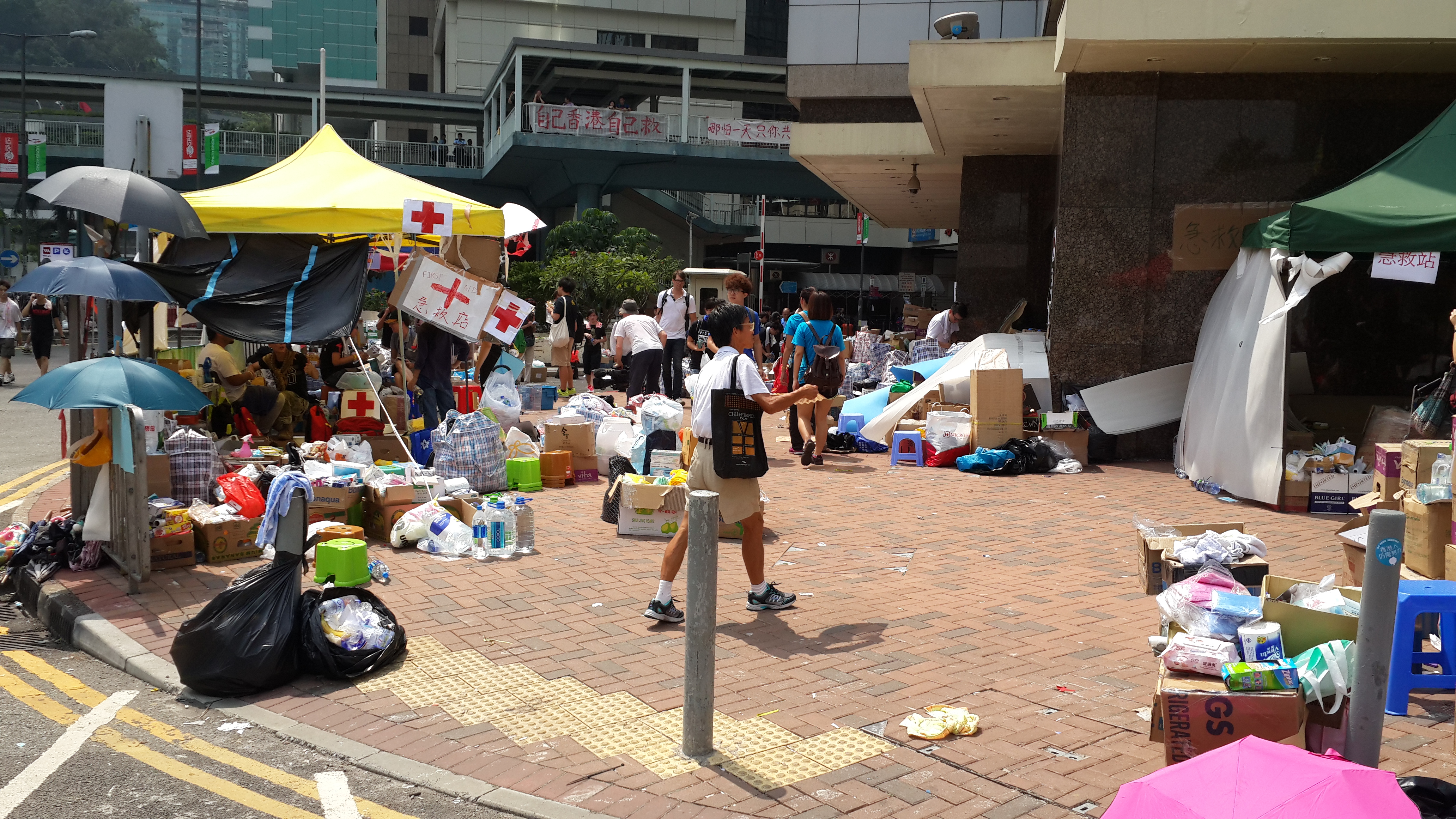
Food and water stockpiled, and trash collected by volunteers
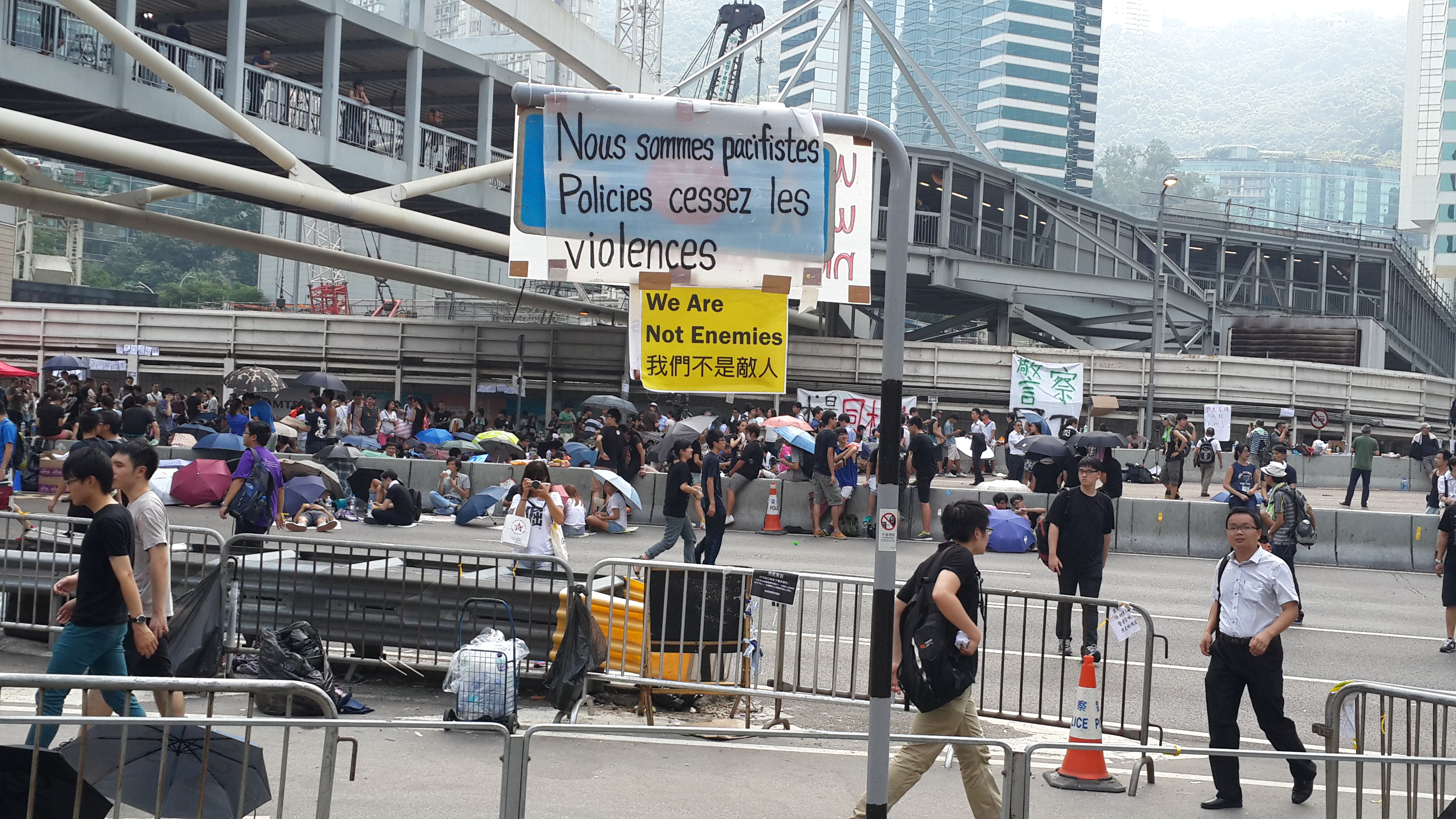

Protests at the gates of the Legislative Council
Let’s hope for all our sakes that the people calling the shots in Beijing, the President and members of the State Council, do not follow in the footsteps of their predecessors in 1989.
 aviott