Home » science (Page 3)
Category Archives: science
Advice to a Billionaire
Michael Liebreich of Bloomberg New Energy Finance calls you one of three Black Swans in the world of energy and transportation this century; the other two being Fracking and Fukushima. You are often compared to Henry Ford, Thomas Edison, Nikola Tesla, the Iron Man, and shades of Einstein. You have advised Presidents. Heads of state visit your factories to see how they could improve the lives of their citizens. You stepped in without fanfare to donate money and provide power to a hospital in Puerto Rico after the devastation of Hurricane Maria. You issue audacious challenges to yourself and to others and sometimes miss deadlines, but ultimately deliver on your promises. Thousands, perhaps millions of people, speculate against you in the stock markets, hoping to make a quick profit from your failure. So far, they’ve been disappointed. But you put your money where your mouth is, so for every one of these speculative sharks, there are a thousand eager customers for your products and millions of well-wishers who hope you can help save the planet.
And yet you feel alone and unloved. You search for a soul mate and are willing to fly to the ends of the earth to find true love. You must know that love is like a butterfly. Be still and perhaps it will land on you. There are no guarantees, but the chances are infinitely greater if you cultivate stillness. And while you wait, exchange your loneliness for the wealth of solitude. As Hannah Arendt and Plato observed: Thinking, existentially speaking, is a solitary but not a lonely business.
As the father of five children, know also that their childhood is a precious and finite resource that you could use to your benefit and theirs. Childhood ends all too soon, so help them in whatever way you can to make good choices. You seem to have done so for yourself. In the meantime, millions of people around the world wish you well, as I do.
Sophia – Elon Musk’s fears come to life?
Elon Musk and Stephen Hawking have often said that AI is the greatest threat facing the world today. Here’s maybe an early example of what they worry about. Meet Sophia, the first draft of an uncannily human-like creation.
Carbon Countdown Clock

Image:courtesy usgs
Ah, Trump. Has pulled the world’s second largest greenhouse gas emitter out of the Paris Accord. Was promised. Was to be expected. The one campaign promise that this prevaricating president did keep. The Guardian newspaper has usefully provided an online carbon countdown clock to show the world how time is running out. I believe Trump’s action might provoke the rest of the world to come together to save our common future.
https://interactive.guim.co.uk/embed/aus/2017/carbon-embed
Click on the link above to see how much time we have left.
Serious Comedians – Giving voice to Lions
An East African proverb. Until the lion learns to speak, every story will glorify the hunter. As with lions in the savannah, so too in human affairs. History is written by the victorious. As far as I know, contemporary Gauls did not write histories of Caesar’s conquests. My early school textbooks were published during colonial times and spoke of the Indian Sepoy Mutiny of 1857. A few years later, my history books reflected the views of a self-governing nation and called it The first war of Indian independence. Similarly, a history text used by children in a Francophone African country began: nos ancêtres, les Gaulois, étaient grands et blonds.
Moving forward to today, a modern nation confronts the semantic shenanigans of a prevaricating president, one who heads the world’s largest military and nuclear strike force. He threatens to destabilize the world, and frequently expresses the desire to overthrow constitutional guarantees of freedom of speech. Freedom of speech is a relatively recent tradition in our human history; a tradition that gives voice to lions. Research insights into the value of biodiversity show that ecological variety is absolutely imperative to the long-term ecological survival of our planet.
A time of instant communication is also a time of instant miscommunication, so many people no longer know where to turn for the truth. Official news agencies tend to broadcast the voice of the hunter, but where do lions tell their side of the story? Leonine voices are emerging from unexpected corners of television and the internet. The new lions are stand-up comedians, and they are emerging in every politically repressed country, from American to Turkey to Zimbabwe. Perhaps North Korea is the only country in the world where the only comedian still standing up is its great leader himself. In several countries that recently show signs of tending towards dictatorship, the leaders are becoming unwitting comedians in the mold of Kim Jong-Un.

Image courtesy the warmonger report.
It’s time for us consumers to realize how serious these jokes are. Time to sit up, stop laughing and act.
In a nutshell, (or) A Nut in a Shell
Where to begin? Needless to describe the sense of loss and dismay as a gracious, thoughtful, highly intelligent family man is replaced by a blustering, orange-hued womanizer who seems to have no respect for anything other than power, wealth and glitter. For better or for worse, the US has been regarded as the leader of the democratic world for much of the last century. In this role, it attracted some of the best and brightest of the world’s young to its universities. They stayed on after graduation, started businesses that thrived and helped make the US the global business and financial powerhouse that it is today. Much of that lustre, also called soft power, has been lost in the past decade, ever since the US began its war on terror and the futile armed incursions in the Middle East.
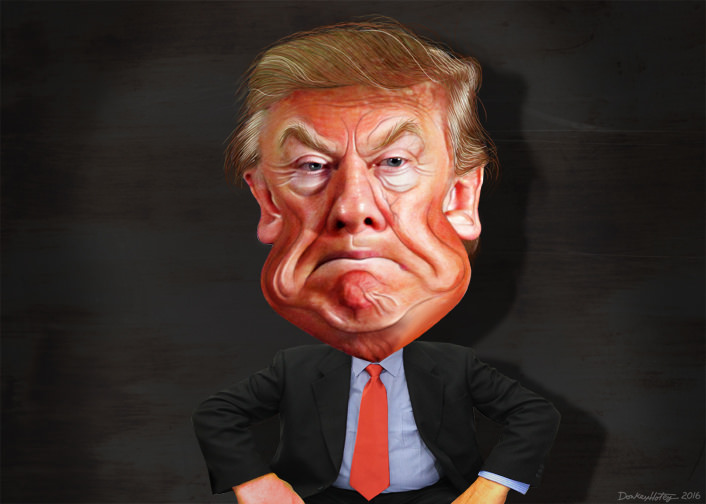
Image: courtesy wikimedia commons
Out of Africa and from the Middle East
Food for thought for those in many countries around the world who wish to permanently stop immigration of ‘foreigners.’
When the first migrants left Africa 75,000 years ago for the Cradle of Civilization — modern Iraq and Kuwait — Stoneking and his team estimate there were fewer than 100 people. They suggest there were just 15 men and 26 women. They also point to a Bering Strait crossing, from Asia to North America, around 15,000 years ago, as is commonly accepted.
Source: M. Stoneking, et al. Human paternal and maternal demographic histories: insights from high-resolution Y chromosome and mtDNA sequences. Investigative Genetics. 2014.
For more by this author, see his Amazon page here, or links to his 4 books on the Google Play store.
Why is it Dark at Night?
The nights of 13th and 14th November 2016 were supermoon nights. I’ll resist the temptation to post my supermoon photos, since Facebook and the Internet were flooded with superb photos of the event, and mine were taken with a cell phone camera. But looking up at the beautiful, impressive moon on that light-flooded night, I remembered a question I was asked three decades ago by an uncle of mine, a keen amateur cosmologist.
“Do you know why it gets dark at night?” he asked.
“Because the sun goes down, naturally,” I replied. Absurd question.
“Think again. What about the light from all the stars you see at night? Many of them are brighter and more powerful that a thousand suns. We should be continuously dazzled by their light, and life on earth as we know it should be impossible.”

Image courtesy National Geographic
I didn’t know the answer to the question and, infuriatingly, my uncle refused to give me the answer, leaving me to search for it myself. I first read the answer in a scientific journal, Physics Today, in an article published in 1974 by someone named Edward Harrison. The article was heavy reading, but I ploughed through it, memorising several paragraphs, so that I could finally answer my uncle’s question. But my understanding was not deep enough to retain the answer, and in a few weeks, the answer evaporated from my mind, leaving only faint traces like water stains on a dry rock.
In October this year, an article appeared in the The Telegraph newspaper which showed me that many academically brighter minds than mine were still wrestling with the answer. This article by science journalist Sarah Knapton should be enough to satisfy the curiosity of the average lay reader. And finally my mind is at rest now.
 aviott