Putting Methuselah in the Shade – World’s Oldest Trees
Ever since I first read Roald Dahl’s Charlie and the Great Glass Elevator as a bedtime story to my daughter nearly two decades ago, I’ve always thought of the Bristlecone Pine that grows somewhere in Nevada as the oldest tree in the world. In the story, Willy Wonka tells the boy Charlie that the oldest living thing in the world is this pine tree. Willy Wonka says the tree is more than 4,000 years old, but Wikipedia shows a photograph of a suitably gnarled tree and states it is actually 5,065 years old.
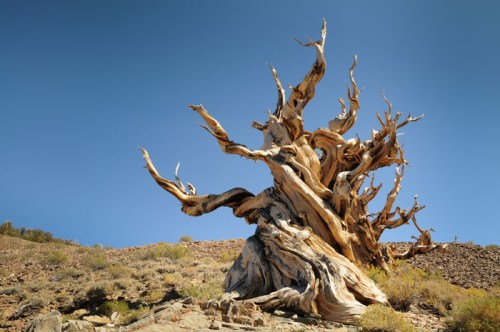
Bristlecone Pine in Ancient Bristlecone Pine Forest
Of course there are other contenders like the magnificent Hundred Horse chestnut (Castagno dei Cento Cavalli) in Sicily, reputedly 2-4,000 years old, and other Bristlecone pines from the same forest. Apparently there is yet another that is claimed to be (an impossible-sounding) one million years old. This is the Pando, in Utah, a collective of aspen tree trunks, all genetically linked by a common root system that has apparently survived a million years.

The Stu-pandous Pando trees of Utah, with a shared common root
To me, this sounds like cheating, even if the root system’s age is impressive by any standards. Not to be outdone, the magazine Nature published an article in 2003 that claims the gingko tree is a living fossil. Recent finds show that gingko species have remained unchanged for the past 51 million years and show remarkable similarity to species that lived during the Jurassic period, hobnobbing with dinosaurs, 170 million years ago.
For more by this author, see his Amazon page here.
The Honda Syndrome
A friend sent me a copy of an article from the New Yorker a few days ago. It was called “A Europe Full of Donald Trumps.” You can read the full text of the article here. The article underlines a widespread perception that most the world is turning right (whatever that means, since political rights and lefts are only meaningful from the standpoint of each individual). However, there does seem to be a worldwide return to nationalism, away from the heady concepts of globalisation and one world united by trade that seemed to promise a new era of international peace and prosperity at the turn of the millennium, less than two decades ago.

1980 Honda Accord hatchback
Way back in 1980, living in Austria, I bought a new car. At that time, Japanese cars were a rarity in this part of the world. Imagine my surprise when a friend from Sweden drove over in his brand new Honda Accord hatchback. It was a beautifully made car for its time, full of features that were expensive add-ons in comparable German cars that cost a lot more even in their bare bones version. So I bought a Honda Accord and as I drove my new car around the city, lo and behold, the streets of Vienna were full of Japanese cars, many of them Hondas! How could this happen overnight? Simply put, my perception had changed, and I was beginning to notice the variety of Japanese brands on the road once I had taken ownership of one myself.
Taking ownership is the key phrase here. Once I recognised the Honda syndrome for what it was, my perception of the world changed drastically. When I befriended people who were passionate about certain issues, I began to discover their world; their community, a whole universe that I previously never knew existed. As I explored these communities, I discovered many other parallel worlds, many other perceptions of reality, each one as real and as valid a paradigm, a world view, as the next. The world was no longer divided into left or right, vegans or carnivores, believers or agnostics, greens or browns,… the list goes on.
Despite the reality of Trump’s showing in the polls in the US, despite the reality of Norbert Hofer winning 36% of the vote in the first round of the presidential elections in Austria, we still live in a world where millions of people care about minorities; fight on behalf of the underprivileged and the voiceless; share their homes with refugees; avoid eating meat for the sake of their health or for the health of the planet; ride bicycles on their daily commute instead of driving; practice mindfulness, not as a current buzzword, but as a day-to-day practice; and love their neighbors as themselves. All this and more exist in the world today, in addition to its Donald Trumps. As I wrote in an earlier blog, A Whisky Bottle as a Metaphor for Life, the global glass is either half empty or half full, and it is our individual perspectives that color it.
See the author’s Amazon page to read more of his work.
Guest post by B.T.Lowry
This is a love letter. Like all love letters, this is full of emotional truths, however much one may quibble about facts.
Turkey’s 2.5 million Syrian refugees
The following text is copied from the blog of economist Larry Willmore, and I think it merits re-posting because of widespread reports in the media in Europe about Turkey’s non-cooperative stance about taking back refugees who have made the hazardous crossing to Europe. Really? Read on below…

image courtesy yenisafak.com
We are bombarded daily with news of problems with the massive influx of Syrian refugees in Europe, Jordan and Lebanon but seldom hear about the much larger number of Syrian refugees in Turkey. The reason there is so little reporting from Turkey is that Syrian refugees there encounter little hostility. Moreover, significant numbers are able to work informally, often in businesses run by Syrians. The Turkish government recently began to issue a restricted number of work permits to refugees. Refugee employment would no doubt increase, along with wages and working conditions, if the tight restrictions were relaxed.
[T]he 2.5 million Syrian refugees in Turkey have encountered less hostility than in Jordan and Lebanon—not surprising given Turkey’s population of 77 million …. Jordan and Lebanon face a significantly higher burden with over one million Syrian refugees in each country, representing an influx equal to, respectively, 20 and 25 percent of the native population.
It may also be that Turkey’s more open business environment has played a role in lowering tensions. ….
Over the last four years, about 4,000 formal tax-paying firms—employing thousands of workers, mostly Turkish—have emerged. And informal enterprises may multiply this number. …. [M]any of these [refugee] workers make less than minimum wage and have no social benefits. But in January 2016 Turkey’s official gazette announced the granting of work permits to refugees, though employment is capped at 10 percent of a firm’s workforce.
Omer M. Karasapan, “The impact of Syrian businesses in Turkey“, Future Development blog, Brookings, 16 March 2016.
For more by this author, see his Amazon page here.
Women and Wild Savages: Book Review
Synopsis: (from the Amazon website) At 18, Lina is an aspiring actress and the stunning daughter of Viennese coffeehouse owners. When the imperial capital’s most sought-after bachelor, Adolf Loos, unexpectedly proposes, she eagerly agrees. But the honeymoon is short-lived. Her “modern” husband might be friends with women activists but his publically progressive views do not extend to his young wife. Thank goodness for the sympathetic ear of Café Central’s beloved, old poet, Peter Altenberg. But when Adolf Loos unwittingly pushes Lina into the arms of his activist friend’s handsome son, Lina becomes entangled in a web of desire, jealousy and intrigue. No man’s love is unconditional. As the three friends rival to mold her into the perfect wife, muse and lover, Lina strives to recall the woman she once imagined herself to be. Fact and fiction weave together with history and romance in this tragic yet inspiring tale of Lina Loos’ struggle for love, liberation and self-fulfillment during her years of marriage to the renowned architect, Adolf Loos.
Set in the early 1900s in fin-de-siècle Vienna, Women and Wild Savages tells the timeless story of a person’s journey to recognize and be herself in a world determined to make her into someone else.

One of the first books I read about Austrian history nearly 4 decades ago was Frederic Morton’s hugely enjoyable “A Nervous Splendor.” This historical novel provided a vertical slice-of-life view of Viennese society in the closing decades of the Habsburg empire at the turn of the 19th century to the 20th. I then read many books about this fascinating period. William Johnston’s scholarly collection of essays, “The Austrian Mind” stands out, as well as Carl Schorske’s “Fin de Siècle Vienna.” Where Morton’s work gave a vertical view of life in the Vienna of the time, KC Blau’s novel gives a complementary, horizontal glimpse of Viennese society. Where Morton’s work was history written as fiction, this novel is more of a fiction written as history (although based on true events). Anyone who has enjoyed any one of the three above-mentioned books will surely give this novel a 5-star rating for its authentic recreation of the atmosphere and mores of the time. Readers who know nothing of Vienna will perhaps miss the authenticity of the period details but will surely enjoy the writing and the development of the characters. So while my personal opinion inclines to 5*, I’ve decided to rate it a 4* overall for the benefit of the average reader. I look forward to reading more of the “Vienna Muses” series as and when when they are published.
For more by this author, see his Amazon page here.
Hinkley. Oh no!
The political decision to power ahead with Hinkley Point C nuclear power station is the energy equivalent of appointing a tone deaf musical director to the London Symphony Orchestra. How much more evidence do Cameron and Co. need? A short litany of anti-Hinckley arguments should suffice.

Hinkley 1
In a case of economics speaking truth to power, the OECD’s 2010 World Energy Outlook quietly increased the average lifetime of a nuclear power plant to 45-55 years, up 5 years from its 2008 edition.
Al Jazeera on Agarwood
Al Jazeera had an interesting report on the endangered Agarwood trees of Hong Kong. This fragrant tree is the reason for Hong Kong’s original name, phonetically, “Heung Gong” or fragrant harbor. The agarwood tree (aquilaria sinensis) grew plentifully all over Hong Kong and its surrounding islands. The tree was widely found in southern mainland China as well. The tree produces a light odorless wood. However, the wood is frequently attacked by a fungus. The tree defends itself by producing a dark, aromatic resin that over time infects the heartwood and infuses it. This valuable heartwood fetches prices of US$ 1000 to 2000 per kilo. Even more valuable is pure agarwood oil distilled from the wood. For example, an Indonesian supplier offers it (see link here), presumably legally sourced, for US$ 10,000 to 12,000 per 100 ml.

A stand of endangered agarwood trees
The agarwood stocks in Mainland China are long gone, hoovered up by traders in the rush to economic development. Hong Kong’s stands have been mainly untouched, protected by the sound administration and relatively uncorrupt bureaucracy left behind after colonial rule. Now these stocks are under increasing threat as more and more poachers take what they can under cover of darkness from remote corners of Hong Kong’s islands.
Sadly, in their clandestine haste to harvest the wood, the thieves indiscriminately cut down all agarwood trees, regardless of whether they’ve been fungus infected or not. Which means that they cut down an entire stand and take only the infected heartwood they find. No wonder that Grace has her work cut out for her!
The resin of the agarwood trees of Assam (aquilaria agallocha) is considered the finest in the world. However, different species of this tree also grow in Vietnam, Cambodia (more on that in the forthcoming book The Trees of Ta Prohm), New Guinea and Burma (Myanmar). A propos Myanmar, congratulations to the NDP on their recent sweeping electoral victory. Best wishes to the newly elected representatives and wisdom to Aung San Suu Kyi in the difficult transition from military to civilian rule.
For more by this author, see his Amazon page here.
Six Degrees of Separation

Dogma?

Religion

6 degrees of separation (image courtesy quotesgram.com)
Liberty vs Justice
Just read an article in The Atlantic by Kaveh Waddell entitled “The Information Revolution’s Dark Turn.” A thoughtful piece based on an interview with Scottish philosopher Alistair Duff. The article reminds me that, in this age where technology, especially information technology, dominates the world economy, we need the arts and philosophy more than ever.
We need artists, philosophers, ecologists and other deep thinkers to observe and articulate trends in society, pointing out the opportunities and pitfalls that lie in wait for the world, striking a balance between the mindless daily diet of horrors and disasters served by the media and the treacly reassurances spouted by politicians in search of votes. The two following sentences resonated with me and I’ve shared the text in italics below.
The ultimate value is not liberty: It is justice. Liberty has to fit within the context of social justice. And where it violates justice, I’m afraid justice trumps liberty.
The first thought that comes to my mind is: try telling that to the Donald. In his case, liberty (donald) trumps justice!
For more by this author, see his Amazon page here.
Seeds of Inequity
What could be more principled than companies that work to genetically modify seeds, breeding out negative traits and selecting a mix of desirable qualities that make them resistant to pests, hardy enough to withstand droughts or floods as desired? After all, farmers have been doing this for hundreds of years, patiently crossing varieties and developing superior strains of the world’s crops. Enter the profit motive. Still no harm done, we thought! Selfish interest is the lever used by civilizations to lift their peoples to prosperity, with the profit motive as the fulcrum on which this lever rests.

Strains of wheat
The world has generally accepted the truth of this principle ever since Adam Smith pointed it out in his seminal work, first published in 1776. Except for a relatively brief interlude when some nations experimented with communism and socialism in a failed search for social justice and equity, the world has broadly accepted Smith’s premise that wealth creation is a good thing and ought to be encouraged by enlightened governments that simply move out of the way and allow entrepreneurs to do their stuff. By and large, this is what seems to have happened in the case of GMOs (genetically modified organisms). Basically, some large corporations have copyrighted and distributed their seeds (sounds fair enough; respect for intellectual property rights sets the basis for innovation and prosperity). The problem is, these corporations have also made the rules about what happens to the seed generations that follow. They have decreed, and governments have accepted, that farmers may not retain a proportion of seeds from their crop for planting the subsequent season, but have to buy the seeds from the corporations again.
As Lizzie Wade points out in her Science article “How Syrians saved an Ancient Seedbank from Civil War”
…Maize, for example, was created by ancient Mesoamericans by painstakingly breeding more and more appetizing teosinte, a stubby grass with tiny, tough kernels that has so little in common with modern maize that archaeologists dismissed it as a possible wild ancestor until genetic tests revealed the surprising truth. The problem in the short run is that conventional breeding can be s…l…o…w. Teosinte was domesticated in central Mexico between 6,000 and 10,000 years ago, but farmers only managed to create a variety that tasted good a mere millennium ago
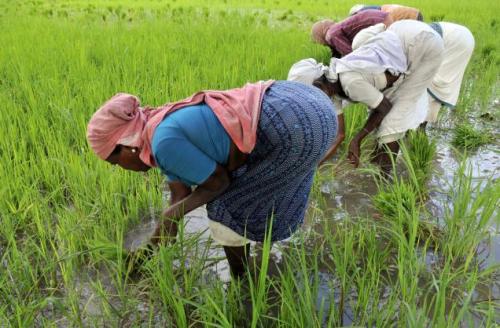
They can plant and reap, but they can’t sow again without buying seed…
As S. Grant points out in his article “10 Problems Genetically Modified Foods are Already Causing,” once they plant GM crops, farmers can no longer legally harvest their own seeds and are in danger of entering an era of perpetual bondage. Thus serfdom re-enters the world in the 21st century, this time clothed in the language of high-tech and carrying the false promise of freedom from hunger. Lawmakers are all too often ignorant and dazzled by technology, so they fail to realise the problems with GM crops are more to do with social and juridical issues rather than with the technology itself.
“In India, seeds are taken as a symbol of God’s blessing. They keep it, they store it, they know what is good seed and bad seed.” “Control oil and you control nations. Control food, and you control people.”
The above two memorable quotes are from a must-see 9-minute video about Natabar Sarangi, a village farmer who distributes free seeds to poor farmers out of the deep conviction that the thousands of varieties of seeds bred and developed over centuries should not be lost. In the process, he helps many of them to modest prosperity.
For more by this author, see his Amazon page here.
Latest Posts
-

December 2021 Newsletter
Originally posted on The Forest Way: A photo essay Most wonderful wishes and best regards to all, for the start of a fresh, healthy, environmental…
-

A Tree Planting Update
I begin this post with an apology. I have posted only sporadically this past year, and the reason is not Covid as one might think.…
-
The Standoff explained: Modi government vs. Indian Small Farmers
The is basically a battle for the future of Indian agriculture. It is also a battle of two opposing philosophies: Small is Beautiful vs. Big…
-

The True Source of Wealth
Many years ago an economist friend told me to invest in stock index funds rather than property. He pointed out charts comparing property prices and…
 aviott