Nature’s Bounty

Hundreds of these large orange blossoms strewn on the path to the beach from a tree overhead. The nameless profligacy of Nature’s bounty. Surely the earth has enough for all if we use its resources wisely.

Indian Khanna grows in profusion beside a walking trail on the outlying islands.
My apologies for the long delay in posting, but I am privileged to be truly living in a state of grace. More on that in the next blog!
Quick Renewable Energy Update
The 103GW of capacity added by renewables last year (2014) equals the energy generating capacity of all 158 nuclear power plant reactors in the USA.
…Wind, solar, biomass and waste-to-power, geothermal, small hydro and marine power contributed an estimated 9.1% of world electricity generation in 2014, up from 8.5% in 2013. This meant that last year the world electricity system emitted 1.3 gigatonnes of CO2 – roughly twice the emissions of the world’s airline industry – less than it would have if that 9.1% had been produced by the same fossil-dominated mix generating the other 90.9% of world power.
“Once again in 2014, renewables made up nearly half of the net power capacity added worldwide” says Achim Steiner, UN Under-Secretary-General and Executive Director of UNEP.
from Environmental Research Web, 2 April 2015
Golden Skirts vs Testosterone in the Financial World
Read a riveting analysis by Economist John Kay on why banks might perform better with women in charge. As an enticement to read further, here is a reproduction of the opening paragraph of his article that was originally published in the Financial Times of 18 March 2015.
The most powerful posts in the financial world are held by women. Janet Yellen chairs the US Federal Reserve, and Christine Lagarde is managing director of the International Monetary Fund. Mary Jo White heads the US Securities and Exchange Commission, and was preceded in that job by Elisse Walter and Mary Schapiro. America’s new Consumer Financial Protection Bureau is directed by a man — but the reason is that the industry feared Senator Elizabeth Warren would fill the role too effectively.
Read the complete article on John Kay’s own blog post here.
As often in the past, thanks to my friend Larry Willmore for his own Thought du Jour blog post that drew my attention to this article.
FREEBIES AT THE THEOSOPHICAL SOCIETY


Some years ago while reading about early explorers into Tibet, I came upon a biography about Helena Blavatsky. Madame Blavatsky was involved in early investigations of spiritualism and eventually went on to found the Theosophical Society with others in 1875. The original organization splintered, and Theosophy does not have the following it once enjoyed, but it continues to foster spiritual growth.
The Theosophical Society in America’s website (www.theosophical.org) outlines their vision, mission, and ethic.
The Theosophical Society in America:
“Has a Vision of wholeness that inspires a fellowship united in study, meditation, and service.
Its Mission is to encourage open-minded inquiry into world religions, philosophy, science, and the arts in order to understand the wisdom of the ages, respect the unity of all life, and help people explore spiritual self-transformation.
Its Ethic holds that our every action, feeling, and thought affects all other beings and that each of us is capable…
View original post 758 more words
It’s Raining Electrons in Small Spaces
Four recent reports on new breakthroughs in renewable energy generation and storage technology reinforce the promise that was once made for nuclear power: abundant energy for all, including the poorest in society, even though it may never be “too cheap to meter.”
High Performance Flow Batteries The promise of renewable energy technologies will be fully realized when battery storage becomes reliable enough and cheap enough to even out intermittent flows. Today the problem is partly solved by feeding energy from rooftop panels into the grid and then receiving compensation from the energy utility for the power supplied either in cash or in the form of reduced electricity bills. Looking at a typical electricity bill in Euroland (my own) I see the following charges. The unit price (per KWh) is between 6.5 and 7.3 Eurocents, but after grid charges, network costs and taxes are added, I pay 26 cents per KWh. Ironically, bulk consumers (factories, office blocks and large companies) pay lower rates, around 8 to 15 cents per KWh, depending on level of consumption. Now the whole picture is changed with the advent of low cost storage systems that make home batteries affordable and economical. Imagine home systems that can deliver electricity for all your needs at no cost for twenty to thirty years, once installed, barring the onetime cost of the system. Coming soon, to an affordable home near you.
Silicon cones inspired by the architecture of the human eye. The retina of the human eye contains photoreceptors in the form of rods and cones. Rods in the retina are the most sensitive to light, while cones enhance colour sensitivity. Modelling photovoltaic cells based on the makeup of the retina, researchers have been able to enhance the sensitivity of solar cells to different colours in the sunlight that falls on each cell and thereby increase electricity output by “milking the spectrum” closer to its theoretical maximum. Increasing efficiency of the average rooftop PV cells from the current 18-20 to 30% would make such systems cheaper by far than grid electricity mostly anywhere in the world, even in temperate countries. Coming soon, to a rooftop near you.
Modular biobattery plant that turns biowaste into energy. Biogas plants are old hat. They have undeniable benefits, turning plant, animal and human waste into energy (methane) while leaving behind a rich sludge that is excellent fertiliser. However, good designs are not common and they are sometimes cumbersome to feed and maintain. Now comes an efficient German design that promises to be modular and economically viable even at a small scale. In another development, the University of West England at Bristol has developed a toilet that turns human urine into electricity on the fly (pardon the pun) and the prototype is currently undergoing testing, appropriately enough, near the student union bar. Coming soon, to a poo-place or a pee-place near you.
New electrolyte for lithium ion batteries. Lithium ion batteries using various electrolytes have already become the workhorse of the current crop of electric cars and for medium-sized storage requirements. New electrolyte chemistry discovered at PNNL Labs shows that reductions of upto ten times in size, cost and density are feasible and various electrolyte/electrode combinations are being further tested for production feasibility. Coming soon, to a battery storage terminal near you.
So what should you do, as a concerned global citizen, until you can lay your hands on one of these devices (or all of them) for your own use? Tread lightly on the earth, don’t buy bottled water, reduce energy use, walk when you can instead of driving your car (your arteries will love you for it), buy local produce, eat less meat (your grateful arteries again), think twice before flying off to that conference (think teleconferencing), buy an electric car if you need a new one, and remember that every liter or gallon of petrol you fill into your old one not only fuels your car but potentially also the conflicts in the Middle East and/or lines the deep pockets of Big Oil which definitely does not want your energy independence.
The Flea on the Behind of an Elephant
Scroll backwards in time to the early 1970s. US President Richard Nixon appointed the Atomic Energy Commission (AEC) to produce a study of recommendations on “The Nation’s Energy Future” based on advice from the National Science Foundation (NSF). Requesting the AEC for energy prognoses is akin to asking a tiger for dietary recommendations; there will surely be no vegetables on the menu! Dr. Dixy Lee Ray, chair of the AEC, predicted in her summation of the report that “solar would always remain like the flea on the behind of an elephant.” In the early 1980s I knew another eminent researcher, Dr. Thomas Henry Lee, a Vice President for research under Jack Welch at General Electric, who often stated that nuclear power would produce “energy that is too cheap to meter,” essentially free.
The AEC study, when it was published, proposed a $10 billion budget for research and development with half going to nuclear and fusion, while the rest would be spent on coal and oil. A mere $36 million was to be allocated to photovoltaics (PV). Dr. Barry Commoner, an early initiator of the environmental movement, was intrigued that the NSF had recommended such a paltry amount for solar. In the 1950s he had successfully lobbied for citizen access to the classified results of atmospheric nuclear tests and was able to prove that such tests led to radioactive buildup in humans. This led to the introduction of the nuclear test ban treaty of 1963.
Dr. Commoner’s own slogan (the first law of ecology is that everything is related to everything else) prompted him to question the AEC’s paltry allocation for solar PV, especially since he knew some of the members of the NSF panel who advised on the recommendations. He discovered the NSF panel’s findings were printed in a report called “Subpanel IX: Solar and other energy sources.” This report was nowhere to be found among the AEC’s documents until a single faded photocopy was unexpectedly discovered in the reading room of the AEC’s own library. The NSF’s experts had foreseen in 1971 a great future for solar electricity, predicting PV would supply more than 7% of the US electrical generation capacity by the year 2000 and the expenditure for realising the solar option would be 16 times less than the nuclear choice.
Clearly, the prediction of 7% solar electric generation has not yet happened, but current efficiency improvements in photovoltaics and battery storage technologies point the way to an energy future far beyond what the NSF predicted in 1971. Fifty years from now, it is nuclear power that is likely to be the flea on the behind of a solar elephant.
Volunteering for a one-way trip
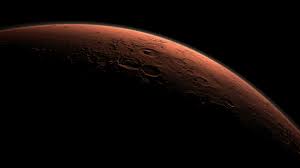
Image: courtesy mars.nasa.gov
Two years ago I wrote a short story called Enigma. It was a rather bleak story of a group of adventurers who volunteer for a space mission to the Red Planet, knowing fully well that they might never return. The story was prompted by a news report that more than 150,000 people had volunteered for a one-way trip to Mars, offered by a group that calls itself Mars One. At the time I wrote it, the story seemed (even to me) hopelessly fatalistic, but I’ve always been intrigued by the idea of space travel, so I included it, with some hesitation, in my last collection of short stories (see The Ironwood Poacher and Other Stories). I tried to put a positive spin on the fatalistic elements of the story by hinting at some kind of a superior intelligence or presence that shows that the indomitable nature of human striving is not futile, that it is a quality to be nurtured; a quality that has rewards beyond death as we know and fear it.
Imagine my surprise when I read an article in Time magazine this morning entitled “Why I’m Volunteering to Die on Mars,” about a young woman named Sonia van Meter. Sonia is one of the Mars One finalists (100 have been chosen from more than 200,000 applicants in the third round of the selection process), and she gives her reasons for wanting to go on a one-way trip to Mars (planned to depart every 2 years, beginning in 2024).
Here are some of the reasons Sonia (who is married and has 2 step-children) gives for volunteering for this mission. Space exploration is worth a human life. Every astronaut that has ever flown has known the risks they were up against once they strapped into that ship. And there’s no guarantee that I won’t be crushed by a collapsing roof tomorrow or diagnosed with a terminal illness next year. Some call this a suicide mission. I have no death wish. But it would be wonderful if my death could be part of something greater than just one individual. If my life ends on Mars, there will have been a magnificent story and a world of accomplishment to precede it.
To know more about why Sonia, and hundreds of thousands like her, who volunteer for such a mission, read the Time article here.
See more books by this author here.
Fossil Fuels are for Dinosaurs
Maybe I’m just prejudiced, but an estimate made by the US Energy Information Administration (EIA) in 2008 (George Bush was President) said “just 140 MW of total utility-scale PV solar capacity would be installed by 2015.” In fact, before end-2014, there was more than 8,100 MW actually installed. Obama has been President in the intervening years. Was this the difference? Could government loan guarantees instituted by his administration have made such a difference?
To be fair to the EIA, the Paris-based IEA (International Energy Agency, an important institution in the international salad of energy agencies) has also under-estimated the growth of renewables worldwide: “the International Energy Agency in 2000 projected 34 GW of wind power globally by 2010, while the actual level reached was 200 GW.”

Image courtesy: http://www.dinoleaks.com
Are these honest errors? Wrong question. This is not a question of honesty, but of views, ideologies, and implicit, unquestioned assumptions on which expert opinions are often based. An executive in a corporation with billions of dollars, pounds, euros, or ringgit locked up in an existing technology naturally thinks: why meddle with a model that has proved successful for a century? Young (mostly), hungry entrepreneurs risking their life savings and livelihoods to usher in an age of new technologies might lose out in the short run but will prevail in the end. This clash of views has nothing to do with honesty, but merely proves the wisdom of the old adage. “Where you stand on an issue depends on where you sit.”
All the news that’s fit to print
The slogan has been used by the New York Times ever since its adoption in 1896. Perhaps because of the NYT’s influence, the message seems to have sunk deep into the world’s collective psyche, and most people believe themselves to be well informed if they read a newspaper, whatever their choice may be, every day. But of course, the day is short, the world is large, and reporters and editors are human too, working to tight deadlines. They are just as beholden to the people who provide cash flow (advertisers; often large, powerful companies) as any office employee to her boss.
And so some of the news that’s fit to print never makes it to print or into the media. It’s hard to bite the hand that feeds even though the reporter might know it deserves a good nip on occasion. The example came powerfully home to me many years ago when I visited an orphanage that was run in exemplary manner; in the best way such an institution could possibly be run. I remarked to the director how relieved I was to know that such fine institutions existed, having seen a devastating documentary just a week earlier, broadcast by a sender of high repute. She perked her ears immediately.
“Oh, was it by so-and-so?” she asked.
“Yes. How did you know?”
“They were here a year ago, while filming the documentary. I suggested they report about this place instead of showing only the negative stories, but they weren’t interested.”
So on top of financial pressures, there is reporter bias as well. Many reporters seem to think that only bad news sells. If the customer is king, then its up to us, the readers to stop buying all the crappy news that’s published. Here are a few good news websites below. This is only a tentative list. There are plenty more out there to look at or, better still, create your own for a guaranteed improvement in your quality of life. Despite its ills, the world is still a beautiful place, and one shouldn’t begin each day with a daily dose of despair.
http://www.huffingtonpost.com/good-news/
http://www.happynews.com/
http://optimistworld.com/News.aspx
http://www.gimundo.com/
http://positivenews.org.uk/
http://www.thebetterindia.com/topics/heroes/
http://www.thebetterindia.com/14672/man-creates-artificial-glaciers-chewang-norphel-ladakh/
See more of this author here.
Purple Sheep runs Purple Eat
The city of Vienna has been governed by the Social Democrats, either alone or in coalition with other parties, since 1945. That’s an unbroken stretch of 70 years! Not bad for a governing party, considering that Vienna is a well-run city and has consistently ranked among the top 3 cities of the world for quality of life for the past decade or two. Among the reasons for the city’s success is the large number of initiatives by private citizens concerned about social justice in the age of globalisation.
One of these initiatives is by a non-profit organisation called Purple Sheep with the avowed objective of keeping an eye on the government to ensure that the city obeys its own laws concerning the welfare of refugees. In brief, PS’s objective (stated in the photo below) is to keep track of, publicise, and protect refugees from excessive official zeal in upholding the law.

Purple Sheep’s Agenda. They are grateful for donations to support their work.
Every so often, registered refugees fall through cracks in the legal framework, are declared inelegible for asylum, and have to leave the country although they might have lived in Austria for years while waiting, and have become well integrated. Appeals are possible, but people live in a kind of limbo while waiting for a decision on an appeal, and they are not allowed to work during this period. So in early 2014, Purple Sheep decided to set up Purple Eat; a place where refugees waiting for a decision on their case for asylum (currently 15 families) can provide a service while conforming to the law.
Housed in a distinctive purple container-like building among the other market stalls on the Rosaliagasse 5 in Vienna’s 12th district, Purple Eat serves a choice of 2 menus, 5 days a week, Tuesdays to Saturdays, from 11 am to 11 pm, prepared by the refugees themselves. What is on offer on a particular day depends on the nationality of the persons responsible for the meal. I visited the place on Thursday evening this week and found a choice of 2 main courses. A Haitian beef goulash, or a Georgian-style mushroom goulash, both menus accompanied by a standard soup, salad and a dessert (no choice here) for 7 Euros. I decided on the Georgian mushroom, and a glass of white wine.

Unmistakably purple and friendly service, Rosaliagasse 5, 1120 Vienna. Be prepared for pleasant surprises.
The soup arrived quickly, a delicious cream of tomato. It was followed by a salad. The lettuce was absolutely crisp and fresh. The dressing was obviously ready-made, out of a packet, but at 7 Euros for a 3-course meal, there are no complaints from this quarter. The Georgian mushroom goulash came next, served in typical Georgian style, topped with a dollop of cream and a sprinkling of walnut. Delicious. And for dessert, a small piece of freshly made cottage cheese pastry (topfen strudel). The menu price of 7 Euros is a recommendation. Customers are encouraged to pay more if they like, since all the money goes directly to the refugee families. Purple Sheep is apparently staffed entirely by volunteers (who don’t get paid, natch), so all the proceeds of go directly to the families who are cooking on that day. Expect a variety of menus, depending on the families who serve their traditional cuisine on different days. I encourage you to go there and be surprised.
See more of this author here
Latest Posts
-

December 2021 Newsletter
Originally posted on The Forest Way: A photo essay Most wonderful wishes and best regards to all, for the start of a fresh, healthy, environmental…
-

A Tree Planting Update
I begin this post with an apology. I have posted only sporadically this past year, and the reason is not Covid as one might think.…
-
The Standoff explained: Modi government vs. Indian Small Farmers
The is basically a battle for the future of Indian agriculture. It is also a battle of two opposing philosophies: Small is Beautiful vs. Big…
-

The True Source of Wealth
Many years ago an economist friend told me to invest in stock index funds rather than property. He pointed out charts comparing property prices and…
 aviott