Ironwood Poacher and Other Stories
Finished at last! A collection of ten short stories that will appear in print in early November, around 48,000 words. Anyone willing to proofread the final pdf of the MS in the next two weeks, please let me know. You will get a free dedicated copy of the book after final publication as a thank you. The Afterword from the volume that follows below says a little bit about each of the stories, but is meant more as a background narrative of the circumstances in which they were written, rather than as a synopsis of the stories themselves.

The Ironwood Poacher: In December 2012, a young woman and her male companion were attacked in a private bus on the outskirts of Delhi. The man was beaten with a metal bar and left incapacitated while the girl was brutally raped and then seriously injured in a frenzy of bloodlust as an aftermath of lust. The case attracted wide media attention and struck a chord in the hearts of millions of urban middle class who were shocked that such a thing could happen to one of their own kind. When the girl died of her injuries thirteen days later, there was an outpouring of grief and violence nation-wide. The mass protests and agitation in urban centers throughout the country were an expression of anger and disbelief that the nation that nurtured Gandhi and non-violence could harbor individuals like these.
Indeed, in 2005, one month prior to Hurricane Katrina, the city of Mumbai experienced unprecedented and disastrous flooding. In contrast to New Orleans, however, the Mumbai floods were not marked by social disorder and violence, but by widespread acts of generosity and altruism. Based on such experiences, the complacent Indian view was that the “Third World-ness” of megacities like Mumbai and Delhi was a positive thing; a virtue that excused the country’s sadly crumbling infrastructure and made it bearable, because it did not have the “culture of violence” found in American cities.
Of course, this complacence was totally delusional, since anyone who cared to look found inescapable signs of the most egregious exploitation everywhere. And behind the exploitation exists systematic violence and intimidation. The people who bear the brunt of this bad treatment are the poor and the disenfranchised, in urban centers of course, but more so in the countryside. Most of these people are voiceless in the media, so their stories are rarely told. The Ironwood Poacher is an attempt to tell such a story.
India is a very large, teeming country, so it may come as a surprise to many middle class Indians living unthinking, sheltered lives in a comfortable cocoon with servants at hand to cater to their needs, to know that violence is deeply ingrained in this society. This violence has many roots. Deeply held beliefs and gender bias, the caste system (especially in rural areas), and the tremendous disparities in income.
The Ironwood Poacher was written long before the Delhi outrage happened, and was prompted by observations of the everyday tyranny of low-level government officials abusing their power. There is plenty of opportunity for petty officials in every town and village, themselves poor and underpaid, to abuse their power, sometimes with the collusion of local landowners or upper caste supporters. So the tribulations of Neela, the poacher’s wife, are played out in thousands of variations across the country daily and weekly, these stories barely making the pages of the local or national news. What is remarkable amidst all this human misery is that retaliatory deeds like Murugan’s happen so rarely. That is one of the true miracles of India, and probably the most positive attribute of the deep spirituality widely evident wherever one travels in the country.
The Flood: The European Union is an unprecedented, brave and bold experiment by thirty-odd countries venturing into uncharted territory. Many economists have predicted that the experiment is doomed, and there is no shortage of possible reasons for failure.
Critics fail to recognize that any bold experiment can fail. For example, the dollar was chosen to become the monetary unit of the United States in 1785, nine years after the declaration of independence. The coinage act helped put together an organized monetary system in 1792. The Federal Reserve Act was passed only in 1913, organizing a national banking system and a central bank, nearly one hundred and thirty years after the dollar was chosen as its currency. And this delay occurred in a vast country only slightly smaller than the area of the European experiment.
Small wonder that populations in EU countries have misgivings about the wisdom of their leaders’ attempts to stabilize the common currency and dispute the need to support the economically weakest members of the union. The Flood is a parable on the need for myths to weld communities together. In the case of Europe, the common roots doubtless lay in ancient Greece and Rome, ironically two of the most economically troubled states in the current union.
Cassie: In the 1990s I was fortunate to have an almost brand-new car to make a long journey across the United States. The car was a driveaway, a one year-old, two-door, cream-colored Cadillac Eldorado hardtop with very few miles on the clock. When I picked it up from an upmarket address in San Francisco for delivery in Miami two weeks later, the owner handed me the keys and papers and said, “I’ve had the car serviced. There’s a full tank of gas, so you shouldn’t have any problems. Here’s the address where the car has to be delivered in Miami.” I handed him the papers from the auto driveaway agency to sign and he did it without bothering to look through the document. Liking his casual, trusting manner, I decided to be up-front with him.
“Look,” I said. “I’m a tourist and I’d like to see as much of the US as I can. The agency said that normally coast-to-coast delivery times are ten days. I’d like to make some stops along the way. Do you mind if I take longer?”
“Sure,” he said at once. “Keep it for longer if you want. This is my mother’s car, and she’s moving to Florida to stay with friends after my father died. She won’t need it for the next four weeks.”
“Thanks very much. That’s very kind of you. One last thing. The agency said I was to inspect the car with you for dents or damage before you fill in and sign this piece of paper to confirm the car’s condition.”
“The car’s in good shape,” he said. “Here! I’ll sign the blank form now and you can fill it in if you find anything you want to note down.” Disarmed and made speechless by the man’s trust and generosity, I wordlessly took the keys and drove away without bothering to fill out the form.
Twenty-four days and four thousand miles later, I had a similar pleasant experience at the other end. I called the Miami number I had been given in San Francisco, and a friendly female voice asked if I’d had a comfortable journey and then gave me detailed directions for the drive to the house. I parked in the shade of a tree-lined driveway and was welcomed into a comfortable living room by a gracious gray-haired woman in her sixties or seventies who patted my hand as I gave the keys and offered me a drink. I chatted with her over coffee and she was very interested in my impressions of the USA and the places I’d seen along the way.
I offered her the agency form to sign before I finally rose to leave. This was to confirm that the car had been delivered to the owner in good condition and ensure that I got my deposit back from the driveaway agency that had insured the risk and helped me find the car.
“Won’t you come out and take a look at the car before you sign?” I asked. She looked at me briefly.
“Did you have any problems on the way?”
“No. The car’s almost brand new and it ran beautifully.”
“Then I don’t need to look at it. I’ll sign that paper for you. Make sure you’ve taken all your things out of the car,” she added as she walked me to the door. I was doubly glad then, in the face of this gentle generosity that, a short while earlier, I had stopped at a service station to have the car shampooed and polished to a high gloss before I returned it with a full tank of gas.
As I rode in a cab later that day to Miami international airport and the flight home, I thought about the countless acts of everyday kindness and trust encountered along the way across America. In a sudden flash of insight, I realized I had stumbled on a principal source of America’s greatness. Something beyond the wealth of nature’s bounty that this nation enjoyed. Trust. Pure and simple. When there is mutual trust among large segments of a population, and rule of law, civil society will flourish. The increasing levels of mistrust and suspicion implied by the gun culture today, especially in the aftermath of nine eleven, does not bode well for America. It implies a gradual diminution of the national store of goodwill and a proportional crumbling of trust.
Contrary to popular myth, there was plenty of good food in small-town America, not just fast food but wholesome fare at reasonable prices in diners and family-run eating establishments throughout the length and breadth of the country.
Staying overnight in a run-down motel east of a north Dallas suburb called Plano, in a nameless little town beside a picturesque stream, I was woken at night by a fierce argument between the couple in the room next door. Objects large and small were thrown about, harsh words were spoken, and the next morning I glimpsed a weary couple check out just before I did, with two small boys in tow.
I went into a roadside diner for breakfast an hour later, and there was a foursome, the father from the motel with the two boys, but instead of the bleary eyed wife I had seen earlier was a pretty young woman who was obviously adored by the boys. Cassie’s tale was born on the drive from Plano to New Orleans. The ramshackle motel became Cassie’s little house and the picturesque stream beside it was where the boys caught their fish for her.
So absorbed was I in the birth of this story while driving that I did not remember to set the Cadillac’s cruise control to the speed limit, and the speedometer needle inched up from sixty-five miles an hour to seventy. I ignored it, thinking five mph over the speed limit was negligible. I was wrong. Not in Texas, as opposed to the adjacent state of Arizona where large trucks seemed to ignore speed limits with impunity. A few miles later, I noticed a car with a flashing blue light behind me. I waited for it to overtake, and when it didn’t, I ignored it for a while until a short wail of a siren told me I should stop.
The police car pulled over behind me and a policeman in uniform with a hand on his holster asked me to lower my window and remain seated. He came up, saluted, and asked for my papers.
“Sir. You have been driving for the past three miles at sixty-nine miles an hour. Why didn’t you stop when you saw the flashing light?”
“I’m sorry officer. I thought you’d overtake if you wanted me to stop.”
“Where are you from?” The tone is incredulous. I tell him.
“We don’t do that over here,” he explained. “My partner was shot last week as he approached a car to check a driver’s papers.”
“I’m sorry. I had no idea…” He looked mollified, and then asked what was in the trunk.
“I don’t know,” I said. “This is a driveaway, and the owner asked if I’d mind if the trunk was filled with his mother’s things. She’s moving to Florida,” I added, seeing the officer’s skeptical look.
“Please open up the trunk.” His hand was on his holster again. I depressed a dashboard button and the entire front seat began to incline backwards. The second button brought it back to rest. The trunk lid rose slowly and majestically in response to the third one I tried, the policeman sternly watching my antics all the while. I got out of the car and saw that the trunk was full, as the owner had told me in San Francisco. My small suitcase rode in luxury on the back seat of the car and I’d not bothered to check the trunk’s contents.
“What’s this?” He pointed to a large cardboard carton that looked like a typical box of detergent.
“Detergent, I hope,” I said, opening the carton. It was filled with a fine white powder. To put it mildly, my heart sank. He put a hand in to take a pinch between two fingers, smell it, and touch a fingertip to his tongue.
“Looks like detergent, smells like detergent, tastes like detergent,” he said, lightening up with a sudden grin.
“Phew.” I was truly relieved. “What would have happened if that powder hadn’t been detergent?” The policeman smiled a grim smile.
“You don’t even want to think about it,” he assured me. “I’m going to let you off without a fine today. But no more speeding in Texas.” With that he saluted and went on his way.
Maestro Ladrini’s Villa: Another day, on another continent, driving between the walled city of Lucca and Viareggio in Italy, there is a small turning to the right that leads up into the surprisingly steep hills and a dusty village called Chiatri. A little beyond Chiatri, at the end of a curving driveway, stood an imposing villa with wrought iron gates, and a private orchard. I drove up to the villa and the door was opened by a handsome woman in a maid’s uniform of knee-length black dress with a brief frilly white apron. She wore dark stockings and elegant black shoes. This was somehow not what I expected from a two-week holiday rental in Tuscany, but the address seemed correct.
“Si?” she said imperiously. I stood on the porch like Johann Strauss, the writer of westerns, and stuttered in broken Italian that I was looking for a rental villa where I was to stay with friends. She pointed imperiously to a round stone tower behind the villa.
“You have to take the road behind this house.”
Later, sitting with Italian friends over a meal of wild boar and polenta at a neighboring farm, I was told that this area was a favorite haunt of the great composer Puccini who liked to hunt and drive fast cars along these narrow roads, so we could imagine him sitting down to enjoy just such a meal as the one we were having.
The story of Maestro Ladrini was an amalgam of all the impressions gained from this holiday; the magical Tuscan countryside, the patrician villas, the dry heat, and the excellent food. I never saw the stately housekeeper at the villa again, but it was not far from Chiatri to Torre del Lago and the lake itself was often referred to as Lago de Puccini instead of by its proper name, Massaciuccoli. We learned later that the stone tower into which our two comfortable holiday apartments had been adapted was the former servants’ quarters of the adjacent villa. Perhaps the Maestro really did live in the villa once.
Heavy Duty: If the Ironwood Poacher gives readers a totally negative view of social conditions in India, Heavy Duty should go a little way to improving it. Rural life is not all abject poverty and social misery. People are people everywhere, and live and laugh and love just the same on all continents.
The Orbs of Celeris: Many arid parts of North Africa and the Middle East were poor for centuries, until oil was discovered and they became fabulously wealthy. Thoughtful people in these countries know that this new wealth cannot last forever. Sheikh Rasheed bin Saeed al Maktoum, who is responsible for the economic transformation of Dubai, has been famously quoted as saying: My grandfather rode a camel, my father rode a camel, I drive a Mercedes, my son drives a Land Rover, his son will drive a Land Rover, but his son will ride a camel. As some energy specialists point out, however, this insight applies not only to citizens of oil rich nations in the Middle East, but also to everyone else. Fossil fuels are finite, and they cause enormous environmental damage at the current scale of extraction and use.
If the initiators of Desertec and other like-minded projects have their way, oil-producing desert kingdoms will flourish again, this time fuelled by the sun. Vast swathes of desert covered with photovoltaic modules and mirror arrays, focusing light on a heat exchanger to produce concentrated solar power, will provide electricity for continental markets through a high voltage direct current grid. That is the plan. There is much that can go wrong before these great plans come to fruition; not least the current widespread social and political uncertainties in the region.
At another extreme, in the far north, similar potential exists to generate electricity that can power the world economy and save it from the environmental consequences of excessive dependence on carbon based forms of energy; coal, oil and natural gas. In these latitudes, the potential to generate electricity lies in the wind and the waves. There are northern isles where onshore and offshore wind farms could today generate sufficient electricity to power a continent, but here again, it is not likely to happen. Why? NIMBY (Not in my back yard), unwillingness to change, fear of visual pollution of landscapes, forgetting that the very landscapes they wish to preserve are themselves the product of centuries of transformation, that some of the landmarks so cherished are themselves the result of human action.
The Orbs of Celeris is the story of a dreamer, a Don Quixote who tilts, not at windmills, but at established mores. Ironically, the lance in this tale is a windmill. The story ends in tragedy, but in real life perhaps it will not. Only the future will tell.
Macawley: The old adage says: if you stand at New York’s Times Square long enough, the whole world will walk by. Macawley explores the truth of that saying. On a trip to New York years ago, I was asked to drop off a package at a Manhattan address for the friend of a friend. I accepted, with some hesitation. In retrospect I am glad I did. Otherwise, I would never have met the person who is called Mrs. Macawley in the story. It’s an author’s privilege to dissemble the truth that is stranger than fiction, and it is for the reader to decide what is truth and what is fiction in the story.
Conception: And he shall come again with glory to judge both the quick and the dead, whose kingdom shall have no end. These words from the Nicene Creed are repeated countless times in Christian liturgy and represent the mainstream definition of Christianity for most Christians. One reads that in both Christianity and Islam the second coming of Christ, sometimes known as the parousia, is the anticipated return of Jesus to earth.
In the New Testament book of the Acts of the Apostles, it says: Now when they had spoken these things, while they watched, He was taken up, and a cloud received him out of their sight. And while they looked steadfastly toward heaven as He went up, behold, two men stood by them in white apparel, who also said, “Men of Galilee, why do you stand gazing up into heaven? This same Jesus, who was taken up from you into heaven, will so come in like manner as you saw him go into heaven.”
It is also widely believed that history does not repeat itself. But what if it does? Conception is a playful investigation of what the second coming could look like in the twenty-first century.
Enigma: On September 12, 2013, BBC News reported, “Voyager I has become the first manmade object to leave the solar system.” Scientists calculate the moment of escape to have occurred on or about 25 August 2012. The two Voyager space probes were launched in 1977, and their primary mission, to study the planets Jupiter, Saturn, Uranus and Neptune, ended in 1989.
According to Mars One, an organization that has been calling for applicants to make a one-way trip to Mars, more than one hundred and fifty thousand people have expressed their willingness to make a one-way trip to the Red Planet. Organizations like Mars One and the Mars Society show that there is plenty of public enthusiasm for space exploration, and Enigma was a result of this realization.
A Night at the Taj Mahal: An estimated 1.7 million engineers graduated from India’s 3500 colleges in 2013 alone. Apart from the fifteen percent graduating from top tier colleges, most of these young men will struggle to find a job. In 1964, employment prospects were also bad, but the number of job seekers was nothing like it is today. The population was around 450 million, less than half of what it is now. Nevertheless, the economy was developing at a pedestrian pace in 1964, and as access to medical care and food distribution became more equitable after independence, birth rates also shot up. It is in this context that the sixteen year-old protagonist of A Night at the Taj Mahal tries to find a shortcut to a University education and the secure employment that is presumed to come with it.
Aviott John
Hong Kong
October 2013
Social Cost of Carbon
Just published in September 2013, the results of a study with implications that are worth publicizing. After examining the true costs of electricity generation using carbon-based fuels, the article points out that the US (also true of most other countries) underestimates the costs of carbon pollution and climate change. Without properly accounting for pollution costs, natural gas appears to be the cheapest generation option for new power plants. The estimates here show that if environmental costs are taken into account, renewable sources of energy are already more cost effective than either natural gas, oil or coal.
The Social Cost of Carbon: Implications for modernising our (US) electricity system
Abstract: The US government must use an official estimate of the “social cost of carbon” (SCC) to estimate carbon emission reduction benefits for proposed environmental standards expected to reduce CO2emissions. The SCC is a monetized value of the marginal benefit of reducing one metric ton of CO2. Estimates of the SCC vary widely. The US government uses values of 11,33, and $52 per metric ton of CO2, classifying the middle value as the central figure and the two others for use in sensitivity analyses. Three other estimates using the same government model but lower discount rates put the figures at 62,122, and $266/ton. In this article, we calculate, on a cents-per-kilowatt-hour basis, the environmental cost of CO2 emissions from fossil fuel generation and add it to production costs. With this, we compare the total social cost (generation plus environmental costs) of building new generation from traditional fossil fuels versus cleaner technologies. We also examine the cost of replacing existing coal generation with cleaner options, ranging from conventional natural gas to solar photovoltaic. We find that for most SCC values, it is more economically efficient (from a social cost–benefit perspective) for the new generation to come from any of these cleaner sources rather than conventional coal, and in several instances, the cleanest sources are preferable to conventional natural gas. For existing generation, for five of the six SCC estimates we examined, replacing the average existing coal plant with conventional natural gas, natural gas with carbon capture and storage, or wind increases economic efficiency. At the two highest SCCs, solar photovoltaic and coal with carbon capture and storage are also more efficient than maintaining a typical coal plant.
Walking along the Dragon’s Back
Colorful name. Spectacular trail. Went on a 2 hour hike along a ridge of the Hong Kong hills. Apparently voted the best Urban Hiking trail in Asia by Time. As beautiful as some of the best mountain walks in Austria, with two important differences, 32 degree heat, and ocean views instead of mountain valleys on two sides. Here are a couple of photos.
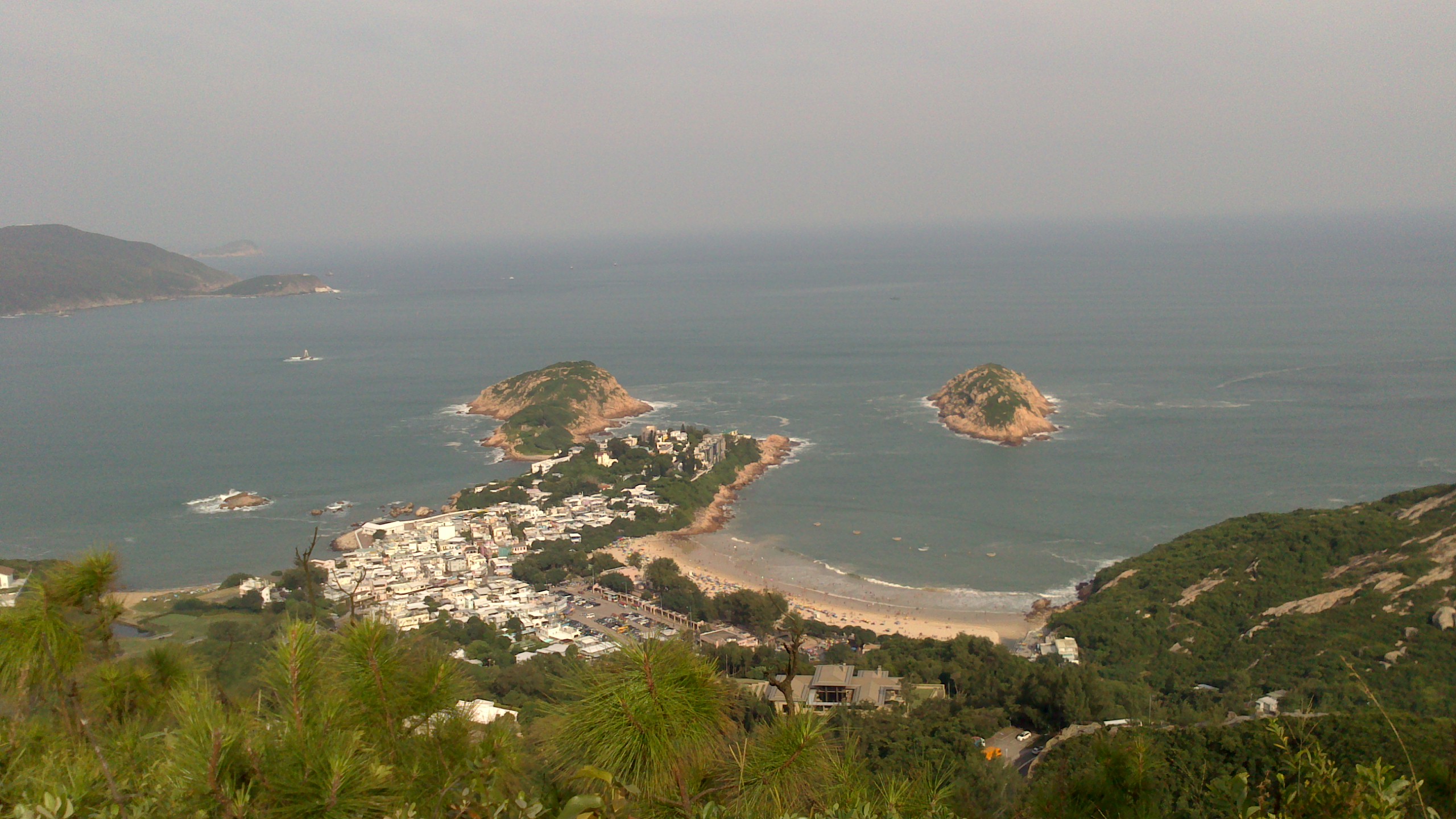
After the descent down a steep trail, there’s a beach in a small curved bay with a few surfers in the water and medium big waves; and the village of Shek O with a line of restaurants. The choice this evening fell on Thai food at a roadside restaurant. Excellent choice. All electrolytes and other post-hike necessities of life tastefully replenished in the course of 2 hours.

Usagi is expected to make landfall in Hong Kong on Sunday evening around 7. Hurricane Usagi is currently the most severe tropical storm of the year and the meteorological office has warned everyone to stay indoors and secure all doors and windows. We have three lovely bonsai trees on our terrace that survived the force 8 gale of early August, but Usagi is reputed to be a force 10, so we will borrow a hand trolley from a neighbour tomorrow morning and move the three heavy urns indoors.
Celebrating mid-autumn in Hong Kong
 Chinese Mooncake
Today, September 19th, is the day of the Mid-Autumn Festival that is widely celebrated in China and Vietnam, and the following day is a public holiday. It is a time when families traditionally get together to celebrate a good harvest. It coincides with the full moon on the 15th day of the eighth month of the Chinese calendar. It’s also called the Moon Festival because of the association with the full moon, or Mooncake Festival because these are eaten at this time. Typical mooncakes are round or rectangular pastries, measuring about 10 cm in diameter and 4–5 cm thick. This is the Cantonese mooncake, eaten in Southern China in Guangdong, Hong Kong, and Macau. A rich thick filling usually made from red bean or lotus seed paste is surrounded by a thin (2–3 mm) crust and may contain yolks from salted duck eggs. Mooncakes are usually eaten in small wedges accompanied by Chinese tea.
Here is a nice link with photographs of the festivities in Hong Kong, including a lantern exhibition and Fire Dragon dance performances.
Earth’s Carrying Capacity
A chance remark by an acquaintance about the world running out of food led me to revisit a paper written in 1979 by Prof. Cesare Marchetti, an iconoclastic physicist and materials scientist who likes to think outside the box. The title of his paper, published in the peer-reviewed journal “Energy” is “10 to the power of 12: a check on earth’s carrying capacity.” The full text of this paper is available here:
Click to access MARCHETTI-076.pdf
A second writer on this topic, this time in a book called “How Many People can the Earth Support, (WW Norton, 1995)” is Joel Cohen, a mathematical biologist. Check this link for a summary of the book.
Click to access how%20many%20people%20can%20the%20earth-%20cohen.pdf
Even if the contents of Marchetti’s paper are seen as a thought experiment using back-of-the-envelope calculations, it still is a remarkable viewpoint that is worth remembering when faced with everyday accounts of the seemingly intractable flood of problems facing humanity: land degradation, overpopulation, the coming water crisis, climate change, environmental refugees, desertification, deforestation, sea level rise, ice melts at the polar caps, stratospheric ozone loss, excessive ground level ozone formation through traffic pollution and so on. The list of problems is seemingly endless, and reading a newspaper seems to involve ingesting a daily diet of hopelessness. In contrast, here are the concluding sentences from Cesare Marchetti’s and Joel Cohen’s papers respectively below.
Marchetti: It seems that the problems of growth are basically of cultural character. The Judeo-Christian axiom that the earth is given to man to be dominated, very material to western aggressive and destructive attitudes, may progressively be substituted by the Buddhist axiom that the earth is given to man to be contemplated; thanks to an enlightened use of technology.
Joel Cohen: More than ever before, the land that supported people became a partly human creation. For humans now, the notion of a static, passive equilibrium is inappropriate, useless. So is the notion of a static “human carrying capacity” imposed by the natural world on a passive human species. There is no choice but to try to control the direction, speed, risks, duration and purposes of our falling forward.
The conclusions I draw from these two very different studies are the same:
- there is no shortage of potential threats to human existence (always has been)
- there is no shortage of solutions
- there is plenty of work to do, so no danger of long-term unemployment
- subtle shifts in the public perception of problems can have tremendous long-term implications (the speed with which such shifts can occur is only the truly new element in global dynamics).
Living on Lamma: Banyan Tree Bay
The principal town/village on Lamma Island is Yung Shue Wan, or Banyan Tree Bay. The beautiful Chinese Banyan, not very different from its Indian cousin is very much in evidence on the island, and seems to be a favourite refuge for several birds, including an elegant species of flycatcher and bulbuls with red cheeks and jaunty pointed crests.
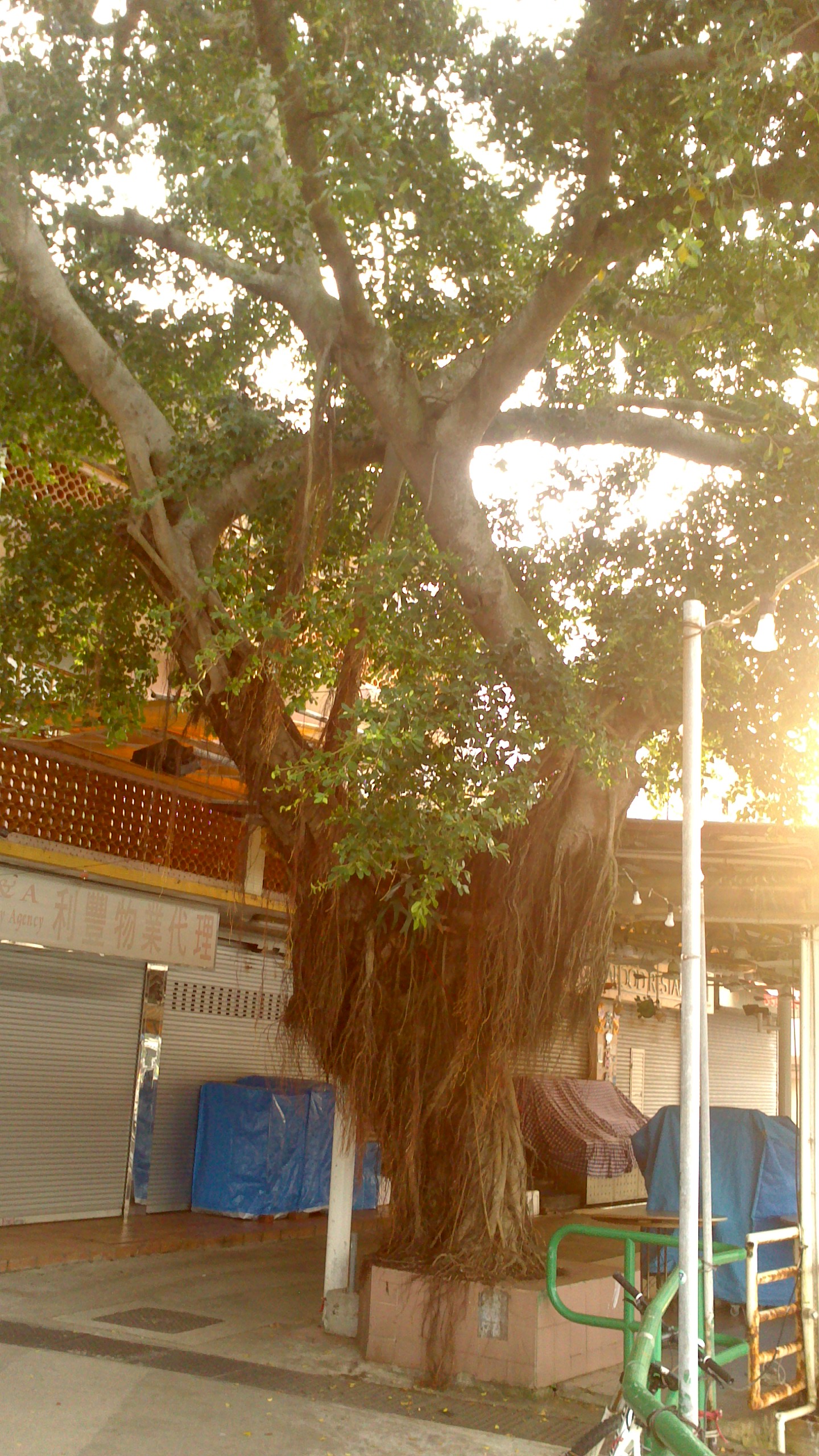
The roots of these strangler trees are commonly seen, and on steep hillsides they provide an invaluable service, holding the soil together and mitigating the effects of disastrous mudslides that occur frequently during the rainy season.

Banyan trees belong to the ficus family, and are related to the common edible fig, Ficus carica. Incidentally, the common name Banyan comes from the Indian word bania, meaning merchant or trader, or those who generally plied their trade in the shade of these trees.
Stories to Go: The Gardener
This story was begun as a fiction exploration to try and get behind the mind of a terrorist, while avoiding all the cliches of religious fundamentalism that are typically associated with it. After the first few paragraphs, the character took over and the story wrote itself. The portrait that emerges more resembles a reflection of Hannah Arendt’s “banality of evil;” a person almost complacently setting out to perform deeds with deadly consequences for others, a complacence compounded by the blessings of dubious spiritual leaders.
THE GARDENER
The man walked slowly, limping a little. “Walk in beauty among the flowers of His garden. The garden that you hold in trust for Him. And as you are faithful to your trust, so may you enjoy the flowers and the fruit of your labour.” He was neither religious nor contemplative, considering himself a doer rather than a thinker. But now the sun was hot and the lines came to his mind unbidden. They could have been from the great poet Rumi, a few of whose verses he had once read in a book years ago, but his friend and teacher the theologian had brushed them aside impatiently as irreligious and therefore irrelevant.
He had not been born with this defect, this impediment in his stride. In fact, he had acquired this disability only a short while ago. The sun was hot, the air still and he moved towards the glass doors set seamlessly in the concrete face of the building, knowing well the layout of its air-conditioned interior, knowing the cool darkness within.
He felt nothing as he was suddenly torn apart, his image split down the middle in two equal parts as the sliding doors opened automatically to admit him. The sweat on his face and beneath his shirt seemed to freeze the instant he stepped into the room. It was so cold inside he shivered. A nail in the leather sole of one shoe clicked softly like a record stuck in a groove as he walked across the polished marble floor towards the reception desk. Reaching into the depths of his loose and voluminous robe and the pretty girl behind the counter flinched as though she expected to see a pistol emerge from it. One could see she was an urban product, with little experience of peasants, disdainful.
She curled her lip at the wrinkled, soiled ticket he laid on the counter. She examined the ticket and seemed resentful that it was in order.
‘Have you any luggage?’ He did not answer the question, but slowly shook his head, eyes never leaving her face, drinking in every well-groomed feature, the carefully plucked eyebrows, the artfully shadowed eyes with mascaraed lids, the teasing touch of pink around her mouth, the provocatively painted slashes of her fingernails, the unfastened top button of her blue and red uniform revealing the beginning swell of her breasts. He read faint contempt in the curl of the lips and knew it was because of his clothes and their smell of sweat. Fundamental in faith, close to the earth, he was a gardener, unashamed of his dress, proud of sacred trust, determined to take the fruit of the garden that the holy book assured. The stains and the smell were of the earth, things to be proud of, proof of having done one’s duty.
He had seen this kind of reaction before, and thought he was indifferent to downcurled lips and veiled contempt. But it still got to him occasionally, as it did now. The girl sensed something dangerous and her insolent eyes, narrowed in disgust, widened momentarily in a flicker of fear. They quickly resumed their expression of boredom, but inwardly he exulted at the reaction he had produced in her. For one small second he had unleashed his carefully hidden resentment and she had flickered. She had caught a glimpse of the pride beneath the peasant exterior, seeing for an instant the real man and not a dust-covered clod.
He looked away, no longer needing eye contact, having proved a point to himself. Exaggerating his limp, drawing attention, certain that she was looking at his retreating figure now, he could feel her gaze in the small of his back. That in itself was quite a victory, but it was only the beginning. One had to take drastic action to attract the attention of jaded sophisticates, shake them out of their self-satisfied lethargy.
Had they no eyes in their heads? Were they blind to the beauties of the garden? Did they not see its flaws, the sprouting weeds, the fading beauty? The parched earth cried out for water, depleted and needing nourishment. Once you saw the connection, it was so simple. The garden had been neglected and now the people suffered. Whose fault was it? Who was to blame for the neglect? He asked himself the questions as he had so many times and answered them with a shrug. It did not matter whose fault it was. There was no point in looking back. He had to go ahead and do what he could do; replanting, transplanting, weeding and watering. “My garden that you hold in trust for me.” Yes, he would be faithful to his trust and the thought made him raise his head and hold it high.
He sought analogies from everyday life. He was like a man working for a company, an advertising company plastering a message across the country: come, see, buy. Our product is good. He was like an advertising executive. He smiled, liking the analogy. Yes, an advertising executive of sorts and today he would open a new account, gain one more customer. But when he thought of the product he was trying to sell, the analogy failed and the smile on his lips altered subtly; a faint alteration at the corners of the mouth and the smile was humorless, menacing, a snarl.
It was a nice airport. The air conditioned interior of the large arrival hall was well lit, the shops with plenty of goods on display, the twinkling lights of the duty-free store, offering a plenitude of perfumes, tobaccos and spirits to soothe the frequent flyer. There was a coffee bar with comfortable lounge chairs and enticing smells of exotic cooking wafted from the international restaurant at the end of the hall. The smell of food made his mouth water. He had been too nervous to eat before setting out. He fished in his coat pocket and found notes of various denominations, large and small. He counted the bigger notes and looked at the flickering digital clock on a television screen above his head. An hour and a half to go, time enough to eat.
He limped diffidently into the dimly lit restaurant and no one stared. On the contrary he was totally ignored. The waiters rustled by the table he occupied, frowning with intense concentration at orders just taken or deep in thought over conversations with the cashier at the counter. He fidgeted slightly, grateful for the subdued lighting, furious at being ignored yet thankful for it. When the tall, thin waiter brushed past for the third time he held out an arm and plucked the man’s sleeve.
“I’d like to eat,” he rasped at the waiter’s coldly polite, questioning glance. The man turned wordlessly away, but the next time he passed by, placed a menu card on the table. Squinting in the semi darkness, trying to make sense of the menu, the names were all strange so he simply pointed to one of the entries at random.
“Lasagna al Forno,” said the waiter. “Only during the lunch hour, between eleven and three. It’s four o’clock now.”
“Well, what can I have?” The waiter pointed to the bottom of the card.
“Yes, I’ll have that,” he said, wondering what kind of spring rolls they were and hoping they were big enough to satisfy his hunger.
“What will you drink, sir?”
“To drink? To drink… I’ll have some tea.”
The spring rolls to his disgust were dainty little rolls that merely increased his hunger. Fortunately tea was served in a large pot and he drank several cups. There was an old-fashioned clock in a prominent corner and its analog face glinted at him, ticking a reminder that there was only half an hour for his flight. He paid and thankfully escaped from the dark interior, blinking at the brightness of the main hall. They cursorily checked his passport at the emigration desk and waved him on. Beyond were the waiting lounges where passengers gathered to board their craft. One more barrier lay between him and the lounges, five curtained booths, three for men and two for women, each occupied by a security officer of the appropriate sex. The booth’s metal detector was out of order today as he had been assured it would be. He counted the booths, third from the right and to be sure counted again, third from the left, the middle one.
Thrusting self-doubt and second thoughts aside, he boldly parted the curtain and entered this booth. Yes, this was the man, the description fitted. He looked at the security officer in the tiny booth, saw the start of recognition in the man’s eyes. Unlike him the man was pale and thin, equally tall, but clean-shaven and crisp in a well pressed uniform whose braid rasped like a file when he moved..
“Passport,’ said the officer, holding out an imperious hand. The accent betrayed good education and the faint tremor of the hand revealed nervousness. He handed over the passport. Already in those two syllables, he could detect the guard’s origins, humble as his own though well disguised. He looked at the officer’s impassive face in sympathy.
Nothing can take your origins away from you, he thought. Wherever you go, however high you rise in the ranks, you will always be branded by your speech. You will open your mouth to speak words of wisdom, but they will only hear the intonation of your words, not their meaning. And hearing the sounds, will nod their heads wisely and say, “Here is another one of those rough-necked peasants who’s forgotten his place.” Afterwards they might smile at you in friendly greeting, acknowledge you with words as one of their own. But in your heart you know you can never belong to them. You belong to us.
“Have you anything to declare?”
“What?” He could not believe the security guard’s question, his silent soliloquy interrupted.
“Are you carrying any liquids, sir? Shaving creams or after shave?”
“No. Of course not.” He realised they could be heard in the adjacent booths. “No. I’ve nothing to declare. You can search my bag,” thrusting it forward. The guard searched briefly but thoroughly, not expecting to find anything there. He looked up with troubled eyes, ritual completed. ‘You can go through now.’
The departure area was full of passengers. He mingled with the crowd and the hostess was already collecting boarding cards from those nearest the gate. She smiled professionally as he filed past and gave his card. He liked that. She had looked at him with steady brown eyes, really looked at him, seeing the sweat and the stains on his clothes, and she had not flinched. If there were more like her in the world, he thought, he would not have to do what he was going to do. She was surely one of the flowers in the garden that the holy book spoke about. He looked at the flower with possessive pride, suddenly yearning to cup its fragile beauty in his protective hands. Yes, he would do that. Later, much later, for now there was work to do.
The bus ride was short and he was in no hurry to enter the aircraft, knowing his seat was right in front of the tourist section, separated from the first class passengers by curtains, the galley and the flight attendants’ cramped work area.
When he reached his seat, he found the brown eyed girl at his side. She had noticed his limp and helped him stow the small grip in the overhead locker, making sure he fastened his seat belt before moving on to inspect the next row of seats. He was in no hurry and felt no fear at the vibrating lurch of the aircraft speeding down the runway, the sudden stillness as they left the ground, the strong sensation of his stomach pulling away from him as they climbed steeply. He felt no fear because he was concentrating on his task, thinking of what he had to do.
He waited till the aircraft had levelled off and the seatbelt signs went out. He slowly eased to his feet and the girl was solicitously at his side again, raising the arm of the seat, making room. She caught his look of gratitude and smiling touched his arm, pointing him in the direction of the toilet. He shuffled to the tiny cabin and once inside lowered his trousers and relieved himself, careful to direct the stream into the center of the bowl and not splash like a peasant. When he was finished, he lowered the seat and squatted with his right leg stretched before him. He slowly unwound the bandage and freed the dully glinting metal. He rested for a few minutes, kneading the cramped leg and restoring circulation.
He thought of the brown-eyed girl, her unflinching eyes, her ready help and friendly smile. He felt suddenly lonely. Lonely and old. If only he had someone like her, if she were on his side, young, fresh, cheerful…
He sighed. This was the problem. In carrying out divinely appointed tasks, he had left the world, mere mortals and desires of the flesh, far behind. If divine will decreed that she survive this mission, perhaps he would come down to earth for a few moments with her. But right now, he had a sacred responsibility to fulfil and no time for earthly charms.
Bombs as Peacemakers?
Newspaper reports about the conflict in Syria increasingly point to a likelihood: that certain strategic Syrian targets will be bombed by the US, with or without its allies. This is to punish Bashar Assad for having allegedly used chemical weapons against defenceless civilians. Horrible deed. The perpetrator deserves to be punished. If Assad personally ordered the killings, will the bombings target him personally? Most likely not. A large number of innocent bystanders will probably be killed. So who is punished by bombing? Is peace likely to result? The answers are, respectively, don’t know and probably not.
The International Peace Research Association profiles over 450 undergraduate, Master’s and Doctoral programs and concentrations in peace studies and conflict resolution spread over 40 countries and 38 U.S. states. The total expenditure on all these 450 programs can be estimated at US $ 4.5 billion annually. The Stockholm Institute for Peace Research (SIPRI), in its authoritative yearbook estimates that global military expenditure was US $ 1,753 billion in 2012, equivalent to 2.5 percent of global GDP. If these relative expenditures are taken as a proxy for the choice of war or negotiation to settle global conflicts, then the outlook for Syria is very grim indeed.
For further analysis and alternatives to the use of explosives as peacemakers, see Dr. John Galtung’s essay on a path to peace for Syria that appeared on al-Jazeera more than a year ago. http://www.aljazeera.com/indepth/opinion/2012/04/201241785537516373.html
Oil Companies Step into the Sunlight
It has been fashionable in green circles to portray oil companies as a major part of the multinational axis of evil that feeds global warming, contributing to the destructive exploitation of our planet, driven by their greed for profit. This blogger has been of the opinion that, ironically, oil companies are among the best equipped to handle the technological challenges that face large scale deployment of renewable energy technology. Compare the technical challenges of setting up large offshore wind farms or drilling from a deep-sea oil platform; installing ocean energy conversion devices, wave generation or tidal flow streams in rough coastal waters; think of the setting up of large scale solar thermal plants or solar PV farms under Saharan conditions. All of these ventures require a high degree of engineering skills and huge amounts of capital; all of which are in plentiful supply at oil companies.
There are visionary leaders among the oil companies who see that the transition to lower carbon fuels was inevitable. BP for one, under the leadership of John Browne, briefly tried to recast itself in the late 1990s as a company “Beyond Petroleum,” but the initiative was defeated by market forces, the world’s insatiable demand for more and bigger cars, and the success of the oil companies themselves in finding ever more efficient ways of secondary and tertiary recovery of oil from wells that had long been considered pumped dry. And now another development to slow the adoption of renewables, the plentiful availability of natural gas through fracking. In addition to being awash in natural gas, the US is set to overtake Saudi Arabia as the world’s second largest oil producer, behind Russia.
Despite all these seeming setbacks to renewables, it is increasingly accepted by research and advisory groups within the oil companies themselves that the large-scale transition to renewable sources of energy is inevitable. BP notes in its 2012 annual report that oil demand has fallen in six of the last seven years, as has coal. Here is a link to several scenario studies by Shell that postulate what the transition could look like. The energy output from renewables worldwide today has reached the level forecast for the year 2025 by the International Energy Agency in 2000, I would similarly argue that Shell’s renewables forecast for the year 2070 will probably be achieved by the year 2050, if not earlier. Predicting future developments is always uncertain, of course, but it is the strength of our collective beliefs and actions today that will determine our tomorrows.
http://www.shell.com/global/future-energy/scenarios/new-lens-scenarios.html
Lamma Island: View from the Top

We feel very privileged to live on Lamma Island, that is home to a relatively quiet rural community, just 25 minutes ferry ride away from the high rises, high life, high fashion and high prices on Hong Kong Island, adjoining Kowloon and the other mainland areas of the Special Administrative Region, as it is called ever since the transfer of sovereignty (referred to as “the Handover” by the English language international press, and “the Return” in mainland China) in 1997.

Our coming here adds to an ongoing problem for the local population, as new immigrants drive up land and housing prices; the age-old conundrum in every country that seeks added income through increased tourism or external investment. In this regard, Austria comes to mind as an exceptional country, where tourism is a large contributor to the economy that manages to raise the standard of living of the local population without pricing them out of the housing market. Opinions on this from some of my economist friends welcomed here!

Latest Posts
-

December 2021 Newsletter
Originally posted on The Forest Way: A photo essay Most wonderful wishes and best regards to all, for the start of a fresh, healthy, environmental…
-

A Tree Planting Update
I begin this post with an apology. I have posted only sporadically this past year, and the reason is not Covid as one might think.…
-
The Standoff explained: Modi government vs. Indian Small Farmers
The is basically a battle for the future of Indian agriculture. It is also a battle of two opposing philosophies: Small is Beautiful vs. Big…
-

The True Source of Wealth
Many years ago an economist friend told me to invest in stock index funds rather than property. He pointed out charts comparing property prices and…
 aviott