Touched by the Invisible Hand
I bought a motorcycle for extensive local travel in an Indian city. A few friends and most of my middle class extended family were aghast when they heard. This is a form of suicide, they said. Look at the state of traffic on the roads. You need to protect yourself in a car.
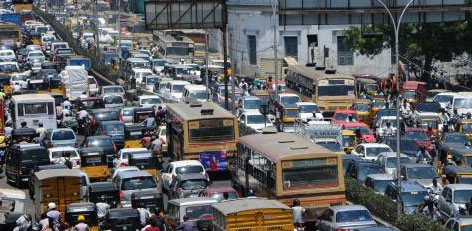
Image: courtesy livechennai.com
Here are my answers to the criticism. First, there’s enough pollution already, and I’d rather travel at 55 km/liter with a 100cc motorbike rather than around 20km/l with a small car. Of course, the best alternative would be an electric vehicle powered by renewable energy, or else public transport, but neither of these options is currently practicable for my purposes.
Second, as the image above shows, progress is much faster with two wheels on congested roads. And third? I was reminded of the third reason this week when I had the painful news of a dear friend killed in a freak traffic accident in a European city, one of the safest cities in the world. I grieve at the loss. My take from the deep sadness I feel is this: seize the day, live as carefully and as well as you can, but follow your heart and do as you think you should do.
From Wellesley to Wellington: Auction Sale for Nostalgia Buffs
I recently attended a Vernissage of watercolor paintings by Chennai based artist Vikram Verghese. Several of his paintings caught my fancy and I bought the one pictured below, mainly as a gesture of solidarity with a talented young artist. I also had another thought at the back of my mind. A friend had remarked at the exhibition: “Why don’t you auction it afterwards to raise money for the rural education center you’re helping to build?” It appeared to be a splendid suggestion and that’s just what I’m doing here.

Ruins of Wellesley House, Fort St. George, Chennai, India, home of the future Duke of Wellington, 1798-1800. Watercolor by Vikram Varghese
The painting below is on sale to the highest bidder. Floor price €1000 (or US$ 1060/Rs. 72,000). This should be sufficient to buy almost 2 kW worth of solar panels and battery storage at today’s prices. The excerpt below is from an article by local historian S. Muthiah, who explains why the ruined building shown in the painting is historically significant. It appeared in the online edition of “The Hindu” newspaper on the 13th February 2017.

FEBRUARY 13, 2017 00:00 IST
My favourite bed-time reading the past couple of years has been the Richard Sharpe series by Bernard Cornwell, in which he puts his hero in the middle of battles from Seringapatam in 1799 to Waterloo in 1815, Cornwell has Sharpe the foundling rise from private to officer through 16 campaigns the British fought. They’re a fun read at one level, but to me the books are much more. They are brilliant, well-researched descriptions of battles and wars with often a bit more than a nod to the political history of the times.
Throughout the series there is a Sharpe-Arthur Wellesley relationship which began in Madras. In my latest read, the connection cropped up again. Coincidentally there arrived an invitation for a water-colour exhibition,Disappearing Dwellings by K. Vikram Varghese, and on its back cover was a picture of a dilapidated house, a house almost collapsing. That house was where Wellesley had lived from his arrival in Madras in 1798 as the Colonel of the 33rd Regiment (after having bought his commission) till he marched to Seringapatam in 1799 during the Fourth Mysore War.
This building, Wellesley House , was built in 1796 and is one of the 16 Archaeological Survey of India-protected monuments among the 30 or so buildings in Fort St. George.
The portion of the house seen in a state of collapse met that fate during the 1980 rains.
Since then, though the main portion still stands tall, talk of restoring the buildings gets nowhere due to territorial rivalries.
With talk of the Army moving out of the Fort, very likely sometime this year, perhaps the ASI will get around to restoring this historical building as well as its protected neighbours and then make a bid for World Heritage Site status for Fort St. George.
Why ‘historical’? Arthur Wellesley took his first steps to serious soldiering while living in this house and went on from here to eventually become the Duke of Wellington, a military legend who had while in India sworn by the Madras Regiment.
Anyone interested in bidding can make an offer on the E-Bay listing at this link. This auction ends in a week, on the 5th of March, 2017.
A Retirement Present (or) How Corrupt is India?
This is a true story. Names have been suppressed in order to protect the identity of individuals involved, even though the events described here happened two decades ago.
Prologue: He had arrived with his wife in India from another country in order to adopt a child. For reasons that do not concern us here, the couple had decided to go it alone, rather than through one of the agencies that acted as intermediaries for the prospective adoptive parents in their home country. They had been through a series of interviews with psychologists, and their domestic situation had been thoroughly vetted by social workers in the home country before they were given an official seal of approval as suitable adoptive parents.

Inner courtyard, Chennai. Watercolor by Vikram Varghese.
The Story: Armed with this preliminary paperwork, the prospective parents began to read up about adoption laws in India. Friends told them of informative TV documentaries that they should watch. One such documentary was particularly painful to watch, since it highlighted the worst malpractices that occurred in various parts of India. They accepted the contents as the unvarnished truth, since it was after all produced by a British documentary film maker of high repute. After the prospective parents had completed their due diligence, they decided to narrow their search to the four southern states of India. Kerala was eliminated as an option early on when they discovered that foreign adoptions were not permitted here. They travelled to cities in two of the other three states before they finally decided to further narrow their search to Madras (Chennai today) the capital of the state of Tamil Nadu, where they had contacted several organizations.
Going simply by gut feel, they eliminated the first two institutions they visited. The people in charge either seemed untrustworthy and shifty-eyed, or the institution seemed too affluent (were they selling children abroad for profit, and if so, how did the children come up for adoption?). There is no absolute certainty in life, but they wanted to be as sure as possible before they made their choice.
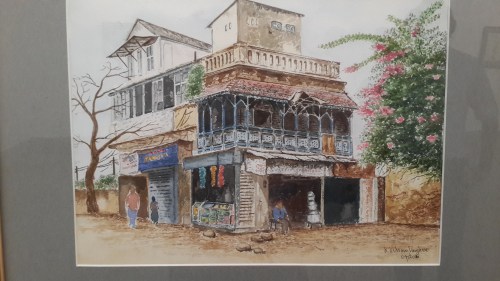
Old homes become highrises. Watercolor by Vikram Varghese
Their third visit was to an organization that was run by a foundation of some sort. The Director of the place was soft-spoken, was dressed elegantly but not ostentatiously, was obviously well educated, and from her name they could infer that she was a Muslim. They were given a tour of the place and met the matron in charge of the crèche, who spoke reasonable English. The matron wore a white cotton sari with a blue border, a pendant in the shape of a cross, and a name tag with a Christian name. Half a dozen women in colorful saris tended to the twenty or thirty infants in the crèche. Some of them wore bindi on their foreheads. The people working in the orphanage seemed like a friendly microcosm of India, with people of at least three faiths working together in harmony, so they decided to apply to this institution.
Back in her office, the Director was firm and clear. As foreigners, they came into the third and lowest category of adoptive parents. First preference was given to Indian nationals living in India. Second came Indian nationals living abroad. Foreign nationals came third in priority and could only adopt children who were not chosen by the first two. This usually means, she concluded, that the child you might get for adoption will be a dark-skinned female. Indian parents usually prefer to adopt boys or light skinned girls.
The couple returned to their home country and three months later, had a phone call. As always happens, the long-awaited news came out of the blue. There was a child available for adoption. A female child, with a very dark complexion that was a year old and had not been adopted by Indian parents. Come to India, and be prepared to stay for 2 or 3 months till the paperwork gets done. They arrived in Chennai, were fortunate to stay in a private home instead of a hotel, so were allowed to bring their new daughter home from the orphanage with them till the adoption formalities were completed. They had six weeks to complete all the legal paperwork before the High Court closed for its 2-month summer recess. To paraphrase Longfellow, the mills of the legal system in India grind exceedingly small and they grind exceedingly slowly. With the result that, three days before the High Court closed for summer recess, they still had 28 stamps, seals and signatures to gather from various offices before the adoption was complete and legal. This number of attestations, they were told, normally takes about a month to procure. A huge setback! They had to get back to their jobs in ten days. They could not take the child with them, which meant she would have to go back to the orphanage for three months, an emotional catastrophe, considering how quickly she had bonded with the adoptive parents. To the child, going back to the orphanage would be like a second abandonment, a betrayal of trust that would undoubtedly deepen whatever emotional scars she already carried. In desperation the father cast about for someone, anyone, who could help speed up the process. An acquaintance told him of a Mr. Fixit, someone who might manage the impossible.
Mr. Fixit was slim, mustachioed, dressed in khaki trousers, white bush shirt and black leather shoes; the kind of non-uniform worn by off-duty policemen and government clerks. He heard the whole story from the distressed adoptive father.
“I’ll do it. Give me five thousand rupees, half in advance. And one thousand for expenses.” he said. There was no time for character evaluations or trustworthiness assessments. There seemed to be no choice. The father handed over 3500 rupees. “Wait in the court, in front of the judges’ chambers, for the next three days.” And with that, Mr. Fixit disappeared.
The father did as he was told. It was the end of April, approaching the hottest season of the year, the “Agni Natshatram – fire star” days of May, so he waited in the shade of a banyan tree that grew in the high court grounds. Merely breathing in the heat was exhausting, so he sat on a nearby bench whenever he could, rising hopefully whenever he saw a file carrying clerk emerge from the judges’ chambers. Courts closed at 5 pm, as the blazing heat of the day began to wane. Mr. Fixit appeared an hour after the court closed on the first evening, triumphantly waving a sheaf of papers. “I got the first six today!” Six down, twenty-two to go. In two days. It seemed impossible at this rate.
“Don’t worry. It’s difficult, but not impossible,” Mr. Fixit reassured.
Day two. Another long day’s fretful waiting, hopping impatiently from sun to shade to bench. Too anxious to eat lunch, impatiently gulping water at noon to quench a raging thirst, too nervous to move away even to a toilet. What if there were last minute questions and he was not there to answer them? At the end of day two, Mr. Fixit emerged again from the labyrinth. “I got the next seven today.” Was there a trace of despondent weariness in his face? Hard to tell. “Tell me you can do it,” the father rasped anxiously. “Yes, yes. Leave it to me.” Thirteen down, fifteen to go.
Would it help to offer more money? Mr. Fixit hesitated, thought for a minute. No, he said. This is more than enough.
Day three. The tension was unbearable. Fatigue settled in waves, batted away by bouts of anxiety. Another eight-hour day, mostly on his feet, moving from sun to shade to bench, with an occasional walk around the courtyard. He saw Mr. Fixit move between offices, sometimes empty handed, at others clutching an ever growing sheaf of papers. Finally, a few minutes past 5 pm. Closing time, and the beginning of the two month summer break. It would break his heart to have to drop the little girl back to the orphanage, unclasp those trusting fingers that twined around his thumb every time he entered the room. But there was no chance that the man could have done it. Not here; not with this kind of bureaucracy. Mr. Fixit approached him at ten minutes past five. He held the sheaf of papers, and there was exhaustion and a touch of despondency in his step.
“And?”
“Sir, I tried. I’m still trying.”
“What is there to try? I’ll give you the rest of the money I owe.”
“No, sir. You do not pay till I finish the job.” Then he explained. “I got up to stamp number 22 by 3 pm today. And then, the clerk who has to sign number 23 was not at his desk. He retires today, his last day of work after 30 years of service in the High Court and he’s been out at farewell parties all afternoon. No one could find him. So I contacted all the others, number 24 to 28 and told them about your case. They all said they will wait in their offices till I find the missing clerk to put his seal. So now you come with me sir. We’ll go and wait for him.”
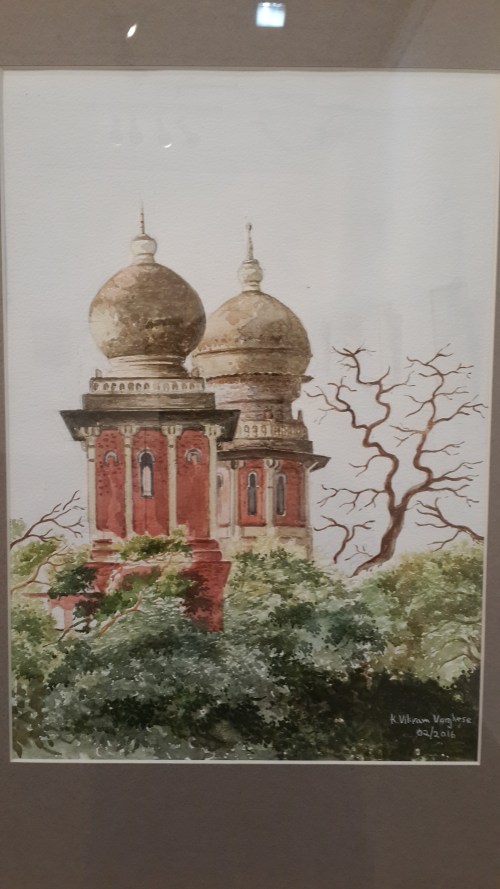
High Court building, Chennai, Indo-Saracenic architecture. Watercolor by Vikram Varghese
I walked into the rooms with Mr. Fixit, unbelieving. The High Court clerical offices were like government offices all over India, relics of the British raj, corridors lined with steel almirahs bulging with case notes, dockets, files tied with string, pages of brown and yellowing papers held together with office clips or rusting staples. From one empty desk to the next. A few clerks were packing up their desks, carting away most of their personal possessions before the long summer recess. One desk was still piled with papers, on top of which lay several gift-wrapped presents, a paper plate with a half-eaten bonda and chutney, a glass of cold tea.
“This man,” Mr. Fixit indicated the desk, “is still out celebrating. He should be back soon.” They pulled up chairs and waited for ten minutes in the now deserted hall. Finally a short smiling man appeared, with crumbs of cake or pakora on his three day growth of beard and looked inquiringly at the two men. “Yes?” Mr. Fixit rose to his feet and began to explain.
“Yes, yes, yes. I know about the case. Five people told me at the farewell party. This is the gentleman?” He looked long and hard at the stranger. The father leapt nervously to his feet, and instinctively reached for his wallet. The clerk looked at Mr. Fixit and beckoned with imperious crooked fingers.
“The papers.” He grabbed the papers, signed on the last page, took two separate seals from his draw, inked both on a worn pad and stamped the paper with loud bangs. “There!” After the days of waiting, the father was beside himself with gratitude, even though the man was merely doing his job. He took out his wallet. The clerk stopped him with a quick gesture.
“Sir. I want no money from you. After thirty years of service in this court, on my last working day, what a retirement present you have given me! It is a privilege to see what my stamp on a paper means to someone. Keep your money sir, and thank you for giving me the chance to do one good deed before retirement. I wish for your daughter a life full of God’s blessings.” The clerk was beaming now, a dark cherub with a three-day growth of beard and crumbs on his face. But there was only time for hurried thank you, thank you’s before Mr. Fixit dragged the father to other offices where clerks number twenty-four to twenty-eight impatiently waited, almost an hour after closing time, seals and signatures at the ready. At all of these desks, the by-now delirious father offered money but met with the same response. “No sir. You are doing a good deed. We wish for your daughter to have a good life.” The last four stamps, seals and signatures were obtained in ten minutes, probably an all-time record for any High Court in India. At precisely one minute to six, Mr. Fixit handed the papers to the father with a flourish.
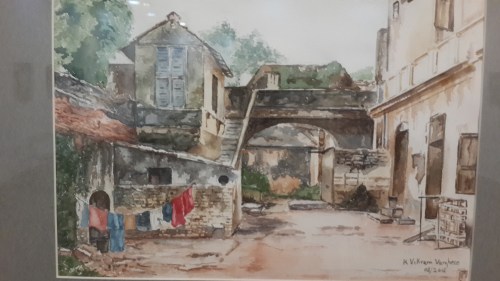
Disappearing Dwellings, Chennai. Watercolor by Vikram Varghese
Epilogue: A few days later the parents visited the orphanage with their newly adopted daughter to wish the staff good-bye. The child was kissed and hugged and caressed by all the staff and finally they sat down for a chat with the Director, the child seated in her lap playing with a pendant. The parents expressed their gratitude to the Director and to the foundation that ran the orphanage, remarking on how well it was run, contrary to their expectations, especially after having seen the TV documentary a few months ago.
“Wait a minute. A documentary? Was it by so-and-so?”
“Yes it was.”
“Interesting! He came here, you know, two years ago, while he was filming. He looked around the place. I told him, why don’t you show something of this place? Why not show a good institution? Not just the bad ones. But he wasn’t interested. They left without taking a single photo of this place.
Corruption: How corrupt is India? I honestly don’t know, having spent twenty-seven years in this country without paying a single bribe. I know someone, a fairly successful businessman, who claims never to have paid a bribe during his entire working career. I know many more, equally successful, who say it’s impossible to do business here without greasing palms all along the way.
Which is true? Both narratives are equally true. Transparency International ranks India 79th on its 2016 index of the most (or least) corrupt countries in the world. India’s close neighbors in this index are Brazil, China, and Albania. I have no idea how corrupt China is, but I do know that China’s infrastructure is far superior to India’s and things seem to work far better there than they do in India. However, in the worldwide rush to industrial prosperity, chasing the American dream (with, perhaps, the exception of Bhutan), I fear the world is losing its soul.
Is this single-minded rush to wealth (and exploitation of the earth) the reason why so many amoral leaders seem to come to power in America and other countries around the world? If so, I begin to think that this country (India) has something unique to offer the world. I think back to the incident at the High Court and dozens of other random acts of kindness and grace that I experienced and accepted unthinkingly, as a matter of course. Today I feel that there is some deep spring of spirituality among its people that has nothing to do with religion, but is a product of time and space, centuries of invasion, centuries of adaptation and forgiving. So perhaps, despite its low ranking on the Transparency International index, the soul of India can show the world the way ahead in the turbulent and troubling years to come.
All watercolors pictured above by Chennai-based artist Vikram Varghese.
In a nutshell, (or) A Nut in a Shell
Where to begin? Needless to describe the sense of loss and dismay as a gracious, thoughtful, highly intelligent family man is replaced by a blustering, orange-hued womanizer who seems to have no respect for anything other than power, wealth and glitter. For better or for worse, the US has been regarded as the leader of the democratic world for much of the last century. In this role, it attracted some of the best and brightest of the world’s young to its universities. They stayed on after graduation, started businesses that thrived and helped make the US the global business and financial powerhouse that it is today. Much of that lustre, also called soft power, has been lost in the past decade, ever since the US began its war on terror and the futile armed incursions in the Middle East.

Image: courtesy wikimedia commons
Chaining the Twitterati: OBAMA CARED

Obama Cared
Now that the current US President and his administration is intent on dismantling everything that the previous president has accomplished, regardless of cost to the nation and the world, it is time to speak of his signature health care program in the past tense and say: OBAMA CARED.
If you, like millions of others around the world, are concerned about petty minded twits who spread their message of hate in a stream of tweets, here’s a positive way to counter their malice. Check out the website of young New Yorker Esti MacInnes at “EstiMadeAnEtsy” for silent ways to stand up and be counted.
Blades of Grass
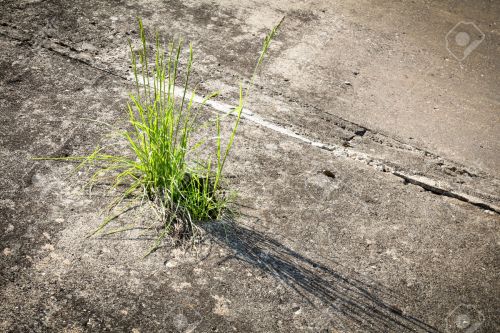
Image courtesy 123rf.com
The recent accession of climate change deniers to positions of power (no names here!) is very depressing news for those millions of people around the world who don’t totally distrust all media, mistrust all scientific research, or contradict factual evidence. Nevertheless there are many examples of happenings around the world that might not make international headlines because they are not (yet) economically significant. Economically significant or not, these actions are ecologically significant in a global context. These are actions that need to be emulated a hundred-fold, a thousand-fold, a million-fold, in the decade to come. A climate scientist friend told me years ago that the world would not act on the climate issue until it became a globally self-evident crisis. And then, he said, people would come together out of the woodwork at the last minute, to do what is needed to save our planet from irreversible changes; for example, in the interplay between circulation of deep ocean waters and the quantity of atmospheric carbon dioxide absorbed by them.
What follows is a short, incomplete list of the various ways people are coming out of the woodwork.
The 2017 Women’s marches around the world could be a powerful harbinger of things to come. According to Wikipedia: The 2017 Women’s Marches were a series of political rallies that took place in cities around the world since January 21, 2017, with the goal of promoting women’s rights, immigration reform, and health care reform; to counter Islamophobia, rape culture, and LGBTQ abuse; and to address racial inequities (e.g., Black Lives Matter), workers’ issues, and environmental issues. There is a sea change here. The Women’s March took place in cities on every continent. It was a spontaneous coming together on a multitude of human rights issues, much bigger causes than merely protesting against He Who Will Not be Named, he who was merely the catalyst that brought the marchers together. Like blades of grass that probe and emerge through the hardest concrete, these marches are the peaceful means to crack the brittle edifice of patriarchal structures the world over.
Three examples from India, where I happen to be at the moment, underline the environmental component of this sea change:
The small town of Meenangadi in Kerala has pledged to become the first carbon-neutral panchayat (rurally governed community) in India. And they expect to do it by 2020. Here’s an explanation of why they are doing this and what steps are being taken to achieve this goal.
In nearby Cochin (or Kochi, as it has been named by the local administration), the International Airport, call sign COK, is the world’s first completely solar powered airport. BBC News, October 2015.
At Kamuthi, near the town of Madurai in Tamil Nadu, the world’s largest solar power plant built on a single site was completed in 8 months, covering an area of 10 sq. km., with a capacity of 648 MW. Al Jazeera, November 2016. Meanwhile in China, this is topped by the Longyangxia Dam Solar Park with a peak output of 840 MW from solar panels clustered at two adjacent sites near the reservoir.
Other blades of grass sprout everywhere. In Vienna, after the election victory of You-Know-Who on 9 November, hundreds of volunteers went out on to the streets to campaign for the green party candidate in Austria’s presidential election. These volunteers were campaigning against scare-mongering and fear-of-the-other tactics that are habitually practiced by right wing demagogues, unfortunately with some success in the recent past. In many countries around the world, people fed up (pun intended) of industrial agriculture are turning to food production in their back yards, on window sills, on terraces. This awareness of the source of our nutrition makes people appreciate its literally life-giving qualities, bringing back the sanctity of producing our own food. The process brings people together in simple ways and promotes communal harmony. Mayors of cities around the world are networking together to circumvent the inaction of their politicians and lawmakers. I see green fields around the world where millions of tender blades of grass crack the concrete of established practice. I see this in the near future, if the millions who have marched will it so. It’s time now to march, plant, demonstrate, protest, cooperate, sow, reap, make your voice heard, switch off your TV, get off your couch, harvest potatoes, get active.
For more by this author, see his Amazon page here, or the link to Google Play where you can download free sample excerpts from his books.
On Wrestlers and Faceless Women
I saw a Hindi movie called Daangal a few days ago. A true story of amateur wrestler Mahavir Singh Phogat in Haryana who raised six girls (four daughters and two nieces whom he adopted on the death of his brother) to be world-class wrestlers who have won many international championships. From a social standpoint, the most remarkable thing is that Haryana is the state with among the worst male/female sex ratios in the country (in 2011, 877 females for every 1000 males). This negative sex ratio is a reliable indicator of low status of women in a society. One can only imagine the real-life battles the Phogat girls faced, in overcoming traditional rural prejudices, cutting their hair, uncovering their faces, competing in early tournaments with boys, finally winning respect by beating many of their male peers and winning championships.
Even though some of the details in the film are untrue, or exaggerated for dramatic effect, there is no disputing that the greatest victory of these young women may not be counted in medals won in the wrestling arena, but in society as a whole. Changes in a society happen in a thousand unexpected ways. Their victories on the floor of the wrestling arena may be reflected in unrelated events in a community. One such example appeared as a feature recently in a Sunday newspaper. In this story, Mahima Jain tells of three women fighting the ghunghat (face veil) in Haryana’s patriarchal stronghold of Faridabad. They wish to show no disrespect to their elders, but also wish to be free of the restriction imposed by the veil. One of them is an educated woman who works in the city with head uncovered all day and sees no reason to cover her face as soon as she returns to her village home.
This news story shows that gender discrimination does not stop with rural, uneducated women, but also affects intelligent, articulate women with advanced educational degrees. As Hans Rosling powerfully shows through statistics in the video posted on this blog earlier in January (Reading the Tea Leaves: a primer for 2017), true development happens in a nation when gender discrimination has been largely overcome. By this definition, there are very few truly developed nations in the world; merely rich ones, poor ones and increasingly, widening gaps within societies between rich and poor.
One amusing and unexpected similarity between the real-life female wrestlers and their film counterparts: the professional wrestlers look just as elegant and sophisticated as the actors who play them in the movie. Check out the photos below without reading the captions first and see if you can tell who’s who.
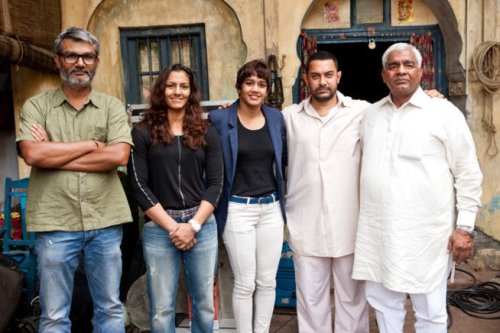
publicity photo from the film
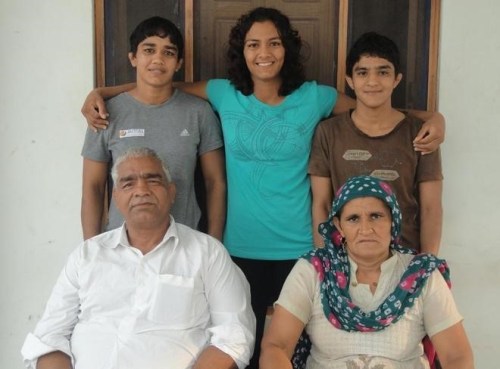
3 of the 6 girls with their parents. Image courtesy thebetterindia
For more by this author, see his Amazon page here, or links to his 4 books on the Google Play store.
Fossil Fuels are for Dinosaurs II
Wake up, Donald et al.! According to the Guardian of 6 January 2017,
China now owned:
- Five of the world’s six largest solar-module manufacturing firms
- The largest wind-turbine manufacturer
- The world’s largest lithium ion manufacturer
- The world’s largest electricity utility
“At the moment China is leaving everyone behind and has a real first-mover and scale advantage, which will be exacerbated if countries such as the US, UK and Australia continue to apply the brakes to clean energy,” he said.
“The US is already slipping well behind China in the race to secure a larger share of the booming clean energy market. With the incoming administration talking up coal and gas, prospective domestic policy changes don’t bode well,” Buckley said.
For more by this author, see his Amazon page here, or links to his 4 books on the Google Play store.
Out of Africa and from the Middle East
Food for thought for those in many countries around the world who wish to permanently stop immigration of ‘foreigners.’
When the first migrants left Africa 75,000 years ago for the Cradle of Civilization — modern Iraq and Kuwait — Stoneking and his team estimate there were fewer than 100 people. They suggest there were just 15 men and 26 women. They also point to a Bering Strait crossing, from Asia to North America, around 15,000 years ago, as is commonly accepted.
Source: M. Stoneking, et al. Human paternal and maternal demographic histories: insights from high-resolution Y chromosome and mtDNA sequences. Investigative Genetics. 2014.
For more by this author, see his Amazon page here, or links to his 4 books on the Google Play store.
Reading the Tea Leaves: a primer for 2017
I recently saw a snippet of an interview with actor Denzel Washington where he talks about the media. “If you don’t read the news,” he says, “you’re uninformed. And if you do read the news, you’re misinformed.” There’s a lot of truth in that statement. However, it’s one thing to read the news as an endless litany of the day’s evils all over the world, and quite another thing to seek out those media that offer in-depth, thoughtful news coverage of trends that shape the world. In the latter type, there is more information on the trends that shape events rather than on sensational local events with no geopolitical significance. Social media is not all bad. In fact, like most technology, good or bad depends on how you use social media and whether you feed off it indiscriminately or choose to sip from the nourishing bits on offer. Gandhi apparently once said: life is like a mirror; if you smile at life, it will smile back at you. Keeping that in mind, go ahead and read news roundups of the year 2016, which has been a pretty horrible year.
But remember that mirror and keep smiling for 2017. Here are some things that the daily news stories do not say. Or if they do, not as headline news but only buried on an inside page. Below is a post by stalwart statistician Hans Rosling that shows unmistakeable positive trends in the world today. I encourage you to sample at least a few minutes of it, and if you’re hooked, there are plenty more by him on YouTube.
I suspect that most of the people who voted for Brexit and the current US President-elect are unaware of the basic facts illustrated by this lecture. In an earlier blog, I cited a quote by Karl Menninger that said: attitudes are more important than facts. Very true, but if facts are accepted to be true they can help to change attitudes. Whatever the year 2017 brings, there will certainly be a lot of surprises, so don’t forget to smile at the mirror of life.
For more by this author, see his Amazon page here, or links to his 4 books on the Google Play store.
Latest Posts
-

December 2021 Newsletter
Originally posted on The Forest Way: A photo essay Most wonderful wishes and best regards to all, for the start of a fresh, healthy, environmental…
-

A Tree Planting Update
I begin this post with an apology. I have posted only sporadically this past year, and the reason is not Covid as one might think.…
-
The Standoff explained: Modi government vs. Indian Small Farmers
The is basically a battle for the future of Indian agriculture. It is also a battle of two opposing philosophies: Small is Beautiful vs. Big…
-

The True Source of Wealth
Many years ago an economist friend told me to invest in stock index funds rather than property. He pointed out charts comparing property prices and…
 aviott