Home » Posts tagged 'culture' (Page 3)
Tag Archives: culture
Soccer as Development: Rooting for Senegal
Aristotle famously said, one swallow does not a summer make. In the same vein, one could also say, eleven soccer players do not a nation make. Nevertheless, the collective pride of a nation gathers behind its soccer team once every four years while millions of people take heart or lose hope when their national team scores goals or is defeated. One way of looking at soccer is as a proxy war. Much better to slug it out on the soccer field than on the battlefield. But to my mind there’s a connection between soccer and development as well.
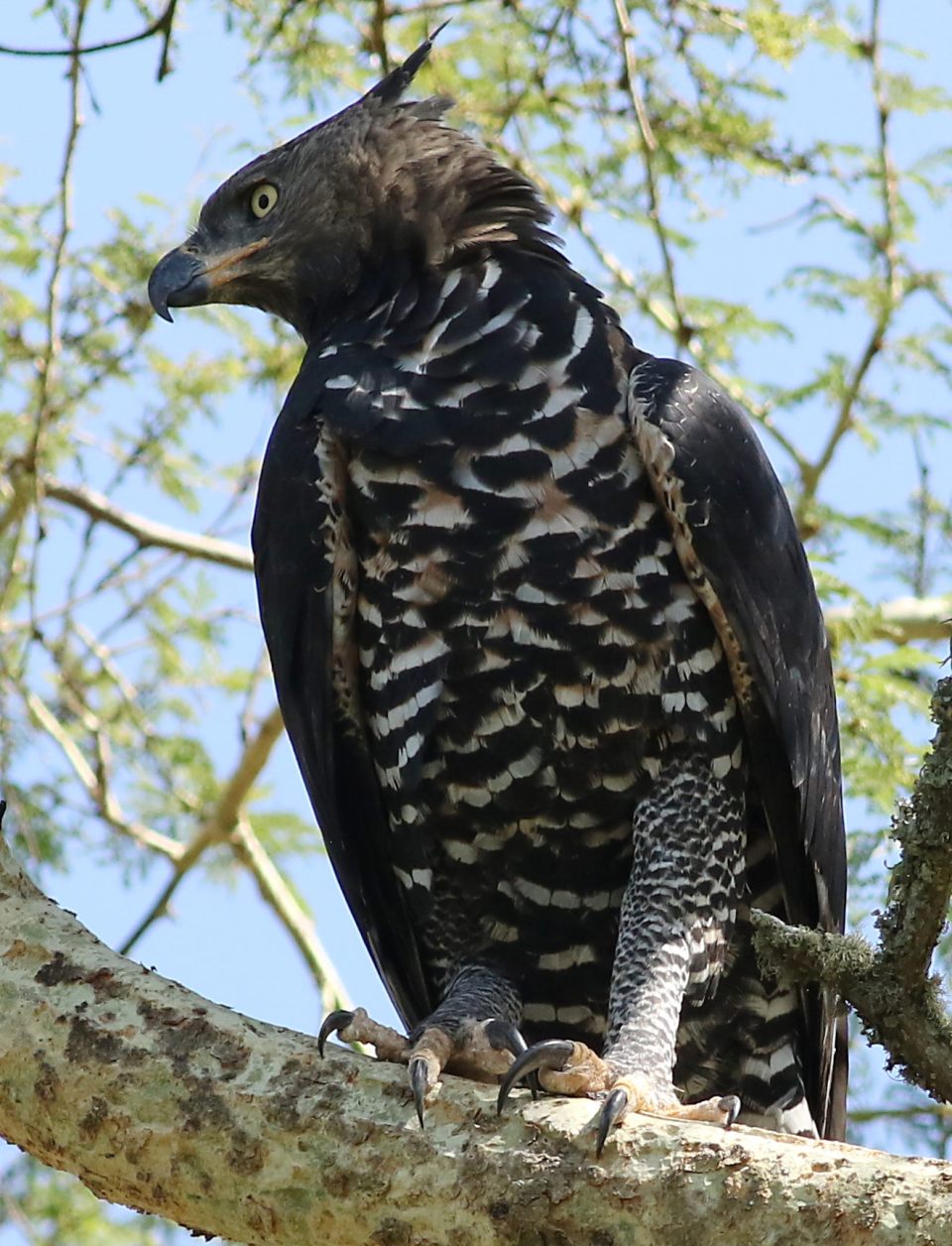
African Crowned Eagle, Senegal. Image courtesy Wikimedia Commons.
Economic development has a lot to do with collective confidence. Way back in 1990, Cameroon’s Roger Milla became an international star on the World Cup stage in Italy that year. He was one of the oldest players on the field, and his habit of doing a victory dance in corner field after scoring a goal made him a celebrity worldwide, not only among soccer fans. It was during these World Cup weeks that I drove to Schärding, a small town in Upper Austria, close to the German border, to spend a weekend exploring a newly opened bicycle path between Schärding and Passau in Germany. In the evening, after a long ride, when I entered the Gasthaus where I had taken a room for the night, the owner behind the bar did a double take and shouted, “Schau, schau. Der Roger Milla ist da.” Look, look, there’s Roger Milla. Everyone turned around to look, some cheered, and I could think of nothing better to do than imitate Roger Milla’s victory dance. The evening went off very well after that. Some of the regulars in the room seemed to think I really was Roger Milla and asked me how come I spoke such good German. (I was born in India, by the way and none of my friends think I even remotely resemble Roger Milla).
When I describe this incident, people ask me: how did you feel? Wasn’t that terribly racist?
Wait a minute, I tell them. Don’t be so quick with the R word. In a part of the world where there are few visible minorities, most people tend to be ethnically challenged. They see only themselves and other people like them, and everyone else is simply ‘the other.‘ This ethnic ignorance is the source of strength of divisive political leaders; the Orbans, the Kaczynskis, and the Petrys of Central Europe. To give an example of how I see it; I recently went on a field trip with a bunch of bird watchers. Where I only saw sparrows and the occasional bul-bul, they saw flycatchers, minivets, drongos, three kinds of woodpecker, kingfishers and many, many more. So too, with the ethnically challenged. Until they learn to see human life in all its rich variety, they will see only two kinds of people: us and them!
So that’s why I wish the Senegal team does well on the soccer field and even hope they win the World Cup, for maybe then, even the most ethnically (or ornithologically) challenged among us will finally realize: there are not only sparrows in Senegal, there are crowned eagles too.
Suffer the little Children: A New Testament Reminder
St. Mark, Chapter 10.
13. And they brought young children to him, that he should touch them: and his disciples rebuked those that brought them.
14. But when Jesus saw it, he was much displeased, and said unto them, Suffer the little children to come unto me, and forbid them not: for of such is the kingdom of heaven.
15. Verily I say unto you, Whosoever shall not receive the kingdom of God as a little child, he shall not enter therein.
16. And he took them up in his arms, put his hands upon them, and blessed them.

Image courtesy dailymail.co.uk
Terrible things are done, mostly by dictatorial governments, to children everywhere, especially to the children of the poor, the powerless and the dispossessed. However, when an official spokesperson for a country that likes to think of itself as a beacon of freedom and the rule of law says, “I can say it is very biblical to enforce the law,” then that person has surely never heard that the law is an ass; that laws were made for people rather than the other way round; that war crimes are committed by people who say, “I was only obeying the law. I merely followed orders.”

It is biblical to obey the law… Image courtesy Youtube.
Chasing Digital Dreams; Neglecting Nature’s Notebooks
I recently heard from a friend whose teenage son seems to be an atypical teenager. He’s home-schooled for one. And he doesn’t have a smart phone. He grew up running around barefoot in nature and learned naturally to avoid carelessly standing on ants nests. Once you’ve been bitten by a swarm of angry ants, you’re not likely to repeat the mistake. There are snakes and centipedes in the woods that surround his home. He is not afraid of them, but has learned to respect them.
He recently went to a local international school to write his board exams. The school is an approved center for these exams and he was registered to appear there as a private candidate. He was thoroughly perplexed by the behaviour of his peers during the exams, as they frantically peered (no pun intended) at their smart phone screens until the last possible minute, and then convulsively reached for the same as soon as they had handed in their papers. This obsessive relationship with their smart devices was alien to him, making him think that smart devices seem to make their owners look less smart. For me, as an adult who has managed to leave this compulsive obsession with social media behind, it’s refreshing to see a teenager who’s in tune with his surroundings, has a sense of fun, loves the outdoors, and reads without compulsion.

Yes, smartphones; but do they make the owners smarter?
Image courtesy: stories.flipkart.com
Some years ago I followed the blog of another teenager who was brought up on a sailboat and had lived most of his life at sea, with periodic long spells on land, wherever his multi-talented parents happened to find a job. Home schooled again, he was no stranger to electronic devices, mainly those used in navigation systems. Judging by the blog, this young man was whip smart and culturally savvy. His descriptions of short stays in several countries (Mexico, Malaysia etc) revealed astounding sensitivity and depths of insight into the social mores of the countries he visited. Unfortunately his blog has disappeared from the web, otherwise I’d have posted a link.
A recent trip to a rain forest with a group of young people reaffirms my belief that the best education for young people is to open their eyes to the world around them, encouraging them to read from Nature’s notebooks, in addition to absorbing the accumulated wisdom contained in printed books. Some lines from a poem by Harindranath Chattopadhyaya seem most relevant here.
In days gone by I used to be
A potter who would feel
His fingers mould the yielding clay
To patterns on his wheel;
But now, through wisdom, lately won,
That pride has died away,
I have ceased to be the potter
And have learned to be the clay.
In other days I used to be
A poet through whose pen
Innumerable songs would come
To win the hearts of men;
But now, through new-got knowledge
Which I hadn’t had so long,
I have ceased to be the poet
And have learned to be the song.
See this author’s page at Amazon.com to see more of his work
On Leeches, Jungle, Bliss and Beauty: things we have lost
I had the privilege of spending a week in a pristine rain forest in the northern Western Ghats with a handful of people best described as practitioners of deep ecology. Which means we moved about in the jungle in the least invasive manner humanly possible, on foot, leaving no footprints behind. On the contrary, it was the forest that left deep footprints in our memories. Here was a small segment of the planet that has been allowed to retain its wildness and its purity. It is still possible to drink water from these streams; pure, unfiltered, sweet; and we did, the whole week. Yes, there are leeches in paradise and my companions taught me to scrape them off with a fingernail from their tail end to dislodge them. “They have a right to live too, and we are the invaders in their habitat.” So-called primitive societies knew how to live in symbiosis with Nature, without the need to ‘conquer‘ it. Our modern civilization, with all its immense achievements, has ‘conquered‘ Nature and with climate change, we are currently witnessing the Pyrrhic depths of our victory.
In the forest, we bathed in rock pools and under waterfalls, luxuriating in Nature’s bounty. Birds, butterflies, trees, and insects were identified and added to lists in notebooks. Latin names of species and botanical names were bandied about freely among the group. “We use the Latin names as definitive identifiers, since local names vary widely, sometimes from one village to the next.” We tasted button-sized jamun fruit (Syzygium Jambulanum, a.k.a.Java Plum, Jambul, black plum, faux pistachier, jambolāo… see what I mean about variations in local and regional names?), mini jackfruits, a variety of Kokum (Garcinia Indica), a cousin of the cashew fruit from a young tree with cashew-like leaves, and the leaves of a tree that left a mildly sweet taste on our tongues when chewed (apparently used as an ingredient for weight loss by the health food industry). I was told about, but did not see, a tree, the underside of its leaves as rough as sandpaper, and used as such by forest tribes to smooth wooden implements and furniture.
We stood at dawn under the eaves of a hut and listened to the Malabar Whistling Thrush sing its daily morning ode to joy. As it sang, I was told that they love the rain and welcome the monsoon with redoubled full-throated vigor.

Malabar Whistling Thrush (also known as the naughty schoolboy)
I learned that, of the many species of colorful butterflies that flitted through the forests, the ones that flew fast and rarely sat still were usually a favored food of birds and insects that preyed on lepidoptera. Some beautiful specimens, on the other hand, hardly bothered to conceal themselves and were often seen lazily gliding down from the treetops to eye level, knowing they were toxic to most predators. Most spectacular among them was the Malabar Tree Nymph, Idea Malabarica. I had never before seen a butterfly glide so far with hardly a flutter of its wings.
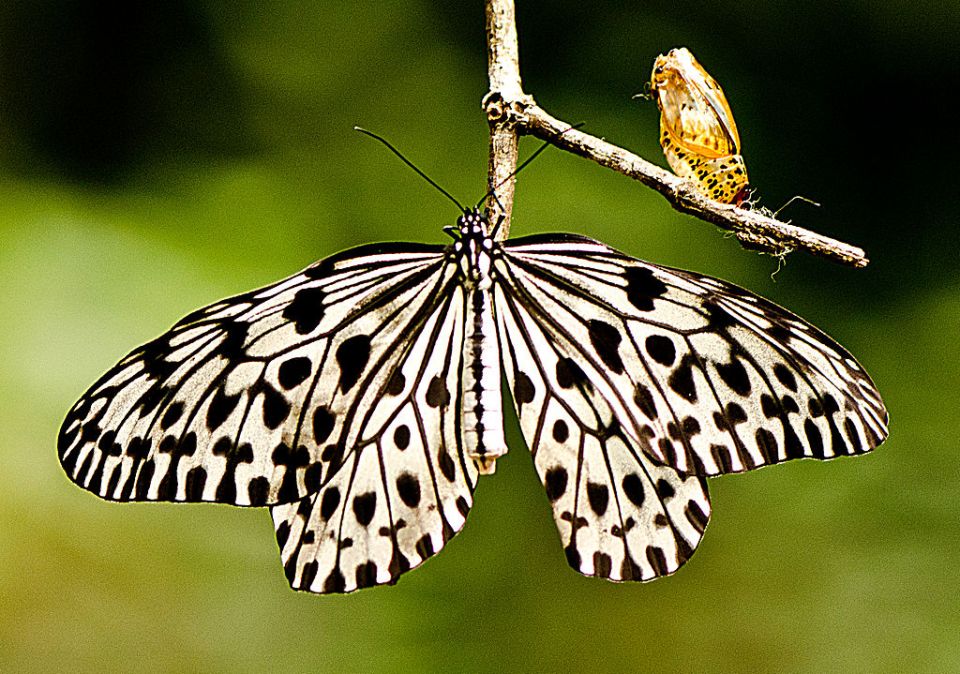
Malabar Tree Nymph – Idea Malabarica
The herpetologist in the group, a snake lover from childhood, thrust a hand into the undergrowth and brought it out to reveal a foot-long, slender green snake curled around his arm; a non-venomous vine snake. “Touch only its underbelly,” he cautioned. “Only predators touch a snake on its back and this causes them stress.” he gave us time to admire it for a few moments before allowing it to slide back into the undergrowth where it immediately became invisible again. A few moments later a metallic blue-black centipede wriggled across our path, looking for all the world like a shiny finished industrial product from Apple rather than a denizen of the wild. We respectfully watched it cross our path before continuing our walk.
While shy langurs leapt about among the topmost branches of the forest canopy, our guide showed us pale gray chalk-like lumps on the ground among the bushes. “Leopard scat,” he said. “There are several in this area, but they’re noctural and shy away from humans. I’ve not seen one in my two years here. There are sloth bears as well, but they too are very reclusive and we never see them” Just as well, since sloth bears, despite their name are very fast and can easily outrun humans.
In the evenings, there were more walks to look at the endless varieties of birds and trees, and we invariably ended up at woodland streams to bathe under a waterfall or soak in rocky pools, taking care not to pollute the water with soaps, creams or lotions. For cosmetic use, the woods provided us with wild aloe vera and a plethora of other medicinal plants I knew nothing about. On the way back to the hut that was our sleeping quarters, a few bits of sambrani were carefully scraped off the bark of a tree. Also known as benzoin resin, gum benzoin or gum Benjamin, it is used in perfumes, incense and medicines. Sambrani usage has a long tradition in India, and its sweet smelling smoke is used during pujas (religious ceremonies) and also in Christian churches to sanctify the communion service.

Nature’s bathtubs and showers: rocky pools and waterfalls
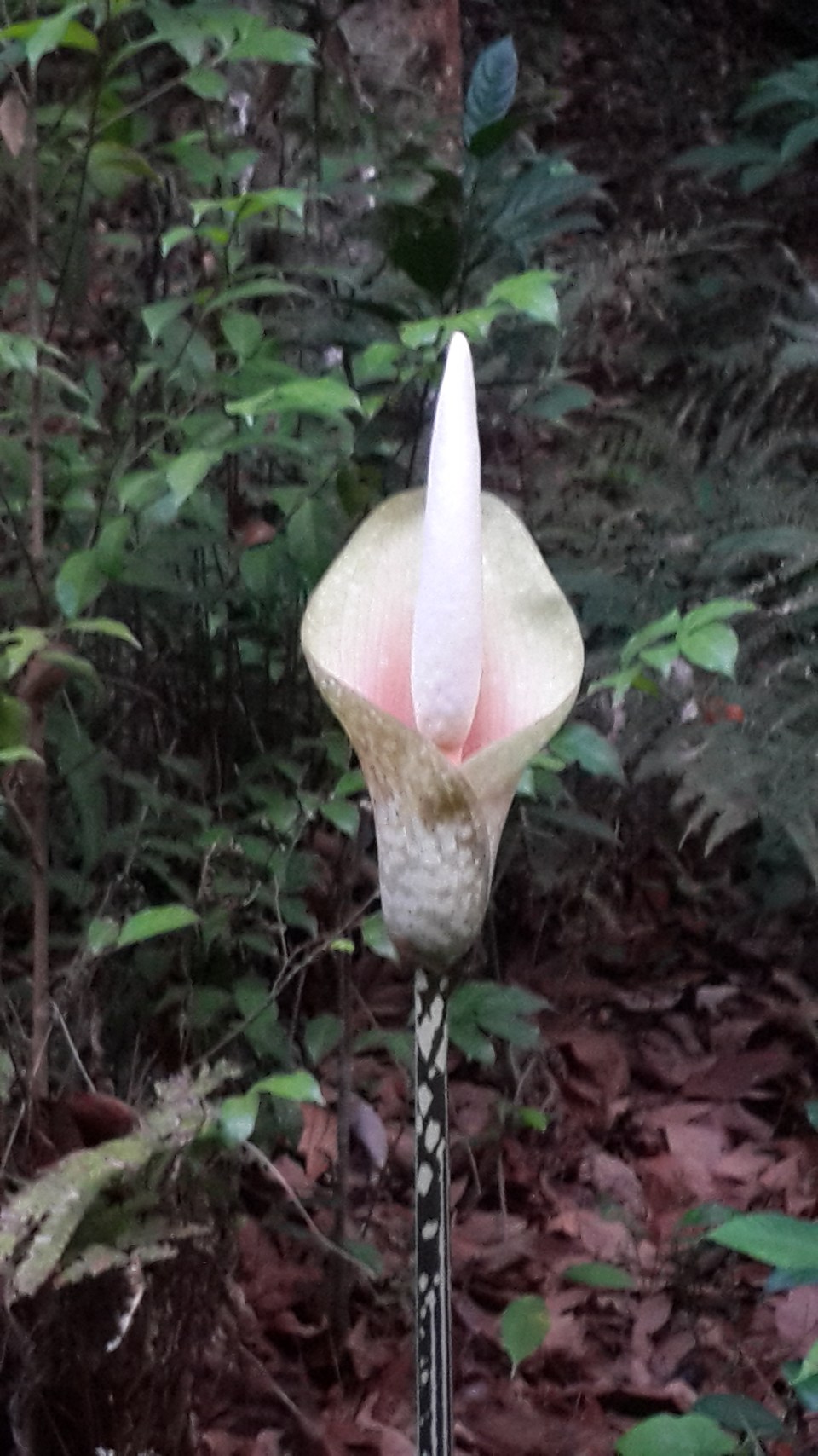
Standing 1 meter tall, this flower exudes a smell of rotting flesh when mature, thereby attracting insects that help pollinate it.
The week spent here was mind-expanding and humbling at the same time. How much knowledge have we lost in the race to industrial progress? How much intrinsic knowledge and wisdom of “uneducated peasants” have we ignored, simply because they had no diplomas on paper, no degrees from institutions of higher learning. After this week, I can’t help thinking, it is we urbanites who have lost out.
See this author’s page at Amazon.com to read more of his work
Finding the Right Words
I read a review of a new book called “Translating Happiness” that describes the emotional privileges enjoyed by people who speak more than one language. The idea of multi-lingual people leading richer lives has been expressed in many different ways by thinkers through the ages. A Chinese proverb (there’s a good Chinese proverb for every occasion!) says that Learning is a treasure that will follow its owner everywhere. A Spanish proverb puts it more strongly and says One who knows two languages is worth two. Roger Bacon calls knowing more than one language the gateway to wisdom.

Greenland Image: courtesy npr.org
In Smilla’s Sense of Snow, author Peter Hoeg has the main character explain in the book that the Inuit and most other Greenlanders have a much more nuanced and deeply intuitive feeling for the varied facets of snow and ice than the rest of the world. To prove this, Smilla says there are 28 different words in Greenlandic languages to describe snow in all its moods and varieties. Although the book is a very readable thriller, a scholarly article I found actually lists 128 words for snow in Greenlandic languages. This is surpassed by a BBC news report of a University of Glasgow study that claims the Scots have 421 different words for snow. Picturesque examples include feefle, “to swirl” and snaw-pouther, “fine, driving snow.” Here I see rich pickings for an academic study of differences between Greenlandic and Scottish use of wintry language.
People who live in island nations and speak only one language are often the quickest to admit how culturally impoverished they are. By that measure, the United States is a linguistic island, with the vast majority of its populace militantly indignant when they encounter people who don’t speak English. An otherwise intelligent and sensitive American acquaintance of mine who travelled abroad for the first time recently made so many derogatory remarks about European customs she encountered. What made her so indignant was that certain customs were different from what she was used to at home. Such people, however decent and well-meaning, are like snails carrying their houses on their backs. They need to ditch their shells and learn to travel light.
See this author’s page at Amazon.com to read more of his work
A Georgian ode to Austria
In June last year I wrote a blog entitled “Living in Limbo–A Streetside Portait” about a man who stands outside the local supermarket and sells the Augustin newspaper. He’s a refugee from Georgia and used to teach philology back home. I cannot communicate well enough with him to know why he had to leave his home. Perhaps he’s a political refugee and is reluctant to talk about it. Today he handed me a story, photocopied from an old edition of the Augustin. Since his German is very halting, I presume someone translated it for him. Whatever the case, the writer comes across as intelligent, well-read and sensitive, and the story deserves a wider audience. Hence I’ve translated it into English and posted it here. I hope you enjoy his story. I’ll simply call the writer Wassili.

Georgian Mountains. Image: courtesy Wikimedia Commons
The Man and the Mountain
I’m no longer a stranger here now. I feel I’m in familiar surroundings. I have many acquaintances who call me by name when they talk to me, which pleases me no end. No one knew me in those days, when an elderly man, Herr F., invited me to his villa. He was eighty years old, but still active and full of joie de vivre. His energy would have put many a younger man to shame. His villa was near Neustadt. He called the Augustin office one day to ask for ‘permission’ to take me to Neustadt. He arrived at the Augustin office in his car to pick me up at the appointed time. This was a great honour to me; such a great honour that it was embarrassing.
I remember another occasion when I felt such embarrassment; it was a very cold day. I had no gloves and I was selling newspapers. I noticed someone staring, and then approach me holding out a pair of gloves, obviously intending to give them to me. I refused, pretending I was not cold, but that was wrong. It’s normal for Austrians to look at strangers, but I only understood much later that it’s even more embarrassing to refuse warmth and gestures of goodwill.
Herr F and I drove in his car. It was an old Ford, but very well maintained. He was in high spirits. We joked and laughed a lot. He showed me his villa. Then he took me out to lunch at a restaurant in the mountains. We ate well and drank a little. Herr F was the first person in Austria who reminded me of the words of the 12th century Georgian poet Schota Rustaweli who said: Never forget the duty of friendship to a friend who shows you his heart, for all paths are open to him.
Several days passed before Herr F. came to see me again. “Wasil,” he said, laughing. “You’re Stalin. And I’m Hitler.”
“No Herr F. That’s impossible. The two of them didn’t like each other. They were enemies. We, however, like and respect each other.” Herr F. smilingly agreed. He knew who Stalin was. I’d spoken about him that day at lunch in the mountains. Stalin was Georgian, from Gori. This place is known for its delicious apples and its Stalin Museum. Many foreigners think Stalin was Russian and when they learn he was Georgian, they come to visit the museum.
I haven’t seen Herr F. for several months now. I’m now selling the Augustin at another location. I have neither his telephone number nor his address in Vienna. What do I know about this man who gave me, a stranger arrived in Vienna, such a memorable day? Who knows if he is in trouble, and if so, how I can help him? Who knows where he is now? Perhaps he’s busy and no longer remembers this simple newspaper seller.
There are perhaps many people who think like me. Perhaps the mountain also thinks so; the mountain that rises five hundred meters in front of me, and spends its time thinking. When no one comes to me to buy a newspaper for a long time, the mountain and I look at each other. I think of the time I worked in a school, with a book in one hand, und taught children Georgian language and literature. Now I’m learning to live, or rather, learning how not to be a stranger in a land where I must live.
Sometimes in autumn the mountain is covered in fog– and it seems to be thinking. Just as I do. A big mountain can think more than the small one can. People are like that. The more they think, the more the fog bothers them. I’m talking about the mountain that stands before me. There are vineyards on its flanks, but I see no one there. I wonder how anyone can produce wine on such steep slopes. Georgia too is a land of mountainous vineyards. Grapes grow there too; grapes that are nurtured like children.
In the country where I was born and grew up, one can see mountains, precursors of the Caucasus. I visited these mountains often in my childhood. I went alone, sat down somewhere under a bush, and looked down fondly at my village, loving every single settlement as far as I could see. You small Austrian alpine mountain, I think. It’s your fault that I’m homesick at the sight of you. I love you too. Even though I’ve not known you so well, I love you from a distance. There will come a time when I’m closer to you. For then, if you allow me, I’ll look on your fields and meadows from above, just as I did as a child, silently and wordlessly turning to the land I used to say: I love you, Georgia! With the greatest respect then, I would then humbly say: I love you, Austria.
See this author’s page at Amazon.com to read more of his work
The Woodpecker’s Tongue
I read an interview with Walter Isaacson (author of Steve Jobs’ biography, among other books) the other day. In it, he says: “I’ll just tell you something small. The tongue of a woodpecker is three times longer than the beak. And when the woodpecker hits the bark at ten times the force that would kill a human, the tongue wraps around the brain and cushions it.”
This information was so startling that I had to go and look it up. Sure enough, the description is accurate. Here are two illustrations, courtesy of Pinterest and Twitter, of the woodpecker’s incredibly long tongue and the way it cushions the brain.
Science has revealed so much of Nature’s secrets. Yet we can be sure that there as many hidden away, waiting to be discovered. Finding this bit of information about the woodpecker’s tongue so close to the beginning of the new year made me wonder what kind of lesson I could learn from it for 2018. Here is an analogy that seems to fit the bill.
We spend increasing amounts of time on social media. Information leaps at us with the rapid fire of a woodpecker’s beak rat-a-tat-ing into a tree. This selective information explosion damages our judgement and impairs our ability to separate fiction from fact. We humans need something to cushion ourselves from the damaging impact of a continuous stream of media inputs. In our case, the woodpecker’s tongue equivalent might be enhanced interactions with the real world; talking to people around us, to family, friends, acquaintances, and people in the society we live in.
I’ve spent a great deal of time on Facebook & Co. in recent years, assuming that these interactions were somehow deepening my ties to the real world. I have undoubtedly benefitted, by being able to keep in touch with friends and relatives living in far-flung corners of the world. Despite these real benefits, the truth has gradually dawned on me that I was becoming more of a consumer and less connected to the world. The perfidious effect of social media was perfectly illustrated a few years ago when a friend came to stay for a while with his wife and new-born baby. The friend was a keen amateur photographer, as eager to record every minute of his son’s life as any first-time parent. The Eureka moment came to me when I saw he was so busy taking and uploading photographs to Facebook that he was totally oblivious to the infant screaming for a long overdue nappy change. The screaming stopped only when the harried mother emerged from the kitchen to soothe and change the baby. This is the point when we need self-awareness to wrap around the endorphin-craving pre-frontal cortexes of our brain as tightly as the woodpecker’s tongue to guide us out of harm’s way.
The Power of Place: Why we travel

Hermitage Museum. Image: courtesy travelrussia.com
On a visit to St. Petersburg many years ago (for an idea when, it was called Leningrad then), emerging from the Hermitage Museum and Winter Palace, eyes dazed and unfocussed after marvelling for two days at the sheer wealth of the collections, our official tour guide told us something that stayed in my mind ever since. You know, she said, St. Petersburg was always much more than the home of royalty. It was a natural home of the arts and literature. For example, after WWII and the total destruction of the city, with more than three million of its population either dead or displaced, the city was like a living tomb. Within a few years, the city was repopulated by uneducated peasants from the surrounding countryside. These new immigrants succumbed to the magic of the city and within a generation, Leningrad/St. Petersburg became a city of the arts and culture once more.
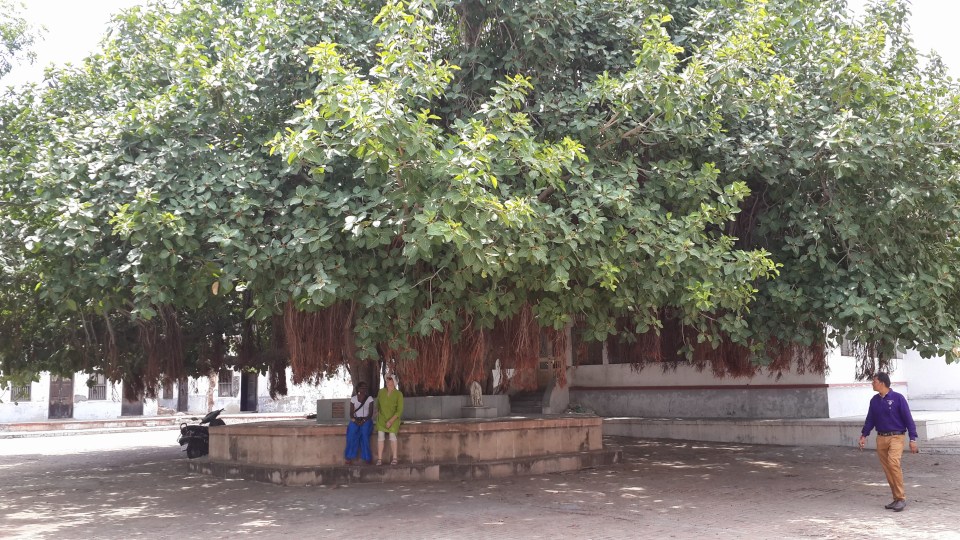
Sacred grove around an Indian temple
I can’t judge the accuracy of the tour guide’s information, but I understood what she meant. There are points on earth that are imbued with a power of place that are impossible to ignore. For example, I have walked through an ancient grove in southern Sweden and felt a certain reverence in that hushed spot. In India, temples are often perched on top of hills or mountains and exude a sense of spiritual calm. In northern Bali, near the small town of Bubunan, there is a spot near the sea where a a group of Tibetan monks suddenly turned up one day. When asked what they were doing, they said they were simply visiting an important location, where several powerful spiritual meridians intersect. The spot where they stood to meditate was a rock on an escarpment that looked out onto a beach with a curving shoreline. It was undoubtedly a picturesque and peaceful spot.
Perhaps this is why we travel. In search of our place in the greater scheme of things. This, and the unseen pull of far off places, is what has made the tourism industry one of the largest on the planet, with an annual turnover of eight trillion dollars. Food for thought, and a reminder to tread lightly as we travel.
Sophia – Elon Musk’s fears come to life?
Elon Musk and Stephen Hawking have often said that AI is the greatest threat facing the world today. Here’s maybe an early example of what they worry about. Meet Sophia, the first draft of an uncannily human-like creation.
The Power of Compassion
Met an unusual individual in Vienna last night. Spare 17 minutes to watch this video of his TED Talk from 2012. You won’t regret it. Of course it was more inspiring to meet him in person.
Feedback welcomed.
 aviott