Home » Posts tagged 'politics' (Page 2)
Tag Archives: politics
Leadership Hope for a Warming World
Several years ago, an Italian acquaintance said to me, “The growth of the Roman Empire was driven by testosterone, you know.” He was a polyglot polymath; a materials scientist by profession, and a keen historian who sometimes spouted Greek and Latin quotations to illustrate the points he made. Julius Caesar, as a promising young general in his thirties, felt like an under-achiever and a failure. He is known to have lamented that Alexander had conquered most of the known world by the age of thirty, while he himself was only a Quaestor (a local magistrate) in Rome. Caesar was forty years old when he formed the first Triumvirate with Crassus and Pompey. He then went on to defeat the Gallic tribes of modern day France over the next eight years, killing more than a million Gauls and Germans in the process (according to Plutarch) and enslaving a million more. Presumably, by the mores of his time, these deaths were considered necessary to establish rule of law, discipline unruly Roman citizens with firm leadership and ensure stable government.

UN General Assembly: Image courtesy United Nations secretariat
After the Second World War, with American leadership and the newly instituted United Nations organizations in 1945, it was widely believed that conquest and rule by force of arms was a thing of the past. Post-1945 the world entered an era of global peace and the longest absence of major wars mankind has ever known. If today’s world outlook seems bleak, blame it on the internet and social media, which are able to convey local impacts of minor skirmishes into our homes with larger-than-life images. Brutal killings appear immediately on the screens we carry in our pockets, or on laptops and smart tablets in homes and offices. When the Cold War ended, American philosopher Francis Fukuyama famously declared the end of history. In a nutshell his thesis was: with the spread of globalization and its accompanying prosperity, liberalism would spread around the world. Fukuyama’s book “The End of History and the Last Man” was published in the heady post-Cold War days of 1992. Today Fukuyama confesses: Twenty five years ago I didn’t have a sense or a theory about how democracies can go backward. And I think they clearly can.” (Washington Post article here)
On the other hand, Harvard psychologist and popular science author Steven Pinker argues that humanity is currently experiencing decreasing levels of violence (TED talk, 20 minutes) However he argues that liberal values are under threat from authoritarian populism, religious fundamentalism and radicalism of the left and right. There is no doubt in my mind that liberal democracies will do better than dictatorships and autocracies in tackling the gravest problem facing humanity today, global climate change. And it is mainly in democracies that the #MeToo movement is taking shape. People involved in the movement are asking questions and demanding action from their governments. Have we reached a tipping point? Can this watershed moment go beyond words to drive meaningful action? My answer to these questions is an emphatic yes. The fact that the movement has unexpectedly taken root in Asia is an enormous portent of things to come.
African press reports indicate that in many countries on the continent, women are afraid to talk about sexual harassment, especially in many of its conflict zones. According to this Zimbabwe newsletter, four of the five riskiest cities for sexual assault and rape are in Africa. There also appears to be a direct correlation between sexual harassment and geopolitics. The greater the gender equality that exists in a country, the less likelihood of autocratic leaders. Strongmen (and wannabe strongmen) look on the exercise of power as a kind of pissing contest, with the Trumps and Erdogans of this world trying to outdo the Putins, Kim Jong-Uns and Dutertes. More women leaders coming to power in countries around the world as a result of the #MeToo movement would be the best news for global climate. Women are less likely to indulge in geopolitical pissing contests. On the one hand women are generally more inclined to collaborate and cooperate and and on the other, their plumbing discourages such childish displays, leaving them with more time to get on with the urgent tasks of governing.
Remember how the Grinch stole Christmas?
Remember the children’s tale of how the Grinch stole Christmas? Well, here’s a true life tale that tells a similar story. See the following link for the newspaper article that talks about the banned video.
See the video below.
Chocolate, Figs and Ham
Coming across some unsweetened chocolate containing dried figs and ham (prsut), the combination seemed so unusual that we picked a packet up to try at home later. This was in a little shop near the open air market of Ljubljana, the eminently walkable capital of Slovenia. The combination, when we tried it, was delicious and to be highly recommended. Tasting this reminded me of a bitterly cold winter evening some years earlier, wandering through a Christmas market in Vienna, when I was stopped by a bearded man who looked like a Peruvian pan flute player.
“You look cold,” he said.
“Yes, I am cold.”
“Try a mug of Aztec chili chocolate with rum,” he said. “It’ll warm you up in no time.”
So we bought two steaming mugs of his brew and soon felt a pleasantly mild fiery glow spread through our innards. It helped us forget frozen hands and the biting cold for a good half hour. Figs originally came from Asia Minor, modern day eastern Turkey, but they spread early all over the Middle East and the Mediterranean. Chocolate probably originated in Olmec lands around 1000 BC where they called it kakawa. The origin of the word chocolate is presumably from an Aztec word ‘xocoatl,’ a bitter drink they brewed from cocoa beans. Here’s a link to a brief history of chocolate.
 A gourmet friend told me several years ago about a trip to Sicily where he ate the most delicious lasagna he’d ever tasted, in a nondescript restaurant in a small village. Curious, he asked the owner, who was also the cook, the secret to his lasagna. “Unsweetened chocolate,” the man explained, pointing to a thin brown layer in the middle.
The Olmecs gave us chocolate and avocados. Kiwi fruit were brought out of China and found a new home in New Zealand where its name changed from Chinese gooseberry to kiwi. Okra originated in Ethiopia and now is used by households from India to Florida. Sugarcane spread from India and New Guinea to the rest of the world. Potatoes and tomatoes also originated from South America, while chick peas came from Turkey and the Middle East as long as 8000 years ago. Ethiopia also gave the world coffee, probably via Mocha in modern day Yemen. Tea, as is well known, came from China.
Where is all this leading to? To people, of course. To the people who consume these foods and beverages all over the world. Thank goodness for the free movement of food and food habits. A world without hummus, okra, tomatoes, potatoes or, God forbid, coffee and tea would be a world of culinary despair. So the way the world is going right now, most nations are saying, ok, we’ll take your food but not your people. Imagine the long-term global poverty and despair that then ensues, not only immediately, but in the long run. Imagine a world of monocultures with no biodiversity! So next time you go to vote, remember to vote for culinary diversity, and the people that come with it. This idea is underlined in the following illustration and article from UK think tank Global Future about future diversity in business leadership.

Global Future Diversity Index
Are You Choking on Carbon? #MeToo
I recently read of efforts by a young Swiss duo, both engineers, whose company, Climeworks, sucks CO2 out of the air and carbonates water, injecting the water underground into basaltic rock. To its own surprise, Climeworks finds that the gas converts to solid carbonate forms underground in a couple of years. So is this a stable way to remove greenhouse gases from the air? There are other uses for captured CO2 of course but the quantities are minuscule compared to global emissions. So the pundits talk of capturing the carbon dioxide and storing it in underground caverns or pumping it under pressure into the depths of the ocean. Why isn’t there more talk among technologists of reducing emissions, instead of accepting emissions as a given and figuring out ways of converting them at great cost to benign forms?
A friend recently commented on efforts to remove atmospheric CO2 and store it underground. It’s like swallowing gas, he says. You know what happens when you have too much gas. You either fart or burp, or both. Accumulated internal gas is painful and you wouldn’t do it to yourself, so why do they want to do it to the earth? Do they know what will happen when the earth farts? So why don’t we plant trees instead?
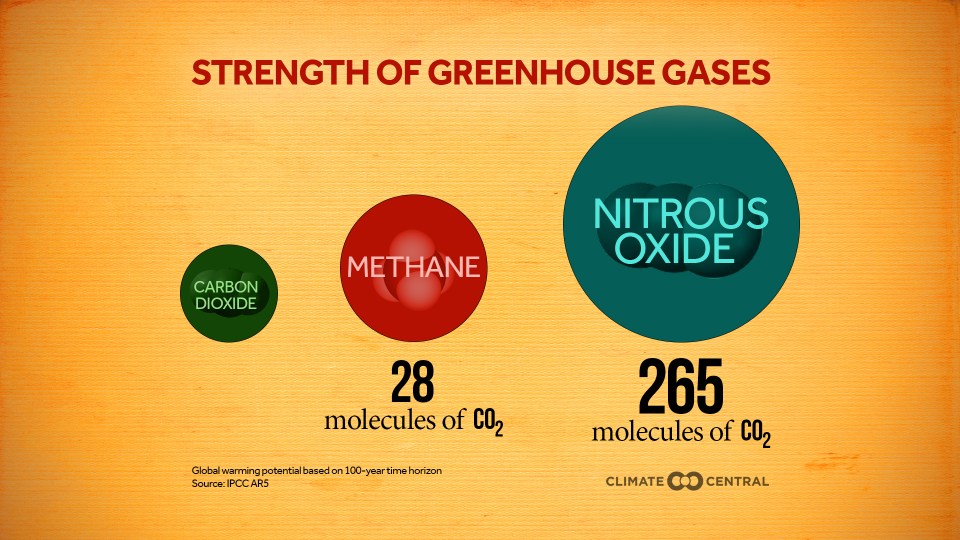
Relative strengths of major greenhouse gases. Image courtesy IPCC
Planting trees is a solution. An average tree sucks up 25 kilos of carbon per year. Humans emit 30 to 40 gigatons of CO2 every year. Let’s say emissions are kept at 30 gigatons a year. Thirty billion tons. That’s… let’s see, forty trees take up one ton per year, so multiply 30 billion by 40… so you get 1,200 billion. That’s 1.2 trillion trees per year just to break even!
How many trees are there on earth already? I found a BBC report of a 2015 Yale University study that estimates the number of trees currently on earth at 3 trillion. That’s 3,000,000,000,000. Since atmospheric CO2 concentrations are going up steadily, the situation would be much worse without these 3 trillion trees. So we still have to suck up the additional 30 gigatons a year, or else reduce emissions. If we take 7 billion to be the global population, leaving aside the old, the infirm and the very young, that leaves around 3 billion people of tree planting age worldwide. In order for 3 billion people to plant 1.2 trillion trees per year, each one will have to plant 400 hundred trees per year.

Persistence of greenhouse gases in the atmosphere. Image courtesy IPCC
Can (and would?) 3 billion people plant 1.2 trillion trees in a year? Of course not. But if even 10% of that number were to plant 10% of the target, we would be well on our way to doing what we need to do. Is this realistic? Quick answer: No. So is there a quick fix? Yes. Eat less meat. Depending on the type of feed, a cow produces 70 to 120 kg. of methane per year. Remember, methane as a greenhouse gas is 23 times more potent than CO2, so cutting down on meat is a quick way to reduce emissions. And it has the added benefit of freeing up pastureland for tree planting. So now we’re beginning to get a handle on things.
If we pump huge quantities of CO2 underground and undersea, the earth might fart (so to speak), with unintended consequences. But cows already fart on an ongoing daily basis, emitting considerable quantities of methane, so eating less meat is a relatively painless quick fix. And then there are lots of concomitant steps that are in the process of hesitantly being implemented, like switching to public transportation and electric cars. And, oh yes, the most environmental step the world is taking is the #MeToo movement! Let’s write that on our foreheads as a reminder to the world. Education and empowerment of women is the fastest way to reduce global greenhouse gas emissions and save our planet.
A is for Amazon
By now mostly everyone who reads the news knows that Amazon’s Jeff Bezos is the world’s richest man, and his customers worldwide are increasing his wealth to the tune of US $ 250,000 per minute! Now, I don’t envy anyone their wealth, especially when it’s been earned through hard work and strategic, long-term thinking. But I do believe that with great wealth comes great responsibility. Other large companies are doing more than paying lip service to the idea of reducing emissions to save the planet. Google’s Waymo has ordered 20,000 Jaguar i-Pace electric cars for its driverless car fleet (an upgrade from its current fleet of Chrysler Pacifica minivans). Even the city of Munich, capital city of BMW’s home state of Bavaria, is encouraging taxi firms to experiment with adding electric cars to their fleets.

Jaguar i-Pace. Image courtesy Jaguar usa.
I can well understand the indignation of the writer of the article in Clean Technica who says, “Amazon thumbs its nose at Sustainability, orders 20,000 conventional Mercedes Sprinter Vans.” Admittedly there are only a handful of companies that can supply the electric vans needed, but that’s just how young industries get a leg up, with the support of far-sighted leaders of companies and corporations who not only look to the bottom line, but also to the welfare of society at large. In Amazon’s case, it appears, the bottom line takes precedence over benevolence. Maybe this is the most important explanation for Bezos’s immense wealth.
As a self-published writer, I’m in a quandary here. I was an early adopter of Amazon’s superb self-publishing tools provided by CreateSpace (for print-on-demand paperback books) and Kindle Direct Publishing (for e-books). I have published four books on Amazon and have three more novels in the pipeline. The novels have been well reviewed by a few readers, so if someday sales improve, I will be making Bezos richer still. What should I do? I need some advice here.
In looking for answers, I found the following New York Times article helpful; a review of a book by Anand Giridhardas entitled “Winners Take All,” a critical look at philanthropo-capitalism as it is practised in the USA today. Ironically, the first place I looked for the book was on the Amazon website.
How much Prosperity?
Around 2009 economist Tim Jackson wrote a book called “Prosperity without Growth” that attracted the attention of policy makers worldwide. Maybe the excitement was mainly in the academic community, but I do know that Tim Jackson was sought after by policy makers and politicians for several years after the publication of his work. I assume the latter were looking for advice about ways to institute policies that would ensure deep systemic change. Of course they did not get any useful information. Jackson’s answers only showed what had to be done, not how to do it. That ‘how to’ is the preserve of politicians and, ultimately us, the electorate.
This brings me to the real reason for failures of governance. Us. We. The. People. Many years ago I had a brief interview with the foreign minister of a country and asked him why he did not implement what we both agreed would be a common sense measure to enhance regional food security at practically no cost. The helplessness implicit in his reply was illuminating. One of the ‘aha’ moments of my life. “Bring me a mandate,” the minister said, “and I will gladly take this decision.” In that moment, like cascading coins from a slot machine, the realization dawned. In democracies, it is us. We have to use our starling intelligence, as members of the swarm to mould societies as we wish. In travels through many countries I’ve noticed that where people sit back and complain about the government, the corruption, the lousy politicians; they are not doing anything much to change the status quo.
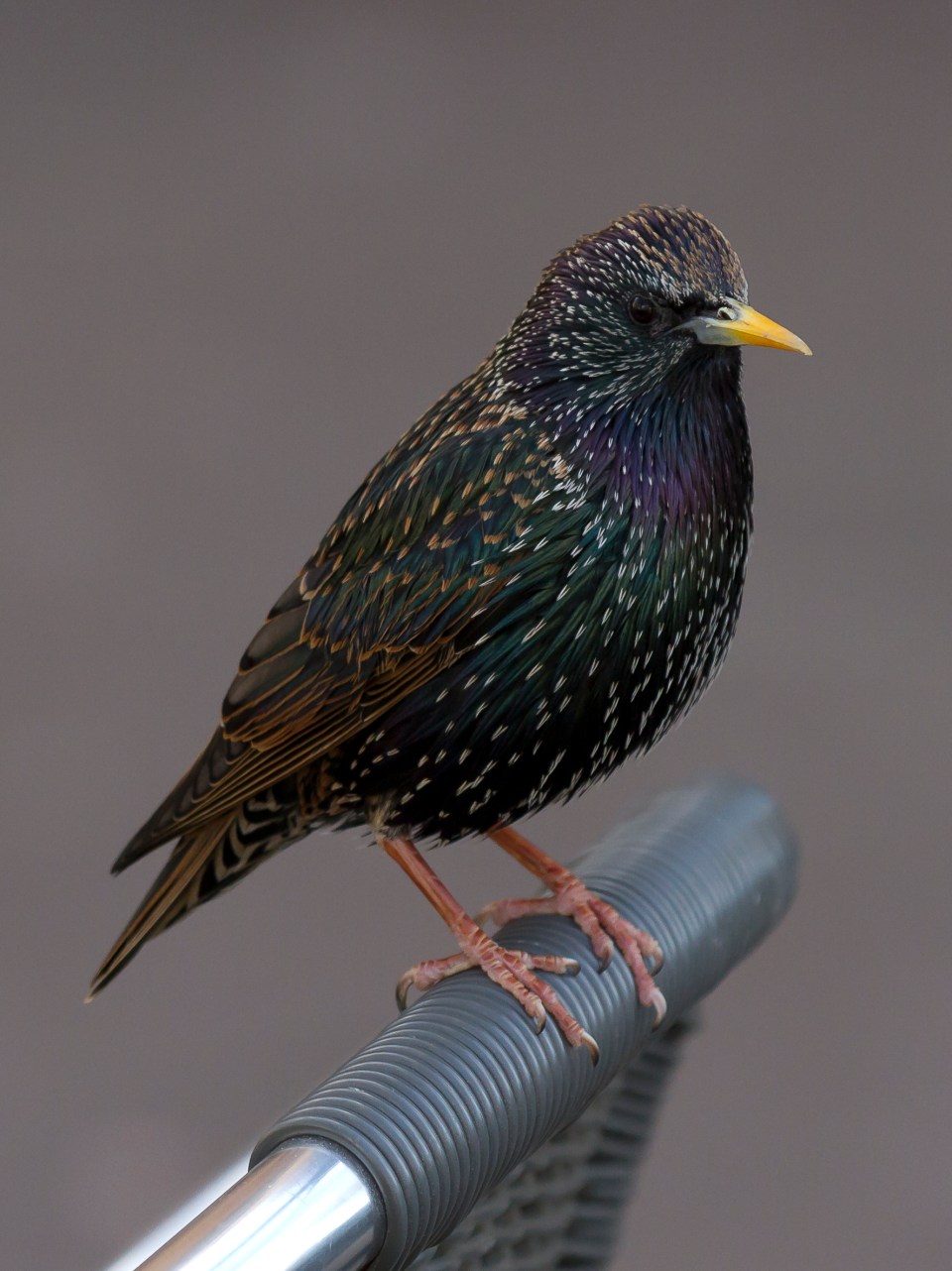
Starling image courtesy Wikipedia
In the words of George Monbiot, writing in the Guardian, we have only the one planet, but we’re living a four-planet lifestyle. In 2018 Earth Overshoot Day fell already on the 1st of August. This is the earliest date since the practice began in the 1970s, calculated by the WWF and the Global Footprint Network. This is the date when humanity’s annual demand on Nature exceeds what the Earth can regenerate over the entire year. In other words, this is the date when we begin to rob the bank. And most of us, good people, in our struggle to provide a comfortable life for our families, in ensuring livelihoods for our children, are totally oblivious to this. So before the politicians act, we have to change ourselves, reduce our demands on the planet. Sometimes this can mean enriching our lives by doing more with less. And very often this change begins with an inward journey that only we can make. No politician can ever do this for us. The transformation that the world needs is inside of us. All of us.
Stewardship of the Earth – R.I.P. Simba
Many years ago, I was shocked when an economist friend of mine (not you, Larry) said “so what?” in response to my moaning about arctic sea ice loss and the threat of extinction to polar bears. The economist in question is a thoughtful, gentle human being who would never think of himself as cruel or unkind. But he was thinking in terms of economic resources for human needs and, like a lot of people, myself included, who are stuck in their heads (i.e. nurture their intellect and take pride in it), they see themselves as thinking people, and therefore naturally superior – unthinkingly superior – to all other living things.
I came to humility rather late in life. This late-found humility was triggered by a number of factors; the increasing number of vegetarians and vegans in my circle of acquaintance, the anti cow-slaughter movement in India, increasing evidence of methane emissions from cattle farming for meat, and a video about South African Anna Breytenbach who has made interspecies communication her life’s work. I had always appreciated animal pets as sentient beings, but Breytenbach’s work, in particular, brought me to see them at eye level so to speak, dispelling any vestigial notion of superiority. Yes, we can think faster, outwit them in IQ tests, juggle, ride bicycles, add numbers, make wars – and exploit our planet – much better than they ever can. Despite all this, if we don’t recognise them as sentient beings with as much right to live as we do, then we put our own humanity, and humankind, at risk.
A friend recently remarked on the number of stray dogs in her neighbourhood. She complained that animal rights activists were busy protecting the rights of the dogs, while ignoring the plight of poor people in the same area who were struggling to eke out a living. I neglected to point out at the time that a government that does not respect the rights of animals as sentient beings is much less likely to respect the rights of economically powerless people. Take the case of infrastructure. When have rich people ever lost their homes and land to make way for a dam? If you can show me an example, I would wager they were richly compensated and ended up materially better off than before. Never so in the case of the poor. The same applies to roads. An eight-lane highway is deemed necessary and land is appropriated, very often from people who can never afford to use that highway.
And so I come in this roundabout way to the fact that Simba died two nights ago. This blog posting is a mark of respect to the passing of a much loved animal. She was only a cat, but she was a sentient being. R.I.P. Simba.
Soccer as Development: Rooting for Senegal
Aristotle famously said, one swallow does not a summer make. In the same vein, one could also say, eleven soccer players do not a nation make. Nevertheless, the collective pride of a nation gathers behind its soccer team once every four years while millions of people take heart or lose hope when their national team scores goals or is defeated. One way of looking at soccer is as a proxy war. Much better to slug it out on the soccer field than on the battlefield. But to my mind there’s a connection between soccer and development as well.
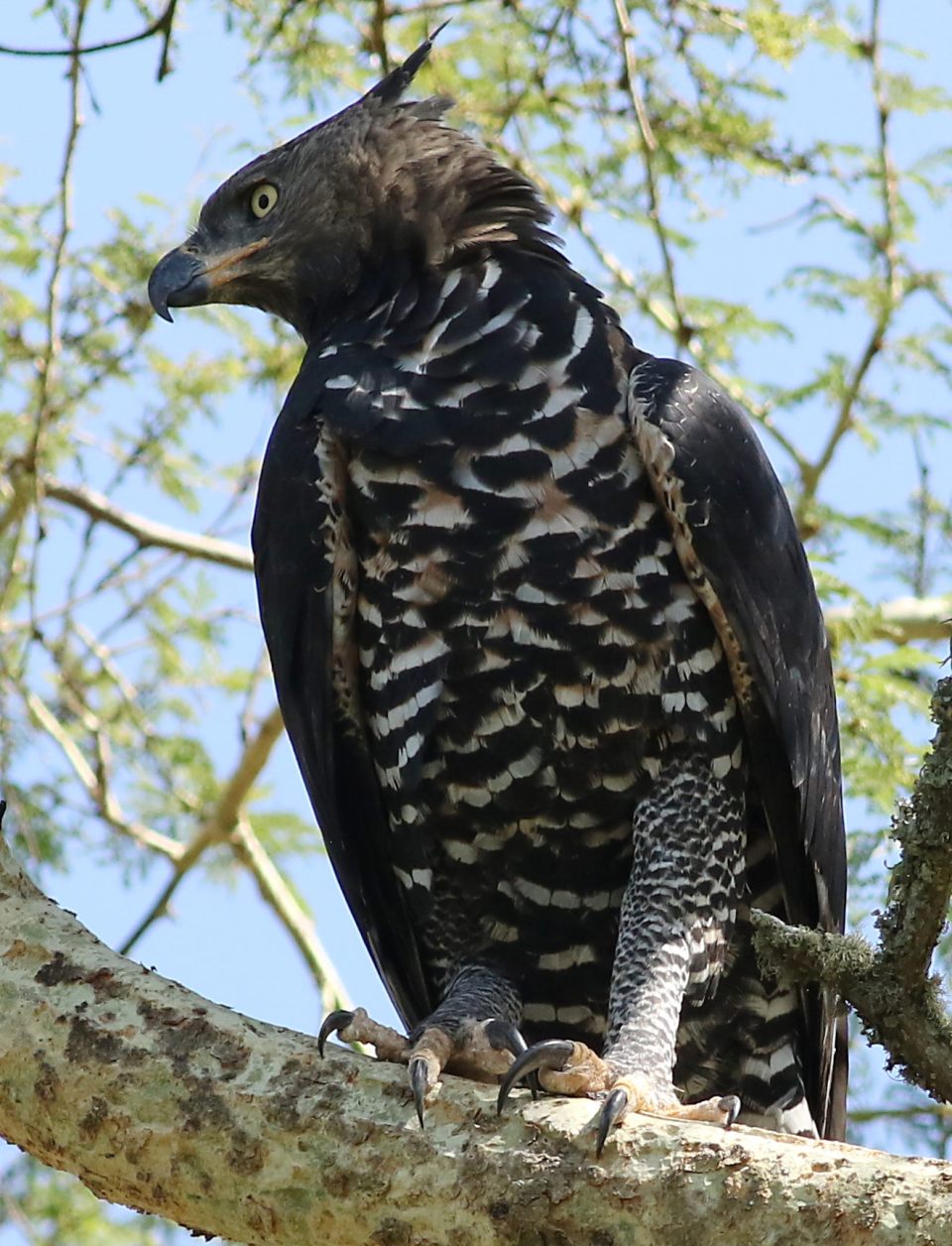
African Crowned Eagle, Senegal. Image courtesy Wikimedia Commons.
Economic development has a lot to do with collective confidence. Way back in 1990, Cameroon’s Roger Milla became an international star on the World Cup stage in Italy that year. He was one of the oldest players on the field, and his habit of doing a victory dance in corner field after scoring a goal made him a celebrity worldwide, not only among soccer fans. It was during these World Cup weeks that I drove to Schärding, a small town in Upper Austria, close to the German border, to spend a weekend exploring a newly opened bicycle path between Schärding and Passau in Germany. In the evening, after a long ride, when I entered the Gasthaus where I had taken a room for the night, the owner behind the bar did a double take and shouted, “Schau, schau. Der Roger Milla ist da.” Look, look, there’s Roger Milla. Everyone turned around to look, some cheered, and I could think of nothing better to do than imitate Roger Milla’s victory dance. The evening went off very well after that. Some of the regulars in the room seemed to think I really was Roger Milla and asked me how come I spoke such good German. (I was born in India, by the way and none of my friends think I even remotely resemble Roger Milla).
When I describe this incident, people ask me: how did you feel? Wasn’t that terribly racist?
Wait a minute, I tell them. Don’t be so quick with the R word. In a part of the world where there are few visible minorities, most people tend to be ethnically challenged. They see only themselves and other people like them, and everyone else is simply ‘the other.‘ This ethnic ignorance is the source of strength of divisive political leaders; the Orbans, the Kaczynskis, and the Petrys of Central Europe. To give an example of how I see it; I recently went on a field trip with a bunch of bird watchers. Where I only saw sparrows and the occasional bul-bul, they saw flycatchers, minivets, drongos, three kinds of woodpecker, kingfishers and many, many more. So too, with the ethnically challenged. Until they learn to see human life in all its rich variety, they will see only two kinds of people: us and them!
So that’s why I wish the Senegal team does well on the soccer field and even hope they win the World Cup, for maybe then, even the most ethnically (or ornithologically) challenged among us will finally realize: there are not only sparrows in Senegal, there are crowned eagles too.
Suffer the little Children: A New Testament Reminder
St. Mark, Chapter 10.
13. And they brought young children to him, that he should touch them: and his disciples rebuked those that brought them.
14. But when Jesus saw it, he was much displeased, and said unto them, Suffer the little children to come unto me, and forbid them not: for of such is the kingdom of heaven.
15. Verily I say unto you, Whosoever shall not receive the kingdom of God as a little child, he shall not enter therein.
16. And he took them up in his arms, put his hands upon them, and blessed them.

Image courtesy dailymail.co.uk
Terrible things are done, mostly by dictatorial governments, to children everywhere, especially to the children of the poor, the powerless and the dispossessed. However, when an official spokesperson for a country that likes to think of itself as a beacon of freedom and the rule of law says, “I can say it is very biblical to enforce the law,” then that person has surely never heard that the law is an ass; that laws were made for people rather than the other way round; that war crimes are committed by people who say, “I was only obeying the law. I merely followed orders.”

It is biblical to obey the law… Image courtesy Youtube.
Climate Action Tracker
The Climate Action Tracker posts regular progress reports on how well various countries are doing to adhere to the Paris Agreements. It tracks emissions from 32 selected countries and the list of the good, the bad, and the ugly is quite surprising even to this seasoned watcher.
Only two countries are on track to fulfil the Paris goal, of limiting emissions to keep global temperatures from rising above 1.5 degrees C; Gambia and Morocco.
The second best choice made in Paris was, if not 1.5 degrees, then at the least 2 degrees C. Just 5 of 32 countries meet this target. Bhutan, Costa Rica, Ethiopia, India and Philippines. All of the remaining 25 countries fall into the category of emitters that will lead to a world of 3 degrees warming or more. See the original list here.
Of course this predicator of doom and gloom relies only on official government policies. The reality on the ground may be a bit different in many of the countries on the list. For example, despite their governments, a few cities, power companies and private individuals already find it cheaper to produce unsubsidised renewable energy, a trend that will speed up, just a cell phone sales did in developing country markets worldwide.
See this author’s page on Amazon.com to read more of his work
 aviott