Home » Posts tagged 'population' (Page 2)
Tag Archives: population
The Decline of the Rest.
 Oswald Spengler published the first volume of his two-volume life’s work, The Decline of the West, in 1918. Seventy-four years later, speaking at the Earth Summit, Rio de Janeiro in 1992, 41st US President George HW Bush, a decent man, declared, “The American way of life is not up for negotiation. Period.” This pre-emptive declaration by the leader of the world’s most powerful nation essentially castrated the noble intentions of the summit, to limit humankind’s exploitation of the earth’s resources to sustainable levels. The result of the Rio summit was Agenda 21, a non-binding, voluntarily implemented action plan for the 21st century. This was the paltry outcome of a nine-day meeting representing 172 countries attended by 116 heads of state, 2400 NGOs and 17,000 other representatives of indigenous peoples and ordinary ‘you and me’ types.
Twenty-one years after the US President’s declaration in Rio, the WWF designated the 20th of August 2013 as “Earth Overshoot Day;” the day that humanity has used as much renewable natural resources as the planet can regenerate in one year. In 2016, Earth Overshoot Day is estimated to have fallen on August 8th, after which date we’re drawing down the planet’s renewable resources for the rest of the year. Pity the poor planet! The American way of life is still not up for negotiation, and the rest of the world is rushing to catch up. If ever populous countries like China and India get there, the planet will be sucked dry and we’ll all have to follow Elon Musk to Mars! So are we condemned to a two-track planet where some countries (or some sections of society within countries) corner material resources and the rest go a-begging? This is the scenario being projected by right wing demagogues worldwide and this is the reason for their recent successes at the ballot box.
Economists and philosophers have tried to redefine human well-being to reflect planetary limits, most notably in recent years by Tim Jackson’s book Prosperity without Growth, which acknowledges that the current definition of economic success is fundamentally flawed. Prosperous societies today increasingly recognize that increased material wealth does not increase well-being. However, most people the world over, regardless of their economic condition, still aspire to some version of the American way of life. This aspiration is reflected in the respect automatically accorded to wealthy people in the world today. A look at the Who’s Who of practically any country includes the names of its wealthiest citizens, together with lists of eminent physicians, lawyers, sportspeople and so on.
Gandhi pithily articulated this state of affairs decades ago when he said: The world has enough for every man’s need but not for every man’s greed. For each according to her needs would be the ideal but, as always, messy reality intervenes. One man’s need is another man’s greed. So it is that millions of well-meaning, virtuous, affluent people the world over would never dream of giving up hard-won creature comforts for the sake of other planetary denizens who are less well off. The spiral of technology has historically been to continuously improve human life, and to continuously create problems at the same time. These problems in turn needed infusions of new technology to solve its problems. So right now, the choices seem to be to outer-planetary colonization, or to invest in defences (gated communities, wealthy enclaves, security guards, border walls) to hold on to material gains. Technology offers a third alternative. The idea of a sharing economy has recently gained a lot of traction. Who needs ownership when mobility and services are seamlessly available? Indeed, ownership becomes a bit of a burden in comparison to the convenience of superb services available on demand with little or no delay.

A gated community safely behind bars
Even if all this is achieved, humankind’s basic inner restlessness will ensure that we keep wanting more and better, with one eye on the people next door. Global contentment is a moving target. Enter mystic and philosopher Sadhguru and his lectures on inner engineering. His most memorable anecdote in the video (begins at minute 16) is a reminder that all is not lost in the midst of this doom and gloom if we can take the time to laugh at ourselves and the posturings that have brought us to this point.

Sadhguru, irreverent mystic
For more writing by this blogger, see his Amazon page here, or the Google Play Store
Monsoon Wedding
The wedding was in Kerala, a state in India whose advertising blurb labels it “God’s Own Country.” Argentinians and Brazilians also make rival claims to have been similarly favoured by the Creator, while each runs the others’ country down “Yeah, God gave your country everything, but then he created you people to compensate!” In the case of Kerala, the affable people of neighbouring Tamil Nadu harbor no such pretensions, laughingly noting that several million people from Kerala prefer to live with them rather than in their own home state. The wedding eve reception and reception were at holiday resorts at Kumarakom.

“Kettuvallam,” (Houseboat) on Vembanad lake amidst clumps of water hyacinth.
Kumarakom is situated on the banks of Vembanad lake, apparently the longest lake in India, whose wetland system covers an area of two thousand square kilometers. Much of Kerala’s claim to God’s bounty comes from the backwaters, large estuarine stretches of brackish water that gives rise to a very rich ecosystem. Part of the lake holds the fresh water that drains into it from several rivers, and this fresh water section is separated from the brackish portion by mudflats. The lake is at the heart of ‘backwater tourism’ in the state, with hundreds of “kettuvallams,” floating homes on motorized traditional boats. The riverboat network spans 200 km from north to south and the lake teems with giant prawns and several other types of freshwater fish.

freshly prepared seafood lunch with tapioca and a glass of toddy

Fish await a fiery fry. Pearl spot, prawn and anchovies…
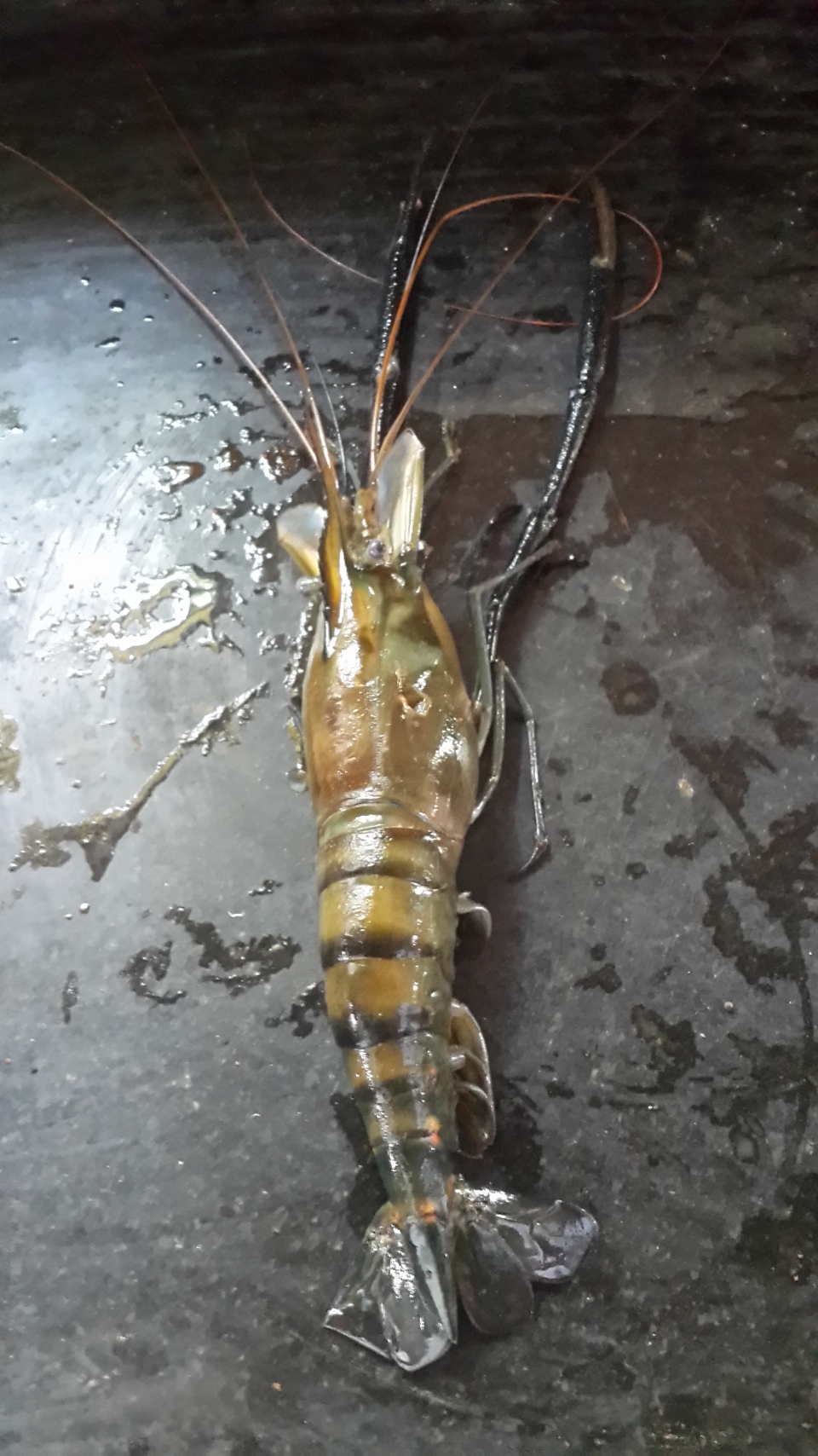
fresh caught prawn
Meanwhile, the bride and groom were happily united at a church in neighboring Kottayam town. It was a glorious wedding with guests travelling from around the world to attend. The groom wore a kilt, befitting his antecedents, and the bride wore a matching tartan sari, designed by the groom’s mother. All in all, a fitting Kerala wedding for the 21st century. The wedding photos belong in a family album rather than this blog, so none appear here. But if you ever are invited to a wedding in Kerala, my advice to you is, go!
For more by this author, see his Amazon page here or on Google Play
Seeds of Inequity
What could be more principled than companies that work to genetically modify seeds, breeding out negative traits and selecting a mix of desirable qualities that make them resistant to pests, hardy enough to withstand droughts or floods as desired? After all, farmers have been doing this for hundreds of years, patiently crossing varieties and developing superior strains of the world’s crops. Enter the profit motive. Still no harm done, we thought! Selfish interest is the lever used by civilizations to lift their peoples to prosperity, with the profit motive as the fulcrum on which this lever rests.

Strains of wheat
The world has generally accepted the truth of this principle ever since Adam Smith pointed it out in his seminal work, first published in 1776. Except for a relatively brief interlude when some nations experimented with communism and socialism in a failed search for social justice and equity, the world has broadly accepted Smith’s premise that wealth creation is a good thing and ought to be encouraged by enlightened governments that simply move out of the way and allow entrepreneurs to do their stuff. By and large, this is what seems to have happened in the case of GMOs (genetically modified organisms). Basically, some large corporations have copyrighted and distributed their seeds (sounds fair enough; respect for intellectual property rights sets the basis for innovation and prosperity). The problem is, these corporations have also made the rules about what happens to the seed generations that follow. They have decreed, and governments have accepted, that farmers may not retain a proportion of seeds from their crop for planting the subsequent season, but have to buy the seeds from the corporations again.
As Lizzie Wade points out in her Science article “How Syrians saved an Ancient Seedbank from Civil War”
…Maize, for example, was created by ancient Mesoamericans by painstakingly breeding more and more appetizing teosinte, a stubby grass with tiny, tough kernels that has so little in common with modern maize that archaeologists dismissed it as a possible wild ancestor until genetic tests revealed the surprising truth. The problem in the short run is that conventional breeding can be s…l…o…w. Teosinte was domesticated in central Mexico between 6,000 and 10,000 years ago, but farmers only managed to create a variety that tasted good a mere millennium ago
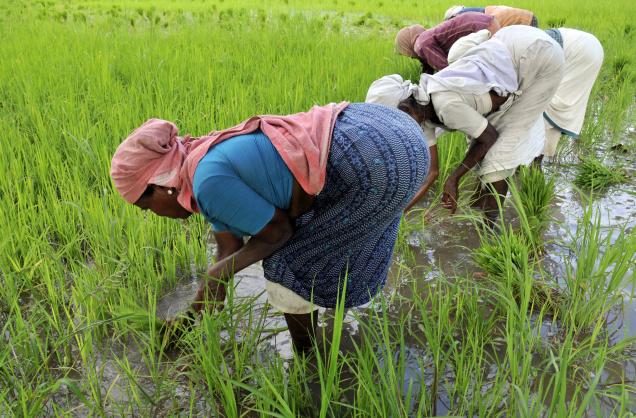
They can plant and reap, but they can’t sow again without buying seed…
As S. Grant points out in his article “10 Problems Genetically Modified Foods are Already Causing,” once they plant GM crops, farmers can no longer legally harvest their own seeds and are in danger of entering an era of perpetual bondage. Thus serfdom re-enters the world in the 21st century, this time clothed in the language of high-tech and carrying the false promise of freedom from hunger. Lawmakers are all too often ignorant and dazzled by technology, so they fail to realise the problems with GM crops are more to do with social and juridical issues rather than with the technology itself.
“In India, seeds are taken as a symbol of God’s blessing. They keep it, they store it, they know what is good seed and bad seed.” “Control oil and you control nations. Control food, and you control people.”
The above two memorable quotes are from a must-see 9-minute video about Natabar Sarangi, a village farmer who distributes free seeds to poor farmers out of the deep conviction that the thousands of varieties of seeds bred and developed over centuries should not be lost. In the process, he helps many of them to modest prosperity.
For more by this author, see his Amazon page here.
Saving the Tiger
Ranthambore National Forest and Tiger Reserve is a stunningly beautiful place that spreads over 450 sq. km. Writers like Jim Corbett and Rudyard Kipling have painted vivid portraits of Indian jungles for readers in the English speaking world. On a recent visit to Ranthambore, sitting in an open jeep, slowly winding its way along rutted jungle trails, tales of Mowgli, Bagheera and Balu the bear seemed to come alive. She expected to see a barefoot boy in a loin cloth peering out from among the tall grasses. Instead, she came face to face with …Shere Khan.
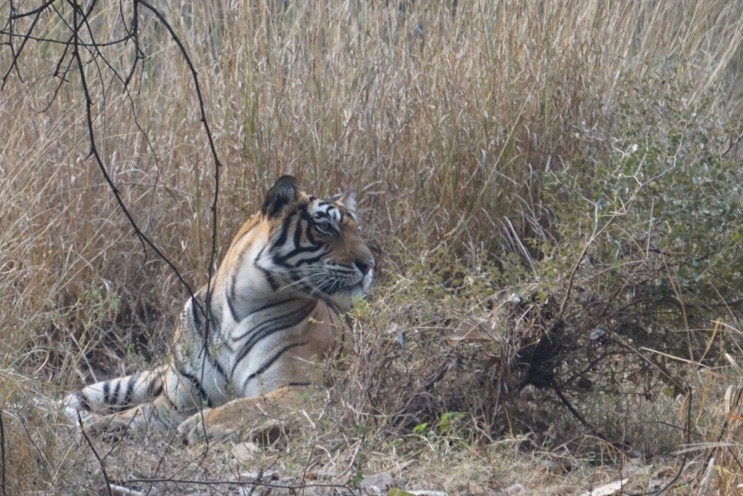
Shere Khan. Her real name, said the guide, is Noor…

…or Mala, or more prosaically, T-39, the mother of 3 healthy cubs
The moment was so unexpected, so pure, so anti-climactic that there seemed to be magic in the air. Noor is also known to the park rangers as Mala, a name that means ‘necklace‘ for the decorative, beadlike stripes on her flank. She had apparently just fed at dawn, the remains of the kill lay somewhere in the grasses nearby, her belly was full, and she was tired and too sleepy to investigate the little open jeep with three occupants parked at a respectful distance.
These magnificent animals are under threat from us humans. Ironically, one way to save them might be to bring more humans to visit them in their natural surroundings, just like the passenger in the jeep who watched her in awed silence for nearly two hours. For every tourist who comes to see them here, there are perhaps two or three locals who earn a livelihood, people who have been displaced from their own natural habitat in the jungle, displaced by the need to preserve wildlife. The villagers who used to live in Ranthambore forest were relocated when the tiger reserve was set up. These displaced people had to carve out a new existence in small settlements surrounding the jungle that was once their home.
We met one of the displaced people, a Rajput by the name of Dharamveer. He was proud of his forbears who had built forts and castles in these hills and jungles, and today he was one of the lucky ones; someone who had done well by doing good. When he was displaced from the forest, Dharamveer had trained as a tiger painter, painting iconic portraits of Shere Khan with the finest of strokes using delicate brushes that were a mere three or four hairs thick. This fine work gave the tigers in the paintings a lustrous lifelike glow that seemed to move as they caught the light. Buoyed by this success, he assisted widowed women to retrain in other handicrafts and has created a thriving business selling their work.

A Rufous Treepie
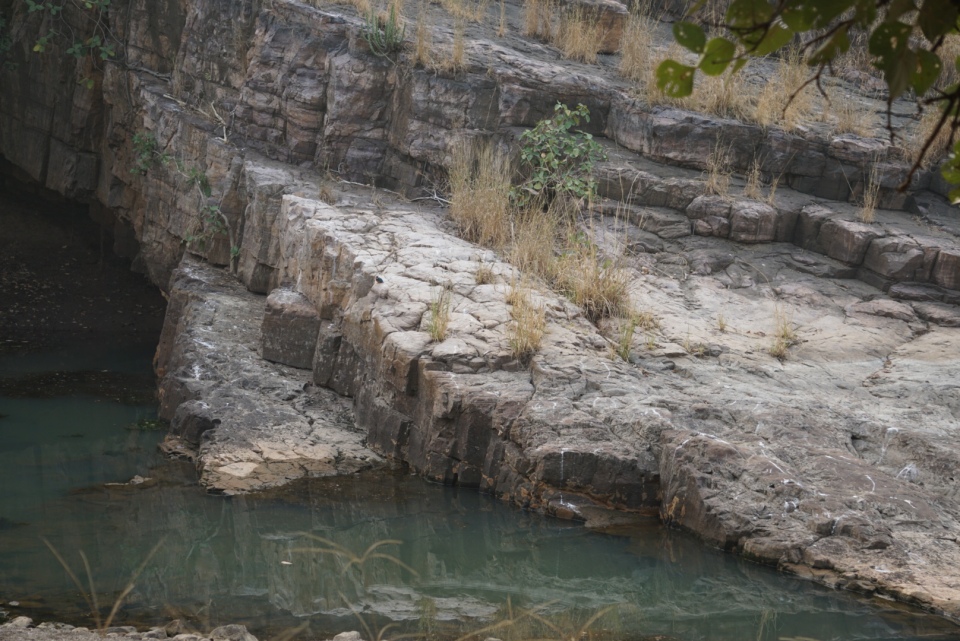
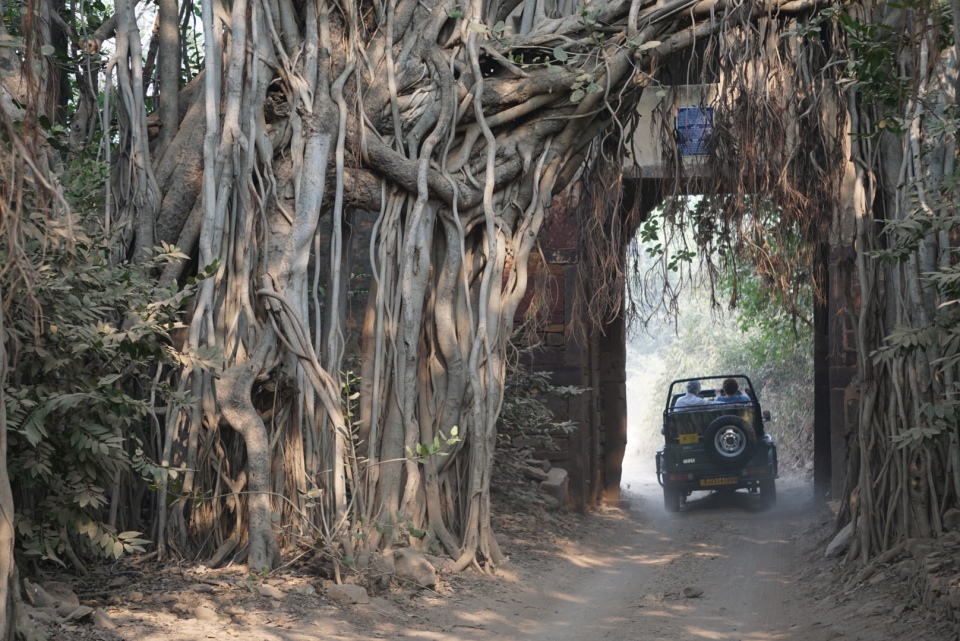
the entrance to the reserve is through the old Ranthambore fortress gate…
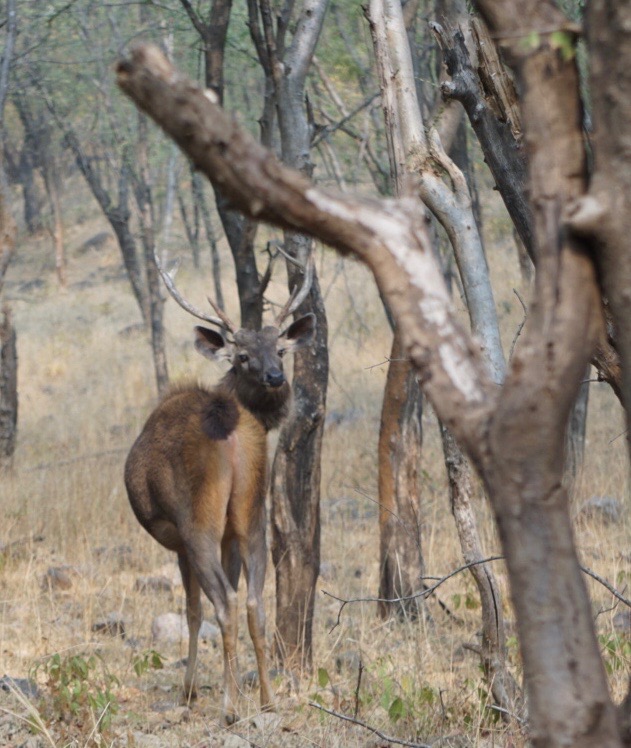
…the sambhur belled, once, twice, and again… (Hunting Song of the Seonee Pack)
We visited his store after the safari and were welcomed by the artisans who proudly showed us their wares. There was exuberant patchwork art, as well as many other fabrics, woven on rural handlooms, carvings, tribal paintings and animal protraits. As usual, there was more than one person could buy, but an American friend is exploring the market for these attractive products outside India. More on that will follow in a later posting.
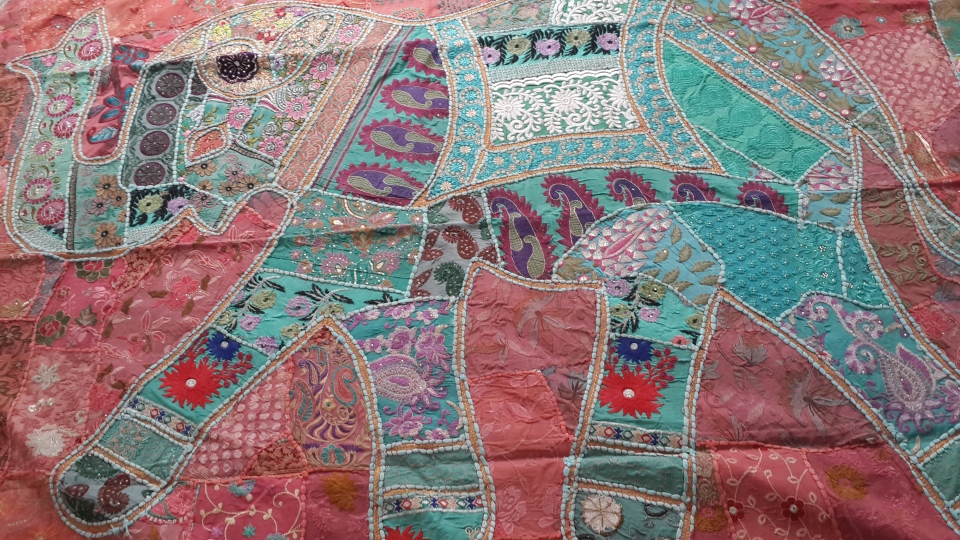
An exuberant patchwork of Hathi the elephant; handloom fabrics, carvings and nature paintings
For more by this author, see his Amazon page here.
Nature’s Bounty

Hundreds of these large orange blossoms strewn on the path to the beach from a tree overhead. The nameless profligacy of Nature’s bounty. Surely the earth has enough for all if we use its resources wisely.

Indian Khanna grows in profusion beside a walking trail on the outlying islands.
My apologies for the long delay in posting, but I am privileged to be truly living in a state of grace. More on that in the next blog!
What 132 schoolchildren should teach us.
Two recent newspaper articles have been very troubling; one of them positively horrific. One hundred and forty-one people died, all but 9 of them children, in a Taliban attack on a school in Pakistan.
The picture below appeared on an online news site nearly two months ago. An Indian love story that could be the beginning of a fairy tale. She is 21, a Muslim, a student at a dental college. He is 24, an engineer, a non-practicing Hindu. They fell in love. Her parents had planned an arranged marriage for her. She did not want it. So Anshida secretly married the man she loved. And they lived happily ever after. Oops, no! Apparently there are enough people in her community willing to resort to violence in order to prevent inter-racial unions, and this couple has been forced to live under police protection ever since. Here is a link to an interview with the couple where Gautham says their only desire is to live in peace together and they might have to leave the country to do so.

Anshida and Gautham, in the Indian Express Nation online edition of November 12, 2014.
Einstein was apparently once asked to explain how radio worked and famously used the example of a long cat. You see, wire telegraph is a kind of a very, very long cat. You pull his tail in New York and his head is meowing in Los Angeles. Do you understand this? And radio operates exactly the same way: you send signals here, they receive them there. The only difference is that there is no cat. The explanation is not so simplistic as it sounds, since nerve impulses are also electrical impulses of a different kind. Now what has this got to do with the persecution of a loving young couple (don’t tell me there’s something wrong with love) and murder of 132 schoolchildren by religious fanatics?
Growing up in the south of India, I experienced Islam as a very benevolent religion of deep faith anchored in tolerance as epitomised by the work of Rumi and Hafez. I saw the following quote taken from the wall of a recently demolished house.

Translation from the Persian of a framed script in a South Indian Muslim household, around 1914
When I came across the apocryphal tale of Einstein’s explanation of how radio works, I realised that Islamic fundamentalist theologians have taken a step backwards in the 20th century and invented a real cat to interpret the gap between scripture and practice. And indeed, it is a cat that squeals horribly. I much prefer the Einsteinian version of an imaginary cat. Counter-progressive theologians have not yet disputed the efficacy of radio transmission without cats. I long for them to do the same in the case of the transmission and observance of religious beliefs. It is to be hoped that the murder of 132 children moves at least some of them to re-examine the dead certainties of their religious beliefs.
The Changing Landscape of Religion
Here is a link to the summary of an article on the changing landscape of religions. This is a synopsis of work done by Vegard Skirbekk et al. and was mostly carried out at the International Institute for Applied Systems Analysis (IIASA), based in Laxenburg near Vienna, Austria.
Religion is a key factor in demography, important for projections of future population growth as well as for other social indicators. A new journal, Yearbook of International Religious Demography, is the first to bring a quantitative demographic focus to the study of religion. The journal is co-edited by IIASA researcher Vegard Skirbekk, an expert in the field of religious demography. The first edition of the journal includes three studies by IIASA researchers:
Read more at: http://phys.org/news/2014-08-landscape-religion.html#jCp
Earth’s Carrying Capacity
A chance remark by an acquaintance about the world running out of food led me to revisit a paper written in 1979 by Prof. Cesare Marchetti, an iconoclastic physicist and materials scientist who likes to think outside the box. The title of his paper, published in the peer-reviewed journal “Energy” is “10 to the power of 12: a check on earth’s carrying capacity.” The full text of this paper is available here:
Click to access MARCHETTI-076.pdf
A second writer on this topic, this time in a book called “How Many People can the Earth Support, (WW Norton, 1995)” is Joel Cohen, a mathematical biologist. Check this link for a summary of the book.
Click to access how%20many%20people%20can%20the%20earth-%20cohen.pdf
Even if the contents of Marchetti’s paper are seen as a thought experiment using back-of-the-envelope calculations, it still is a remarkable viewpoint that is worth remembering when faced with everyday accounts of the seemingly intractable flood of problems facing humanity: land degradation, overpopulation, the coming water crisis, climate change, environmental refugees, desertification, deforestation, sea level rise, ice melts at the polar caps, stratospheric ozone loss, excessive ground level ozone formation through traffic pollution and so on. The list of problems is seemingly endless, and reading a newspaper seems to involve ingesting a daily diet of hopelessness. In contrast, here are the concluding sentences from Cesare Marchetti’s and Joel Cohen’s papers respectively below.
Marchetti: It seems that the problems of growth are basically of cultural character. The Judeo-Christian axiom that the earth is given to man to be dominated, very material to western aggressive and destructive attitudes, may progressively be substituted by the Buddhist axiom that the earth is given to man to be contemplated; thanks to an enlightened use of technology.
Joel Cohen: More than ever before, the land that supported people became a partly human creation. For humans now, the notion of a static, passive equilibrium is inappropriate, useless. So is the notion of a static “human carrying capacity” imposed by the natural world on a passive human species. There is no choice but to try to control the direction, speed, risks, duration and purposes of our falling forward.
The conclusions I draw from these two very different studies are the same:
- there is no shortage of potential threats to human existence (always has been)
- there is no shortage of solutions
- there is plenty of work to do, so no danger of long-term unemployment
- subtle shifts in the public perception of problems can have tremendous long-term implications (the speed with which such shifts can occur is only the truly new element in global dynamics).
 aviott