Home » culture (Page 9)
Category Archives: culture
Nature’s Bounty

Hundreds of these large orange blossoms strewn on the path to the beach from a tree overhead. The nameless profligacy of Nature’s bounty. Surely the earth has enough for all if we use its resources wisely.

Indian Khanna grows in profusion beside a walking trail on the outlying islands.
My apologies for the long delay in posting, but I am privileged to be truly living in a state of grace. More on that in the next blog!
Golden Skirts vs Testosterone in the Financial World
Read a riveting analysis by Economist John Kay on why banks might perform better with women in charge. As an enticement to read further, here is a reproduction of the opening paragraph of his article that was originally published in the Financial Times of 18 March 2015.
The most powerful posts in the financial world are held by women. Janet Yellen chairs the US Federal Reserve, and Christine Lagarde is managing director of the International Monetary Fund. Mary Jo White heads the US Securities and Exchange Commission, and was preceded in that job by Elisse Walter and Mary Schapiro. America’s new Consumer Financial Protection Bureau is directed by a man — but the reason is that the industry feared Senator Elizabeth Warren would fill the role too effectively.
Read the complete article on John Kay’s own blog post here.
As often in the past, thanks to my friend Larry Willmore for his own Thought du Jour blog post that drew my attention to this article.
Purple Sheep runs Purple Eat
The city of Vienna has been governed by the Social Democrats, either alone or in coalition with other parties, since 1945. That’s an unbroken stretch of 70 years! Not bad for a governing party, considering that Vienna is a well-run city and has consistently ranked among the top 3 cities of the world for quality of life for the past decade or two. Among the reasons for the city’s success is the large number of initiatives by private citizens concerned about social justice in the age of globalisation.
One of these initiatives is by a non-profit organisation called Purple Sheep with the avowed objective of keeping an eye on the government to ensure that the city obeys its own laws concerning the welfare of refugees. In brief, PS’s objective (stated in the photo below) is to keep track of, publicise, and protect refugees from excessive official zeal in upholding the law.

Purple Sheep’s Agenda. They are grateful for donations to support their work.
Every so often, registered refugees fall through cracks in the legal framework, are declared inelegible for asylum, and have to leave the country although they might have lived in Austria for years while waiting, and have become well integrated. Appeals are possible, but people live in a kind of limbo while waiting for a decision on an appeal, and they are not allowed to work during this period. So in early 2014, Purple Sheep decided to set up Purple Eat; a place where refugees waiting for a decision on their case for asylum (currently 15 families) can provide a service while conforming to the law.
Housed in a distinctive purple container-like building among the other market stalls on the Rosaliagasse 5 in Vienna’s 12th district, Purple Eat serves a choice of 2 menus, 5 days a week, Tuesdays to Saturdays, from 11 am to 11 pm, prepared by the refugees themselves. What is on offer on a particular day depends on the nationality of the persons responsible for the meal. I visited the place on Thursday evening this week and found a choice of 2 main courses. A Haitian beef goulash, or a Georgian-style mushroom goulash, both menus accompanied by a standard soup, salad and a dessert (no choice here) for 7 Euros. I decided on the Georgian mushroom, and a glass of white wine.

Unmistakably purple and friendly service, Rosaliagasse 5, 1120 Vienna. Be prepared for pleasant surprises.
The soup arrived quickly, a delicious cream of tomato. It was followed by a salad. The lettuce was absolutely crisp and fresh. The dressing was obviously ready-made, out of a packet, but at 7 Euros for a 3-course meal, there are no complaints from this quarter. The Georgian mushroom goulash came next, served in typical Georgian style, topped with a dollop of cream and a sprinkling of walnut. Delicious. And for dessert, a small piece of freshly made cottage cheese pastry (topfen strudel). The menu price of 7 Euros is a recommendation. Customers are encouraged to pay more if they like, since all the money goes directly to the refugee families. Purple Sheep is apparently staffed entirely by volunteers (who don’t get paid, natch), so all the proceeds of go directly to the families who are cooking on that day. Expect a variety of menus, depending on the families who serve their traditional cuisine on different days. I encourage you to go there and be surprised.
See more of this author here
Books are Bad for You.
I can imagine a conversation with friends who think it’s crazy to say that books are bad for your health. What a self-destructive statement for a writer to make; a writer whose three books have recently received more than a dozen positive reviews (see author page on Amazon) But it’s true. In different parts of the world, at different times, books have proved harmful to their authors, as well as to their owners and readers. The Index Librorum Prohibitorum was published in 1559 by the Pope and listed books deemed heretical, blasphemous or simply lascivious and were therefore banned. Various editions of the Index were published in later years. The 20th and the last edition was published as late as 1948 and it was only abolished in 1966 by Pope Paul VI. Probably the most famous victim of the Index was Giordano Bruno who was burned at the stake in Rome in 1600 although admittedly, to the Inquisition, his principal crimes were not his writings but his heretical skepticism of many Catholic beliefs including the Virgin Mary and the trinity.
Closer to our time, in the 20th century, the list of books banned by Nazi Germany in the 1930s was long and included the literature of Marxism, Communism, pacifism, democratic writings and, of course, works by Jewish authors. During the cultural revolution in China between 1966 and 1976 a man who later became my close personal friend was sentenced to years in labor camp simply for being a mathematician with a small private library of books. His principal crime perhaps was to know more than the young Red Guards who conducted his trial, spat at him and made him walk around for months with a dunce cap on his head.
Even these relatively recent incidents of the 20th century seem to have faded from a public mind that is drowning in information but starved of meaning. Precisely the reason why much of the world is reacting with demonstrations of outrage (rightly so) at the murders of 12 journalists in Paris while largely ignoring (sadly so) the massacre of 2000 people in Baga village in Nigeria where more than a million people have been internally displaced by Boko Haram’s violence.
Boko Haram can be most literally translated as “books are bad for you,” where Boko means books, literature, the printed word, the world of ideas; and Haram means impure or unclean. Boko Haram’s primitive ideology thrives in the absence of the world’s collective outrage that would force local leaders to take more forceful action to stop this cancer from spreading. This is a cancer that can unleash a civil war and spread to several neighbouring countries; Cameroon, Chad and Niger. This is no longer only a Nigerian problem. In the age of globalisation, this is a problem for the world.
Here is a link to the website of the Quilliam Foundation, an organisation that exists to fight the battle of ideas that lies at the roots of modern religious extremism, which is a form of theocratic fascism. Listen also to an interview with Maajid Nawaz, the co-founder of Quilliam who, as a former radical Islamist, is eminently qualified to talk about the topic. For those who despair at the directions that religious fundamentalism is taking the world, listening to the talk will be 43 minutes well spent. Thanks to Larry Willmore for his Facebook post drawing my attention to the talk.
See more of this author here
Molybdomancy
I started off intending to write about the Austrian New Year’s Eve custom of Bleigiessen and learnt several things today. First, the posh name for the practice is molybdomancy: the art of divining the future from the shapes of molten metal that is quickly thrown into cold water. Second, this is not only an Austrian custom, but is widely practiced in Germany and in the Nordic countries as well. Apparently in Finland, the practice goes by the name of uudenvuodentina and is quite popular. According to this source, the practice originated in ancient Greece and later travelled to the Nordic and Central European countries where the custom is still followed today, although the results are interpreted more in a spirit of fun rather than being taken seriously. No wonder the word molybdomancy has been quite forgotten!
Originally made from tin, nowadays bleigiessen sets are sold in the streets in the week preceding New Year in small bags consisting of half a dozen pieces of tin or lead alloy mixed with cheaper metal. The pieces are molded into shapes associated with good luck; horseshoes, pigs, chimneysweeps, toadstools or 4-leaf clovers. I bought a bag for New Year’s Eve and settled down with six of my nearest and dearest to see what 2015 has in store for us.

What 2015 has in store for the family.
As you can see, the results are outstanding! 2015 is going to be a wonderful year for the family; two of them will perform exceptional deeds, while the rest will be merely brilliant. I wish all my readers a similarly uplifting prognosis.
What 132 schoolchildren should teach us.
Two recent newspaper articles have been very troubling; one of them positively horrific. One hundred and forty-one people died, all but 9 of them children, in a Taliban attack on a school in Pakistan.
The picture below appeared on an online news site nearly two months ago. An Indian love story that could be the beginning of a fairy tale. She is 21, a Muslim, a student at a dental college. He is 24, an engineer, a non-practicing Hindu. They fell in love. Her parents had planned an arranged marriage for her. She did not want it. So Anshida secretly married the man she loved. And they lived happily ever after. Oops, no! Apparently there are enough people in her community willing to resort to violence in order to prevent inter-racial unions, and this couple has been forced to live under police protection ever since. Here is a link to an interview with the couple where Gautham says their only desire is to live in peace together and they might have to leave the country to do so.

Anshida and Gautham, in the Indian Express Nation online edition of November 12, 2014.
Einstein was apparently once asked to explain how radio worked and famously used the example of a long cat. You see, wire telegraph is a kind of a very, very long cat. You pull his tail in New York and his head is meowing in Los Angeles. Do you understand this? And radio operates exactly the same way: you send signals here, they receive them there. The only difference is that there is no cat. The explanation is not so simplistic as it sounds, since nerve impulses are also electrical impulses of a different kind. Now what has this got to do with the persecution of a loving young couple (don’t tell me there’s something wrong with love) and murder of 132 schoolchildren by religious fanatics?
Growing up in the south of India, I experienced Islam as a very benevolent religion of deep faith anchored in tolerance as epitomised by the work of Rumi and Hafez. I saw the following quote taken from the wall of a recently demolished house.

Translation from the Persian of a framed script in a South Indian Muslim household, around 1914
When I came across the apocryphal tale of Einstein’s explanation of how radio works, I realised that Islamic fundamentalist theologians have taken a step backwards in the 20th century and invented a real cat to interpret the gap between scripture and practice. And indeed, it is a cat that squeals horribly. I much prefer the Einsteinian version of an imaginary cat. Counter-progressive theologians have not yet disputed the efficacy of radio transmission without cats. I long for them to do the same in the case of the transmission and observance of religious beliefs. It is to be hoped that the murder of 132 children moves at least some of them to re-examine the dead certainties of their religious beliefs.
Why do I write? revisited.
A short story deals with a tiny slice of life on a local scale but can, like a hologram, contain the big picture or illustrate universal themes. A novel does the same, but tries to give the hologram greater depth and detail. In choosing new fiction, a prospective reader looking at an unknown author can decide based on the genre: crime, thriller, romance, sci-fi, and so on. For an author who explores the world and writes stories that do not fall into any of these genres and therefore classes his work as “literary fiction”, the task of finding a readership is close to hopeless, given the number of fine writers and superb new books that appear online and in bookstores every day. It takes a certain stubborn foolishness to attempt to do this. On this count alone, I consider myself eminently qualified to be a writer of literary fiction. The rest is up to unknown readers out there to take a risk and invest some of their precious time reading a new author’s work.
I am keenly aware of this formidable entry barrier and therefore grateful to several unknown reviewers and three friends who have taken the time and trouble to write a total of (currently) fourteen four and five-star reviews of my three books on Amazon’s various sites and on Goodreads.
Napoleon Hill, in concluding his famous self-help classic “Think and Grow Rich” quotes Emerson as he states: if we are related, we have through these pages met. So to those many unknown reviewers I say, we have, through these pages met, and I am honoured to make your acquaintance. This is why I write. It is you who make the work worthwhile.

The Demoiselle Cranes of Khichan
The town of Phalodi lies halfway between Jodhpur and Jaisalmer on the Rajasthan tourist circuit. Phalodi is an unremarkable town that one drives through in a couple of minutes on the good highway that links the two larger cities. Phalodi is known as the salt city of India and was an important trading post in the days of camel caravans travelling along the overland silk route. Six kilometers away from here, driving along a narrow dirt road, is an even more unremarkable and dusty village called Khichan. The village has been a traditional stop for decades on the annual migratory route of Demoiselle Cranes between September and March each year. Sometime during the 1970s, after a series of droughts, a local Jain merchant decided to help the few dozen migrant visitors and began to feed them grain. The following year, the number of visiting birds doubled and more volunteers stepped in to contribute grain or funds for the feeding of the birds. By 1996, Otto Pfister writes in a despatch of the Oriental Bird Club, that 6000 cranes were visiting and being fed half a ton of grain per day (mainly sorghum) for six months every year. By 2012, there were an estimated 20,000 of these elegant birds in Khichan every year, on their way back from breeding sites in Mongolia and Eurasia. After crossing the steppes of Central Asia, where they are hunted by predators like the golden eagle, these delicate-looking birds fly at heights of 5000 to 10,000 meters to cross the Himalayas. This is an incredible feat at oxygen-starved altitudes and along the way are other dangers; the wars in Afghanistan, or human disruption of their habitats.

Image: courtesy birdingblogs.com
The crane is known as Koonj in Hindi, and there are many stories told about why the village community decided to feed the birds. One villager, when asked, speaks of the birds as auspicious symbols. “As long as the birds come, the future of our village is assured.” In the epic Mahabharata, the disciplined flight formation of the family groups of these birds is imitated when forming battle lines (Krauncha Vyuha) in the Kurukshetra war. In the crane-shaped formation of infantry units, forces are distributed to imitate the cranes’s wingspan, with a formidable, penetrating centre depicting the crane’s head and beak.
Through the power of the media, what was once a small local custom has attracted a large international following. The village of Khichan is now on the tourist map of Rajasthan and bird lovers from all over the world visit the place. What started forty years ago as a gesture to help a small flock of 150 migrant birds now attracts over 20,000 cranes annually. There are several amateur videos of the remarkable spectacle on You Tube. Here is one example https://www.youtube.com/watch?v=YSWEWdp-X_k
One observer writes: The most amazing thing during the morning feeding sessions perhaps is how disciplined the cranes are. They fly into specially created enclosures, walled fields of around an acre each. When one batch has fed, the next batch flies in for their turn. If the field is full, they land outside the field and patiently wait their turn.
Beginning in the 1970s, several remarkable people have transformed the face of Rajasthan. One of these, Rajendra Singh, mentioned in an earlier blog (Stepwells and Johads:digging into the past) as the man who restored the flow of seven dried up rivers in Rajasthan, now finds his expertise in demand at international meetings like the Economist Water Forum in early November where he advised property owners in the UK about methods to prevent flooding in Northumberland and elsewhere. For more, see The driest part of India offers a solution to Britain’s floods, from the Telegraph of 7 November 2014.
A lot has been written in recent years about mitigation and adaptation measures to counter AGW (anthropogenic global warming) and climate change. It is to mankind’s own long-term benefit to protect biodiversity. Ecological studies show that biologically diverse communities are more productive and stable. Traditional communities have long followed this wisdom, hard-won through years of observation and patience. Modern science confirms their wisdom. Positive actions usually come full circle, but when the circles are on a global scale they so large that we often do not see it.
The lake of deeds, and a dyslexic scholar
Ramcharitamanas (the lake of the deeds of Rama) is one of the greatest works of Hindu literature. Written by Goswami Tulsidas in the 17th century, it was written in Awadhi, a dialect of Hindi, and made the epic Ramayana, till then only read by the privileged few, (mostly upper castes) who knew Sanskrit, available to the common man. This widespread access to the Ramayana stories led to the birth of the tradition of Ramlila, the dramatic enactment of text, all over the north of India.
Tulsidas lived during the reign of Mughal Emperor Akbar (the great, 1556-1605) who was noted for his religious tolerance, emphasised by his promulgation of Din-i-Ilahi, a religion derived from a syncretic mix of Islam, Hinduism, Zoroastrianism and Christianity. To underline the point the Emperor took three principal wives from three religious faiths; Muslim, Hindu and Christian. Presumably due to Akbar’s religious tolerance, the enactment of Ramlila’s beloved text spread through Mughal lands and were adopted by the Phad singers and puppeteers of Rajasthan where they are still performed today (see my earlier post: Facebook for the Gods). Akbar was believed to be dyslexic, so he was read to every day, had a remarkable memory and loved to debate with scholars.
Written in seven kandas or cantos, Tulsidas equated his work with the seven steps leading into the holy waters of a Himalayan lake, Manasarovar. The lake lies on the Tibetan plateau and covers an area of 320 sq. km. The name comes from the Sanskrit words manas, mind, and sarovara, lake and refers to the belief that Lake Manasarovar was created in the mind of Lord Brahma before it was manifested on earth.

Lake Manasarovar. Tibetan Plateau, 4590 m.
Akbar’s acceptance of different religious beliefs led Time magazine to note in 2011 “While the creed (i.e. :Din-i-Ilahi) no longer lingers, the ethos of pluralism and tolerance that defined Akbar’s age underlies the values of the modern republic of India.” Quite a tribute to a dyslexic scholar emperor who died four hundred years ago!
For more by this author, see his Amazon page or his link on Google Play
Jesus on a Lotus, Whispers in Nandi’s Ears
Christianity came to India before it came to most of Europe. It was probably (and plausibly) brought by Thomas the Apostle in 52 AD, the name being derived from the Aramaic Toma, meaning twin. St. Ephrem the Syrian writes in the 4th century that the Apostle was put to death in India and that his remains were brought to Edessa (fairly close to Antioch – Antakya – in modern-day Turkey) by a devout merchant by the name of Khabin. British historian Vincent A. Smith (1848 – 1920) says, “It must be admitted that a personal visit of the Apostle Thomas to South India was easily feasible in the traditional belief that he came by way of Socotra, where an ancient Christian settlement undoubtedly existed. I am now satisfied that the Christian church of South India is extremely ancient.”
According to tradition, Thomas landed on the Malabar coast, where his skill as a carpenter won him the favour of the local king. He was allowed to preach the Gospel and convert believers to Christianity. Thereafter, he moved across southern India for the next 20 years before he was finally killed near the coastal city of Madras, present-day Chennai, in AD 72 apparently because a local king grew jealous of his increasing popularity. Marco Polo, writing in the 13th century, states that the apostle was accidentally killed by a bird hunter who was shooting at peacocks in Mylapore. More recent interpretation of inscriptions found on the Pehlvi cross, near present-day St. Thomas Mount, by the Portuguese in 1547, suggest that the legend of Thomas’ martyrdom was based on mis-translations of the middle Persian script. Whatever the truth of the Apostle’s death, at this point in time, the legend of his martyrdom has been firmly established to a degree that makes it a fact, and there is a basilica built on the site of the tomb at San Thome, one of only three in the world directly associated with the 12 Apostles. (The other two are St. Peter’s in Rome, and Santiago de Compostela in Spain, dedicated to James). Since India is a land of syncretism, the tomb and St. Thomas Mount have been a pilgrimage site for Christians, Hindus and Muslims since at least the 16th century. The Indian church has adapted in India and adopted some of this syncretism by introducing certain Hindu rites (such as the tying of the thali at weddings). Knowing this, one is not surprised to find that the image of Christ on the cross at the cathedral of San Thome is flanked by two peacocks and that his feet rest on a lotus.

lotus feet flanked by peacocks
The area around the San Thome basilica belonged to the ancient city of Mylapore, or the city of peacocks. A temple was built in the 7th century AD in Mylapore. According to legend, Shakthi, the divine embodiment of the female, worshipped Siva in the form of a peacock, giving its Tamil name (Mylai) to the city. The temple was built to commemorate this, and is dedicated to Siva. Inside the temple is a statue of Nandi, the bull, which is Siva’s favourite mount, and also a gatekeeper to Siva and his consort Parvati. For this reason, it is believed that whispering one’s secret wishes in Nandi’s ear is as good as a direct request to Siva himself.
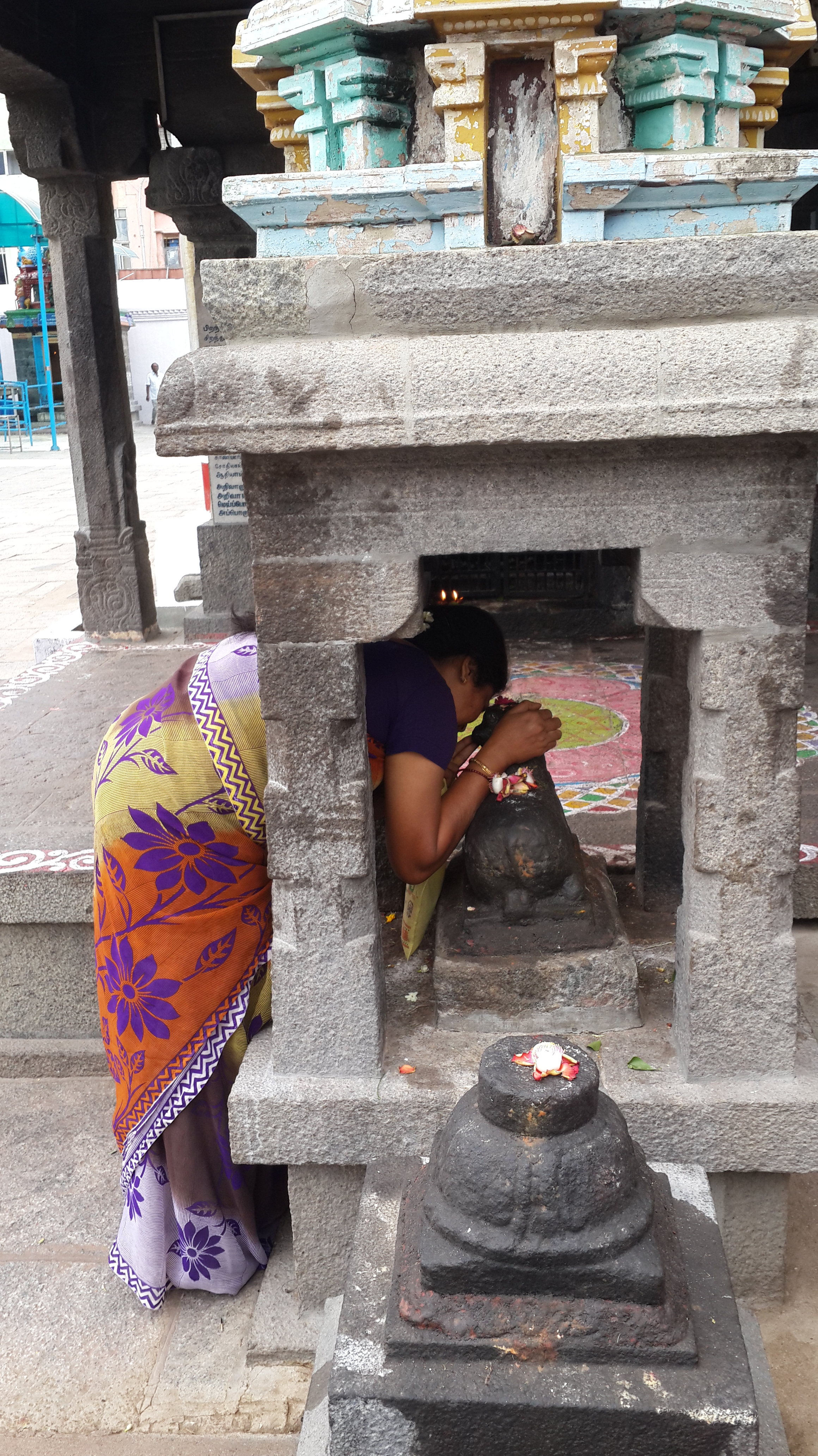
her word in God’s ear…

the temple courtyard is a relaxed and friendly space
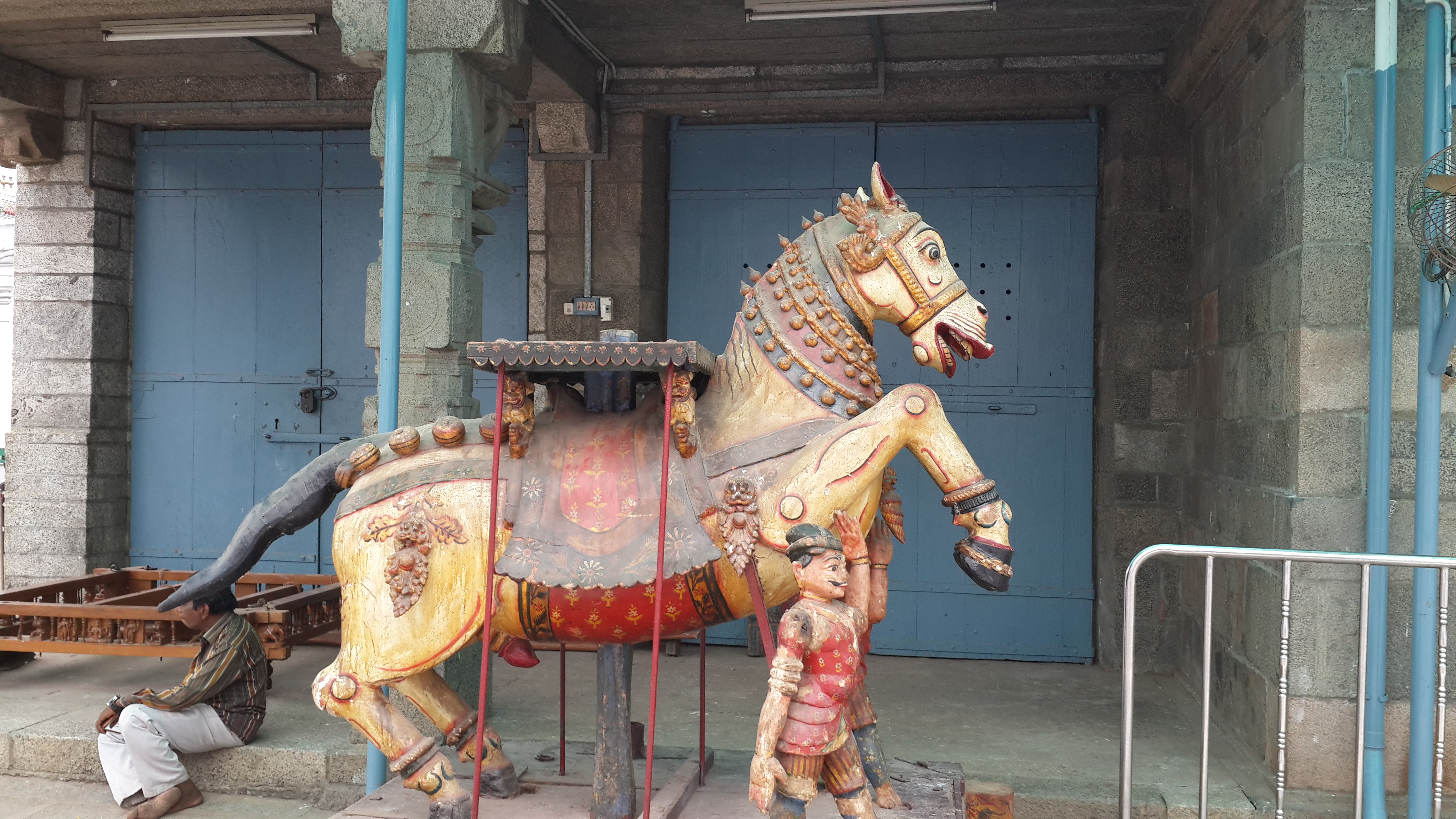
and splashes of colour
Being a good tourist, and wishing to hedge my bets in the afterlife, I prayed at the lotus feet of Jesus and whispered my innermost wishes in Nandi’s ear. Choose the link to follow this blog for updates on how well this strategy works in the coming months…
 aviott