Home » religion (Page 2)
Category Archives: religion
On Wrestlers and Faceless Women
I saw a Hindi movie called Daangal a few days ago. A true story of amateur wrestler Mahavir Singh Phogat in Haryana who raised six girls (four daughters and two nieces whom he adopted on the death of his brother) to be world-class wrestlers who have won many international championships. From a social standpoint, the most remarkable thing is that Haryana is the state with among the worst male/female sex ratios in the country (in 2011, 877 females for every 1000 males). This negative sex ratio is a reliable indicator of low status of women in a society. One can only imagine the real-life battles the Phogat girls faced, in overcoming traditional rural prejudices, cutting their hair, uncovering their faces, competing in early tournaments with boys, finally winning respect by beating many of their male peers and winning championships.
Even though some of the details in the film are untrue, or exaggerated for dramatic effect, there is no disputing that the greatest victory of these young women may not be counted in medals won in the wrestling arena, but in society as a whole. Changes in a society happen in a thousand unexpected ways. Their victories on the floor of the wrestling arena may be reflected in unrelated events in a community. One such example appeared as a feature recently in a Sunday newspaper. In this story, Mahima Jain tells of three women fighting the ghunghat (face veil) in Haryana’s patriarchal stronghold of Faridabad. They wish to show no disrespect to their elders, but also wish to be free of the restriction imposed by the veil. One of them is an educated woman who works in the city with head uncovered all day and sees no reason to cover her face as soon as she returns to her village home.
This news story shows that gender discrimination does not stop with rural, uneducated women, but also affects intelligent, articulate women with advanced educational degrees. As Hans Rosling powerfully shows through statistics in the video posted on this blog earlier in January (Reading the Tea Leaves: a primer for 2017), true development happens in a nation when gender discrimination has been largely overcome. By this definition, there are very few truly developed nations in the world; merely rich ones, poor ones and increasingly, widening gaps within societies between rich and poor.
One amusing and unexpected similarity between the real-life female wrestlers and their film counterparts: the professional wrestlers look just as elegant and sophisticated as the actors who play them in the movie. Check out the photos below without reading the captions first and see if you can tell who’s who.

publicity photo from the film
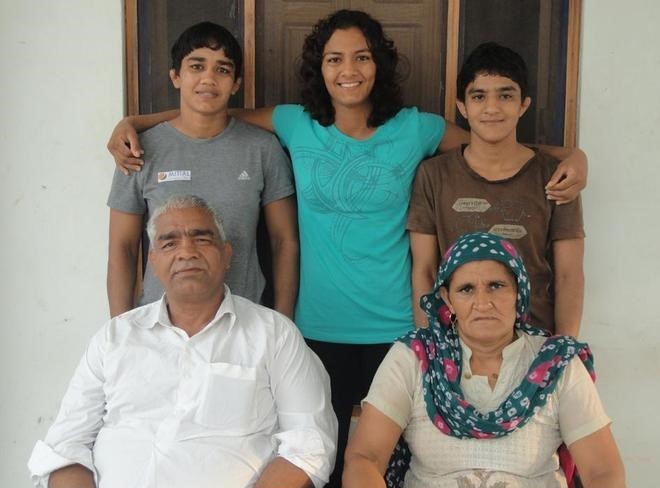
3 of the 6 girls with their parents. Image courtesy thebetterindia
For more by this author, see his Amazon page here, or links to his 4 books on the Google Play store.
The Dice that lost a Kingdom
The grand epic of the Mahabharata tells of the war between two clans, the Pandavas and the Kauravas. The many stories in the book of tales, which are told in some 100,000 stanzas of classical Sanskrit verse are together 12 times the length of the entire Bible. I have read several different English translations of this stupendous work. Despite the sometimes stilted language of the translations I read, the sublime poetry and wisdom of this work invariably shine through. I have searched for years for the perfect translation, and found it at last on the internet. The tale in its entirety is so complex, with a huge cast of characters and so many different sub-plots, that I thought it impossible to ever write a summary that does justice to the tale. Until this discovery on the internet of a synopsis written by someone (or a collective) calling themselves Wm. Blake Fabricators. A Google search led me to someone called Richard Blumberg who is apparently based in Cincinnati. Kudos to Richard Blumberg, then, for writing the most readable and comprehensive synopsis of this monumental work; a synopsis that effortlessly conveys the essence of the stories in fluid prose. I have reproduced the Introduction from the website below, and copied the links to synopses of the other six major episodes, with an Afterword and a Bibliography. I’m convinced that readers of this page, and followers of this blog, will not regret the 20 minutes they might spend following the links below to read the rest of this fascinating story.

As played in the Mahabharata, 4-sided dice with numbers 1,3,4 and 6
It has been called the national epic of India, and it is that, in very much the same sense that the Iliad is the national epic of Classical Greece. The Mahabharata is the story of a great war that ended one age and began another. The story has been passed down to us in a classical canon of Sanskrit verses some 100,000 stanzas long; that’s about 12 times the length of the Western Bible. The best scholarly evidence indicates that the earliest layers of the epic were composed between 2500 and 3000 years ago. The text had reached pretty much its present form by about 300-400 C.E.
Mahabharata has also been called the Hindu bible. It is important at the outset to recognize that epic and bible are both Eurocentric terms. The former implies the kind of single-minded focus on the hero and his deeds that characterizes the stories that we Europeans learned as epics in our schooling. And the latter term implies a certain iconic status for the book in its society; our bible is not something we know so much as it is something we swear on. None of that is particularly true for the Mahabharata, although it is not completely false either. It just misses the point.
Epic and bible together imply an absolute division between the sacred and the profane – one pure fable and the other Holy Truth – that simply doesn’t exist in the Hindu vision. Our Eurocentric minds, trained in a Jahwist tradition of good and evil, true and false, demand that the story go into one slot or the other, and if it is too big, then we will reduce it to fit. The Hindu mind, I think, rather than force the story into any single category, conceives a story big enough to encompass all categories.
The Mahabharata itself says it quite positively.
What is found herein may also be found in other sources,
What is not found herein does not matter.
The Mahabharata contains virtually all the lore and legend of the Classical Hindu Tradition – which is also, in typical Hindu defiance of simple-minded historicity – very much a living tradition. Here are the great creation stories – Manu’s flood, the churning of the milk ocean, the descent of the Ganges. Here are the favorite myths and fairy tales. Here are the jokes. Here are the codes of law – moral, ethical, natural. One of the best things about the Mahabharata is its wonderful richness of episode and detail.
But Mahabharata is not a random collection of tales, like the Medieval gestes (to further prove the habit of thinking Eurocentrically). Every digressive bit of the Mahabharata is there to shed light on a central story. The core event of that story is the great battle that was fought on the field of Kurukshetra between the five sons of King Pandu and their allies on the one side and the hundred sons of King Dhritarashtra, with their allies, on the other side. The battle was the culmination of a long history of struggle and diplomatic maneuvering, and it involved virtually every tribal king and every powerful city-state in Central and Northern India at the time.
It was a tragic war, that pitted brothers against brothers, sons against fathers and uncles, brave noble men against brave noble men. And it was devastating. Nearly all of the best men died in the long battle. The Pandavas, the sons of King Pandu, survived, but there was no victory, for the war had destroyed the world that they knew, and the emptiness of what they had won colored the rest of their lives.
Now to say that the Mahabharata is the story of a great battle is to say that Hamlet is the story of an unsuccessful usurpation, or that Moby Dick is the story of a whale hunt. Hindu cosmology is sweeping, and the story of the Mahabharata war has cosmological significance, in that it marks the end of one yuga and the beginning of another. There are four yugas in every great cycle of existence, each one diminished from the one before. The yuga that ended with the Mahabharata war was the dvapara yuga – the age of heros, during which noble values still prevailed and men remained faithful to the principles and tasks of their castes. The age that follows the battle is the Kali yuga, the last age of the world; in it, all values are reduced, law becomes fragmented and powerless, and evil gains sway. We live in the Kali yuga.
The breadth of its vision is one of the things that makes the Mahabharata the best story I know. But there are other reasons. Mahabharata has a riveting plot and a compelling dramatic structure. Its characters are complex and real, with depth of personality that is unmatched in any other epical or biblical story I have heard. Finally, I have found the Mahabharata to be full of wisdom.
In the next few minutes, I am going to try to give you a sense of how the Mahabharata story goes.
Since the story has cosmic significance, its ultimate beginnings are lost in the mists of time and the minds of unknowable immensities; a wealth of family histories, myths, and fables lead up to the events that I will tell you about. I will jump into the story at a point where the succession to the kingship had come into question.

South Indian Temples as Guardians of Nature
I was talking to the knowledgeable Tamil Professor about the preservation of traditional knowledge of medicinal plants in south India in general and Tamil Nad in particular. One reason, he explains to me, is that temples have traditionally been the protectors and benefactors of trees in a locality. Every temple has a “Sthala Vriksham” or sacred plant for that temple. A recently published book (in Tamil) gives the local name, the botanical name, and the medicinal value, of nearly 60 temple plants in the state. For example, Patala – Stereospermum sauvealens, also known as Rose Flower Fragrant in English, Padari in Tamil and Podal, Parul, Padala… in various Indian languages is used to treat snake and scorpion bites and also neurological and hepatological conditions. Local names of other sacred plants are Poolai (Aerva Lenatea, or mountain knotgrass), Vanni (Prosopis spicigera, a plant of the pea family that is related to honey mesquite), Thillai (Excoecaria Agallocha, a mangrove species). Mangroves of Excoecaria Agallocha surround the ancient Thillai Chidambaram temple in Tamil Nadu.

Prosopis spicigera, Shami tree, ayurvedic treatment for intestinal parasitic worms…

Aerva Lanatea, used to treat kidney stones, Alzheimer, etc.

Thillai Chidambaram temple. Image courtesy Wikipedia
As someone who is allergic to the shrill lessons preached by adherents of some religions, it is very refreshing, in this ecologically endangered world, to see the practical and common-sense benefits of devotion.
For more by this author, see his Amazon page here or on Google Play
The Politics of Inclusion
If one reads the newspapers in Europe these days, it’s easy to imagine a world going unbalanced. Political chaos in Britain; the shock of Trump’s rise to political prominence in the US; the continued slaughter in Syria; the failed coup in Turkey; honor killings of women in the Middle East and South Asia; young girls kidnapped in the hundreds by a sinister cultish organization in Nigeria with hate and abhorrence of non-religious learning as its primary motivation; China flexing its military muscle in the South China Sea…the list goes on. The underlying cause of each of these symptoms is one and the same, the quest for economic power. In itself harmless, economic power, the accumulation of wealth, is such a basic human instinct that it was unquestioned long before Adam Smith came along to make it intellectually respectable.
What we should question, however, is the tendency of modern societies to equate development with wealth, and economic poverty with under-development. There will be conflict in the world as long as wealth accumulation is equated with development. No one wants to be under-developed, so development currently means increased exploitation of the world’s resources. Ultimately, it is the scramble for the world’s resources that fuels all the conflicts and emigrations we observe today. Interestingly, many of those people, mostly politically right-wing, who rage against immigrants these days invoke a past society free of injustice and racially pure. They forget, or are unaware that, for a species that genetically differs from a chimpanzee by only 1.3% of its genes, talk of racial purity is an absurd notion, absurd to the point of imbecility.
The politics of inclusion that most people yearn for, but don’t know how to create, actually begins with us. The process of inclusion begins with us, one person at a time. Perhaps that is why the process is so daunting, since we have to change ourselves first, before we begin to find the politics of inclusion that the majority of the world seems to be longing for. Check out this link to hear what geneticist David Suzuki has to say about modern economic thought.
For more by this author, see his Amazon page here.
Dam(n)ed Words
“In the beginning was the word,” the book of St. John begins, in the King James version. “And the word was with God and the word was God.”
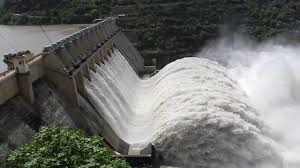
An overflow of words. Image: courtesy youtube.com
In the Katha Upanishad (approximately 5th century BCE), OM is related to the first primeval sound and the creation of the Universe, in an eerie echo of modern physics and the sounds that presumably accompanied the Big Bang. However, this analogy cannot be drawn too far, since the word OM has multiple meanings and interpretations in the Upanishads and in Buddhist belief. The Huffington Post says “Om is also considered the mother of the bija, or “seed” mantras — short, potent sounds that correlate to each chakra and fuel longer chants (like, say, Om Namah Shivaya). Depending on who you talk to, it relates to either the third eye or the crown chakra, connecting us to the Divine. No wonder it is core to some Buddhist systems and other Indian religions. Some say it’s even among the sounds recorded in deep space — on NASA’s website, Earth itself sounds a bit om-y.”
Coming to the present day, which is our primary concern here, Lucia Graves writes in the Guardian (July 13th, 2016) “It used to be that you had to read between the lines to determine that Donald Trump was stoking racial resentments. And it used to be that the subjects of his racial animus were mostly immigrants. But now, increasingly, he’s casting a wider net and amping up his rhetoric.” Also in the Guardian of the same date, another headline says, “Labour’s Luciana Burger receives death threats telling her to ‘watch her back.'” Because she’s Jewish. Chilling news, seven decades after the horrors of the Shoah!
In Bangladesh, India and Pakistan, the language of intolerance has grown more strident in recent years, often drowning the voice of reason. The Islam of the Sufis seems to be disappearing from public discourse, and the all-embracing tolerance of Hinduism seems to be hardening at its edges. In the Middle East, the intolerant rhetoric of various groups has led to spectacular and bloody breakdown of civil society in the region.
The world as we know it began with words. Even so, the unraveling of our world and civilization as we know it, also begins with words. It begins with the language of the bigot, the language of the nationalist, the language of the religious fanatic speaking on behalf of God (presumption or megalomania?), the language of the intolerant, the language of politicians looking to increase their grip on power. In politics today, the language of intolerance seems to be gaining ground, becoming socially acceptable. Socially acceptable? That means us. That we accept it. Unless we emphatically refute it at every encounter. By casting votes, by speaking up, by voting with our feet. The last case scenario is, sadly, what prompts the widespread immigration we see today.
See more work by this author on his Amazon page here or on the Google Play store.
The White Temple – Ajarn Chalermchai’s Dream
Fifteen kilometers southwest of Chiang Rai stands a surreal, snowy white temple. It is known as the Wat at Rong Khun, but tourists simply call it the white temple and flock there in the thousands. Entrance is free, from around 9 to 5 every day, and tourists arrive in groups, large and small, or privately in a taxi, as we did. Apart from its natural beauty spots, half of the most important tourist sites in Thailand are palaces and temples, or Wats. Some of the beautiful palaces have Wats attached to them, and some of the Wats look like beautiful palaces. So much so that a friend warned me, it’s easy to have your fill and get wat-ed out. So I was reluctant to make a detour to see another temple, but we heard so much about it that we decided to go.

The entrance to the temple over a small bridge
To begin with, the parking lot itself was dauntingly huge for such a small village so close to the Thai-Myanmar border. There were large groups of mostly Chinese and Thai tourists at the temple; smaller groups from a smattering of nearby Asian countries and a few Europeans. Picking up a free brochure available in several languages, one learns that the temple is a work in progress begun 16 years ago, that it was conceived and built by Ajarn Chalermchai Kositpipat, an artist who was born in Chiang Rai. “I want to be good and valuable to my country. I want to create arts in my own style and to develop Thai Buddhist arts to be developed internationally. I want people of all nations to come and admire my works, like when they want to visit the Taj Mahal or Angkor Wat.”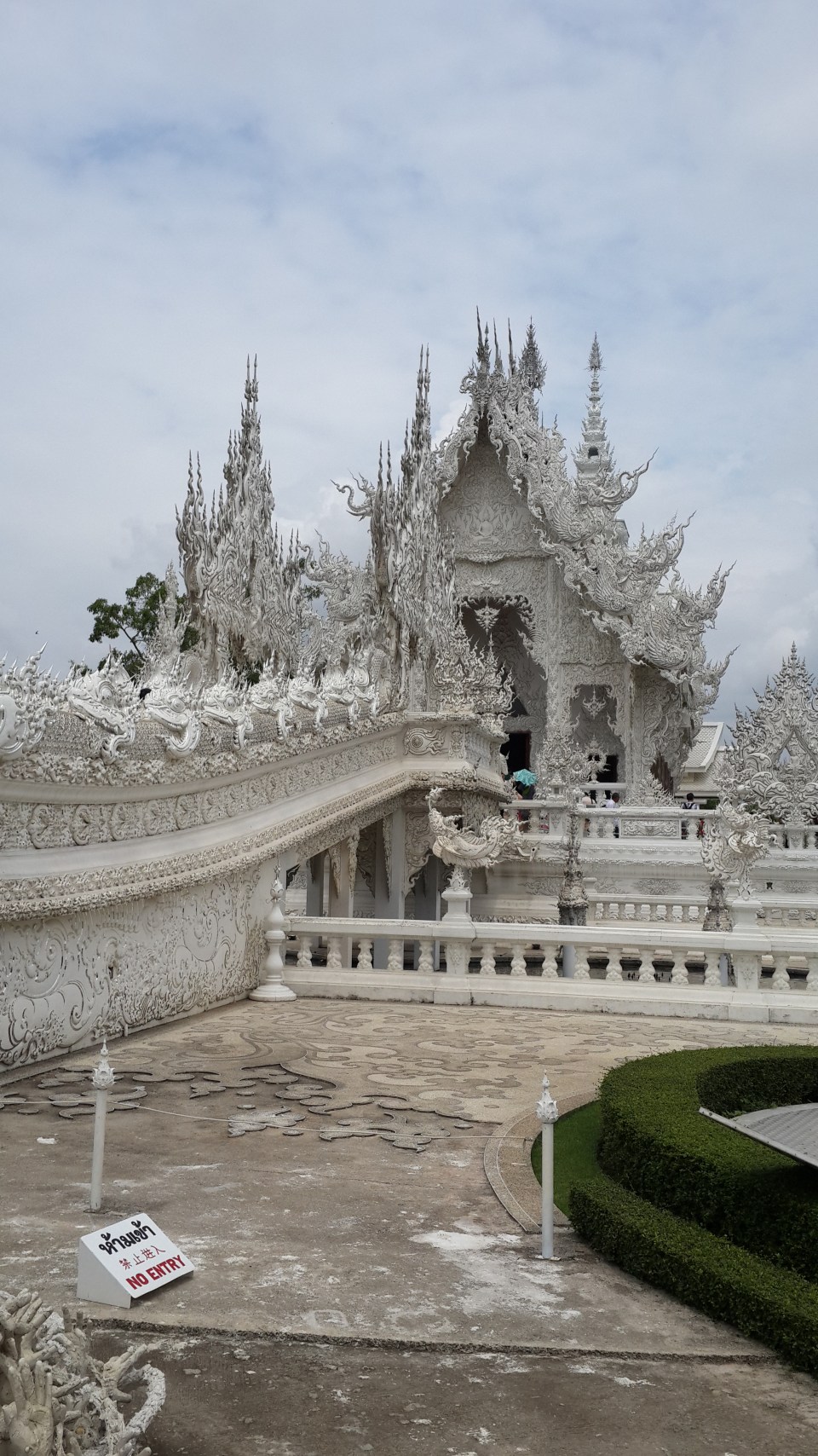

shapes reminiscent of mudras…
The art and architecture of the temple certainly is distinctly Thai. One sees shapes reminiscent of mudras made by the flowing hand movements of a Thai dancer. Chalermchai says he takes themes from ancient Thai murals, trying to create a modern synthesis that is recognizably and uniquely Thai. If the number of visitors is taken as a measure, then his ambition has certainly been realized. Within the temple are modern murals that face a statue of the Lord Buddha. “I want people to feel peace and happiness and to envision the kindness of the Lord Buddha to all beings,” says Chalermchai. “The mural shows the final conflict of the Lord Buddha’s own demon before he received enlightenment and freedom from immoral thoughts.” When asked about the images of George Bush and bin Laden in the demon’s eyes, the artist replies. “I want everyone to know that our world is being destroyed by those who crave to build weapons that kill. They segregate and therefore cannot find peace….”
Chalermchai expects to complete the temple in 90 years.He begins each day at 2 a.m. with an hour of meditation, then creates and sculpts. An artist whose wealth stems from the roughly 200 artworks he produced every year, he now devotes most of his time to the completion of the temple and currently produces around ten paintings a year. The entire site is kept spotlessly clean and supervised by zealous volunteers who ensure that tourists are modestly attired before they enter the temple. The toilets are guarded by a bronze hermaphrodite keeper.
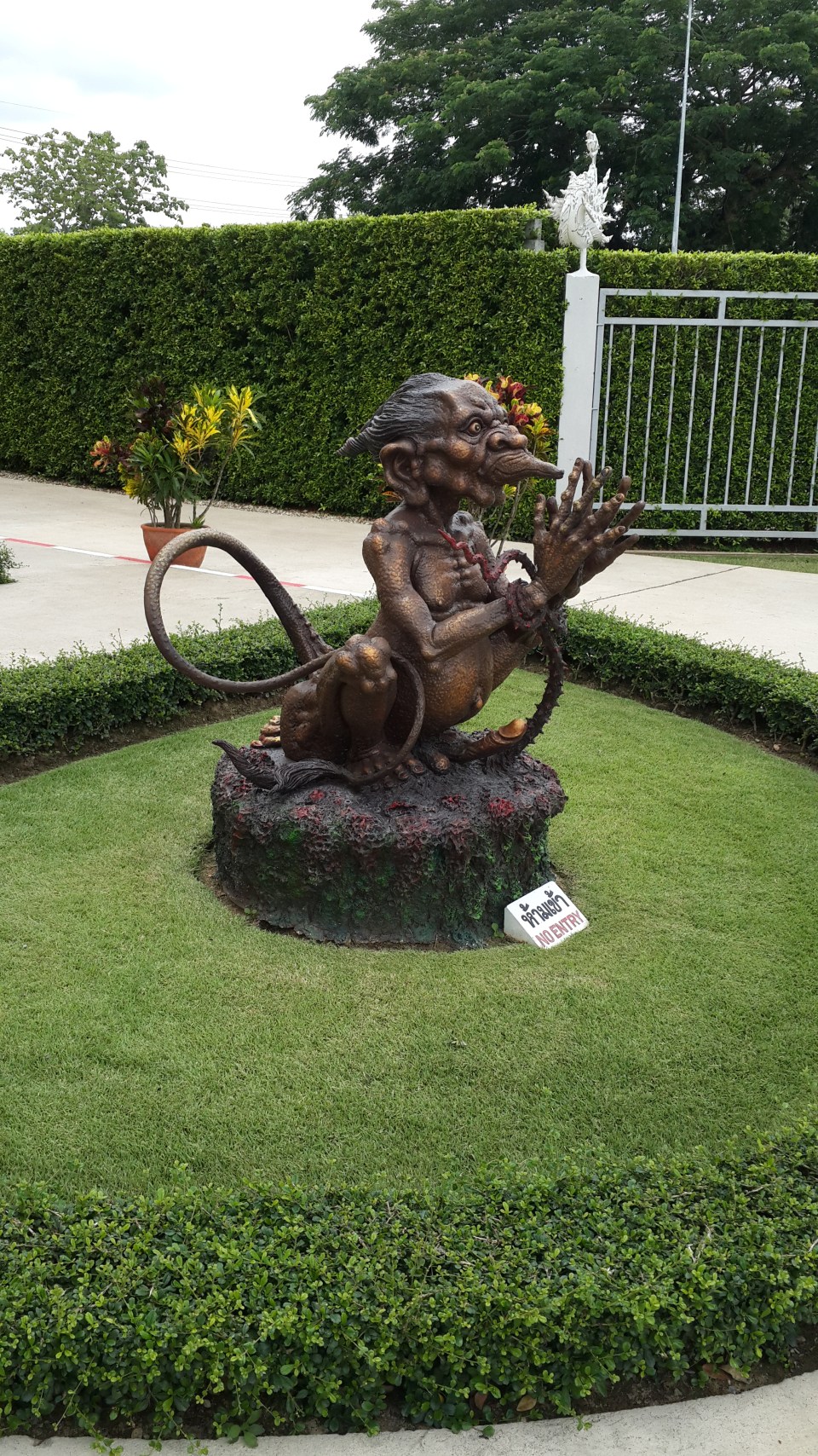
The bronze hermaphrodite custodian of the toilet, front…

…and rear
Concluding with the artist’s own words: “I want to discipline the mind to train me toward being a good person with clear thinking, speaking well and doing good deeds. We are all human and I want to give goodness to people. If we have love and forgiveness in our hearts, it will come out naturally. You need to practice patience before you can control your own mind.”

…I want to give goodness to people.
For more by this author, see his Amazon page here.
Nature’s Bounty

Hundreds of these large orange blossoms strewn on the path to the beach from a tree overhead. The nameless profligacy of Nature’s bounty. Surely the earth has enough for all if we use its resources wisely.

Indian Khanna grows in profusion beside a walking trail on the outlying islands.
My apologies for the long delay in posting, but I am privileged to be truly living in a state of grace. More on that in the next blog!
Books are Bad for You.
I can imagine a conversation with friends who think it’s crazy to say that books are bad for your health. What a self-destructive statement for a writer to make; a writer whose three books have recently received more than a dozen positive reviews (see author page on Amazon) But it’s true. In different parts of the world, at different times, books have proved harmful to their authors, as well as to their owners and readers. The Index Librorum Prohibitorum was published in 1559 by the Pope and listed books deemed heretical, blasphemous or simply lascivious and were therefore banned. Various editions of the Index were published in later years. The 20th and the last edition was published as late as 1948 and it was only abolished in 1966 by Pope Paul VI. Probably the most famous victim of the Index was Giordano Bruno who was burned at the stake in Rome in 1600 although admittedly, to the Inquisition, his principal crimes were not his writings but his heretical skepticism of many Catholic beliefs including the Virgin Mary and the trinity.
Closer to our time, in the 20th century, the list of books banned by Nazi Germany in the 1930s was long and included the literature of Marxism, Communism, pacifism, democratic writings and, of course, works by Jewish authors. During the cultural revolution in China between 1966 and 1976 a man who later became my close personal friend was sentenced to years in labor camp simply for being a mathematician with a small private library of books. His principal crime perhaps was to know more than the young Red Guards who conducted his trial, spat at him and made him walk around for months with a dunce cap on his head.
Even these relatively recent incidents of the 20th century seem to have faded from a public mind that is drowning in information but starved of meaning. Precisely the reason why much of the world is reacting with demonstrations of outrage (rightly so) at the murders of 12 journalists in Paris while largely ignoring (sadly so) the massacre of 2000 people in Baga village in Nigeria where more than a million people have been internally displaced by Boko Haram’s violence.
Boko Haram can be most literally translated as “books are bad for you,” where Boko means books, literature, the printed word, the world of ideas; and Haram means impure or unclean. Boko Haram’s primitive ideology thrives in the absence of the world’s collective outrage that would force local leaders to take more forceful action to stop this cancer from spreading. This is a cancer that can unleash a civil war and spread to several neighbouring countries; Cameroon, Chad and Niger. This is no longer only a Nigerian problem. In the age of globalisation, this is a problem for the world.
Here is a link to the website of the Quilliam Foundation, an organisation that exists to fight the battle of ideas that lies at the roots of modern religious extremism, which is a form of theocratic fascism. Listen also to an interview with Maajid Nawaz, the co-founder of Quilliam who, as a former radical Islamist, is eminently qualified to talk about the topic. For those who despair at the directions that religious fundamentalism is taking the world, listening to the talk will be 43 minutes well spent. Thanks to Larry Willmore for his Facebook post drawing my attention to the talk.
See more of this author here
Molybdomancy
I started off intending to write about the Austrian New Year’s Eve custom of Bleigiessen and learnt several things today. First, the posh name for the practice is molybdomancy: the art of divining the future from the shapes of molten metal that is quickly thrown into cold water. Second, this is not only an Austrian custom, but is widely practiced in Germany and in the Nordic countries as well. Apparently in Finland, the practice goes by the name of uudenvuodentina and is quite popular. According to this source, the practice originated in ancient Greece and later travelled to the Nordic and Central European countries where the custom is still followed today, although the results are interpreted more in a spirit of fun rather than being taken seriously. No wonder the word molybdomancy has been quite forgotten!
Originally made from tin, nowadays bleigiessen sets are sold in the streets in the week preceding New Year in small bags consisting of half a dozen pieces of tin or lead alloy mixed with cheaper metal. The pieces are molded into shapes associated with good luck; horseshoes, pigs, chimneysweeps, toadstools or 4-leaf clovers. I bought a bag for New Year’s Eve and settled down with six of my nearest and dearest to see what 2015 has in store for us.

What 2015 has in store for the family.
As you can see, the results are outstanding! 2015 is going to be a wonderful year for the family; two of them will perform exceptional deeds, while the rest will be merely brilliant. I wish all my readers a similarly uplifting prognosis.
What 132 schoolchildren should teach us.
Two recent newspaper articles have been very troubling; one of them positively horrific. One hundred and forty-one people died, all but 9 of them children, in a Taliban attack on a school in Pakistan.
The picture below appeared on an online news site nearly two months ago. An Indian love story that could be the beginning of a fairy tale. She is 21, a Muslim, a student at a dental college. He is 24, an engineer, a non-practicing Hindu. They fell in love. Her parents had planned an arranged marriage for her. She did not want it. So Anshida secretly married the man she loved. And they lived happily ever after. Oops, no! Apparently there are enough people in her community willing to resort to violence in order to prevent inter-racial unions, and this couple has been forced to live under police protection ever since. Here is a link to an interview with the couple where Gautham says their only desire is to live in peace together and they might have to leave the country to do so.

Anshida and Gautham, in the Indian Express Nation online edition of November 12, 2014.
Einstein was apparently once asked to explain how radio worked and famously used the example of a long cat. You see, wire telegraph is a kind of a very, very long cat. You pull his tail in New York and his head is meowing in Los Angeles. Do you understand this? And radio operates exactly the same way: you send signals here, they receive them there. The only difference is that there is no cat. The explanation is not so simplistic as it sounds, since nerve impulses are also electrical impulses of a different kind. Now what has this got to do with the persecution of a loving young couple (don’t tell me there’s something wrong with love) and murder of 132 schoolchildren by religious fanatics?
Growing up in the south of India, I experienced Islam as a very benevolent religion of deep faith anchored in tolerance as epitomised by the work of Rumi and Hafez. I saw the following quote taken from the wall of a recently demolished house.

Translation from the Persian of a framed script in a South Indian Muslim household, around 1914
When I came across the apocryphal tale of Einstein’s explanation of how radio works, I realised that Islamic fundamentalist theologians have taken a step backwards in the 20th century and invented a real cat to interpret the gap between scripture and practice. And indeed, it is a cat that squeals horribly. I much prefer the Einsteinian version of an imaginary cat. Counter-progressive theologians have not yet disputed the efficacy of radio transmission without cats. I long for them to do the same in the case of the transmission and observance of religious beliefs. It is to be hoped that the murder of 132 children moves at least some of them to re-examine the dead certainties of their religious beliefs.
 aviott