Home » religion (Page 3)
Category Archives: religion
Terrorism and Climate Change: A Single Solution

Two thirds of the world’s electricity is generated by burning fossil fuels.
Much of the world’s wars and terrorism occur in the Middle East where, not so coincidentally, much of the world’s oil also originates. A lot of the world’s climate change problem (the majority of the world by now admits that there is a problem) is due to burning fossil fuels. In 2013, oil provided around 33% of global primary energy consumption* (i.e. energy contained in fuels used to generate electricity, heating, industry, transportation or other end users). This amounts to nearly 87 million barrels of oil per day. One third of this oil came from the Middle East.
The World Coal Association states that (in 2013): Coal provides around 30.1% of global primary energy needs, generates over 40% of the world’s electricity and is used in the production of 70% of the world’s steel. Coal is more democratically distributed around the world than oil, and there is not much likelihood of wars being fought over coal reserves. Coal is also a relatively “dirty” fuel and produces more CO2 (ca. 200) per unit of energy delivered than oil (ca. 150) or natural gas (117).
A listing of principal terror groups in the world includes ISIS, Boko Haram, Al-Shabaab, Al-Qaeda, Al-Nusra, Ansar al-Sharia, Hezbollah and Hamas. Al-Jazeera news notes that the United Arab Emirates published this week a list of 80 organisations worldwide, including the foregoing, that it formally identified as terrorists. Some of the organisations on that list perhaps do not belong there, but the larger point to be made in this article still holds. When great wealth flows from all parts of the world into the hands of a few, great disparities ensue; injustice and violence occur. The world needs to get off its greed for oil and move to renewable sources of energy. Of course the transition will be painful; but less disruptive than continued terror. Reduced global oil consumption can lessen the flow of disproportionate wealth that the world directs into the coffers of a few by 20 to 30% in the next ten years.
Is the transformation do-able within this time frame? The world’s experts are divided fairly equally between yes and no. Why? Because it hasn’t been done before. But here is an indirect answer. The Paris-based International Energy Agency (IEA) has revised its estimates for deployment of renewables worldwide upwards several times in the past decade. The forecasts made in 2002 for the year 2020 were exceeded by the year 2010. So perhaps the correct answer is not to be found among energy experts but in a quote from Spanish poet Antonio Machado (1875 – 1939) who said:
Caminante, no hay camino
Se hace camino al andar.
Traveller, there is no path
The path is made by walking.
Paraphrased less poetically into modern business-speak: walk the walk, don’t simply talk! We have to make choices as individuals before nations and governments follow in our footsteps.
*For more background, see Energy Trends Insider, with links to BP’s widely used Statistical Review of World Energy 2014. Oil accounted for 33 percent of all the energy consumed in the world in 2013. This amounts to 86.8 million barrels per day. Of this, roughly 32% came from the Middle East.
http://www.ren21.net/Portals/0/documents/activities/gfr/REN21_GFR_2013.pdf
The lake of deeds, and a dyslexic scholar
Ramcharitamanas (the lake of the deeds of Rama) is one of the greatest works of Hindu literature. Written by Goswami Tulsidas in the 17th century, it was written in Awadhi, a dialect of Hindi, and made the epic Ramayana, till then only read by the privileged few, (mostly upper castes) who knew Sanskrit, available to the common man. This widespread access to the Ramayana stories led to the birth of the tradition of Ramlila, the dramatic enactment of text, all over the north of India.
Tulsidas lived during the reign of Mughal Emperor Akbar (the great, 1556-1605) who was noted for his religious tolerance, emphasised by his promulgation of Din-i-Ilahi, a religion derived from a syncretic mix of Islam, Hinduism, Zoroastrianism and Christianity. To underline the point the Emperor took three principal wives from three religious faiths; Muslim, Hindu and Christian. Presumably due to Akbar’s religious tolerance, the enactment of Ramlila’s beloved text spread through Mughal lands and were adopted by the Phad singers and puppeteers of Rajasthan where they are still performed today (see my earlier post: Facebook for the Gods). Akbar was believed to be dyslexic, so he was read to every day, had a remarkable memory and loved to debate with scholars.
Written in seven kandas or cantos, Tulsidas equated his work with the seven steps leading into the holy waters of a Himalayan lake, Manasarovar. The lake lies on the Tibetan plateau and covers an area of 320 sq. km. The name comes from the Sanskrit words manas, mind, and sarovara, lake and refers to the belief that Lake Manasarovar was created in the mind of Lord Brahma before it was manifested on earth.

Lake Manasarovar. Tibetan Plateau, 4590 m.
Akbar’s acceptance of different religious beliefs led Time magazine to note in 2011 “While the creed (i.e. :Din-i-Ilahi) no longer lingers, the ethos of pluralism and tolerance that defined Akbar’s age underlies the values of the modern republic of India.” Quite a tribute to a dyslexic scholar emperor who died four hundred years ago!
For more by this author, see his Amazon page or his link on Google Play
Jesus on a Lotus, Whispers in Nandi’s Ears
Christianity came to India before it came to most of Europe. It was probably (and plausibly) brought by Thomas the Apostle in 52 AD, the name being derived from the Aramaic Toma, meaning twin. St. Ephrem the Syrian writes in the 4th century that the Apostle was put to death in India and that his remains were brought to Edessa (fairly close to Antioch – Antakya – in modern-day Turkey) by a devout merchant by the name of Khabin. British historian Vincent A. Smith (1848 – 1920) says, “It must be admitted that a personal visit of the Apostle Thomas to South India was easily feasible in the traditional belief that he came by way of Socotra, where an ancient Christian settlement undoubtedly existed. I am now satisfied that the Christian church of South India is extremely ancient.”
According to tradition, Thomas landed on the Malabar coast, where his skill as a carpenter won him the favour of the local king. He was allowed to preach the Gospel and convert believers to Christianity. Thereafter, he moved across southern India for the next 20 years before he was finally killed near the coastal city of Madras, present-day Chennai, in AD 72 apparently because a local king grew jealous of his increasing popularity. Marco Polo, writing in the 13th century, states that the apostle was accidentally killed by a bird hunter who was shooting at peacocks in Mylapore. More recent interpretation of inscriptions found on the Pehlvi cross, near present-day St. Thomas Mount, by the Portuguese in 1547, suggest that the legend of Thomas’ martyrdom was based on mis-translations of the middle Persian script. Whatever the truth of the Apostle’s death, at this point in time, the legend of his martyrdom has been firmly established to a degree that makes it a fact, and there is a basilica built on the site of the tomb at San Thome, one of only three in the world directly associated with the 12 Apostles. (The other two are St. Peter’s in Rome, and Santiago de Compostela in Spain, dedicated to James). Since India is a land of syncretism, the tomb and St. Thomas Mount have been a pilgrimage site for Christians, Hindus and Muslims since at least the 16th century. The Indian church has adapted in India and adopted some of this syncretism by introducing certain Hindu rites (such as the tying of the thali at weddings). Knowing this, one is not surprised to find that the image of Christ on the cross at the cathedral of San Thome is flanked by two peacocks and that his feet rest on a lotus.

lotus feet flanked by peacocks
The area around the San Thome basilica belonged to the ancient city of Mylapore, or the city of peacocks. A temple was built in the 7th century AD in Mylapore. According to legend, Shakthi, the divine embodiment of the female, worshipped Siva in the form of a peacock, giving its Tamil name (Mylai) to the city. The temple was built to commemorate this, and is dedicated to Siva. Inside the temple is a statue of Nandi, the bull, which is Siva’s favourite mount, and also a gatekeeper to Siva and his consort Parvati. For this reason, it is believed that whispering one’s secret wishes in Nandi’s ear is as good as a direct request to Siva himself.
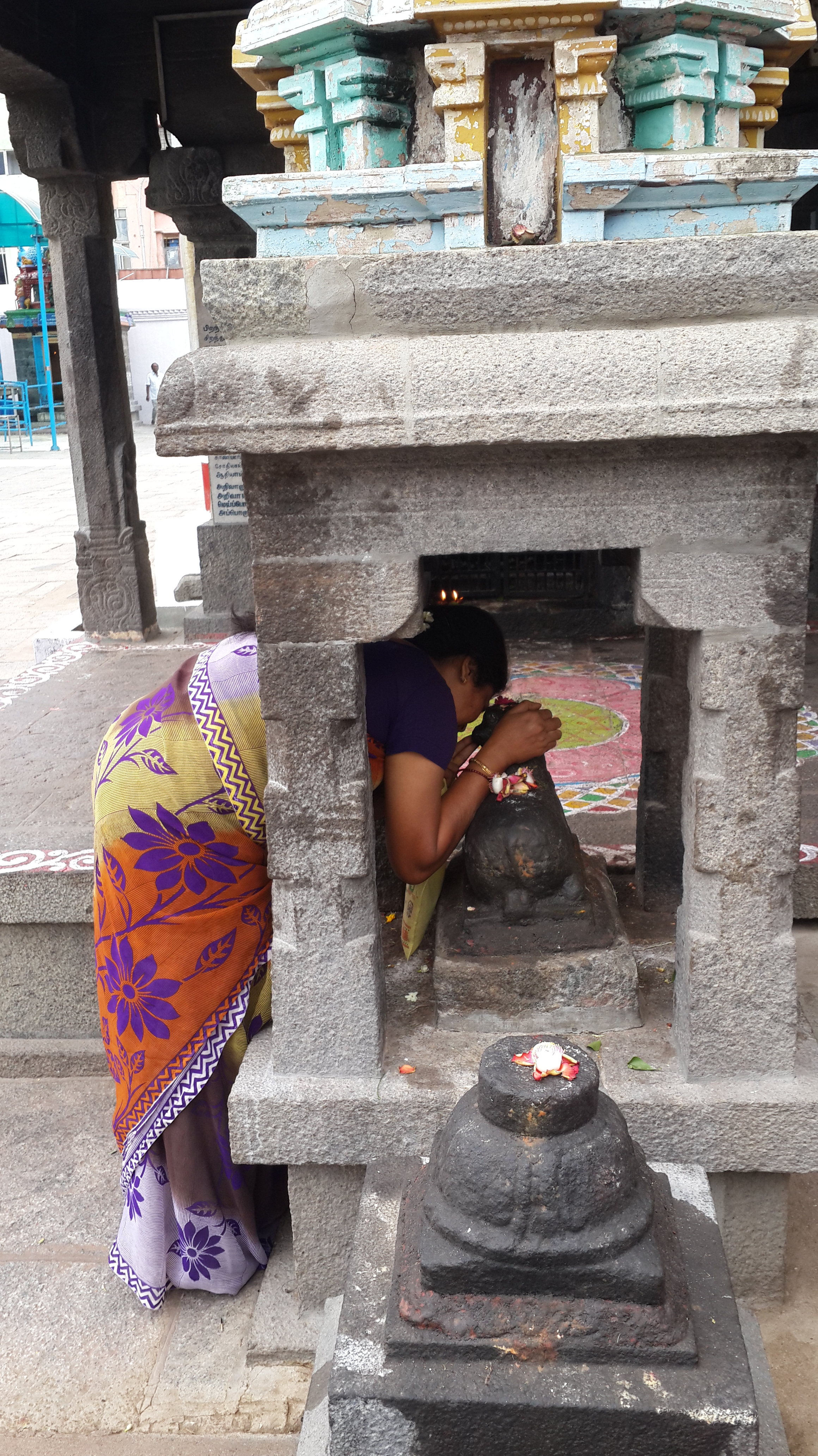
her word in God’s ear…

the temple courtyard is a relaxed and friendly space
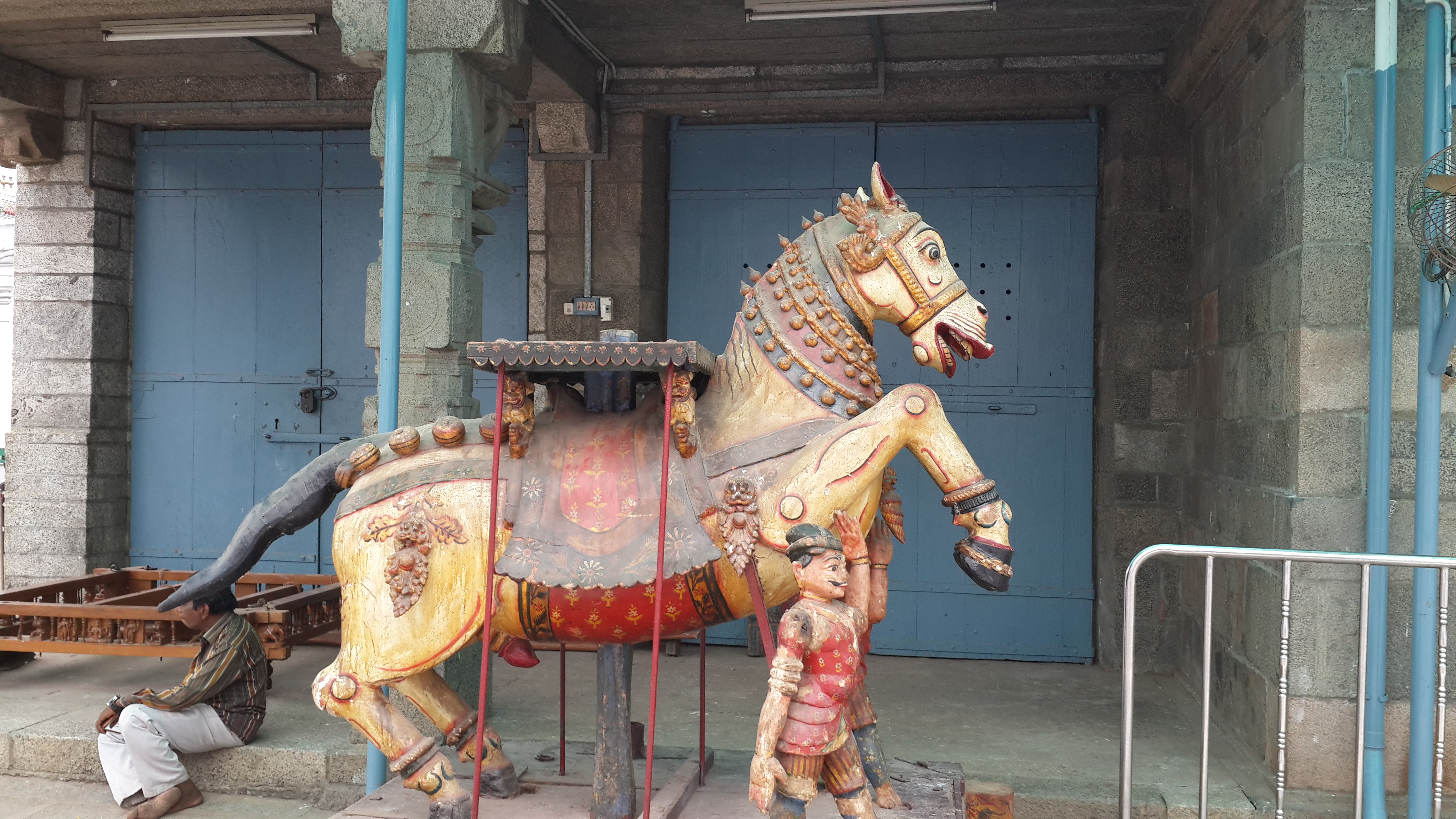
and splashes of colour
Being a good tourist, and wishing to hedge my bets in the afterlife, I prayed at the lotus feet of Jesus and whispered my innermost wishes in Nandi’s ear. Choose the link to follow this blog for updates on how well this strategy works in the coming months…
 aviott