Home » Posts tagged 'climate change' (Page 6)
Tag Archives: climate change
The Politics of Inclusion
If one reads the newspapers in Europe these days, it’s easy to imagine a world going unbalanced. Political chaos in Britain; the shock of Trump’s rise to political prominence in the US; the continued slaughter in Syria; the failed coup in Turkey; honor killings of women in the Middle East and South Asia; young girls kidnapped in the hundreds by a sinister cultish organization in Nigeria with hate and abhorrence of non-religious learning as its primary motivation; China flexing its military muscle in the South China Sea…the list goes on. The underlying cause of each of these symptoms is one and the same, the quest for economic power. In itself harmless, economic power, the accumulation of wealth, is such a basic human instinct that it was unquestioned long before Adam Smith came along to make it intellectually respectable.
What we should question, however, is the tendency of modern societies to equate development with wealth, and economic poverty with under-development. There will be conflict in the world as long as wealth accumulation is equated with development. No one wants to be under-developed, so development currently means increased exploitation of the world’s resources. Ultimately, it is the scramble for the world’s resources that fuels all the conflicts and emigrations we observe today. Interestingly, many of those people, mostly politically right-wing, who rage against immigrants these days invoke a past society free of injustice and racially pure. They forget, or are unaware that, for a species that genetically differs from a chimpanzee by only 1.3% of its genes, talk of racial purity is an absurd notion, absurd to the point of imbecility.
The politics of inclusion that most people yearn for, but don’t know how to create, actually begins with us. The process of inclusion begins with us, one person at a time. Perhaps that is why the process is so daunting, since we have to change ourselves first, before we begin to find the politics of inclusion that the majority of the world seems to be longing for. Check out this link to hear what geneticist David Suzuki has to say about modern economic thought.
For more by this author, see his Amazon page here.
Oceans of Lithium
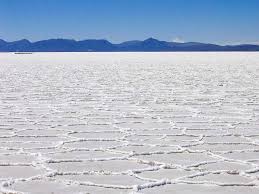
Salar de Uyuni. Source: Wikipedia.en
Salar de Uyuni in Southwest Bolivia contains an estimated 43 % of the world’s easily recoverable lithium. Together with neighbors Chile and Argentina, the three countries contain 70% of the planet’s reserves. As most people are aware by now, the renewables revolution is gathering momentum, and the world needs lithium, lots of it. The people who follow these trends estimate that Tesla’s Gigafactory alone, when it comes into production, will double world demand for lithium, whose prices have shot up just in the last two months of 2015 (from US$ 6500 to 13,000 a ton in November/December). American, Japanese, Chinese and South Korean companies are already mining around 170,000 tons of lithium worldwide. The Argentinian salares, or salt flats, comprise thousands of square miles in the provinces of Catamarca, Jujuy and Salta. The Salinas Grandes in the latter province is estimated to be the third largest in the world. But the grand-daddy of them all is the Salar de Uyuni in Bolivia that stretches over 10,000 sq.km. To paraphrase Exupéry, Salar de Uyuni is made up of salt, salt salt, and more salt, to a depth of one meter or more. In addition to common salt (sodium chloride), the salars contain other useful chlorides; potassium, magnesium and lithium chloride. The estimated 9 millions tons of lithium contained in this salar, conveniently concentrated by natural evaporation, should be enough to power a global energy revolution or two, but at what cost? Bolivia has suspended mining operations after the local residents opposed it, and Chile is granting no new concessions. These are understandable steps, in the light of what economists call ‘the resource curse.‘ In a nutshell, the resource curse or the resource paradox is that often countries with non-renewable natural resources (like minerals and oil) tend to have lower economic growth and less democracy than countries with fewer natural assets.
Understanding the resource curse does not help the international battery industry or alleviate the world’s need for non-polluting sources of energy, however. The increasing price of lithium is driving research into methods of obtaining it from the most abundant source on the planet, the oceans. Industrial ecologist Robert Ayres confidently predicted to me more than a decade ago that we would get all the lithium we need from the ocean. “There’s billions of tons there,” he said. True, there is an estimated 230 billion tons of lithium in seawater, but at a concentration of 0.14 to 0.25 parts per million, I did not believe it possible to extract it in meaningful quantities at reasonable cost. Changed my tune this week.
Many companies worldwide have been experimenting with various reverse osmosis technologies (the same technology that’s most often used to desalinate seawater) to produce brine concentrates dense enough to make lithium extraction economical. Now there are reports of several companies in a dozen countries that envisage producing lithium from brine concentrates at prices ranging from $1,500 to 5,000 per ton. Here’s an article about one of them.
For more by this author, see his Amazon page here.
Turkey’s 2.5 million Syrian refugees
The following text is copied from the blog of economist Larry Willmore, and I think it merits re-posting because of widespread reports in the media in Europe about Turkey’s non-cooperative stance about taking back refugees who have made the hazardous crossing to Europe. Really? Read on below…

image courtesy yenisafak.com
We are bombarded daily with news of problems with the massive influx of Syrian refugees in Europe, Jordan and Lebanon but seldom hear about the much larger number of Syrian refugees in Turkey. The reason there is so little reporting from Turkey is that Syrian refugees there encounter little hostility. Moreover, significant numbers are able to work informally, often in businesses run by Syrians. The Turkish government recently began to issue a restricted number of work permits to refugees. Refugee employment would no doubt increase, along with wages and working conditions, if the tight restrictions were relaxed.
[T]he 2.5 million Syrian refugees in Turkey have encountered less hostility than in Jordan and Lebanon—not surprising given Turkey’s population of 77 million …. Jordan and Lebanon face a significantly higher burden with over one million Syrian refugees in each country, representing an influx equal to, respectively, 20 and 25 percent of the native population.
It may also be that Turkey’s more open business environment has played a role in lowering tensions. ….
Over the last four years, about 4,000 formal tax-paying firms—employing thousands of workers, mostly Turkish—have emerged. And informal enterprises may multiply this number. …. [M]any of these [refugee] workers make less than minimum wage and have no social benefits. But in January 2016 Turkey’s official gazette announced the granting of work permits to refugees, though employment is capped at 10 percent of a firm’s workforce.
Omer M. Karasapan, “The impact of Syrian businesses in Turkey“, Future Development blog, Brookings, 16 March 2016.
For more by this author, see his Amazon page here.
Hinkley. Oh no!
The political decision to power ahead with Hinkley Point C nuclear power station is the energy equivalent of appointing a tone deaf musical director to the London Symphony Orchestra. How much more evidence do Cameron and Co. need? A short litany of anti-Hinckley arguments should suffice.
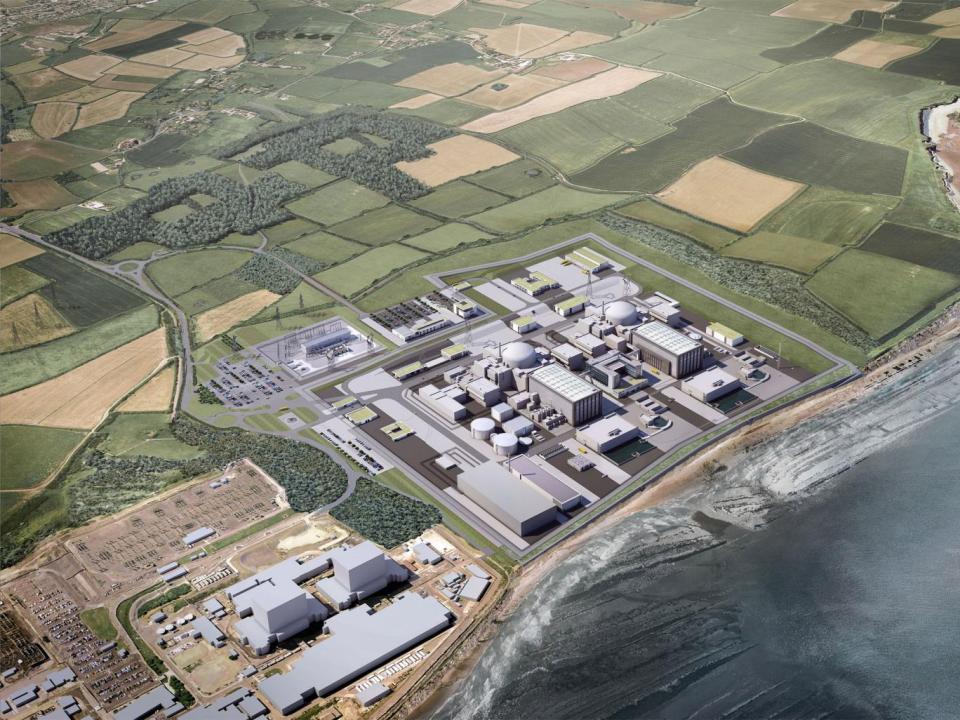
Hinkley 1
In a case of economics speaking truth to power, the OECD’s 2010 World Energy Outlook quietly increased the average lifetime of a nuclear power plant to 45-55 years, up 5 years from its 2008 edition.
Seeds of Inequity
What could be more principled than companies that work to genetically modify seeds, breeding out negative traits and selecting a mix of desirable qualities that make them resistant to pests, hardy enough to withstand droughts or floods as desired? After all, farmers have been doing this for hundreds of years, patiently crossing varieties and developing superior strains of the world’s crops. Enter the profit motive. Still no harm done, we thought! Selfish interest is the lever used by civilizations to lift their peoples to prosperity, with the profit motive as the fulcrum on which this lever rests.
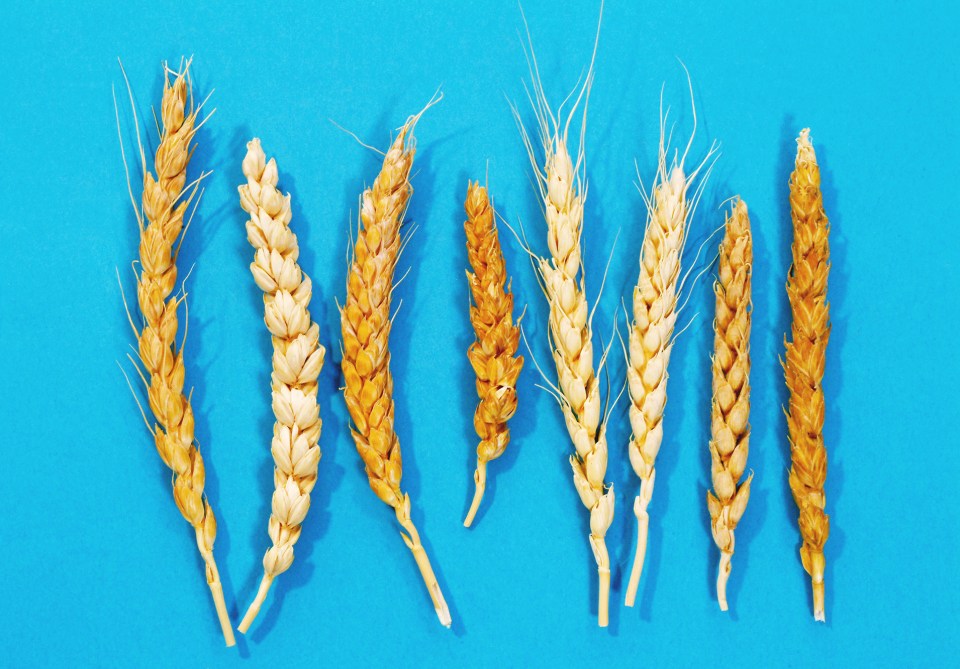
Strains of wheat
The world has generally accepted the truth of this principle ever since Adam Smith pointed it out in his seminal work, first published in 1776. Except for a relatively brief interlude when some nations experimented with communism and socialism in a failed search for social justice and equity, the world has broadly accepted Smith’s premise that wealth creation is a good thing and ought to be encouraged by enlightened governments that simply move out of the way and allow entrepreneurs to do their stuff. By and large, this is what seems to have happened in the case of GMOs (genetically modified organisms). Basically, some large corporations have copyrighted and distributed their seeds (sounds fair enough; respect for intellectual property rights sets the basis for innovation and prosperity). The problem is, these corporations have also made the rules about what happens to the seed generations that follow. They have decreed, and governments have accepted, that farmers may not retain a proportion of seeds from their crop for planting the subsequent season, but have to buy the seeds from the corporations again.
As Lizzie Wade points out in her Science article “How Syrians saved an Ancient Seedbank from Civil War”
…Maize, for example, was created by ancient Mesoamericans by painstakingly breeding more and more appetizing teosinte, a stubby grass with tiny, tough kernels that has so little in common with modern maize that archaeologists dismissed it as a possible wild ancestor until genetic tests revealed the surprising truth. The problem in the short run is that conventional breeding can be s…l…o…w. Teosinte was domesticated in central Mexico between 6,000 and 10,000 years ago, but farmers only managed to create a variety that tasted good a mere millennium ago
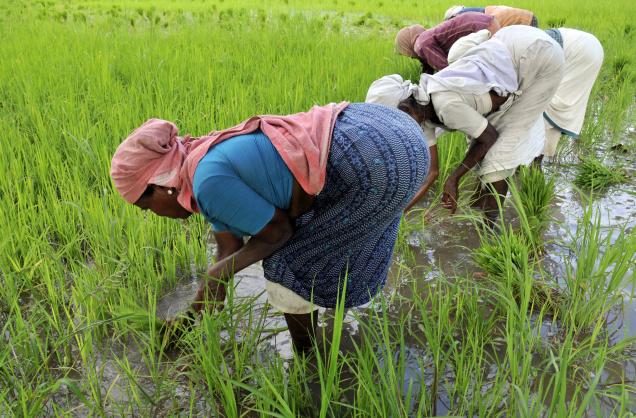
They can plant and reap, but they can’t sow again without buying seed…
As S. Grant points out in his article “10 Problems Genetically Modified Foods are Already Causing,” once they plant GM crops, farmers can no longer legally harvest their own seeds and are in danger of entering an era of perpetual bondage. Thus serfdom re-enters the world in the 21st century, this time clothed in the language of high-tech and carrying the false promise of freedom from hunger. Lawmakers are all too often ignorant and dazzled by technology, so they fail to realise the problems with GM crops are more to do with social and juridical issues rather than with the technology itself.
“In India, seeds are taken as a symbol of God’s blessing. They keep it, they store it, they know what is good seed and bad seed.” “Control oil and you control nations. Control food, and you control people.”
The above two memorable quotes are from a must-see 9-minute video about Natabar Sarangi, a village farmer who distributes free seeds to poor farmers out of the deep conviction that the thousands of varieties of seeds bred and developed over centuries should not be lost. In the process, he helps many of them to modest prosperity.
For more by this author, see his Amazon page here.
Saving the Tiger
Ranthambore National Forest and Tiger Reserve is a stunningly beautiful place that spreads over 450 sq. km. Writers like Jim Corbett and Rudyard Kipling have painted vivid portraits of Indian jungles for readers in the English speaking world. On a recent visit to Ranthambore, sitting in an open jeep, slowly winding its way along rutted jungle trails, tales of Mowgli, Bagheera and Balu the bear seemed to come alive. She expected to see a barefoot boy in a loin cloth peering out from among the tall grasses. Instead, she came face to face with …Shere Khan.

Shere Khan. Her real name, said the guide, is Noor…

…or Mala, or more prosaically, T-39, the mother of 3 healthy cubs
The moment was so unexpected, so pure, so anti-climactic that there seemed to be magic in the air. Noor is also known to the park rangers as Mala, a name that means ‘necklace‘ for the decorative, beadlike stripes on her flank. She had apparently just fed at dawn, the remains of the kill lay somewhere in the grasses nearby, her belly was full, and she was tired and too sleepy to investigate the little open jeep with three occupants parked at a respectful distance.
These magnificent animals are under threat from us humans. Ironically, one way to save them might be to bring more humans to visit them in their natural surroundings, just like the passenger in the jeep who watched her in awed silence for nearly two hours. For every tourist who comes to see them here, there are perhaps two or three locals who earn a livelihood, people who have been displaced from their own natural habitat in the jungle, displaced by the need to preserve wildlife. The villagers who used to live in Ranthambore forest were relocated when the tiger reserve was set up. These displaced people had to carve out a new existence in small settlements surrounding the jungle that was once their home.
We met one of the displaced people, a Rajput by the name of Dharamveer. He was proud of his forbears who had built forts and castles in these hills and jungles, and today he was one of the lucky ones; someone who had done well by doing good. When he was displaced from the forest, Dharamveer had trained as a tiger painter, painting iconic portraits of Shere Khan with the finest of strokes using delicate brushes that were a mere three or four hairs thick. This fine work gave the tigers in the paintings a lustrous lifelike glow that seemed to move as they caught the light. Buoyed by this success, he assisted widowed women to retrain in other handicrafts and has created a thriving business selling their work.

A Rufous Treepie
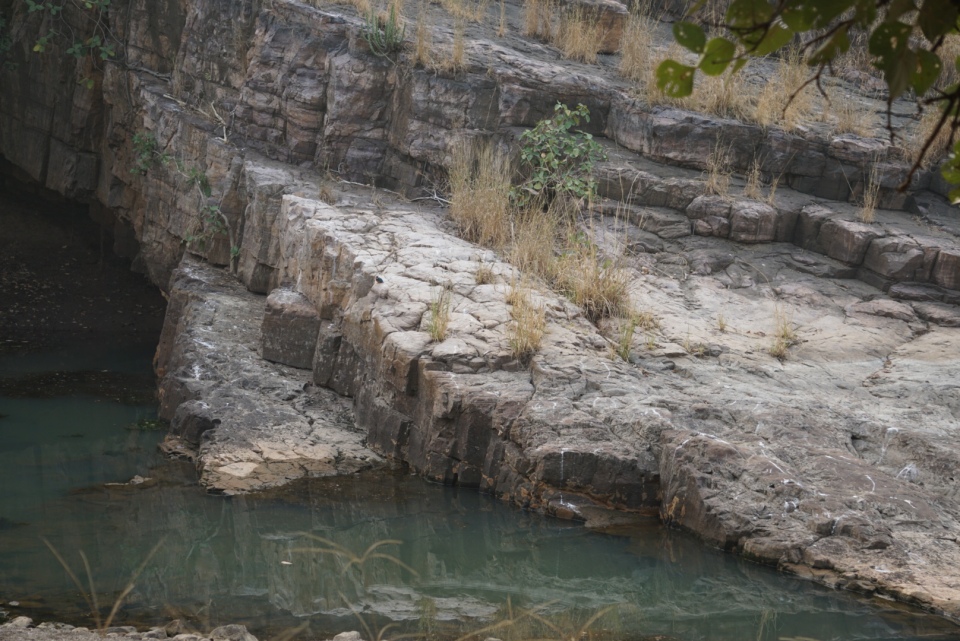
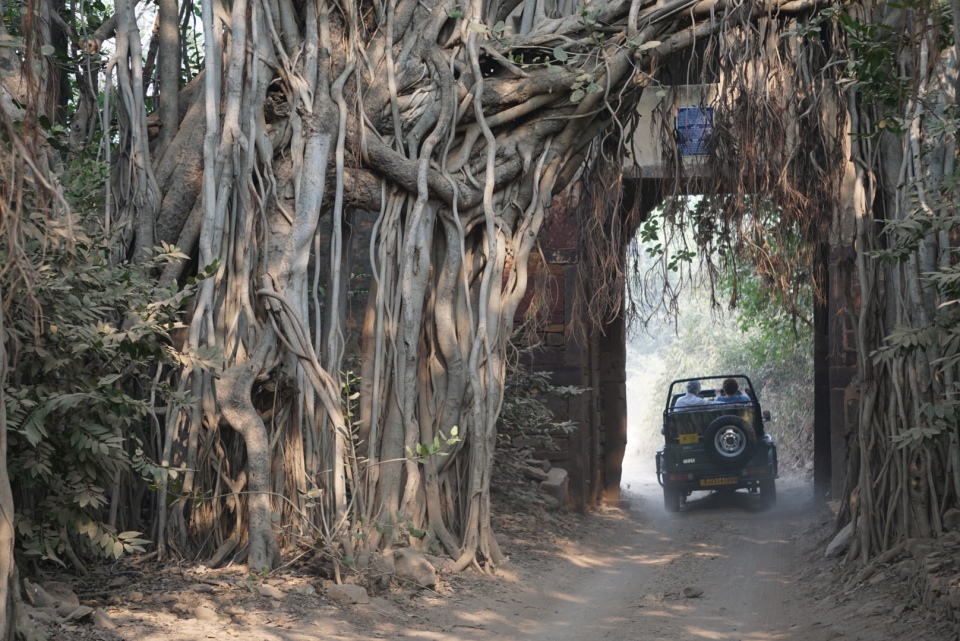
the entrance to the reserve is through the old Ranthambore fortress gate…
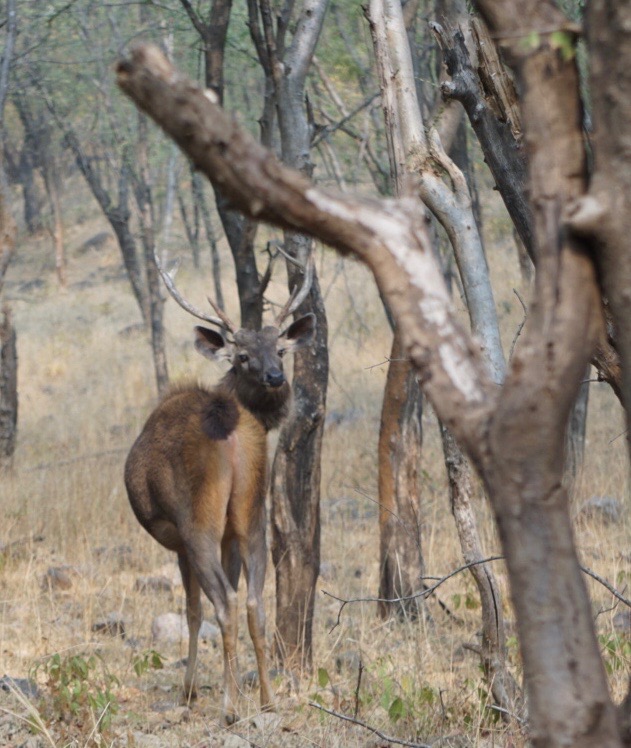
…the sambhur belled, once, twice, and again… (Hunting Song of the Seonee Pack)
We visited his store after the safari and were welcomed by the artisans who proudly showed us their wares. There was exuberant patchwork art, as well as many other fabrics, woven on rural handlooms, carvings, tribal paintings and animal protraits. As usual, there was more than one person could buy, but an American friend is exploring the market for these attractive products outside India. More on that will follow in a later posting.

An exuberant patchwork of Hathi the elephant; handloom fabrics, carvings and nature paintings
For more by this author, see his Amazon page here.
Spreading the Sunshine 1: A New Year Message
Even today, in the first half of the twenty-first century, thousands of villages in Africa and Asia (mainly in India) remain off-grid and have no access to electricity. Ever since a three-month stay in Kenya and Tanzania in 1985, I have dreamt of bringing solar lighting to the smallest villages on these two continents. In Kenya I was astounded to see that, as early as 1985, a few rural families had bought individual solar panels connected to used car batteries to power a single light bulb and the occasional television set. They did this because they had no hope of access to grid electricity in their lifetimes. It’s even more astounding to think that in affluent countries today, the majority of people who drive $ 20,000 cars consider solar power unaffordable without government subsidies. No wonder the world is hotting up! Such economic calculations show how skewed our thinking is.
Of course it was obvious that this journey of a thousand miles begins with a single step. Less obvious was what this first step should be. Mhairi made the first step on a recent (November 2015) visit to a village on the outskirts of a tiger sanctuary in Rajasthan. She made contact with the owner of a handicrafts shop on the edge of the Ranthambore national forest and tiger reserve who helps village craftswomen earn a living by marketing the beautiful tiger paintings, patchwork quilts with mirror designs and appliqué fabrics they make. Dharamveer was thrilled to hear about the idea of installing solar lighting for the nearby villages. He immediately took us to visit three of the 10 surrounding villages. These villagers have limited or no access to electricity. Even the few homes connected to the grid have power only 2 or 3 days a week, so they end up spending 2 to 3 hundred rupees a month on electricity bills or on kerosene for inadequate lighting with lamps. The proposal to pre-finance solar lamps for each household in the village was met with much enthusiasm. They were quite willing to pay 200 to 300 rupees a month for reliable solar lighting. And they were delighted to hear that, at a price of just 499 rupees (US $ 7 at current exchange rates), the lamps would belong to them within three months. Apart from the environmental costs of burning kerosene, the biggest drawbacks are cost and inadequate light for children studying or doing homework.

The Pico lamp, US $ 7 with a 2-year guarantee.
The idea we propose is quite simple. We plan to finance around one hundred of these solar lamps initially, to be distributed to a number of households in the ten target villages. Presumably they will be paid for in 3 months from the money the villagers save from their kerosene and electricity bills. We will request voluntary contributions for another 2 months and use the extra money to expand the circle of recipients till all households in the villages are covered. After which one can think of more elaborate systems, for example, like the model shown here that costs 7000 rupees or US $ 100 at today’s exchange rates. Greenlight is a for-profit company started in the US by three engineers, two American and one Indian. Their products have received good reviews in the international press.

The Sun King Home 120 is priced at approx US $ 100, can power USB devices and mobile phones.
We have decided on Greenlight’s Sun King model range, based only on our own internet research and news reports. Readers of this blog are invited to give feedback or share their own experiences with different models. I can envisage offering a range of different systems based on cost and reliability. I look forward to hearing from you.
For more by this author, see his Amazon page here.
Two Old Friends
No, this is not a short story. I met two old friends yesterday, to the left of the path to the Power Station Beach on Lamma, both of whom I hadn’t met in years. The first was a Greater Coucal (centropus sinensis), also known as the crow pheasant. Its haunting call is heard everywhere on this island, so there must be scores of them here if not hundreds, but this is the first time in two years that I’ve seen one. Here’s a link to a YouTube video that someone posted from Thailand.
The second was a bittern, whose European cousin I used to frequently meet among the reeds at the edge of a pond on the outskirts of Vienna, usually in late autumn. Here’s a mobile camera photo of the bittern that may be distinguishable if you can enlarge it on your screen.
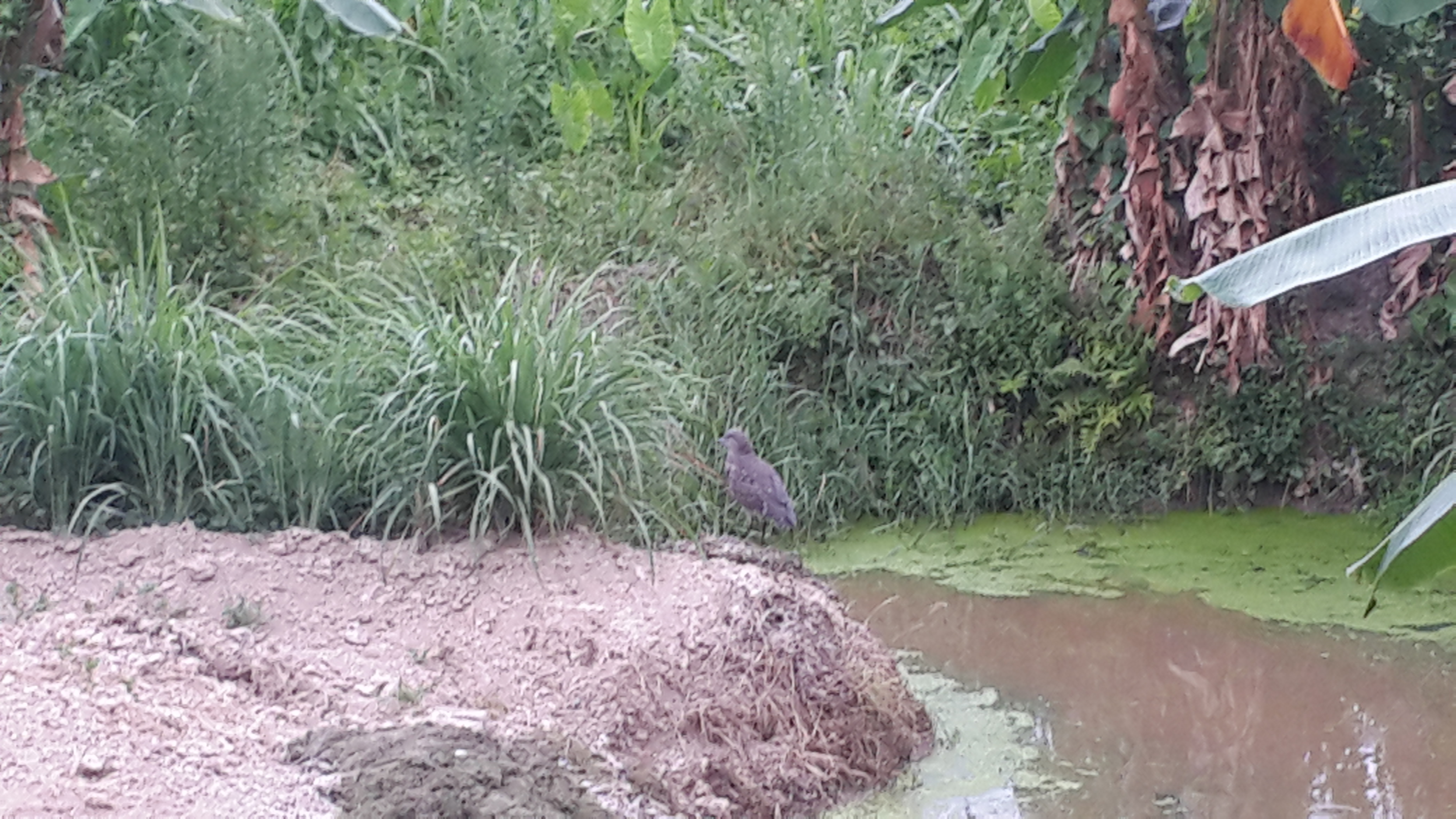
Bitterns are facing habitat loss worldwide
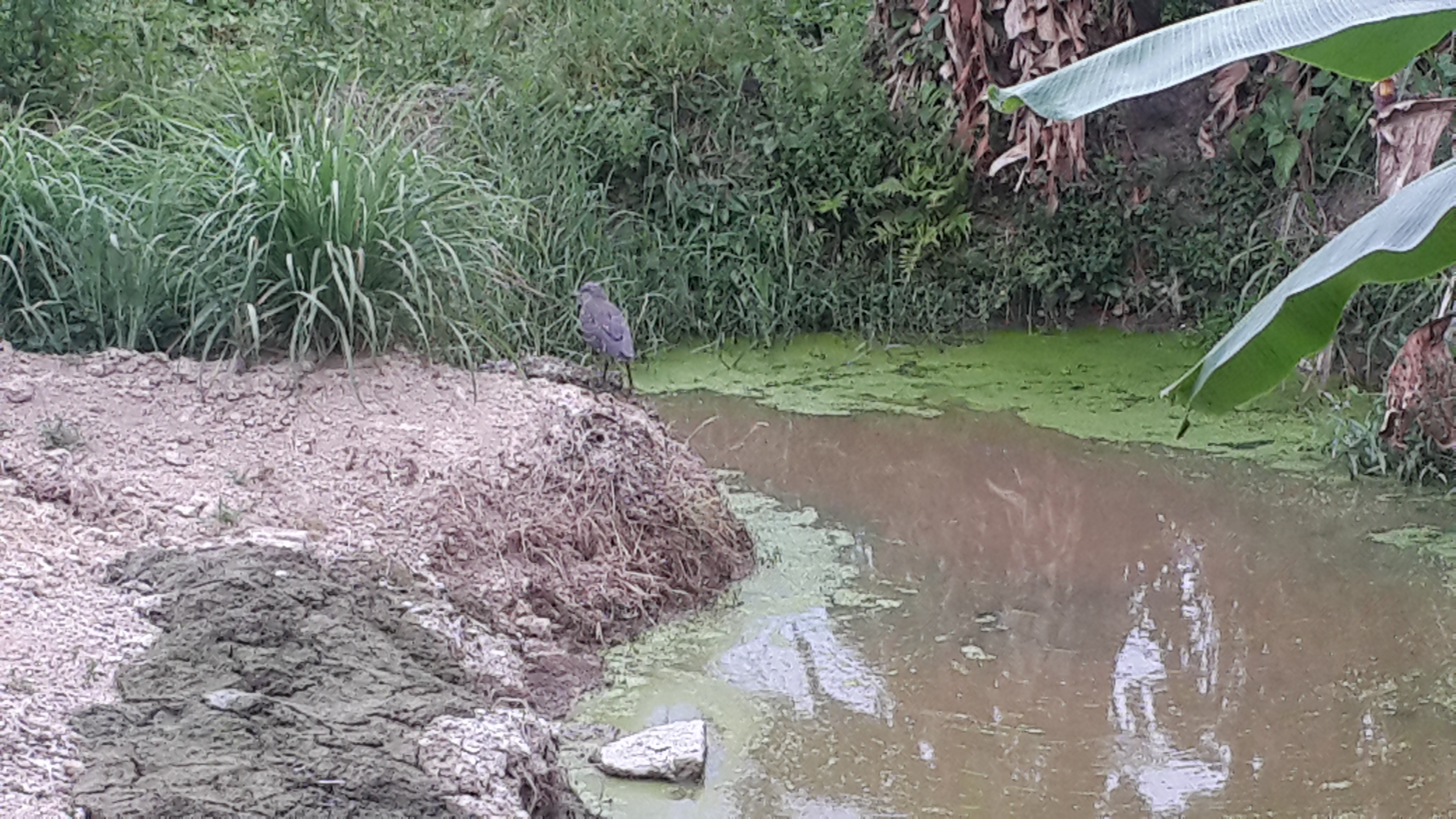
Bitterns, and thousands of other species, are being endangered by habitat loss, so it looks like rethinking ‘development’ may be an idea whose time has finally come.
Nature’s Bounty

Hundreds of these large orange blossoms strewn on the path to the beach from a tree overhead. The nameless profligacy of Nature’s bounty. Surely the earth has enough for all if we use its resources wisely.

Indian Khanna grows in profusion beside a walking trail on the outlying islands.
My apologies for the long delay in posting, but I am privileged to be truly living in a state of grace. More on that in the next blog!
It’s Raining Electrons in Small Spaces
Four recent reports on new breakthroughs in renewable energy generation and storage technology reinforce the promise that was once made for nuclear power: abundant energy for all, including the poorest in society, even though it may never be “too cheap to meter.”
High Performance Flow Batteries The promise of renewable energy technologies will be fully realized when battery storage becomes reliable enough and cheap enough to even out intermittent flows. Today the problem is partly solved by feeding energy from rooftop panels into the grid and then receiving compensation from the energy utility for the power supplied either in cash or in the form of reduced electricity bills. Looking at a typical electricity bill in Euroland (my own) I see the following charges. The unit price (per KWh) is between 6.5 and 7.3 Eurocents, but after grid charges, network costs and taxes are added, I pay 26 cents per KWh. Ironically, bulk consumers (factories, office blocks and large companies) pay lower rates, around 8 to 15 cents per KWh, depending on level of consumption. Now the whole picture is changed with the advent of low cost storage systems that make home batteries affordable and economical. Imagine home systems that can deliver electricity for all your needs at no cost for twenty to thirty years, once installed, barring the onetime cost of the system. Coming soon, to an affordable home near you.
Silicon cones inspired by the architecture of the human eye. The retina of the human eye contains photoreceptors in the form of rods and cones. Rods in the retina are the most sensitive to light, while cones enhance colour sensitivity. Modelling photovoltaic cells based on the makeup of the retina, researchers have been able to enhance the sensitivity of solar cells to different colours in the sunlight that falls on each cell and thereby increase electricity output by “milking the spectrum” closer to its theoretical maximum. Increasing efficiency of the average rooftop PV cells from the current 18-20 to 30% would make such systems cheaper by far than grid electricity mostly anywhere in the world, even in temperate countries. Coming soon, to a rooftop near you.
Modular biobattery plant that turns biowaste into energy. Biogas plants are old hat. They have undeniable benefits, turning plant, animal and human waste into energy (methane) while leaving behind a rich sludge that is excellent fertiliser. However, good designs are not common and they are sometimes cumbersome to feed and maintain. Now comes an efficient German design that promises to be modular and economically viable even at a small scale. In another development, the University of West England at Bristol has developed a toilet that turns human urine into electricity on the fly (pardon the pun) and the prototype is currently undergoing testing, appropriately enough, near the student union bar. Coming soon, to a poo-place or a pee-place near you.
New electrolyte for lithium ion batteries. Lithium ion batteries using various electrolytes have already become the workhorse of the current crop of electric cars and for medium-sized storage requirements. New electrolyte chemistry discovered at PNNL Labs shows that reductions of upto ten times in size, cost and density are feasible and various electrolyte/electrode combinations are being further tested for production feasibility. Coming soon, to a battery storage terminal near you.
So what should you do, as a concerned global citizen, until you can lay your hands on one of these devices (or all of them) for your own use? Tread lightly on the earth, don’t buy bottled water, reduce energy use, walk when you can instead of driving your car (your arteries will love you for it), buy local produce, eat less meat (your grateful arteries again), think twice before flying off to that conference (think teleconferencing), buy an electric car if you need a new one, and remember that every liter or gallon of petrol you fill into your old one not only fuels your car but potentially also the conflicts in the Middle East and/or lines the deep pockets of Big Oil which definitely does not want your energy independence.
 aviott