Home » Posts tagged 'culture' (Page 7)
Tag Archives: culture
Turkey’s 2.5 million Syrian refugees
The following text is copied from the blog of economist Larry Willmore, and I think it merits re-posting because of widespread reports in the media in Europe about Turkey’s non-cooperative stance about taking back refugees who have made the hazardous crossing to Europe. Really? Read on below…

image courtesy yenisafak.com
We are bombarded daily with news of problems with the massive influx of Syrian refugees in Europe, Jordan and Lebanon but seldom hear about the much larger number of Syrian refugees in Turkey. The reason there is so little reporting from Turkey is that Syrian refugees there encounter little hostility. Moreover, significant numbers are able to work informally, often in businesses run by Syrians. The Turkish government recently began to issue a restricted number of work permits to refugees. Refugee employment would no doubt increase, along with wages and working conditions, if the tight restrictions were relaxed.
[T]he 2.5 million Syrian refugees in Turkey have encountered less hostility than in Jordan and Lebanon—not surprising given Turkey’s population of 77 million …. Jordan and Lebanon face a significantly higher burden with over one million Syrian refugees in each country, representing an influx equal to, respectively, 20 and 25 percent of the native population.
It may also be that Turkey’s more open business environment has played a role in lowering tensions. ….
Over the last four years, about 4,000 formal tax-paying firms—employing thousands of workers, mostly Turkish—have emerged. And informal enterprises may multiply this number. …. [M]any of these [refugee] workers make less than minimum wage and have no social benefits. But in January 2016 Turkey’s official gazette announced the granting of work permits to refugees, though employment is capped at 10 percent of a firm’s workforce.
Omer M. Karasapan, “The impact of Syrian businesses in Turkey“, Future Development blog, Brookings, 16 March 2016.
For more by this author, see his Amazon page here.
Women and Wild Savages: Book Review
Synopsis: (from the Amazon website) At 18, Lina is an aspiring actress and the stunning daughter of Viennese coffeehouse owners. When the imperial capital’s most sought-after bachelor, Adolf Loos, unexpectedly proposes, she eagerly agrees. But the honeymoon is short-lived. Her “modern” husband might be friends with women activists but his publically progressive views do not extend to his young wife. Thank goodness for the sympathetic ear of Café Central’s beloved, old poet, Peter Altenberg. But when Adolf Loos unwittingly pushes Lina into the arms of his activist friend’s handsome son, Lina becomes entangled in a web of desire, jealousy and intrigue. No man’s love is unconditional. As the three friends rival to mold her into the perfect wife, muse and lover, Lina strives to recall the woman she once imagined herself to be. Fact and fiction weave together with history and romance in this tragic yet inspiring tale of Lina Loos’ struggle for love, liberation and self-fulfillment during her years of marriage to the renowned architect, Adolf Loos.
Set in the early 1900s in fin-de-siècle Vienna, Women and Wild Savages tells the timeless story of a person’s journey to recognize and be herself in a world determined to make her into someone else.

One of the first books I read about Austrian history nearly 4 decades ago was Frederic Morton’s hugely enjoyable “A Nervous Splendor.” This historical novel provided a vertical slice-of-life view of Viennese society in the closing decades of the Habsburg empire at the turn of the 19th century to the 20th. I then read many books about this fascinating period. William Johnston’s scholarly collection of essays, “The Austrian Mind” stands out, as well as Carl Schorske’s “Fin de Siècle Vienna.” Where Morton’s work gave a vertical view of life in the Vienna of the time, KC Blau’s novel gives a complementary, horizontal glimpse of Viennese society. Where Morton’s work was history written as fiction, this novel is more of a fiction written as history (although based on true events). Anyone who has enjoyed any one of the three above-mentioned books will surely give this novel a 5-star rating for its authentic recreation of the atmosphere and mores of the time. Readers who know nothing of Vienna will perhaps miss the authenticity of the period details but will surely enjoy the writing and the development of the characters. So while my personal opinion inclines to 5*, I’ve decided to rate it a 4* overall for the benefit of the average reader. I look forward to reading more of the “Vienna Muses” series as and when when they are published.
For more by this author, see his Amazon page here.
Saving the Tiger
Ranthambore National Forest and Tiger Reserve is a stunningly beautiful place that spreads over 450 sq. km. Writers like Jim Corbett and Rudyard Kipling have painted vivid portraits of Indian jungles for readers in the English speaking world. On a recent visit to Ranthambore, sitting in an open jeep, slowly winding its way along rutted jungle trails, tales of Mowgli, Bagheera and Balu the bear seemed to come alive. She expected to see a barefoot boy in a loin cloth peering out from among the tall grasses. Instead, she came face to face with …Shere Khan.
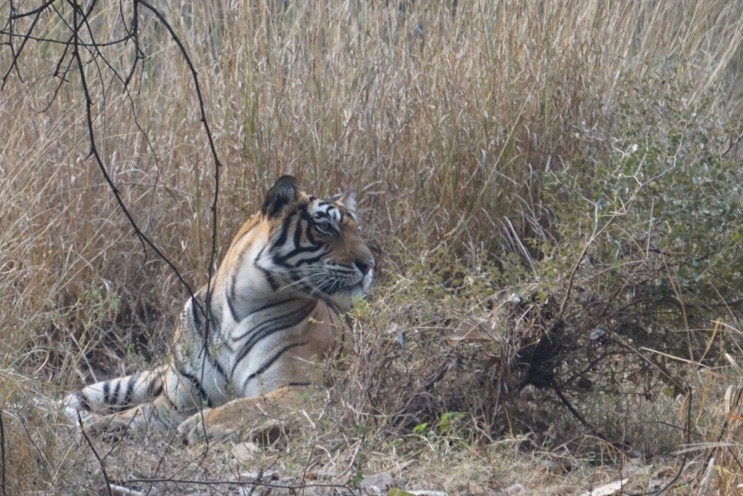
Shere Khan. Her real name, said the guide, is Noor…

…or Mala, or more prosaically, T-39, the mother of 3 healthy cubs
The moment was so unexpected, so pure, so anti-climactic that there seemed to be magic in the air. Noor is also known to the park rangers as Mala, a name that means ‘necklace‘ for the decorative, beadlike stripes on her flank. She had apparently just fed at dawn, the remains of the kill lay somewhere in the grasses nearby, her belly was full, and she was tired and too sleepy to investigate the little open jeep with three occupants parked at a respectful distance.
These magnificent animals are under threat from us humans. Ironically, one way to save them might be to bring more humans to visit them in their natural surroundings, just like the passenger in the jeep who watched her in awed silence for nearly two hours. For every tourist who comes to see them here, there are perhaps two or three locals who earn a livelihood, people who have been displaced from their own natural habitat in the jungle, displaced by the need to preserve wildlife. The villagers who used to live in Ranthambore forest were relocated when the tiger reserve was set up. These displaced people had to carve out a new existence in small settlements surrounding the jungle that was once their home.
We met one of the displaced people, a Rajput by the name of Dharamveer. He was proud of his forbears who had built forts and castles in these hills and jungles, and today he was one of the lucky ones; someone who had done well by doing good. When he was displaced from the forest, Dharamveer had trained as a tiger painter, painting iconic portraits of Shere Khan with the finest of strokes using delicate brushes that were a mere three or four hairs thick. This fine work gave the tigers in the paintings a lustrous lifelike glow that seemed to move as they caught the light. Buoyed by this success, he assisted widowed women to retrain in other handicrafts and has created a thriving business selling their work.

A Rufous Treepie
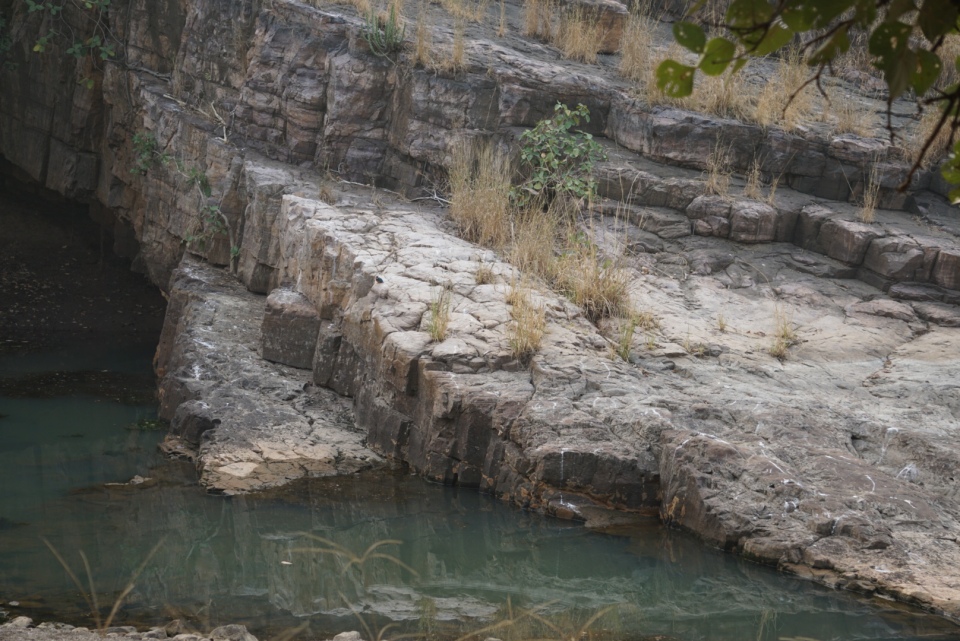
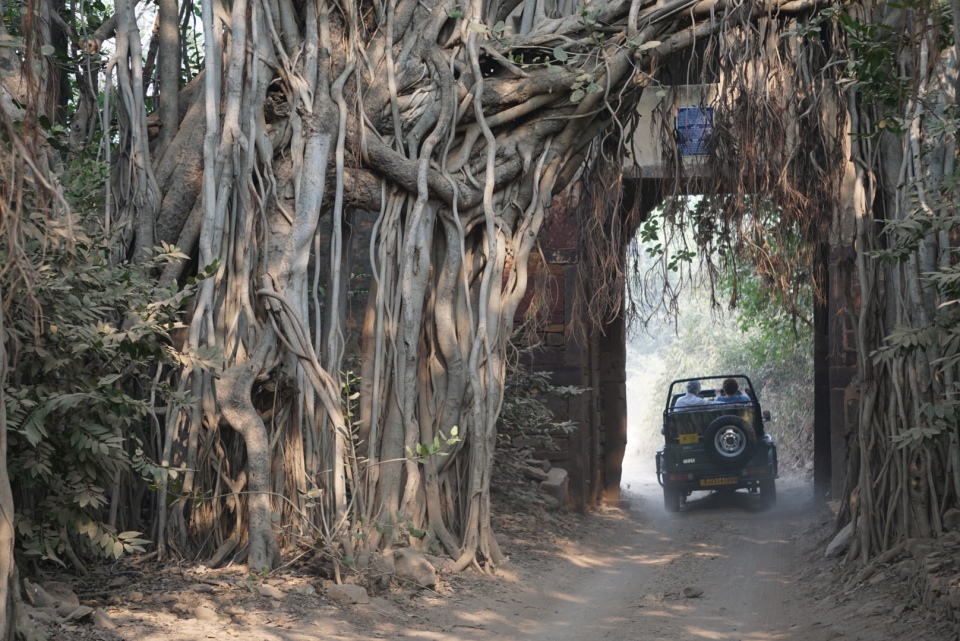
the entrance to the reserve is through the old Ranthambore fortress gate…
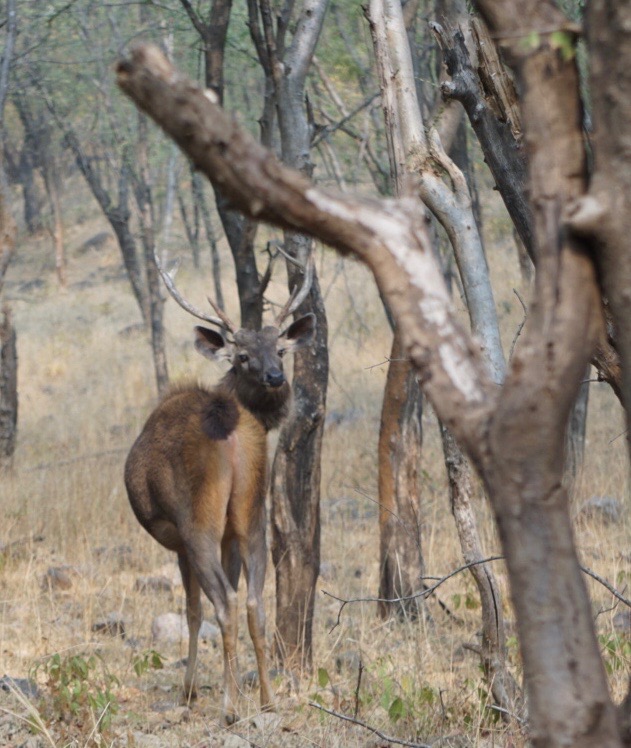
…the sambhur belled, once, twice, and again… (Hunting Song of the Seonee Pack)
We visited his store after the safari and were welcomed by the artisans who proudly showed us their wares. There was exuberant patchwork art, as well as many other fabrics, woven on rural handlooms, carvings, tribal paintings and animal protraits. As usual, there was more than one person could buy, but an American friend is exploring the market for these attractive products outside India. More on that will follow in a later posting.
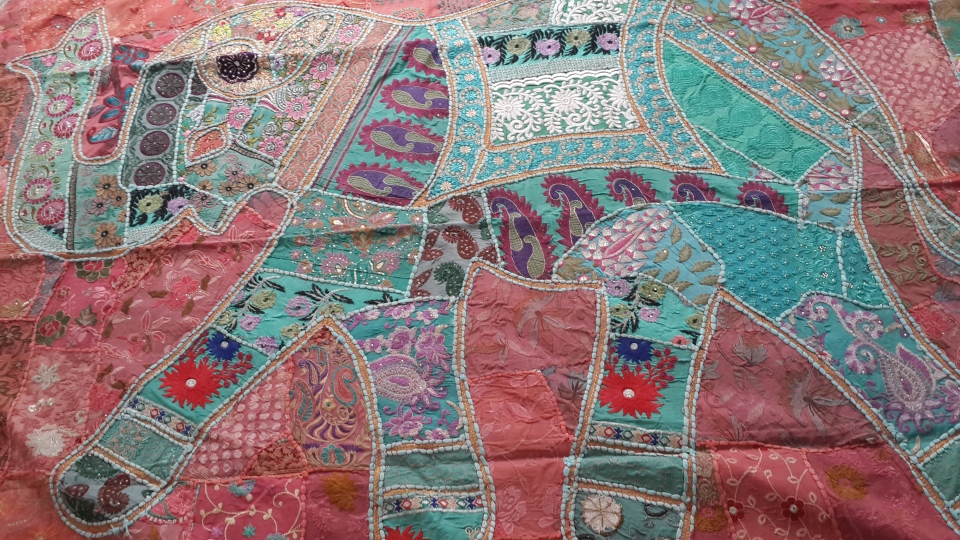
An exuberant patchwork of Hathi the elephant; handloom fabrics, carvings and nature paintings
For more by this author, see his Amazon page here.
Monkey Business at an Indian Wedding
We were privileged to attend a traditional Indian wedding at a marriage hall in Agra, just a stone’s throw away from the Taj Mahal. The chief cook was busy with two assistants in a couple of small enclosures adjacent to the main hall. They labored over a gas cooking fire, preparing sweetmeats and the main meal for the 300 guests expected to attend. Watching over the cooking fires perched on an adjacent wall were two handsome gray langurs who occasionally bared their teeth at someone or something in the distance.
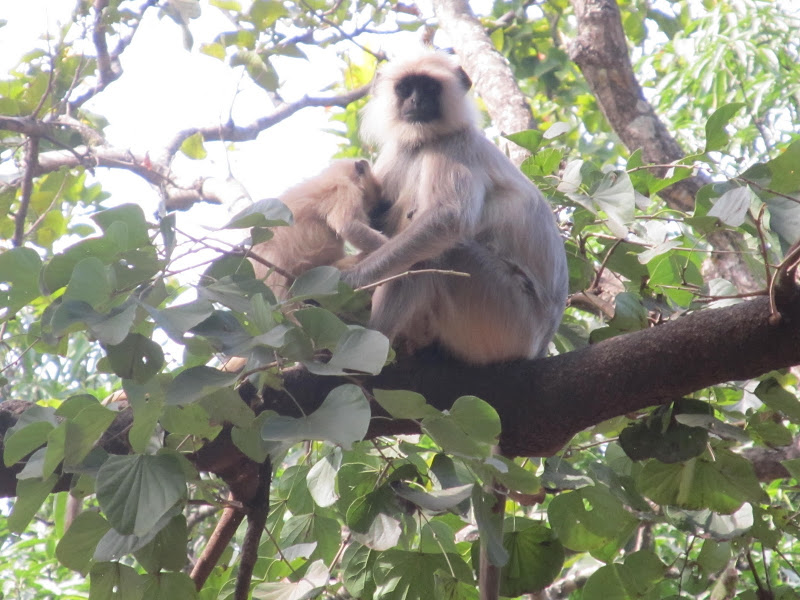
Watching over the cooking fires: Hanuman Langurs
They were watching over the cooking fires and keeping a troop of a dozen marauding rhesus macaques at bay. The two langurs belonged to the cook who kept them as pets for this very purpose.
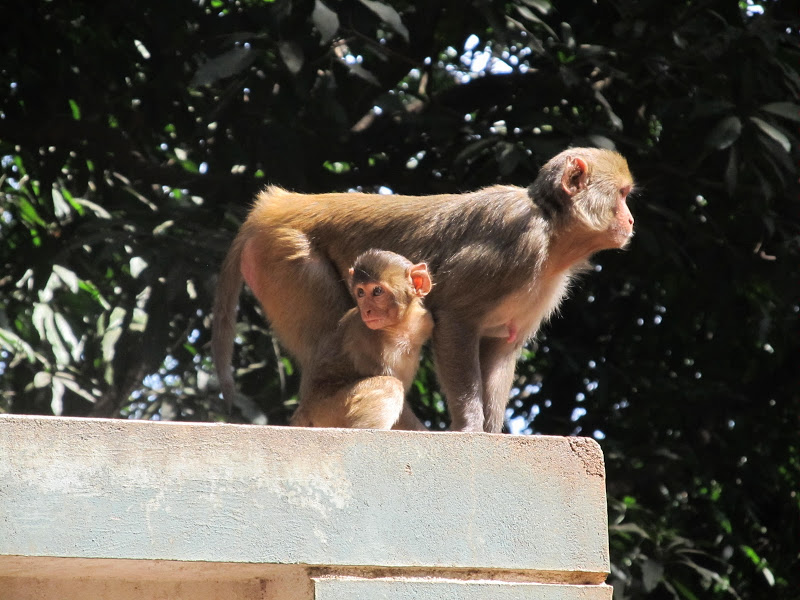
Not invited to the banquet: Rhesus Macaques
These itinerant cooks are specialists who travel around during the wedding season carrying their large cast-iron vats, giant ladles and woks. They are in great demand during the wedding season from November till July, and are often booked out months in advance. They can churn out meals for hundreds at a couple of days notice. A preliminary tasting convinced us it would be a meal to look forward to. More details after tonight’s banquet.
Waiting for Grace
Grace came from nowhere, caught me unawares, like when you’re sitting in a park totally engrossed in your whodunit and suddenly there’s a delicious aroma of baking bread, yeast and dough with overtones of garlic and perhaps the gentle bubble of melting cheese, sizzling oil and fat, and you wonder what else is in the pizza topping, book totally forgotten, and you remember that you haven’t had breakfast yet, only a cup of coffee and you came out of the house to run a couple of errands on a Saturday morning, wandered into a bookstore on the way home and found this book someone had raved about, bought it on impulse and sat down to read and then were lost in the murder mystery. Life’s something like that. Creeps up on us. The best lives are lived mostly unplanned. Correction! The best lives are planned and then lived with so many deviations from the plan so that we ultimately arrive at a destination more perfect than we could ever have imagined. Life is as perfect as you make it to be. No great secret here. It’s what you make of it. I know that. You know that. So how do I imbue Grace with that knowledge without preaching?
Yes, Grace! There’s me on that metaphorical park bench, reading the metaphorical whodunit of life and then, like the waft of baking pizza smells, Grace sneaks into the corners of my mind, invades it with tendrils of soft enticement and then I’m completely lost, I have to type, to search, to pin down this elusive character who beckons with so much mystery. What is Grace made of? How did she come to be? She has certain powers; powers that she herself is not aware of, perhaps. So how does she comes to know her own power? Is she humbled by it? Do they, these powers, make her over-confident and over-reach herself?
So for a frenzied three months, I sat down and typed. I typed in the morning and I typed in the evening, sometimes late at night I woke up with a vision and I was Grace seeing the answer to a puzzle, a mystery. Who poisoned the harmless old lady’s friendly Jack Russell terrier? And why? And why was the old lady so sure the poisoning was deliberate? What a shock to find that on this idyllic, almost paradisical, island! It was an island in the South China Sea near Hong Kong, very hot, very steamy, and the writing was like an outpouring from a fever of the brain. But somewhere in the soul of the scribe sits a heart of ice that dissects and says, no, no; this is implausible, this cannot be true. But life is like that! Life often cannot be true, and yet these things do happen. Take the disappearance of MH370, for instance; the best aviation brains and experts in the world still cannot deduce what happened, or how; until recently, a bit of wreckage was washed ashore that perhaps will provide some conjecture of the truth. But a novel does not have this luxury. And so the fevered search for the soul of Grace continued.
More about Grace in the next post…
Salaam Bombay come to Life.
“What one is in life is sometimes really a matter of when someone loves you, when someone cares for you or gives their life for you.”
This quote is from Amin Sheikh’s book “Life is Life: I am because of you.” A true story. An autobiography of a street child who made good in Bombay/Mumbai. He ran away from home at the age of five to escape an abusive stepfather. He lived on the streets for several years, until he was taken in by an NGO called Snehasadan.

Amin Sheikh: the world is his oyster at age 35
Today, he has his own travel company, has written an autobiography and intends to start a cafe. As an aside, he is also doing everything he can to ensure that other homeless children do not have to go through what he himself went through. He concludes his book with these words. “That was my life and my journey. I have come a long way but I have a long way to go. To do much more than all I have done so far. To give back to life and share with people, to stand for all those other Amins in the world.”
Buy the book. All proceeds from the book will be used to help young children get an education and find employment after they turn 18. He currently takes care of 8 kids, 4 boys and 4 girls. To know more, see his own blog at http://iambecauseofyou.com/
Four Levels of Leadership

Image courtesy Guardian.com
Great leadership is an elusive quality that we all think we recognise when we see. It takes hindsight and history to set a final seal of approval on an individual’s greatness as a leader. Among the many ways of looking at leadership, here are four classes or levels of leadership, in ascending order of quality. To which one do you belong?
I Did It: The most common type of leader belongs to the ‘I did it’ school and cements a reputation by constantly highlighting his/her own role and the positive accomplishments that result. This is probably the most common and the most rudimentary form of leadership. The vast majority of political leaders in the world today fall into this category.
S/He Did It: With more experience, maturity and personal growth, a few managers stop managing and become true leaders. In such cases, all members of a team have no hesitation in acknowledging that the group’s successes are a reflection of the values imbued by its head. After a task is successfully accomplished, the team gives the leader credit and says, “S/he did it.”
We Did It: There is a subtler form of leadership that stresses inclusivity, strives to bring out the best in people, and is cloaked in benevolence. The benevolence may be skin deep or may go deeper than that. In either case it is more effective than the first two levels. Anyone fortunate enough to work in an organization with this kind of leadership identifies completely with the tasks to be accomplished and takes ‘ownership’ in the best sense of the word.
I Did It: At the highest level, however, the world of leadership comes back to the ‘I,’ but in a completely non-egoistic sense. This is the spiritual I that embodies and identifies with the whole world. There is no need for the presence of a leader. Every single one of these exalted I’s is a member of a team; within an organisation, within a country, within the world. The I that reaches this state is truly a universal I. In order to reach this level, we need to take charge of ourselves, each one of us individually. And when we do, we will also become exemplary followers, of the kind that all visionary organisations and societies need. There is a ‘circle of life’ philosophy at work here, a spiritual component, to this level of leadership. This is a level worth aspiring to, and is the only kind of leadership that can change the course of the world.
Nature’s Bounty

Hundreds of these large orange blossoms strewn on the path to the beach from a tree overhead. The nameless profligacy of Nature’s bounty. Surely the earth has enough for all if we use its resources wisely.

Indian Khanna grows in profusion beside a walking trail on the outlying islands.
My apologies for the long delay in posting, but I am privileged to be truly living in a state of grace. More on that in the next blog!
Golden Skirts vs Testosterone in the Financial World
Read a riveting analysis by Economist John Kay on why banks might perform better with women in charge. As an enticement to read further, here is a reproduction of the opening paragraph of his article that was originally published in the Financial Times of 18 March 2015.
The most powerful posts in the financial world are held by women. Janet Yellen chairs the US Federal Reserve, and Christine Lagarde is managing director of the International Monetary Fund. Mary Jo White heads the US Securities and Exchange Commission, and was preceded in that job by Elisse Walter and Mary Schapiro. America’s new Consumer Financial Protection Bureau is directed by a man — but the reason is that the industry feared Senator Elizabeth Warren would fill the role too effectively.
Read the complete article on John Kay’s own blog post here.
As often in the past, thanks to my friend Larry Willmore for his own Thought du Jour blog post that drew my attention to this article.
Volunteering for a one-way trip

Image: courtesy mars.nasa.gov
Two years ago I wrote a short story called Enigma. It was a rather bleak story of a group of adventurers who volunteer for a space mission to the Red Planet, knowing fully well that they might never return. The story was prompted by a news report that more than 150,000 people had volunteered for a one-way trip to Mars, offered by a group that calls itself Mars One. At the time I wrote it, the story seemed (even to me) hopelessly fatalistic, but I’ve always been intrigued by the idea of space travel, so I included it, with some hesitation, in my last collection of short stories (see The Ironwood Poacher and Other Stories). I tried to put a positive spin on the fatalistic elements of the story by hinting at some kind of a superior intelligence or presence that shows that the indomitable nature of human striving is not futile, that it is a quality to be nurtured; a quality that has rewards beyond death as we know and fear it.
Imagine my surprise when I read an article in Time magazine this morning entitled “Why I’m Volunteering to Die on Mars,” about a young woman named Sonia van Meter. Sonia is one of the Mars One finalists (100 have been chosen from more than 200,000 applicants in the third round of the selection process), and she gives her reasons for wanting to go on a one-way trip to Mars (planned to depart every 2 years, beginning in 2024).
Here are some of the reasons Sonia (who is married and has 2 step-children) gives for volunteering for this mission. Space exploration is worth a human life. Every astronaut that has ever flown has known the risks they were up against once they strapped into that ship. And there’s no guarantee that I won’t be crushed by a collapsing roof tomorrow or diagnosed with a terminal illness next year. Some call this a suicide mission. I have no death wish. But it would be wonderful if my death could be part of something greater than just one individual. If my life ends on Mars, there will have been a magnificent story and a world of accomplishment to precede it.
To know more about why Sonia, and hundreds of thousands like her, who volunteer for such a mission, read the Time article here.
See more books by this author here.
 aviott