Home » Posts tagged 'energy' (Page 2)
Tag Archives: energy
Life After IIASA 1975-2013: Five Years On
February 2018 will mark five years after my retirement from IIASA. These five years have been full of new experiences, travel and writing. My wife and I have also attempted during this time to modify our lifestyle to be as carbon neutral as possible. Measures include living without a car, using a bicycle for shopping and public transport for travel where possible. Trips by air are unavoidable in the lifestyle we’ve chosen, and we’ve attempted to offset this carbon by buying solar panels for a farm school in India and a solar farm in Austria, 8 KW in all. These panels will apparently offset around 8 tons annually, but there’s still more to be done.
I first heard about sea level rise in a talk by paleo-climatologist Herbert Flohn at IIASA sometime in the late 1970s. At that time, many of the information requests that the IIASA library received were about global effects of a nuclear winter in the aftermath of nuclear war. Research themes changed quickly; interest moving to carbon dioxide emissions from fossils fuels, global warming, acid rain and stratospheric ozone.
In the intervening years, the reality of human-induced global warming has been accepted by all but the most ideologically blinkered societies worldwide. Travelling through parts of rural India soon after retirement in 2013, I saw repeated instances of people taking actions to adapt to climate change; water harvesting to compensate for unprecedented droughts, reforestation efforts; introduction of organic farming methods and drought resistant crops. I’d like to think that much of the credit for these adaptation and mitigation actions goes to studies by IIASA and other research institutions worldwide; scientific studies whose results filtered down over decades through the media and drew attention to these problems early on. There’s no way to prove this, and some of the water harvesting systems I saw were really ancient structures brought back into use. See more about that here
Efforts in 2015 and 2016 to help establish a rural education and vocation center failed for a very positive reason. The five acres of land (2 hectares) that had been donated to us for school use by a well-wisher is worth approximately € 300,000 (€65,000 per acre at today’s prices). The donated property was fertile agricultural land and classified as such. The local administrative authorities refused permission to reclassify the plot for use as a school and insisted that the land remain in use for agriculture. This was a positive outcome, because one of our reasons for this choice of location of a school was to prevent displacement of the rural population by expensive housing projects that would only benefit urbanites.
However the effort was not wasted. Since then our local partners have decided to build an organic farm on the land and use the experience gained to encourage the farming practices of communities in neighbouring villages. One function of this farm would be to develop markets for organic produce. We discovered several small companies in the area that offer free midday meals to their workers. They were happy to find a local supply of good vegetables. One enterprising factory owner offered his workers three free meals a day, sourcing all the vegetables from his own backyard. The vegetables he showed us were grown in plastic tubs lined with mats made of nutrient-rich hemp fibers. In fact, the method is so successful that he gives away growing kits free to any of his workers who want one for their own families’ use.
An encounter in early 2017 with a conservationist who runs a hatchery for Olive Ridley turtles on the sea coast near Chennai city led me to Tiruvannamalai, a town 200 km to the south-west. Here is an organic farm school where text-book sustainable living is practiced in the most lively and joyous manner possible. There are around 100 children in the school, ranging in age from 8 to 18. The links below will give an idea of activities at the school.
http://www.marudamfarmschool.org/
https://yourstory.com/2017/12/2-lakh-trees-ngo-regenerating-forest-tamil-nadu/
http://www.theforestway.org/greening/planting.html
In addition to organic farming, environmental conservation and education, the school also works with villagers in the surrounding countryside, reforesting the hill that dominates the temple town, planting around 15,000 trees a year. The school’s efforts inspired us (myself and a few friends in India) to help them become energy self-sufficient, adding 5 KW of solar panels to the three they already had. Together with battery backup, the school is now completely independent of the grid. (photo attached).
This activity led me to a thought. If IIASA’s work ultimately inspired these kinds of sustainability acts, what about IIASA’s own carbon footprint? IIASA’s alumni are scattered all over the world. What if we joined together, wherever we are, and worked to offset IIASA’s carbon emissions? Such actions would benefit our own communities, wherever we may happen to live. To kick-start this effort, I’ve decided to fund the planting of 1000 trees in 2018 through the farm school mentioned above. If each tree sequesters 25 kilos of carbon (as a rule of thumb, regardless of species), this would offset 25 tons of the Institute’s annual carbon emissions.
Should this be a formal organized effort? Readers’ suggestion welcomed here. All we would need is a virtual platform where one can document one’s own efforts and have a running tally. Ultimately the goal is to achieve carbon neutrality, not only for the Institute, but also for the communities in which each one of us lives. But, as for so many initiatives, IIASA could be a starting point.
On a personal note, the years since retirement have been very fulfilling. Thanks to my wife’s job, we were able to spend 2 idyllic years on an island paradise near Hong Kong. This provided background material for a work of fiction, Grace in the South China Sea. There are two sequels in the pipeline (The Trees of Ta Prohm, and Heartwood), to appear in 2018. Look for the earlier books and announcements on the Amazon author page here.
See this author’s page at Amazon.com to read more of his work.
Carbon Countdown Clock

Image:courtesy usgs
Ah, Trump. Has pulled the world’s second largest greenhouse gas emitter out of the Paris Accord. Was promised. Was to be expected. The one campaign promise that this prevaricating president did keep. The Guardian newspaper has usefully provided an online carbon countdown clock to show the world how time is running out. I believe Trump’s action might provoke the rest of the world to come together to save our common future.
https://interactive.guim.co.uk/embed/aus/2017/carbon-embed
Click on the link above to see how much time we have left.
Drinking Cocanutta Wataa–a refreshing trend
As temperatures rise around the world (think summer, think global warming!), lip-smacking ads of frosted glasses of beer, cola or other carbonated drinks appear on billboards and media screens. Plying Indian roads on a motorbike in the approaching summer of 2017 has shown one refreshing (pardon the pun) trend in the soft drinks world. Roadside stalls increasingly tend to offer locally sourced products (fresh tender coconut, palm fruit, sugar cane juice, watermelon, lassi, buttermilk and various local juices) rather than the ubiquitous glass or plastic bottled offerings of multinationals. All this without the benefit of national ad campaigns. Environmentalists at work, common sense, or simple economics?
As Harry Belafonte famously sang, it’s good for your daughter too.
Touched by the Invisible Hand
I bought a motorcycle for extensive local travel in an Indian city. A few friends and most of my middle class extended family were aghast when they heard. This is a form of suicide, they said. Look at the state of traffic on the roads. You need to protect yourself in a car.

Image: courtesy livechennai.com
Here are my answers to the criticism. First, there’s enough pollution already, and I’d rather travel at 55 km/liter with a 100cc motorbike rather than around 20km/l with a small car. Of course, the best alternative would be an electric vehicle powered by renewable energy, or else public transport, but neither of these options is currently practicable for my purposes.
Second, as the image above shows, progress is much faster with two wheels on congested roads. And third? I was reminded of the third reason this week when I had the painful news of a dear friend killed in a freak traffic accident in a European city, one of the safest cities in the world. I grieve at the loss. My take from the deep sadness I feel is this: seize the day, live as carefully and as well as you can, but follow your heart and do as you think you should do.
Blades of Grass

Image courtesy 123rf.com
The recent accession of climate change deniers to positions of power (no names here!) is very depressing news for those millions of people around the world who don’t totally distrust all media, mistrust all scientific research, or contradict factual evidence. Nevertheless there are many examples of happenings around the world that might not make international headlines because they are not (yet) economically significant. Economically significant or not, these actions are ecologically significant in a global context. These are actions that need to be emulated a hundred-fold, a thousand-fold, a million-fold, in the decade to come. A climate scientist friend told me years ago that the world would not act on the climate issue until it became a globally self-evident crisis. And then, he said, people would come together out of the woodwork at the last minute, to do what is needed to save our planet from irreversible changes; for example, in the interplay between circulation of deep ocean waters and the quantity of atmospheric carbon dioxide absorbed by them.
What follows is a short, incomplete list of the various ways people are coming out of the woodwork.
The 2017 Women’s marches around the world could be a powerful harbinger of things to come. According to Wikipedia: The 2017 Women’s Marches were a series of political rallies that took place in cities around the world since January 21, 2017, with the goal of promoting women’s rights, immigration reform, and health care reform; to counter Islamophobia, rape culture, and LGBTQ abuse; and to address racial inequities (e.g., Black Lives Matter), workers’ issues, and environmental issues. There is a sea change here. The Women’s March took place in cities on every continent. It was a spontaneous coming together on a multitude of human rights issues, much bigger causes than merely protesting against He Who Will Not be Named, he who was merely the catalyst that brought the marchers together. Like blades of grass that probe and emerge through the hardest concrete, these marches are the peaceful means to crack the brittle edifice of patriarchal structures the world over.
Three examples from India, where I happen to be at the moment, underline the environmental component of this sea change:
The small town of Meenangadi in Kerala has pledged to become the first carbon-neutral panchayat (rurally governed community) in India. And they expect to do it by 2020. Here’s an explanation of why they are doing this and what steps are being taken to achieve this goal.
In nearby Cochin (or Kochi, as it has been named by the local administration), the International Airport, call sign COK, is the world’s first completely solar powered airport. BBC News, October 2015.
At Kamuthi, near the town of Madurai in Tamil Nadu, the world’s largest solar power plant built on a single site was completed in 8 months, covering an area of 10 sq. km., with a capacity of 648 MW. Al Jazeera, November 2016. Meanwhile in China, this is topped by the Longyangxia Dam Solar Park with a peak output of 840 MW from solar panels clustered at two adjacent sites near the reservoir.
Other blades of grass sprout everywhere. In Vienna, after the election victory of You-Know-Who on 9 November, hundreds of volunteers went out on to the streets to campaign for the green party candidate in Austria’s presidential election. These volunteers were campaigning against scare-mongering and fear-of-the-other tactics that are habitually practiced by right wing demagogues, unfortunately with some success in the recent past. In many countries around the world, people fed up (pun intended) of industrial agriculture are turning to food production in their back yards, on window sills, on terraces. This awareness of the source of our nutrition makes people appreciate its literally life-giving qualities, bringing back the sanctity of producing our own food. The process brings people together in simple ways and promotes communal harmony. Mayors of cities around the world are networking together to circumvent the inaction of their politicians and lawmakers. I see green fields around the world where millions of tender blades of grass crack the concrete of established practice. I see this in the near future, if the millions who have marched will it so. It’s time now to march, plant, demonstrate, protest, cooperate, sow, reap, make your voice heard, switch off your TV, get off your couch, harvest potatoes, get active.
For more by this author, see his Amazon page here, or the link to Google Play where you can download free sample excerpts from his books.
Fossil Fuels are for Dinosaurs II
Wake up, Donald et al.! According to the Guardian of 6 January 2017,
China now owned:
- Five of the world’s six largest solar-module manufacturing firms
- The largest wind-turbine manufacturer
- The world’s largest lithium ion manufacturer
- The world’s largest electricity utility
“At the moment China is leaving everyone behind and has a real first-mover and scale advantage, which will be exacerbated if countries such as the US, UK and Australia continue to apply the brakes to clean energy,” he said.
“The US is already slipping well behind China in the race to secure a larger share of the booming clean energy market. With the incoming administration talking up coal and gas, prospective domestic policy changes don’t bode well,” Buckley said.
For more by this author, see his Amazon page here, or links to his 4 books on the Google Play store.
The Ineffable Sadness of Neutered Cats
The sugar cubes floated in my thickly creamed coffee before slowly dropping out of sight. This was a sequel to views of Klimt at the Upper Belvedere in Vienna, itself a sequel to a memorable week exploring inner landscapes of the soul.
There were two of them. They led happy lives, replete with feline fulfilment. They loved to purr and cuddle in bed with their humans in the night. They ate well. Always had food and drink served to them. They never went hungry. They seemed at peace with themselves and their world. There were vestiges of wildness in them still to remind you that, despite centuries of domestication, they were their own creatures, creatures of the wild; individuals. And yet, there was an edge missing. You could see it in their eyes. It was a mixture of sadness and resignation. I came to recognize this glance in the cats and my heart went out for what I had done to them. Years later, I saw a video of a woman who could communicate with animals including big cats, the world’s apex predators, and interpret them in anthropomorphic terms. This video changed my thinking about domestic pets. Having been sensitized by this new thinking, I began to see all the subtle forms of exclusion that are practised in societies around the world.
Most ancient cultures respected the natural world, seeing humans as an intrinsic part of it. At sometime in our collective past, we began to call ourselves civilized and parted ways intellectually with nature. This paid off for a few centuries, roughly until the end of the twentieth century. René Descartes famously declared humans to be the thinking species in the sixteenth century. We think, therefore we are (…superior to all other forms of life?). Science and technology have tamed the earth, have subdued nature to such an extent that, like in the Tweety and Sylvester cartoons, we are in danger of cutting off the branch on which we perch. Of course we don’t think of ourselves as prejudiced, but every time we turn away from a conversation with an unfamiliar “other” we practise a form of discrimination just the same. I noticed with a shock of recognition, the ‘sadness of cats’ on the faces of people in the news; in the gaze of a young woman going through the shipwreck of her marriage; in the face of a man devastated by war and conflict; in the catatonic resignation of a child dragged from the rubble of a bombed home. Where does all this violence begin?
It begins with the way we treat all sentient beings, not just our own kind. Gandhi allegedly said, more than a half century ago, the greatness of a nation and its moral progress can be judged by the way its animals are treated. Anthropologist Michael Thompson, in his 1979 book Rubbish Theory, explores the rise and fall in value of objects, depending on scarcity or abundance. He uses bakelite ashtrays as an example in the book. This early synthetic product of the 1930s was sold cheap, and now have become collectors items. Following from Rubbish Theory we should infer that, since animals in the wild have become a scarce commodity, we should value them highly. Conversely, with world population close to seven and a half billion, human life is cheap. Perhaps this is what we are seeing in international politics these days. But here is the paradox of human existence. If we subscribe solely to economic logic, we deny our humanity and diminish ourselves, sowing the seeds for our own ultimate destruction.
Rulers, kings and presidents come and go, but the earth will survive. However, humankind will not survive, if we continue to pursue only economic growth and ignore the unmistakeable signals that the planet continually sends us. Many of our leaders ignore it. It’s time to change those leaders. And here is another paradox of politics. We can change these leaders only if we change ourselves first.
For more by this author, see the links to other work on his Amazon page, or the Google Play Store
Oceans of Lithium
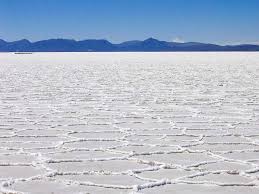
Salar de Uyuni. Source: Wikipedia.en
Salar de Uyuni in Southwest Bolivia contains an estimated 43 % of the world’s easily recoverable lithium. Together with neighbors Chile and Argentina, the three countries contain 70% of the planet’s reserves. As most people are aware by now, the renewables revolution is gathering momentum, and the world needs lithium, lots of it. The people who follow these trends estimate that Tesla’s Gigafactory alone, when it comes into production, will double world demand for lithium, whose prices have shot up just in the last two months of 2015 (from US$ 6500 to 13,000 a ton in November/December). American, Japanese, Chinese and South Korean companies are already mining around 170,000 tons of lithium worldwide. The Argentinian salares, or salt flats, comprise thousands of square miles in the provinces of Catamarca, Jujuy and Salta. The Salinas Grandes in the latter province is estimated to be the third largest in the world. But the grand-daddy of them all is the Salar de Uyuni in Bolivia that stretches over 10,000 sq.km. To paraphrase Exupéry, Salar de Uyuni is made up of salt, salt salt, and more salt, to a depth of one meter or more. In addition to common salt (sodium chloride), the salars contain other useful chlorides; potassium, magnesium and lithium chloride. The estimated 9 millions tons of lithium contained in this salar, conveniently concentrated by natural evaporation, should be enough to power a global energy revolution or two, but at what cost? Bolivia has suspended mining operations after the local residents opposed it, and Chile is granting no new concessions. These are understandable steps, in the light of what economists call ‘the resource curse.‘ In a nutshell, the resource curse or the resource paradox is that often countries with non-renewable natural resources (like minerals and oil) tend to have lower economic growth and less democracy than countries with fewer natural assets.
Understanding the resource curse does not help the international battery industry or alleviate the world’s need for non-polluting sources of energy, however. The increasing price of lithium is driving research into methods of obtaining it from the most abundant source on the planet, the oceans. Industrial ecologist Robert Ayres confidently predicted to me more than a decade ago that we would get all the lithium we need from the ocean. “There’s billions of tons there,” he said. True, there is an estimated 230 billion tons of lithium in seawater, but at a concentration of 0.14 to 0.25 parts per million, I did not believe it possible to extract it in meaningful quantities at reasonable cost. Changed my tune this week.
Many companies worldwide have been experimenting with various reverse osmosis technologies (the same technology that’s most often used to desalinate seawater) to produce brine concentrates dense enough to make lithium extraction economical. Now there are reports of several companies in a dozen countries that envisage producing lithium from brine concentrates at prices ranging from $1,500 to 5,000 per ton. Here’s an article about one of them.
For more by this author, see his Amazon page here.
Hinkley. Oh no!
The political decision to power ahead with Hinkley Point C nuclear power station is the energy equivalent of appointing a tone deaf musical director to the London Symphony Orchestra. How much more evidence do Cameron and Co. need? A short litany of anti-Hinckley arguments should suffice.

Hinkley 1
In a case of economics speaking truth to power, the OECD’s 2010 World Energy Outlook quietly increased the average lifetime of a nuclear power plant to 45-55 years, up 5 years from its 2008 edition.
Spreading the Sunshine 1: A New Year Message
Even today, in the first half of the twenty-first century, thousands of villages in Africa and Asia (mainly in India) remain off-grid and have no access to electricity. Ever since a three-month stay in Kenya and Tanzania in 1985, I have dreamt of bringing solar lighting to the smallest villages on these two continents. In Kenya I was astounded to see that, as early as 1985, a few rural families had bought individual solar panels connected to used car batteries to power a single light bulb and the occasional television set. They did this because they had no hope of access to grid electricity in their lifetimes. It’s even more astounding to think that in affluent countries today, the majority of people who drive $ 20,000 cars consider solar power unaffordable without government subsidies. No wonder the world is hotting up! Such economic calculations show how skewed our thinking is.
Of course it was obvious that this journey of a thousand miles begins with a single step. Less obvious was what this first step should be. Mhairi made the first step on a recent (November 2015) visit to a village on the outskirts of a tiger sanctuary in Rajasthan. She made contact with the owner of a handicrafts shop on the edge of the Ranthambore national forest and tiger reserve who helps village craftswomen earn a living by marketing the beautiful tiger paintings, patchwork quilts with mirror designs and appliqué fabrics they make. Dharamveer was thrilled to hear about the idea of installing solar lighting for the nearby villages. He immediately took us to visit three of the 10 surrounding villages. These villagers have limited or no access to electricity. Even the few homes connected to the grid have power only 2 or 3 days a week, so they end up spending 2 to 3 hundred rupees a month on electricity bills or on kerosene for inadequate lighting with lamps. The proposal to pre-finance solar lamps for each household in the village was met with much enthusiasm. They were quite willing to pay 200 to 300 rupees a month for reliable solar lighting. And they were delighted to hear that, at a price of just 499 rupees (US $ 7 at current exchange rates), the lamps would belong to them within three months. Apart from the environmental costs of burning kerosene, the biggest drawbacks are cost and inadequate light for children studying or doing homework.

The Pico lamp, US $ 7 with a 2-year guarantee.
The idea we propose is quite simple. We plan to finance around one hundred of these solar lamps initially, to be distributed to a number of households in the ten target villages. Presumably they will be paid for in 3 months from the money the villagers save from their kerosene and electricity bills. We will request voluntary contributions for another 2 months and use the extra money to expand the circle of recipients till all households in the villages are covered. After which one can think of more elaborate systems, for example, like the model shown here that costs 7000 rupees or US $ 100 at today’s exchange rates. Greenlight is a for-profit company started in the US by three engineers, two American and one Indian. Their products have received good reviews in the international press.

The Sun King Home 120 is priced at approx US $ 100, can power USB devices and mobile phones.
We have decided on Greenlight’s Sun King model range, based only on our own internet research and news reports. Readers of this blog are invited to give feedback or share their own experiences with different models. I can envisage offering a range of different systems based on cost and reliability. I look forward to hearing from you.
 aviott