Home » Renewables (Page 3)
Category Archives: Renewables
Advice to a Billionaire
Michael Liebreich of Bloomberg New Energy Finance calls you one of three Black Swans in the world of energy and transportation this century; the other two being Fracking and Fukushima. You are often compared to Henry Ford, Thomas Edison, Nikola Tesla, the Iron Man, and shades of Einstein. You have advised Presidents. Heads of state visit your factories to see how they could improve the lives of their citizens. You stepped in without fanfare to donate money and provide power to a hospital in Puerto Rico after the devastation of Hurricane Maria. You issue audacious challenges to yourself and to others and sometimes miss deadlines, but ultimately deliver on your promises. Thousands, perhaps millions of people, speculate against you in the stock markets, hoping to make a quick profit from your failure. So far, they’ve been disappointed. But you put your money where your mouth is, so for every one of these speculative sharks, there are a thousand eager customers for your products and millions of well-wishers who hope you can help save the planet.
And yet you feel alone and unloved. You search for a soul mate and are willing to fly to the ends of the earth to find true love. You must know that love is like a butterfly. Be still and perhaps it will land on you. There are no guarantees, but the chances are infinitely greater if you cultivate stillness. And while you wait, exchange your loneliness for the wealth of solitude. As Hannah Arendt and Plato observed: Thinking, existentially speaking, is a solitary but not a lonely business.
As the father of five children, know also that their childhood is a precious and finite resource that you could use to your benefit and theirs. Childhood ends all too soon, so help them in whatever way you can to make good choices. You seem to have done so for yourself. In the meantime, millions of people around the world wish you well, as I do.
Carbon Countdown Clock

Image:courtesy usgs
Ah, Trump. Has pulled the world’s second largest greenhouse gas emitter out of the Paris Accord. Was promised. Was to be expected. The one campaign promise that this prevaricating president did keep. The Guardian newspaper has usefully provided an online carbon countdown clock to show the world how time is running out. I believe Trump’s action might provoke the rest of the world to come together to save our common future.
https://interactive.guim.co.uk/embed/aus/2017/carbon-embed
Click on the link above to see how much time we have left.
Fossil Fuels are for Dinosaurs II
Wake up, Donald et al.! According to the Guardian of 6 January 2017,
China now owned:
- Five of the world’s six largest solar-module manufacturing firms
- The largest wind-turbine manufacturer
- The world’s largest lithium ion manufacturer
- The world’s largest electricity utility
“At the moment China is leaving everyone behind and has a real first-mover and scale advantage, which will be exacerbated if countries such as the US, UK and Australia continue to apply the brakes to clean energy,” he said.
“The US is already slipping well behind China in the race to secure a larger share of the booming clean energy market. With the incoming administration talking up coal and gas, prospective domestic policy changes don’t bode well,” Buckley said.
For more by this author, see his Amazon page here, or links to his 4 books on the Google Play store.
Learning in a Village
Studies about global warming talk about the need for developing countries to adapt to climate change. The good news is that in India a wide range of mitigation and adaptation measures are taking place. To use the phrase of Augustin, Vienna’s well-loved figure of historical myth, “the situation is serious but not hopeless.” At the end of this article are links to some examples that illustrate various initiatives that are already working. However, with 68% of the country’s population in villages, India needs many more such miracles. My wife and I recently joined a project, started by some local partners, to develop a sustainable school in a village in Tamil Nadu.
The village lies in a green, agricultural area about forty kilometers from the city of Chennai (pop. 8.23 million) in the Chingleput district of Tamil Nadu. Although surrounded by productive farmland, approach roads to this village are so poor as to be almost non-existent. The roads were badly damaged in the extensive flooding that followed the unusually heavy monsoon rains of September-October 2015. Parts of the city of Chennai and the surrounding countryside were inundated to depths of one to two meters.
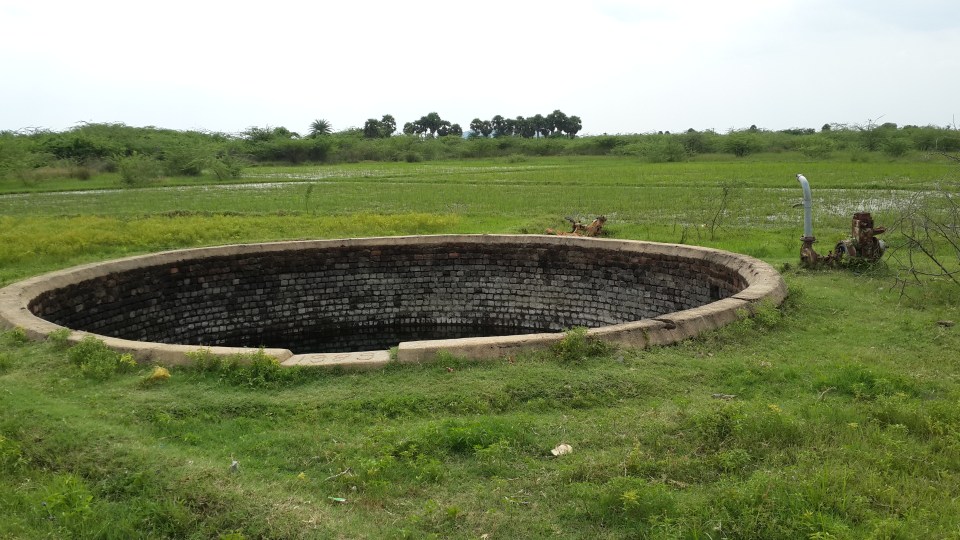
Water wells and green fields: the surrounding countryside
The village itself, when one arrives, is relatively prosperous. There are many large wells that supply water for irrigation. The land seems fertile and a variety of crops is grown. Despite this, young people are moving in droves to the cities, lured by scenes of urban wealth and glamor on television. These people are merely following a trend happening in many countries around the world as small farm holdings sell out to larger entities and corporations that can practice industrial-scale farming with all its recognized negative consequences.

The many faces of learning
The idea of a rural sustainable school is really very simple. In addition to conventional education, the childrens’ learning will be focused on practical skills that are relevant in a rural environment; from organic farming, forestry, carpentry, medicinal uses of plants, setting up and servicing small-scale photovoltaics, forestry, wildlife management (the area is very rich in bird-life) etc. In addition, there are plans to use a locally patented system that incorporates waste plastic into long-lasting road surfaces. In all of these efforts, voluntary labor (shramdhan) will play the most important role. For without local participation, there will be no long-term program. With local participation, the community takes ownership of all the above areas, become experts in selected areas and run it themselves. This is the main reason that the partners are starting this school project on a self-financed basis. As soon as outside money enters the equation, a certain precious balance is lost and people will tend to sit back and wait for capital to provide answers that they would otherwise look for themselves.
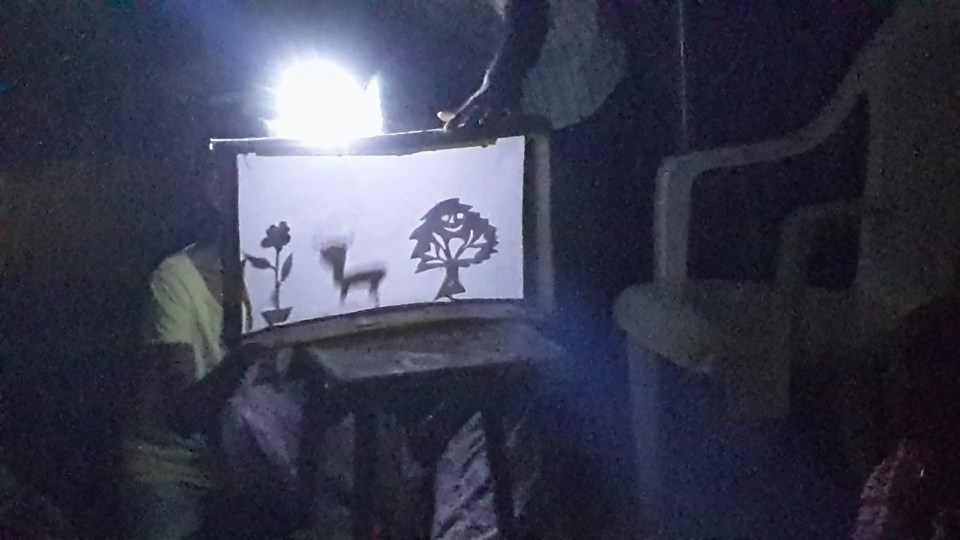
A shadow puppet play made by 8-year-olds using home-made props
https://www.youtube.com/watch?v=3LHe9I6QPu8 jal khet (Water Fields)
https://www.youtube.com/watch?v=aBfjsdICGT0
https://www.youtube.com/watch?v=9hmkgn0nBgk
The school building itself will be constructed on-site with compressed stabilized earth blocks (CSEBs) that do not need firing or baking like conventional bricks. They just need compression following which the bricks are kept wet for a month and then sun-dried for three months. Electricity will initially be provided by 5 Kw of solar panels that are expected to cost around €4000 at current prices. More capacity and storage will be added as the price falls. For more information about the philosophy behind the project, see this article on my blog. “Development as an Attitude: learning to unlearn.”
For more by this author, see his Amazon page or the Google Play Store here.
The Ineffable Sadness of Neutered Cats
The sugar cubes floated in my thickly creamed coffee before slowly dropping out of sight. This was a sequel to views of Klimt at the Upper Belvedere in Vienna, itself a sequel to a memorable week exploring inner landscapes of the soul.
There were two of them. They led happy lives, replete with feline fulfilment. They loved to purr and cuddle in bed with their humans in the night. They ate well. Always had food and drink served to them. They never went hungry. They seemed at peace with themselves and their world. There were vestiges of wildness in them still to remind you that, despite centuries of domestication, they were their own creatures, creatures of the wild; individuals. And yet, there was an edge missing. You could see it in their eyes. It was a mixture of sadness and resignation. I came to recognize this glance in the cats and my heart went out for what I had done to them. Years later, I saw a video of a woman who could communicate with animals including big cats, the world’s apex predators, and interpret them in anthropomorphic terms. This video changed my thinking about domestic pets. Having been sensitized by this new thinking, I began to see all the subtle forms of exclusion that are practised in societies around the world.
Most ancient cultures respected the natural world, seeing humans as an intrinsic part of it. At sometime in our collective past, we began to call ourselves civilized and parted ways intellectually with nature. This paid off for a few centuries, roughly until the end of the twentieth century. René Descartes famously declared humans to be the thinking species in the sixteenth century. We think, therefore we are (…superior to all other forms of life?). Science and technology have tamed the earth, have subdued nature to such an extent that, like in the Tweety and Sylvester cartoons, we are in danger of cutting off the branch on which we perch. Of course we don’t think of ourselves as prejudiced, but every time we turn away from a conversation with an unfamiliar “other” we practise a form of discrimination just the same. I noticed with a shock of recognition, the ‘sadness of cats’ on the faces of people in the news; in the gaze of a young woman going through the shipwreck of her marriage; in the face of a man devastated by war and conflict; in the catatonic resignation of a child dragged from the rubble of a bombed home. Where does all this violence begin?
It begins with the way we treat all sentient beings, not just our own kind. Gandhi allegedly said, more than a half century ago, the greatness of a nation and its moral progress can be judged by the way its animals are treated. Anthropologist Michael Thompson, in his 1979 book Rubbish Theory, explores the rise and fall in value of objects, depending on scarcity or abundance. He uses bakelite ashtrays as an example in the book. This early synthetic product of the 1930s was sold cheap, and now have become collectors items. Following from Rubbish Theory we should infer that, since animals in the wild have become a scarce commodity, we should value them highly. Conversely, with world population close to seven and a half billion, human life is cheap. Perhaps this is what we are seeing in international politics these days. But here is the paradox of human existence. If we subscribe solely to economic logic, we deny our humanity and diminish ourselves, sowing the seeds for our own ultimate destruction.
Rulers, kings and presidents come and go, but the earth will survive. However, humankind will not survive, if we continue to pursue only economic growth and ignore the unmistakeable signals that the planet continually sends us. Many of our leaders ignore it. It’s time to change those leaders. And here is another paradox of politics. We can change these leaders only if we change ourselves first.
For more by this author, see the links to other work on his Amazon page, or the Google Play Store
The Decline of the Rest.
 Oswald Spengler published the first volume of his two-volume life’s work, The Decline of the West, in 1918. Seventy-four years later, speaking at the Earth Summit, Rio de Janeiro in 1992, 41st US President George HW Bush, a decent man, declared, “The American way of life is not up for negotiation. Period.” This pre-emptive declaration by the leader of the world’s most powerful nation essentially castrated the noble intentions of the summit, to limit humankind’s exploitation of the earth’s resources to sustainable levels. The result of the Rio summit was Agenda 21, a non-binding, voluntarily implemented action plan for the 21st century. This was the paltry outcome of a nine-day meeting representing 172 countries attended by 116 heads of state, 2400 NGOs and 17,000 other representatives of indigenous peoples and ordinary ‘you and me’ types.
Twenty-one years after the US President’s declaration in Rio, the WWF designated the 20th of August 2013 as “Earth Overshoot Day;” the day that humanity has used as much renewable natural resources as the planet can regenerate in one year. In 2016, Earth Overshoot Day is estimated to have fallen on August 8th, after which date we’re drawing down the planet’s renewable resources for the rest of the year. Pity the poor planet! The American way of life is still not up for negotiation, and the rest of the world is rushing to catch up. If ever populous countries like China and India get there, the planet will be sucked dry and we’ll all have to follow Elon Musk to Mars! So are we condemned to a two-track planet where some countries (or some sections of society within countries) corner material resources and the rest go a-begging? This is the scenario being projected by right wing demagogues worldwide and this is the reason for their recent successes at the ballot box.
Economists and philosophers have tried to redefine human well-being to reflect planetary limits, most notably in recent years by Tim Jackson’s book Prosperity without Growth, which acknowledges that the current definition of economic success is fundamentally flawed. Prosperous societies today increasingly recognize that increased material wealth does not increase well-being. However, most people the world over, regardless of their economic condition, still aspire to some version of the American way of life. This aspiration is reflected in the respect automatically accorded to wealthy people in the world today. A look at the Who’s Who of practically any country includes the names of its wealthiest citizens, together with lists of eminent physicians, lawyers, sportspeople and so on.
Gandhi pithily articulated this state of affairs decades ago when he said: The world has enough for every man’s need but not for every man’s greed. For each according to her needs would be the ideal but, as always, messy reality intervenes. One man’s need is another man’s greed. So it is that millions of well-meaning, virtuous, affluent people the world over would never dream of giving up hard-won creature comforts for the sake of other planetary denizens who are less well off. The spiral of technology has historically been to continuously improve human life, and to continuously create problems at the same time. These problems in turn needed infusions of new technology to solve its problems. So right now, the choices seem to be to outer-planetary colonization, or to invest in defences (gated communities, wealthy enclaves, security guards, border walls) to hold on to material gains. Technology offers a third alternative. The idea of a sharing economy has recently gained a lot of traction. Who needs ownership when mobility and services are seamlessly available? Indeed, ownership becomes a bit of a burden in comparison to the convenience of superb services available on demand with little or no delay.

A gated community safely behind bars
Even if all this is achieved, humankind’s basic inner restlessness will ensure that we keep wanting more and better, with one eye on the people next door. Global contentment is a moving target. Enter mystic and philosopher Sadhguru and his lectures on inner engineering. His most memorable anecdote in the video (begins at minute 16) is a reminder that all is not lost in the midst of this doom and gloom if we can take the time to laugh at ourselves and the posturings that have brought us to this point.

Sadhguru, irreverent mystic
For more writing by this blogger, see his Amazon page here, or the Google Play Store
Oceans of Lithium

Salar de Uyuni. Source: Wikipedia.en
Salar de Uyuni in Southwest Bolivia contains an estimated 43 % of the world’s easily recoverable lithium. Together with neighbors Chile and Argentina, the three countries contain 70% of the planet’s reserves. As most people are aware by now, the renewables revolution is gathering momentum, and the world needs lithium, lots of it. The people who follow these trends estimate that Tesla’s Gigafactory alone, when it comes into production, will double world demand for lithium, whose prices have shot up just in the last two months of 2015 (from US$ 6500 to 13,000 a ton in November/December). American, Japanese, Chinese and South Korean companies are already mining around 170,000 tons of lithium worldwide. The Argentinian salares, or salt flats, comprise thousands of square miles in the provinces of Catamarca, Jujuy and Salta. The Salinas Grandes in the latter province is estimated to be the third largest in the world. But the grand-daddy of them all is the Salar de Uyuni in Bolivia that stretches over 10,000 sq.km. To paraphrase Exupéry, Salar de Uyuni is made up of salt, salt salt, and more salt, to a depth of one meter or more. In addition to common salt (sodium chloride), the salars contain other useful chlorides; potassium, magnesium and lithium chloride. The estimated 9 millions tons of lithium contained in this salar, conveniently concentrated by natural evaporation, should be enough to power a global energy revolution or two, but at what cost? Bolivia has suspended mining operations after the local residents opposed it, and Chile is granting no new concessions. These are understandable steps, in the light of what economists call ‘the resource curse.‘ In a nutshell, the resource curse or the resource paradox is that often countries with non-renewable natural resources (like minerals and oil) tend to have lower economic growth and less democracy than countries with fewer natural assets.
Understanding the resource curse does not help the international battery industry or alleviate the world’s need for non-polluting sources of energy, however. The increasing price of lithium is driving research into methods of obtaining it from the most abundant source on the planet, the oceans. Industrial ecologist Robert Ayres confidently predicted to me more than a decade ago that we would get all the lithium we need from the ocean. “There’s billions of tons there,” he said. True, there is an estimated 230 billion tons of lithium in seawater, but at a concentration of 0.14 to 0.25 parts per million, I did not believe it possible to extract it in meaningful quantities at reasonable cost. Changed my tune this week.
Many companies worldwide have been experimenting with various reverse osmosis technologies (the same technology that’s most often used to desalinate seawater) to produce brine concentrates dense enough to make lithium extraction economical. Now there are reports of several companies in a dozen countries that envisage producing lithium from brine concentrates at prices ranging from $1,500 to 5,000 per ton. Here’s an article about one of them.
For more by this author, see his Amazon page here.
Hinkley. Oh no!
The political decision to power ahead with Hinkley Point C nuclear power station is the energy equivalent of appointing a tone deaf musical director to the London Symphony Orchestra. How much more evidence do Cameron and Co. need? A short litany of anti-Hinckley arguments should suffice.

Hinkley 1
In a case of economics speaking truth to power, the OECD’s 2010 World Energy Outlook quietly increased the average lifetime of a nuclear power plant to 45-55 years, up 5 years from its 2008 edition.
Spreading the Sunshine 1: A New Year Message
Even today, in the first half of the twenty-first century, thousands of villages in Africa and Asia (mainly in India) remain off-grid and have no access to electricity. Ever since a three-month stay in Kenya and Tanzania in 1985, I have dreamt of bringing solar lighting to the smallest villages on these two continents. In Kenya I was astounded to see that, as early as 1985, a few rural families had bought individual solar panels connected to used car batteries to power a single light bulb and the occasional television set. They did this because they had no hope of access to grid electricity in their lifetimes. It’s even more astounding to think that in affluent countries today, the majority of people who drive $ 20,000 cars consider solar power unaffordable without government subsidies. No wonder the world is hotting up! Such economic calculations show how skewed our thinking is.
Of course it was obvious that this journey of a thousand miles begins with a single step. Less obvious was what this first step should be. Mhairi made the first step on a recent (November 2015) visit to a village on the outskirts of a tiger sanctuary in Rajasthan. She made contact with the owner of a handicrafts shop on the edge of the Ranthambore national forest and tiger reserve who helps village craftswomen earn a living by marketing the beautiful tiger paintings, patchwork quilts with mirror designs and appliqué fabrics they make. Dharamveer was thrilled to hear about the idea of installing solar lighting for the nearby villages. He immediately took us to visit three of the 10 surrounding villages. These villagers have limited or no access to electricity. Even the few homes connected to the grid have power only 2 or 3 days a week, so they end up spending 2 to 3 hundred rupees a month on electricity bills or on kerosene for inadequate lighting with lamps. The proposal to pre-finance solar lamps for each household in the village was met with much enthusiasm. They were quite willing to pay 200 to 300 rupees a month for reliable solar lighting. And they were delighted to hear that, at a price of just 499 rupees (US $ 7 at current exchange rates), the lamps would belong to them within three months. Apart from the environmental costs of burning kerosene, the biggest drawbacks are cost and inadequate light for children studying or doing homework.

The Pico lamp, US $ 7 with a 2-year guarantee.
The idea we propose is quite simple. We plan to finance around one hundred of these solar lamps initially, to be distributed to a number of households in the ten target villages. Presumably they will be paid for in 3 months from the money the villagers save from their kerosene and electricity bills. We will request voluntary contributions for another 2 months and use the extra money to expand the circle of recipients till all households in the villages are covered. After which one can think of more elaborate systems, for example, like the model shown here that costs 7000 rupees or US $ 100 at today’s exchange rates. Greenlight is a for-profit company started in the US by three engineers, two American and one Indian. Their products have received good reviews in the international press.

The Sun King Home 120 is priced at approx US $ 100, can power USB devices and mobile phones.
We have decided on Greenlight’s Sun King model range, based only on our own internet research and news reports. Readers of this blog are invited to give feedback or share their own experiences with different models. I can envisage offering a range of different systems based on cost and reliability. I look forward to hearing from you.
For more by this author, see his Amazon page here.
It’s Raining Electrons in Small Spaces
Four recent reports on new breakthroughs in renewable energy generation and storage technology reinforce the promise that was once made for nuclear power: abundant energy for all, including the poorest in society, even though it may never be “too cheap to meter.”
High Performance Flow Batteries The promise of renewable energy technologies will be fully realized when battery storage becomes reliable enough and cheap enough to even out intermittent flows. Today the problem is partly solved by feeding energy from rooftop panels into the grid and then receiving compensation from the energy utility for the power supplied either in cash or in the form of reduced electricity bills. Looking at a typical electricity bill in Euroland (my own) I see the following charges. The unit price (per KWh) is between 6.5 and 7.3 Eurocents, but after grid charges, network costs and taxes are added, I pay 26 cents per KWh. Ironically, bulk consumers (factories, office blocks and large companies) pay lower rates, around 8 to 15 cents per KWh, depending on level of consumption. Now the whole picture is changed with the advent of low cost storage systems that make home batteries affordable and economical. Imagine home systems that can deliver electricity for all your needs at no cost for twenty to thirty years, once installed, barring the onetime cost of the system. Coming soon, to an affordable home near you.
Silicon cones inspired by the architecture of the human eye. The retina of the human eye contains photoreceptors in the form of rods and cones. Rods in the retina are the most sensitive to light, while cones enhance colour sensitivity. Modelling photovoltaic cells based on the makeup of the retina, researchers have been able to enhance the sensitivity of solar cells to different colours in the sunlight that falls on each cell and thereby increase electricity output by “milking the spectrum” closer to its theoretical maximum. Increasing efficiency of the average rooftop PV cells from the current 18-20 to 30% would make such systems cheaper by far than grid electricity mostly anywhere in the world, even in temperate countries. Coming soon, to a rooftop near you.
Modular biobattery plant that turns biowaste into energy. Biogas plants are old hat. They have undeniable benefits, turning plant, animal and human waste into energy (methane) while leaving behind a rich sludge that is excellent fertiliser. However, good designs are not common and they are sometimes cumbersome to feed and maintain. Now comes an efficient German design that promises to be modular and economically viable even at a small scale. In another development, the University of West England at Bristol has developed a toilet that turns human urine into electricity on the fly (pardon the pun) and the prototype is currently undergoing testing, appropriately enough, near the student union bar. Coming soon, to a poo-place or a pee-place near you.
New electrolyte for lithium ion batteries. Lithium ion batteries using various electrolytes have already become the workhorse of the current crop of electric cars and for medium-sized storage requirements. New electrolyte chemistry discovered at PNNL Labs shows that reductions of upto ten times in size, cost and density are feasible and various electrolyte/electrode combinations are being further tested for production feasibility. Coming soon, to a battery storage terminal near you.
So what should you do, as a concerned global citizen, until you can lay your hands on one of these devices (or all of them) for your own use? Tread lightly on the earth, don’t buy bottled water, reduce energy use, walk when you can instead of driving your car (your arteries will love you for it), buy local produce, eat less meat (your grateful arteries again), think twice before flying off to that conference (think teleconferencing), buy an electric car if you need a new one, and remember that every liter or gallon of petrol you fill into your old one not only fuels your car but potentially also the conflicts in the Middle East and/or lines the deep pockets of Big Oil which definitely does not want your energy independence.
 aviott