Home » Uncategorized (Page 5)
Category Archives: Uncategorized
A lake palace, and a lake of tears
Udaipur is one of the must-see cities of Rajasthan, for its iconic Lake Palace situated in the middle of Lake Pichola with its grand series of stone and marble palaces that have been successively added along the shores over centuries. Udaipur’s royals belong to the longest unbroken line of rulers in the world, having endured for more than a millennium.

One of the world’s longest ruling dynasties, 1400 years
The present-day city was founded in the 1530s at around 1000 feet above sea level, close to the cooling influence of the Aravalli range of hills. The aboriginal hill tribes of the Aravallis, the Bhils, were traditionally self-sufficient hunter-gatherers and good archers. Bhil tribesmen assisted Rajput troops in their periodic wars against Mughal armies, and for this reason, the Mewar coat-of-arms portrays both a tribal armed with bow and arrows and a Rajput warrior flanking the shield with a fortress in the middle.
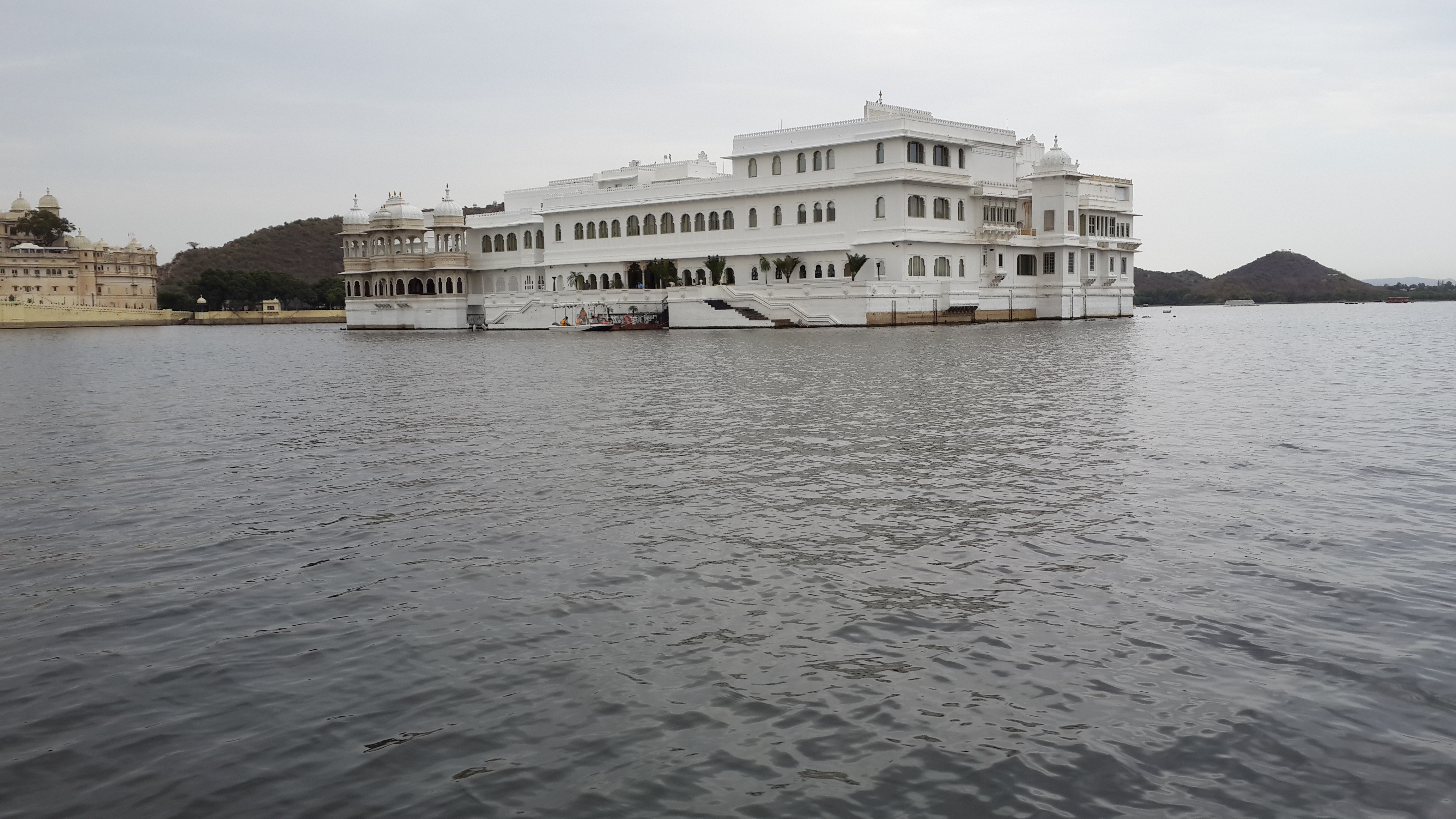
A wedding cake of a hotel on Lake Pichola
The lake dries out occasionally when there is a succession of bad monsoons, but a project is underway to ensure a steady inflow and expand the rainwater harvesting systems that were installed in the palaces from the 17th century onwards.

Nowadays the royal barge is only for decor or the occasional VIP hotel guest.
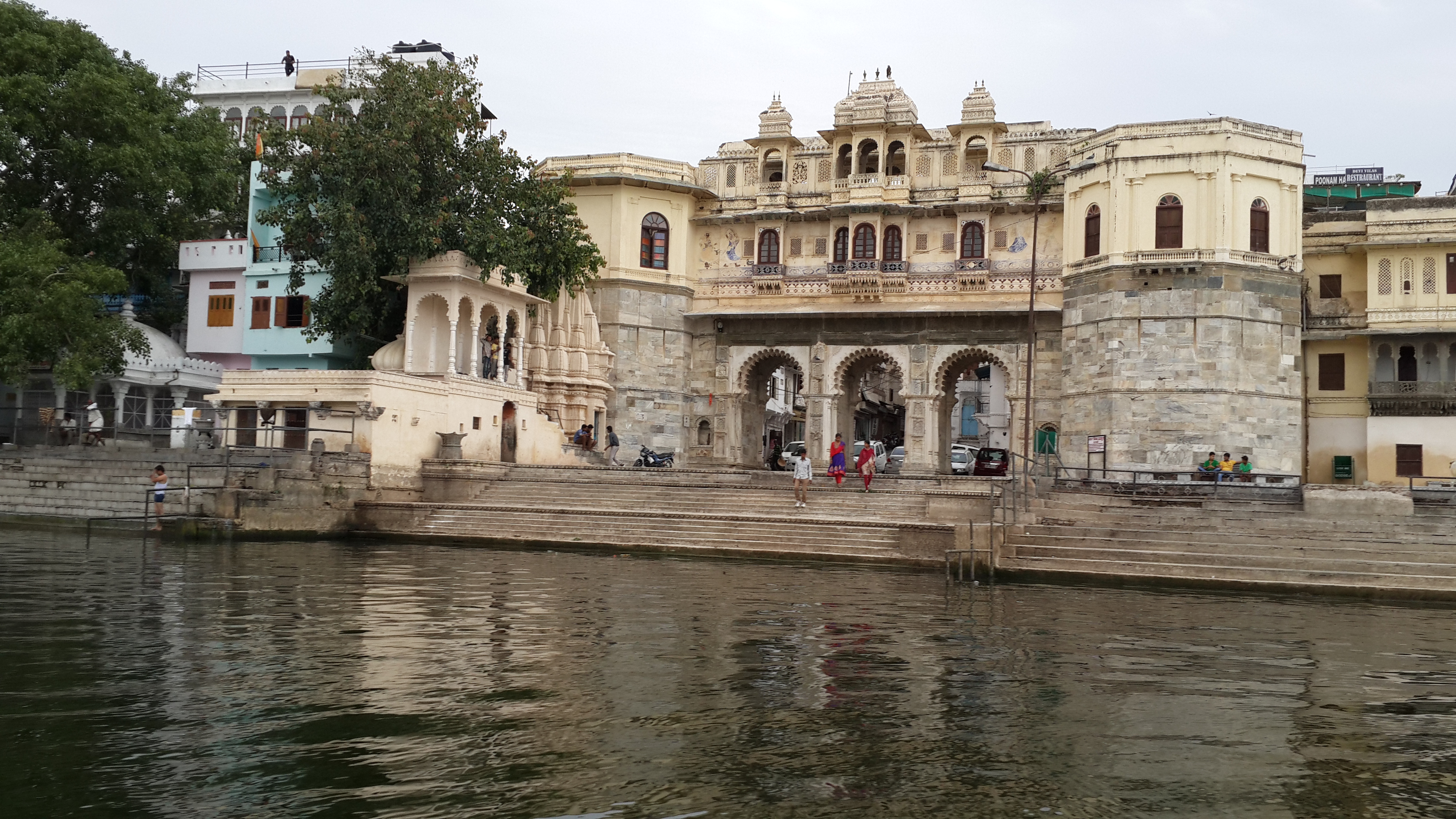

More palaces and bathing ghats line the lakeshore…

…most are hotels.
Pushkar: a holy lake of tears.
Pushkar is one of the holy places for Hindus in India. There is a temple to Brahma in Pushkar, a rarity. There are only six temples dedicated to Brahma worldwide and this is considered the most important. There are several beautiful stories associated with the reasons for Pushkar’s sanctity. One has it that Siva’s wife Sati was insulted by her father (this is a long story in itself, see the URL below for more) and literally burned with shame. Siva was so overcome on hearing of the death of his wife that he wept inconsolably. The pools formed by the tears from his two eyes are the lake at Pushkar and the Katasraj temple lake about 300 kilometers away that lies today in Pakistan’s Punjab province.
There is another story about the reason for Pushkar’s spiritual significance. In this, Brahma saw a demon named Vajranabha killing people, so he killed the demon with a divine lotus flower. In this process, the petals of the lotus flower fell to the earth and formed the lake. Yet another story tells of a mortal, a Rajput king, following a wild boar down to the lake during a hunt. He stopped to quench his thirst and found that dipping his hand in the lake had cured his leukoderma. Whatever the reasons for its perceived sanctity, the town exudes a certain contradictory bustling calm and the lake itself is surrounded by temples and bathing ghats. The biggest attraction for tourists is the annual 5-day camel fair where livestock are bought and sold.
See the stories of Siva and Sati at http://www.swami-krishnananda.org/bhagavata/bhagavata_4.html

Innumerable temples line the lake
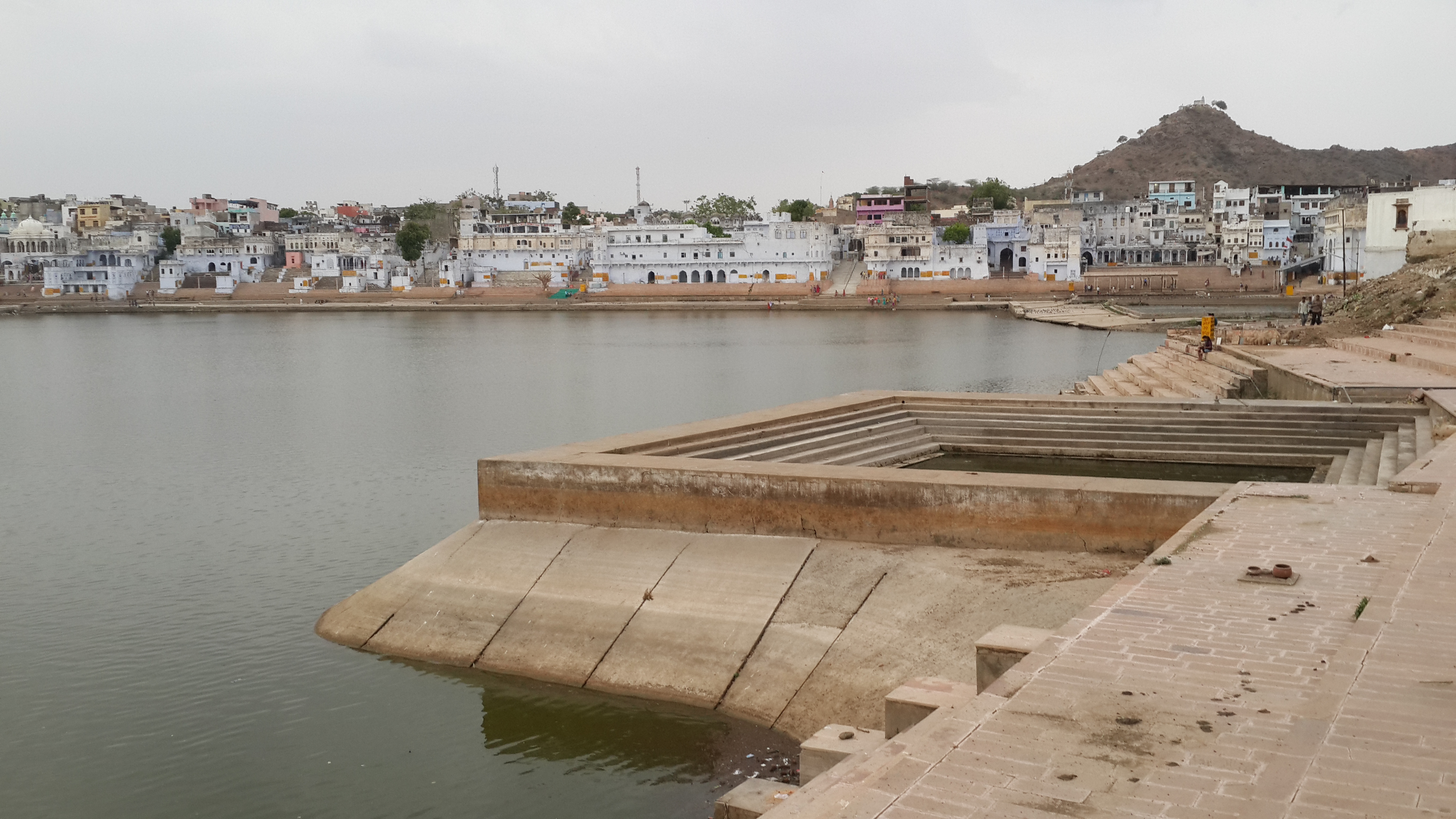
A small sign reminds visitors to remove their shoes while walking around…

…this is holy ground

Blue City: britches, brahmins and battlements
Our tour guide showed us around the impressive Mehrangarh fort and indicated the blue-washed houses in the valley below. All those blue houses, he said, belong to Brahmin families. Further enquiry found many other explanations for the blue coloring, so the jury is out on this one. Other possible reasons: as in the case of imperial yellow in Austrian Habsburg palaces, the color could have been chosen because it was the least expensive. Whatever the real reason, Jodhpur is commonly described as the “blue city” of Rajasthan and, together with Jaisalmer and Jaipur, make up a trio of colored cites in the state. Jaisalmer really is a golden city; golden sands of the Thar desert that spread from its outskirts and the golden sandstone of which the city is built. Seen from the fort, the city of Jodhpur is speckled with blue, the afore-mentioned allegedly brahmin houses. Jaipur is called the pink city mainly because of the iconic Hava Mahal, and because its royal family preferred the colour on all their buildings. But in today’s Jaipur, bustling with handicrafts and industry and bursting at the seams with people, the pink color is lost unless one wanders among the historic buildings and older parts of the city.
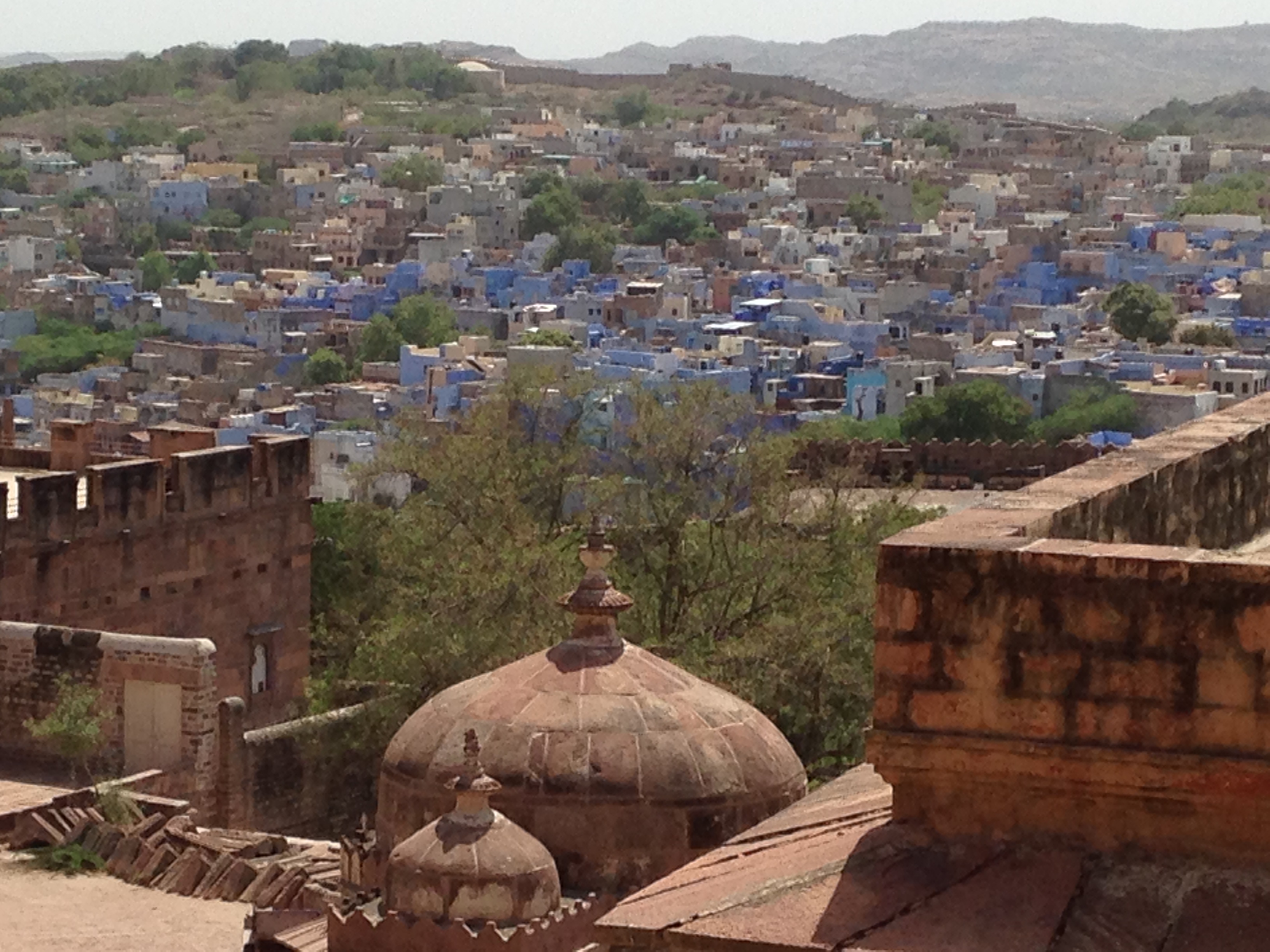
Blue-speckled city of Jodhpur seen from Mehrangarh Fort
Mehrangarh fort in Jodhpur is probably the most impressive in Rajasthan and well worth a visit of 2 or 3 hours (there’s more than three hours worth to see if you can take it in at a stretch), from royal palanquins to a beautiful collection of swords, and finery worn by royalty in centuries past. A tip: the audio guides available in the fort are excellent and provide concise commentary at every important object on display. In addition to its blue-painted houses, the dominating fort, and riding breeches named after the city, Jodhpur was also famed for its Marwari horses. They are a hardy breed with distinctive ears that point towards each other. They have a regal gait and are descended from local ponies interbred with Arabian and Mongolian horses beginning in the 12th century.Close to Jodhpur lies Mihir Garh, a boutique hotel with only 9 rooms that Lonely Planet listed in 2014 as the most unique hotel in the world.
A well-paved road leads from Jodhpur to Udaipur, again a city named after its founder Udai Singh in the 1530s, although this dynasty has ruled in the area for more than a thousand years, and represents the world’s longest unbroken ruling line, from the 9th century to the mid-twentieth. More on Udaipur and Pushkar in the next post.
Golden City: More bhang for the buck
Jaisalmer was an important node in the overland silk route and well-connected to the world at the time of Marco Polo. Built from the local yellow sandstone that turns to tawny gold in the evening sunlight, its fortress dominates the landscape, rising with crenellated walls several hundred feet above the surrounding plain. From the 12th century, it was a flourishing trade post for nearly 700 years. Camel trains brought Damascene swords, Afghani carpets from Herat, Persian wines from Shiraz, and “green-eyed Circassian beauties headed for the harems of Hindustan.” The last denominated may be a catch-all term for women from the trans-Caucasus region of Eurasia. The most famous Circassian of all is probably Roxolana who, as Hurrem Sultan, rose from slave to concubine to favourite wife of Suleiman the Magnificent (1520-1566) and ultimately, one of the most powerful figures in his court. Roxolana was actually of Ukrainian or Ruthenian descent, but the wife she ousted from Suleiman’s favour, the beautiful Gulbehar, was undoubtedly Circassian. Contrary to legend, Marco Polo did not visit Jaisalmer. Perhaps he should have. Today, as it did then, Jaisalmer gleams like a golden mirage at the edge of the Thar desert. Approaching the city from the north-east, from the direction of Bikaner, there is endless sunlight and more golden sand. Passing Pokran, the site of India’s first nuclear test in 1974, there is an array of hope for the future, rows of photovoltaic cells that are part of a 40 MW plant set up in 2012 to provide power to Rajasthan state. NOTE: Click on images below for larger view.

UNESCO World Heritage site. Golden city on a hill
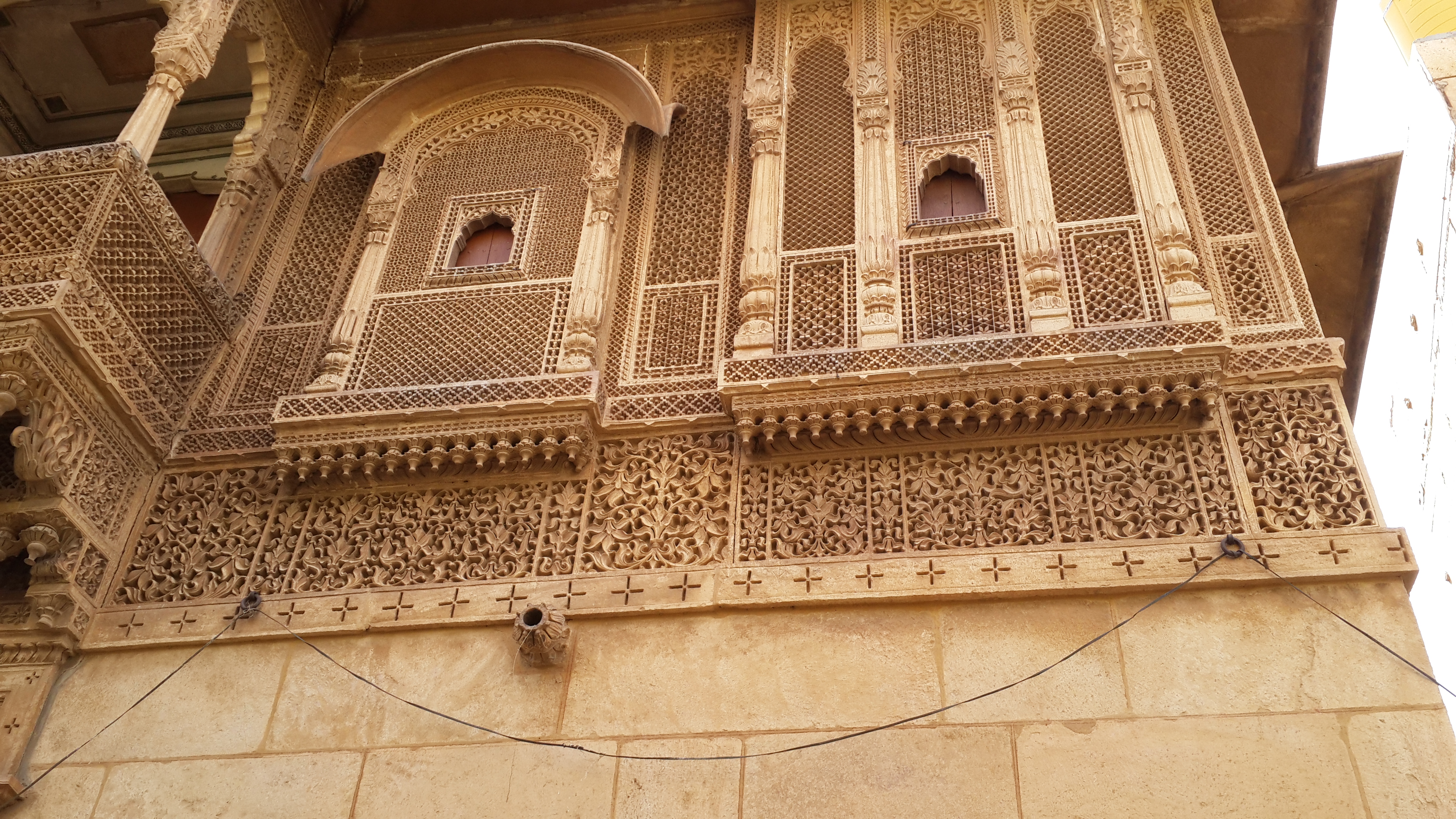
Magnificently carved stonework on every street and corner
There is something easy-going about the pace of life in the city, unusual in that it is the first inhabited monument in the world to have been declared a World Heritage site in 2013. Around 450 families reside in the fort complex and some of their homes have been converted into hotels, which puts additional strain on the centuries old infrastructure that was designed for a royal household and a few hundred retainers. After a walk around the city lasting several hours, we were totally captivated by the relaxed atmosphere in the city and found a possible explanation when our guide offered us a choice of masala chai or a glass of milk or tea laced with bhang. When asked if it was legal, he turned and pointed to a sign down the street. The offer was tempting, but deterred by the 40-degree heat, I regretfully declined.

Street legal bhang in Jaisalmer
Bhang has been used since Vedic times in India and both Hindu sadhus and Muslim Sufis use it to heighten their spiritual ecstasy. Bhang is most commonly made by grinding cannabis leaves and adding a mixture of milk, ghee and spices. Sometimes ground almonds and sugar are added to the milk and this drink is called “thandai.”

The handicrafts within were far finer than the orthography

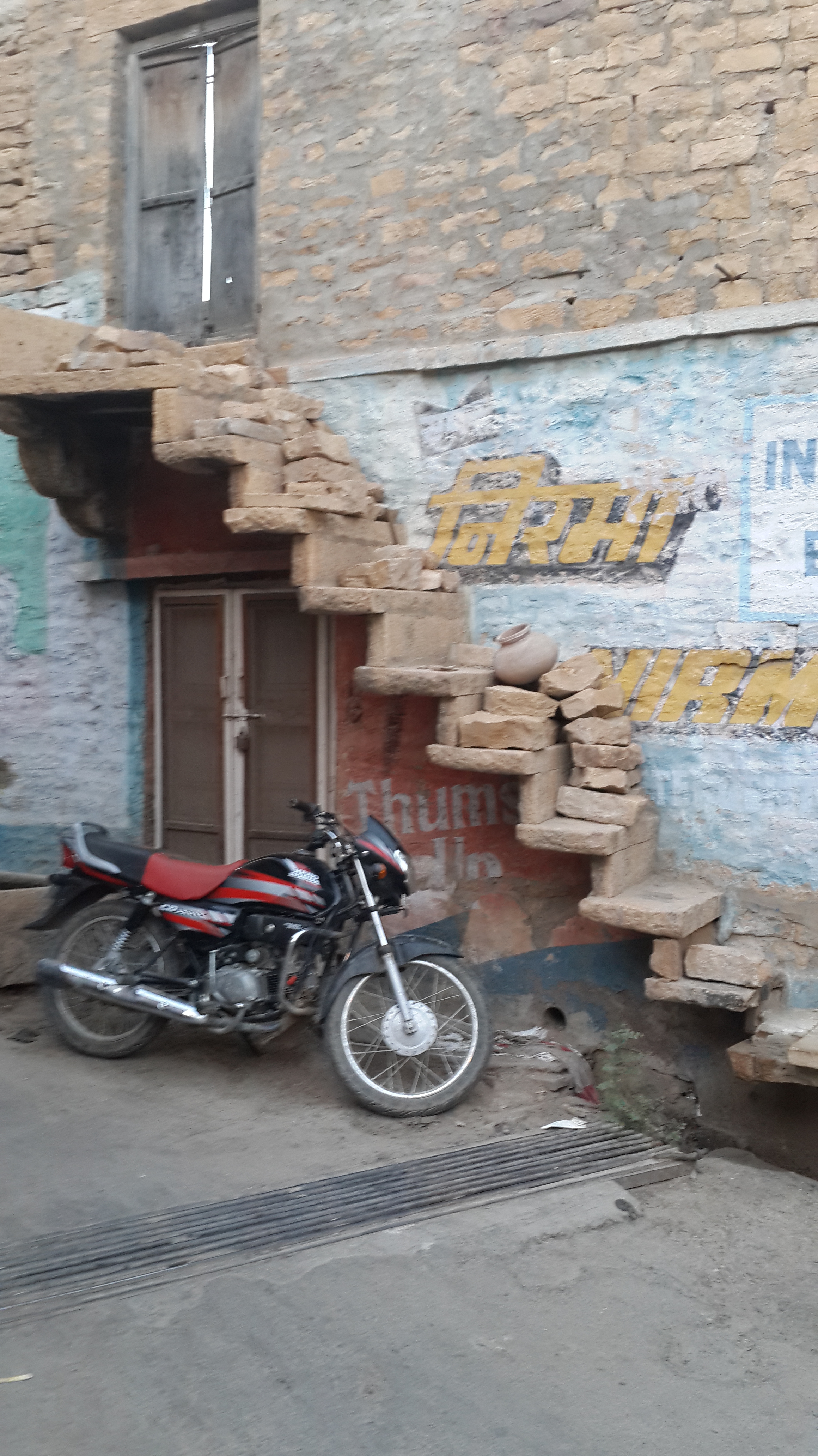
Easy living: Stairway to nowhere
Disinviting a Hornet

There was a temporary hiatus in writing activity for more than four hours yesterday because I noticed a hornet building a nest just outside my balcony door. I don’t know much about hornets but this one was large and looked extremely aggressive. Looking up the internet, I found articles about Asian Giant Hornets and their painful (to potentially lethal) venom. The first headline said: Giant hornets kill 42 in China (this was apparently in Shaanxi province in 2013). Deciding that tolerance of nature and the wild stops under my own roof, I asked my landlord for help. He came along and demolished the nest with a broom handle when the wasp was off hunting for more building material. We then poured vinegar over the site hoping to throw the hornet off the scent
Note: this method worked because the hornet was just beginning to build. Definitely not recommended for a larger nest. Get professional help if you have a problem. The hornet returned ten minutes later and began building a second nest a few meters away from the site of the demolition. Off it flew to collect more hornet bricks or clay or whatever for its new home. I demolished this one too, vacuumed the remains and poured vinegar again to throw it off the scent.

Looking for its demolished nest
The spot outside the balcony door was obviously well suited because it returned, searched for a few minutes, then began to build a third time. Remembering that firefighters sometimes use a blanket of foam, I covered the nest with a mound of a thick cleaning fluid and shut the doors. The two cats obviously knew that the insect was potentially lethal. They watched with obvious respect through the glass doors as it buzzed about furiously outside before flying off to find a more suitable building site.

Not again!
Ah, the joys of living on a sub-tropical island paradise! As in the Bible, there are snakes in this paradise too. According to a book on the local flora and fauna, cobras, vipers, banded kraits and Burmese pythons are to be found here. However, snakes are shy creatures and in the past year of extensive hikes through the many trails on this island, I’ve only once glimpsed a vanishing tail at dusk. However, I’ve been repeatedly told that small animals, especially cats and dogs are at risk from the Burmese pythons.
The Changing Landscape of Religion
Here is a link to the summary of an article on the changing landscape of religions. This is a synopsis of work done by Vegard Skirbekk et al. and was mostly carried out at the International Institute for Applied Systems Analysis (IIASA), based in Laxenburg near Vienna, Austria.
Religion is a key factor in demography, important for projections of future population growth as well as for other social indicators. A new journal, Yearbook of International Religious Demography, is the first to bring a quantitative demographic focus to the study of religion. The journal is co-edited by IIASA researcher Vegard Skirbekk, an expert in the field of religious demography. The first edition of the journal includes three studies by IIASA researchers:
Read more at: http://phys.org/news/2014-08-landscape-religion.html#jCp
Humayun’s Tomb and the Star of David
Visiting Mughal Emperor Humayun’s tomb in Delhi, I was surprised to see the six-pointed star of David adorn the entrance to the West gateway. The tomb was built by Humayun’s son, Akbar the Great, in memory of his father six years after the latter’s death. Akbar was known to be a wise ruler who was religiously tolerant and looked on all faiths as equally valid interpretations of the same divinity. I assumed that the stars above the tomb were an early expression of mutual Jewish-Muslim tolerance and understanding. The stone tablet outside the gate dispels this notion (see the second photograph below).


Wikipedia says that the star became a symbol of Jewish communities only during the 19th century and the symbol was inherited from medieval Arabic literature by Kabbalists for use in talismanic protective amulets.
The conflict between Arabs and Israelis has lasted more than 2000 years (see my earlier post entitled History in 1000 words: The Israeli -Palestinian conflict at https://aviott.org/2012/12/06/history-in-1000-words-the-israeli-palestinian-conflict-2/
Far too long! The world needs more Akbars and Yitzhak Rabins with the courage to make peace and perhaps even die for it.
Kürtőskalács on Lamma
Lamma Island’s many restaurants, food stalls and stores offer a variety of cuisines, from Chinese to Fish & Chips to Continental. The stores that cater to this small population of 6,000 (twice that on weekends) stock mostly everything from Austrian jams (Darbo naturrein!), to Marmite. One of the few things that have been missing till now were Hungarian Chimney Cakes (Kürtőskalács in Hungarian).

Fortunately, this sad state of affairs has been remedied by Roland who bakes them fresh every morning at the Prime Bar, next to where Tony dispenses his excellent offerings of soul-saving South American coffee as people rush to catch the morning ferries to work. The crisp rolls are mildly sweet and come with a choice of toppings including cinammon and chopped walnut. Both coffee and rolls are highly recommended.
Yung Shue Wan Main street, from 7 to 11 am.
The World is a Book: St. Augustine
Saint Augustine of Hippo (present-day Algeria) lived from 354 to 430 CE and is the source of one of the most well-known quotes about travel. “The world is a book, and those who do not travel read only one page.” The grand-daddy of all famous travel quotes is Lao Tzu’s eminently quotable “The journey of a thousand miles begins with a single step.” Of course, at the times these quotes were made, travel was expensive and perilous. Today hordes of innocents travel far afield armed with little more than a credit card and, perhaps most hazardous, an overdraft on their bank accounts at home. Paradoxically, the hazards of travel are global and impersonal. A single intercontinental jet flight can cause as much CO2 emissions (1 ton) as a year of driving (around 12,000 km) an average car.
However, in today’s interconnected world, it simply won’t do to live life on a single page. Recently, when contemplating an intercontinental journey from Europe to Asia, I explored the possibility of taking ‘a slow boat to China,’ and discovered that travel on an assortment of cargo ships was possible, only the journey would take three months and cost around US $10,000 instead of 15 hours and $1000 by plane. So what is a globally responsible citizen to do? The incipient wanderlust of early childhood was stimulated decades ago by my grandfather’s collection of bound volumes of National Geographic Magazine filled with travel descriptions and black and white photos from the 1920s and 1930s; from that glorious age when there were still many unknown parts of the world and when the bulk of humanity still lived a single-page existence. Today, billions of people live confused and deracinated lives because the bulk of their multi-page wisdom and experience comes from, or is filtered by, television.
Around the turn of the millenium (that was only 15 years ago), National Geographic offered a 110-year archive of issues on CD that was bought by aspiring world (armchair) travellers. The software was clunky and time-consuming to use, and the operating systems quickly became outdated (anyone with a Windows NT operating system is welcome to my 1999 NatGeo CD collection). The email offer from National Geographic received today for online access to 125 years of the magazine holds the promise of longer accessibility than the CD-ROM version. As the quote on the desk of a professional archivist I know says: Electronic archives are good for eternity or five years, whichever comes first.
Here is the link. The archive is free for a limited time.
Daniel Ellsberg Defending Edward Snowden
US Secretary of State John Kerry called Edward Snowden a coward and a traitor and praised Daniel Ellsberg, who leaked the Pentagon Papers to the New York Times in 1971, for having stayed in the country after the leaks about the Vietnam War.
Daniel Ellsberg, writing in the Guardian, says that Edward Snowden is not a coward, but has no chance of a fair hearing and trial because of the Espionage Act.
On the Today show and CBS, Kerry complimented me (Daniel Ellsberg) again – and said Snowden “should man up and come back to the United States” to face charges. But John Kerry is wrong, because that’s not the measure of patriotism when it comes to whistleblowing, for me or Snowden, who is facing the same criminal charges I did for exposing the Pentagon Papers.
…Snowden’s chance of being allowed out on bail (is) zero. (Ellsberg: I was out on bond, speaking against the Vietnam war, the whole 23 months I was under indictment). More importantly, the current state of whistleblowing prosecutions under the Espionage Act makes a truly fair trial wholly unavailable to an American who has exposed classified wrongdoing. Legal scholars have strongly argued that the US supreme court – which has never yet addressed the constitutionality of applying the Espionage Act to leaks to the American public – should find the use of it overbroad and unconstitutional in the absence of a public interest defense. The Espionage Act, as applied to whistleblowers, violates the First Amendment, is what they’re saying.
Without reform to the Espionage Act that lets a court hear a public interest defense – or a challenge to the appropriateness of government secrecy in each particular case – Snowden and future Snowdens can and will only be able to “make their case” from outside the United States.
See the link below for the full article from the Guardian of 30 May 2014.
The Wisdom of 7 year-olds
Why is six afraid of seven?
Because seven ate nine.
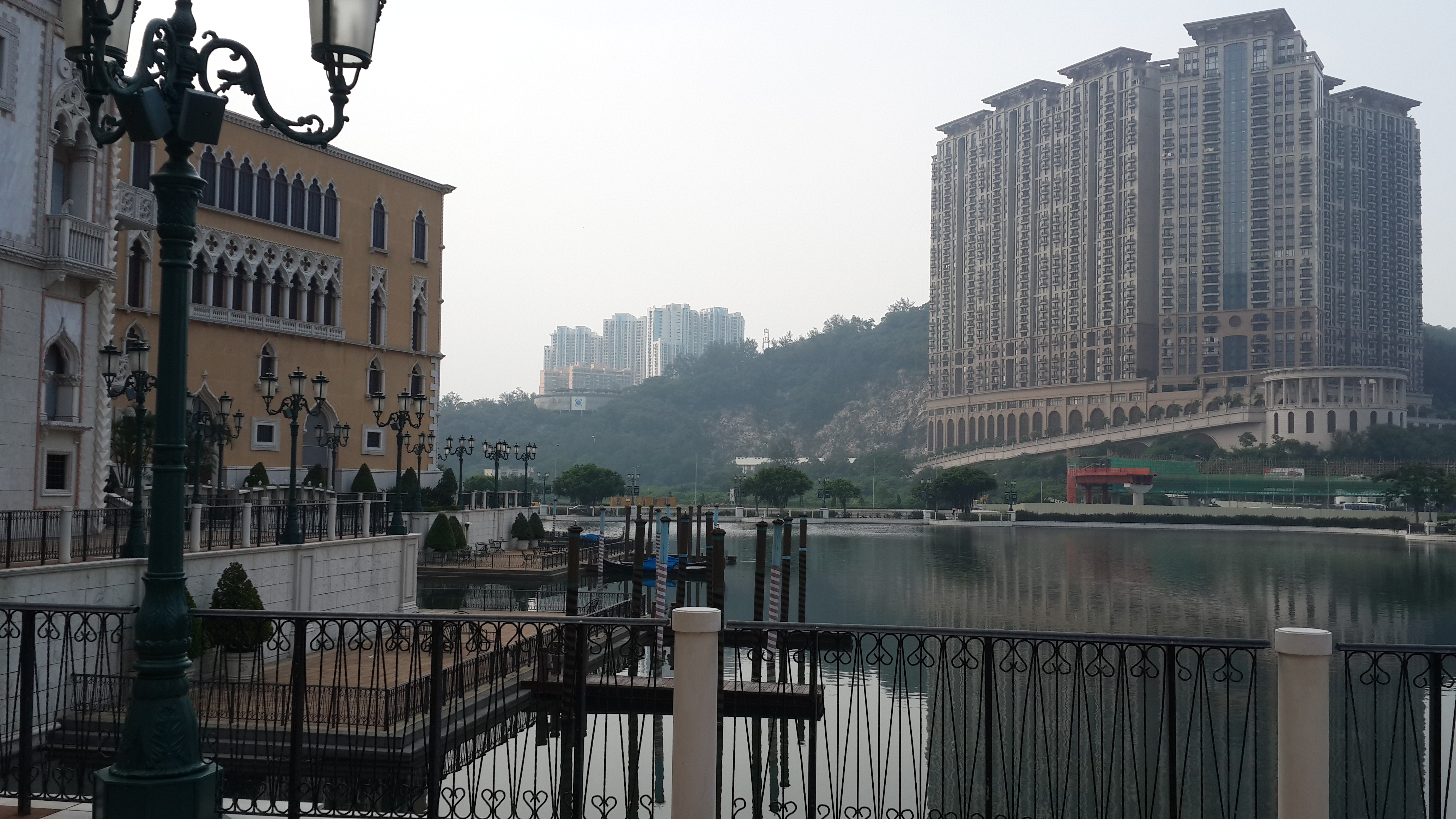
Macau Highrise overlooks Venetian cityscape.

Heirs to Camillo Agrippa, fencing master, Italy, 1590-1650. Author of “Trattato di Scienza d’Arme.”
 aviott