Saving the Tiger
Ranthambore National Forest and Tiger Reserve is a stunningly beautiful place that spreads over 450 sq. km. Writers like Jim Corbett and Rudyard Kipling have painted vivid portraits of Indian jungles for readers in the English speaking world. On a recent visit to Ranthambore, sitting in an open jeep, slowly winding its way along rutted jungle trails, tales of Mowgli, Bagheera and Balu the bear seemed to come alive. She expected to see a barefoot boy in a loin cloth peering out from among the tall grasses. Instead, she came face to face with …Shere Khan.

Shere Khan. Her real name, said the guide, is Noor…

…or Mala, or more prosaically, T-39, the mother of 3 healthy cubs
The moment was so unexpected, so pure, so anti-climactic that there seemed to be magic in the air. Noor is also known to the park rangers as Mala, a name that means ‘necklace‘ for the decorative, beadlike stripes on her flank. She had apparently just fed at dawn, the remains of the kill lay somewhere in the grasses nearby, her belly was full, and she was tired and too sleepy to investigate the little open jeep with three occupants parked at a respectful distance.
These magnificent animals are under threat from us humans. Ironically, one way to save them might be to bring more humans to visit them in their natural surroundings, just like the passenger in the jeep who watched her in awed silence for nearly two hours. For every tourist who comes to see them here, there are perhaps two or three locals who earn a livelihood, people who have been displaced from their own natural habitat in the jungle, displaced by the need to preserve wildlife. The villagers who used to live in Ranthambore forest were relocated when the tiger reserve was set up. These displaced people had to carve out a new existence in small settlements surrounding the jungle that was once their home.
We met one of the displaced people, a Rajput by the name of Dharamveer. He was proud of his forbears who had built forts and castles in these hills and jungles, and today he was one of the lucky ones; someone who had done well by doing good. When he was displaced from the forest, Dharamveer had trained as a tiger painter, painting iconic portraits of Shere Khan with the finest of strokes using delicate brushes that were a mere three or four hairs thick. This fine work gave the tigers in the paintings a lustrous lifelike glow that seemed to move as they caught the light. Buoyed by this success, he assisted widowed women to retrain in other handicrafts and has created a thriving business selling their work.

A Rufous Treepie
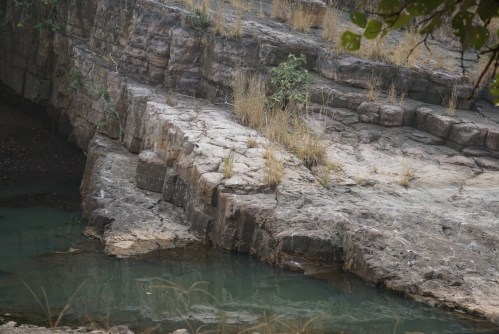

the entrance to the reserve is through the old Ranthambore fortress gate…

…the sambhur belled, once, twice, and again… (Hunting Song of the Seonee Pack)
We visited his store after the safari and were welcomed by the artisans who proudly showed us their wares. There was exuberant patchwork art, as well as many other fabrics, woven on rural handlooms, carvings, tribal paintings and animal protraits. As usual, there was more than one person could buy, but an American friend is exploring the market for these attractive products outside India. More on that will follow in a later posting.

An exuberant patchwork of Hathi the elephant; handloom fabrics, carvings and nature paintings
For more by this author, see his Amazon page here.
Books on Google Play

Available on Google Play
To all Android users: The above 4 books are now available on Google Play. The first 20% of each book can be downloaded as a free sample. For the owner of a not-so-new smartphone (3 year-old Samsung) like myself, the text was surprisingly easy to read in both vertical and landscape modes. Downloads were almost instantaneous using a reasonably standard wi-fi connection. To access the books, select the “Entertainment” header on the Google Playstore app, and then open the category “books” to search under author or title. Hint: The entire title story of the Ironwood Poacher collection can be downloaded and read as a free sample.
Forthcoming: All 4 of the above titles coming soon to the iTunes store, plus Desert Dreams, an illustrated travel guide to the fascinating and history-laden state of Rajasthan that will be published only as an e-book on Google Play, iTunes and Kindle. Additionally, a brand new website (aviottjohn.com) designed by a young professional based in Munich, plus a subsequent post on some small steps to save the iconic Indian tiger. Follow this blog for automatic notifications of updates.
Spreading the Sunshine 1: A New Year Message
Even today, in the first half of the twenty-first century, thousands of villages in Africa and Asia (mainly in India) remain off-grid and have no access to electricity. Ever since a three-month stay in Kenya and Tanzania in 1985, I have dreamt of bringing solar lighting to the smallest villages on these two continents. In Kenya I was astounded to see that, as early as 1985, a few rural families had bought individual solar panels connected to used car batteries to power a single light bulb and the occasional television set. They did this because they had no hope of access to grid electricity in their lifetimes. It’s even more astounding to think that in affluent countries today, the majority of people who drive $ 20,000 cars consider solar power unaffordable without government subsidies. No wonder the world is hotting up! Such economic calculations show how skewed our thinking is.
Of course it was obvious that this journey of a thousand miles begins with a single step. Less obvious was what this first step should be. Mhairi made the first step on a recent (November 2015) visit to a village on the outskirts of a tiger sanctuary in Rajasthan. She made contact with the owner of a handicrafts shop on the edge of the Ranthambore national forest and tiger reserve who helps village craftswomen earn a living by marketing the beautiful tiger paintings, patchwork quilts with mirror designs and appliqué fabrics they make. Dharamveer was thrilled to hear about the idea of installing solar lighting for the nearby villages. He immediately took us to visit three of the 10 surrounding villages. These villagers have limited or no access to electricity. Even the few homes connected to the grid have power only 2 or 3 days a week, so they end up spending 2 to 3 hundred rupees a month on electricity bills or on kerosene for inadequate lighting with lamps. The proposal to pre-finance solar lamps for each household in the village was met with much enthusiasm. They were quite willing to pay 200 to 300 rupees a month for reliable solar lighting. And they were delighted to hear that, at a price of just 499 rupees (US $ 7 at current exchange rates), the lamps would belong to them within three months. Apart from the environmental costs of burning kerosene, the biggest drawbacks are cost and inadequate light for children studying or doing homework.

The Pico lamp, US $ 7 with a 2-year guarantee.
The idea we propose is quite simple. We plan to finance around one hundred of these solar lamps initially, to be distributed to a number of households in the ten target villages. Presumably they will be paid for in 3 months from the money the villagers save from their kerosene and electricity bills. We will request voluntary contributions for another 2 months and use the extra money to expand the circle of recipients till all households in the villages are covered. After which one can think of more elaborate systems, for example, like the model shown here that costs 7000 rupees or US $ 100 at today’s exchange rates. Greenlight is a for-profit company started in the US by three engineers, two American and one Indian. Their products have received good reviews in the international press.

The Sun King Home 120 is priced at approx US $ 100, can power USB devices and mobile phones.
We have decided on Greenlight’s Sun King model range, based only on our own internet research and news reports. Readers of this blog are invited to give feedback or share their own experiences with different models. I can envisage offering a range of different systems based on cost and reliability. I look forward to hearing from you.
For more by this author, see his Amazon page here.
Deeg: The Palace that Time Forgot
A pleasure garden in a timeless corner of a forgotten palace. Deeg did not much impact the history of the wider world outside, but in this palace can be seen glimpses of the glory it reflected after Suraj Mal’s victories over the Mughal emperors and conquest of Delhi. He brought back several buildings entire, marble and all, cut into numbered blocks and skilfully reassembled in his palace grounds. The seams are invisible, and the buildings include Nur Jahan’s favorite marble perch from which she presumably contemplated the blue flowing waters of the Yamuna River. Today that truly is a dream.
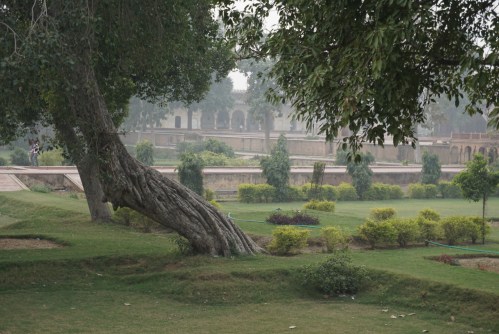
A timeless pleasure garden in a forgotten palace
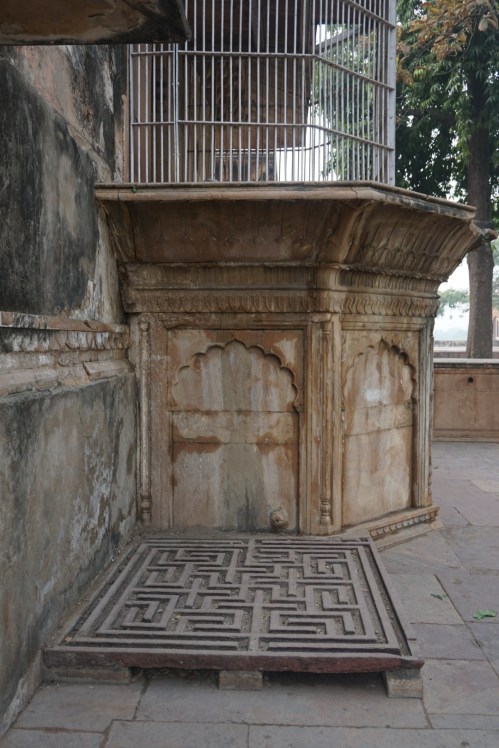
The Maharaja’s pet tiger lived in adjoining quarters

What is this life if, full of care, we have no time to lie down and stare…
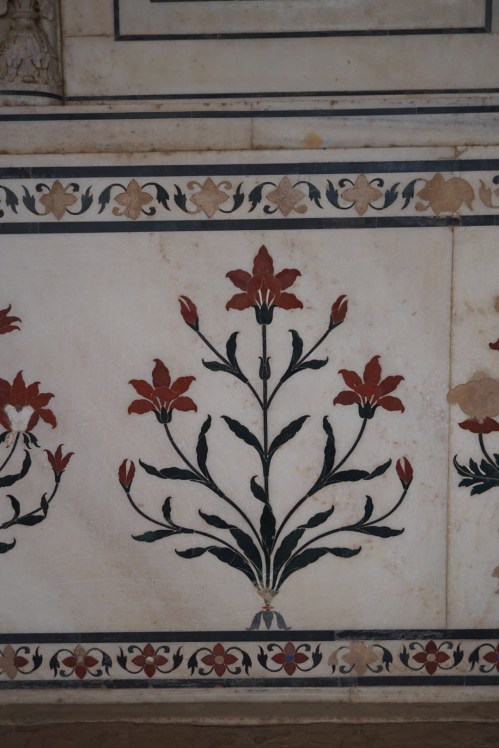
The artisanal excellence embodied in the Taj Mahal is to be found here too

Doorways to Neverland
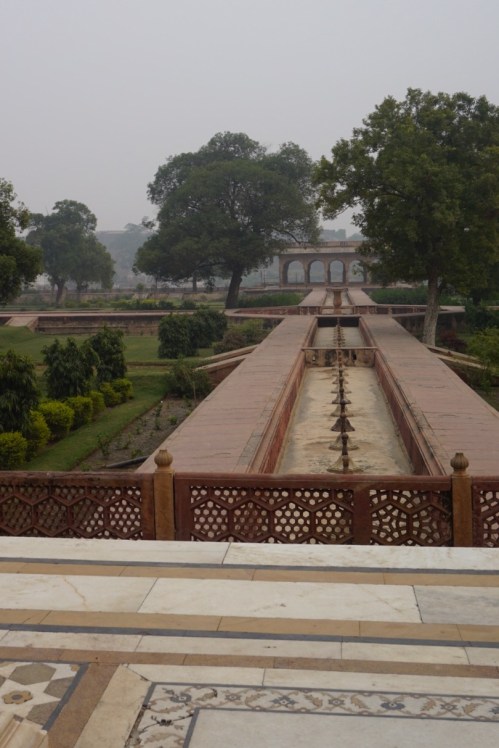
Three thousand fountains powered by gravity feed from tanks with water from the River Yamuna still flow twice a year.
For more by this author, see his Amazon page here.
The Banquet and afterwards…
The wedding banquet was a long drawn out affair that began at seven in the evening in a brightly lit and freshly decorated marriage garden. Guests trundled in from 7.30 on, with a constant stream of arrivals greeting friends and relatives. Street food was prepared fresh by a handful of cooks who constantly replenished the buffet tables. Small molded plates were available, pressed from the large dried leaves of a local tree, the ultimate in recyclable convenience. Marriage gardens are a big business in India, by the way, and even the most modest ones enjoy a healthy cash flow, while upmarket ones in urban areas are more like themed parks that can cost € 50,000 a night or more. It was mind-boggling for me to think of the amounts of money being spent on the most lavish weddings. In contrast, the one we attended in Agra was a masterpiece of careful budgeting that looked three times more expensive than it actually did.
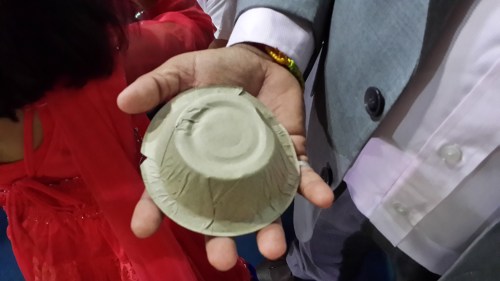
The ultimate in recyclability: compressed leaf bowls
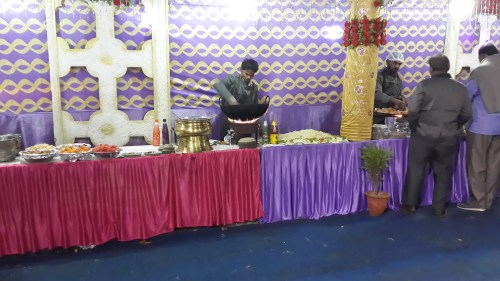
Delicious street food made to order on demand
While all this cooking, eating and socialising went on in the marriage garden, the groom arrived in a carriage drawn by two white horses, accompanied by lights and music. A short while later, bride and groom mounted a raised platform where the actual ceremony is to take place. Traditional Indian weddings are a delight for the guests, who enjoy hours of free food and fraternity, while the bride and groom endure a long drawn out ceremony dictated by religious rites and countless local traditions. The couple are finally wedded at dawn, by this time numbed to exhaustion. This could be a reason why arranged marriages last and divorces are rare. However, as traditions die out, there are many signs of change.
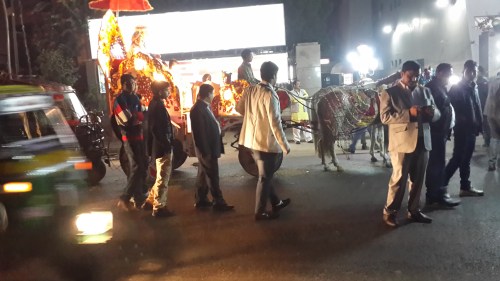
The groom arrives in a horse drawn carriage
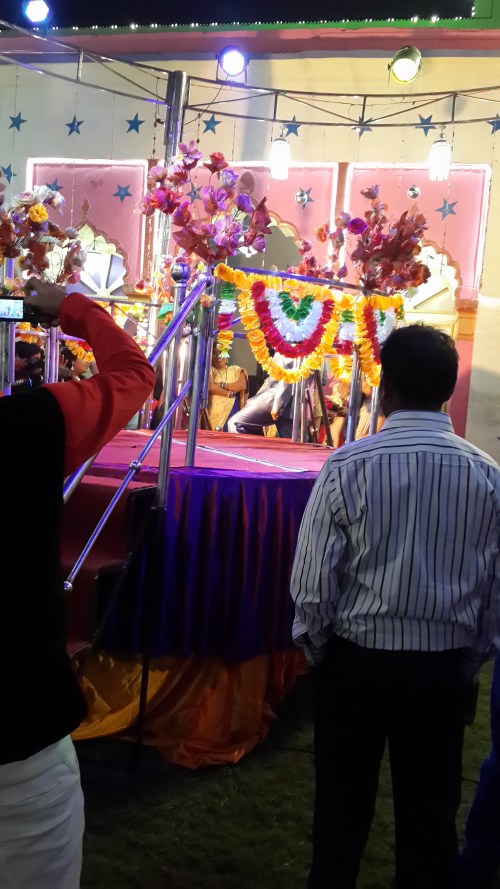
The raised platform on which the exhausted couple will finally be wed.
Signs of change next morning everywhere, ubiquitous cell-phones, ads for online shopping, fat cars muscling their way into narrow, overcrowded streets. But after last night’s banquet, we will rest a couple of hours and then drive to Deeg, the palace that time forgot. More in the next blog.
Monkey Business at an Indian Wedding
We were privileged to attend a traditional Indian wedding at a marriage hall in Agra, just a stone’s throw away from the Taj Mahal. The chief cook was busy with two assistants in a couple of small enclosures adjacent to the main hall. They labored over a gas cooking fire, preparing sweetmeats and the main meal for the 300 guests expected to attend. Watching over the cooking fires perched on an adjacent wall were two handsome gray langurs who occasionally bared their teeth at someone or something in the distance.
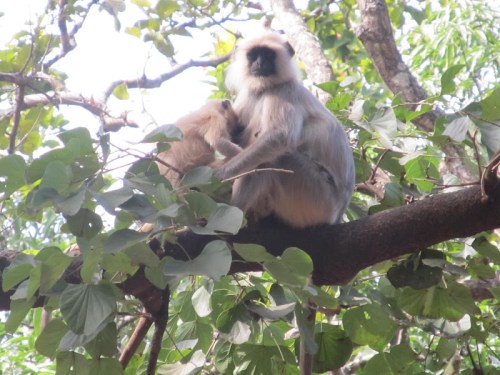
Watching over the cooking fires: Hanuman Langurs
They were watching over the cooking fires and keeping a troop of a dozen marauding rhesus macaques at bay. The two langurs belonged to the cook who kept them as pets for this very purpose.

Not invited to the banquet: Rhesus Macaques
These itinerant cooks are specialists who travel around during the wedding season carrying their large cast-iron vats, giant ladles and woks. They are in great demand during the wedding season from November till July, and are often booked out months in advance. They can churn out meals for hundreds at a couple of days notice. A preliminary tasting convinced us it would be a meal to look forward to. More details after tonight’s banquet.
Saving Trees: Grace in the South China Sea as a Kindle edition
 “Grace in the South China Sea,” is now available as an e-book on Kindle. For copyright reasons, it won’t appear on the i-Tunes bookstore or Google Play books for 3 months, till mid-February. Potential readers are encouraged to buy the electronic edition rather than the paperback. One, it’s much cheaper, at US $ 3.21 (€3, or £2.30 at various Amazon sites), as opposed to $10.63 plus postage. Two, no trees have to die for the sake of a few hours of escapist reading pleasure. Hint. Trees play an important part in the story.

For more by this author, see the Amazon page here.
Why Fossil Fuels are for Dinosaurs
Pity the poor middle management engineers at Volkswagen who are getting it in the neck for doing what their bosses told them to do, either explicitly or implicitly. There is a tremendous pool of superb engineering expertise at VW and at all the hundreds, if not thousands of ancillary companies worldwide that provide VW with components for the range of cars produced by the group. For decades they have been honing their skills, shaving ever-decreasing slivers of efficiency out of a mature technology that has been continuously refined for more than a hundred years. And now this technology has reached the end of a glorious innings. The automobile, driven by the internal combustion engine, has changed the face of the earth, has transformed the lives of every one of us. Let’s stand up and pay homage to all the brilliant men and women who developed and refined this means of individual transportation that gave us so much freedom to move, to explore the world.
And before we sit down again, let’s observe a minute’s silence for all the thousands of people who will be out of jobs unless they are flexible enough to retrain, whose expertise will no longer be needed. The VW scandal shows, more clearly than any technical study, that the internal combustion has finally reached its limits. It can no longer cope with the air pollution standards demanded by the finite limits of our planet. Locomotion by means of controlled explosions within a confined space, the basis of internal combustion engines, cannot compete with the smooth power of an electric motor.
I first rented and drove an electric car six years ago. It was an expensive car, very basic, and the battery drained alarmingly quickly. Nevertheless, I could see the potential of the electric motor, and was immeasurably thrilled as the partially drained battery re-charged on a long hill descent, putting back nearly 50% of the power it had used to climb the hill. Not only that, but I hardly touched the brake. The speed of descent could be controlled by selecting between various levels of regenerative braking. That was the epiphany. Range anxiety is like fear of flying. Very real, but irrational.
For a conventional car company like VW, the imperative to continue doing what it knows best is irresistible. Otherwise what are they going to do with the hundreds of specialists on their payroll because electric motors are compact and virtually maintenance free? e-cars don’t need elaborate cooling systems; regenerative braking reduces wear and tear on conventional brakes; service intervals are much longer and costs are lower… the list goes on. What about batteries and range I hear you say? Yes. Batteries are a weak point, but they are getting better all the time. In 2010 my electric bicycle had a range of 25 kilometers with a 7-kilo lithium metal hydride battery pack (the battery pack was susceptible to the memory effect. i.e. it had to be completely drained before recharging). By 2012, my bicycle had a range of 50 kilometers, the lithium ion battery weighed less than 2 kilos and could be charged at any time without worrying about the memory effect. With ICE’s the fuel has to come from far away (often from troubled parts of the world). With an electric car, you can potentially make your own fuel at home and then it’s virtually free. Apart from concern for the planet, the biggest argument is when you think in terms of efficiency. The operating efficiency of an electric car is around 88%. For the best ICE’s after accounting for friction, losses in transmission, combustion, etc., the comparable figure is 15% to 30% (Energy Trends Report, 2008)
So if you have to buy a new car in the near future, project your thinking a little bit into the future and ask yourself: do I want to invest in a dinosaur?
The Island: Grace in the South China Sea
Grace entered the world yesterday. Readers take note. Grace entered without fanfare, a good omen in these days of multi-level international conflict, air disasters and general gloom. This is the first book in a trilogy.

Boats, sampans in Abderdeen Harbor, Hong Kong. Cover photograph by M. MacInnes
Grace is a young woman of twenty-six when she discovers her unusual gift, a gift that enables her to find a lucrative job and acquire a modest fortune over the next five years. She sees at close quarters the environmental destruction caused by the company she works for, resigns from her job, and retires to an idyllic island in the South China Sea while trying to decide what to do with her life. A chance encounter with a lonely old woman grieving over the death of her beloved pet mongrel sets her unwittingly on a path where she has to use her burgeoning powers to avenge a murder and save her own life.
Although part of a trilogy, this is a complete novel in itself. The second book about Grace, The Trees of Ta Prohm, is forthcoming in 2016. See the Amazon page here for more details. The e-book version of this novel will appear in mid-November.
The Power of Words
I promised to post more about Grace several weeks ago. I apologise for the delay. Life intervened. In the interim, I also had feedback from readers of the manuscript that suggested a few changes. One change led to another and an extensive re-write ensued. This work is now almost finished. In the meantime, my sincere thanks to the several readers who invested so much of their time to proofread and comment on the manuscript. They will remain anonymous here, but will be acknowledged in the book, when “Grace in the South China Sea” finally appears a month from now.
There is a story by Arthur Clarke that Hemingway, challenged by fellow writers at a dinner table to write a moving story in less than ten words, did it with six. His short story read: For sale. Baby shoes. Never worn.
A picture may be worth a thousand words, but it takes words to say it. The power of words. Grace, a young woman slowly becoming aware of her powers. Grace: def:. The exercise of love, kindness or goodwill; disposition to benefit or serve another.  Watch this space.
Latest Posts
-

December 2021 Newsletter
Originally posted on The Forest Way: A photo essay Most wonderful wishes and best regards to all, for the start of a fresh, healthy, environmental…
-

A Tree Planting Update
I begin this post with an apology. I have posted only sporadically this past year, and the reason is not Covid as one might think.…
-
The Standoff explained: Modi government vs. Indian Small Farmers
The is basically a battle for the future of Indian agriculture. It is also a battle of two opposing philosophies: Small is Beautiful vs. Big…
-

The True Source of Wealth
Many years ago an economist friend told me to invest in stock index funds rather than property. He pointed out charts comparing property prices and…
 aviott