In Defense of the Tata Nano
I recently read several critical safety reviews of small cars in Indian newspapers including the Tata Nano. The reviews show that these small cars do not adequately protect their occupants from harm in the event of a head-on collision at 60 kilometres per hour. There is no doubt that these tests are objectively carried out and the potential damage to life and limb is very real.
The base starting price of the Nano in 2014 is US$ 2,300. around twice that of several popular brands of motorcycles. Therefore the relevant safety question to be asked here is: who is the intended target buyer for the Nano? If this aspect is considered, the real question will be: how much increased security will a potential buyer experience in moving up from a motorbike to a Nano? The street scenes below will speak for themselves.
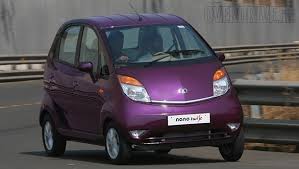

The Tata Nano and its competition

Above: The Tata Nano and its competition
Banyans, Cuckoos, Cannonballs and Theosophy
Sounds like a strange mix, but the caption above is easily explained. The international headquarters of the Theosophical Society occupies an area of 104 hectares (260 acres) of wooded land. Nearly 15 acres of this land is occupied by just one tree, a 450 year old banyan that has had room to spread within the protected grounds.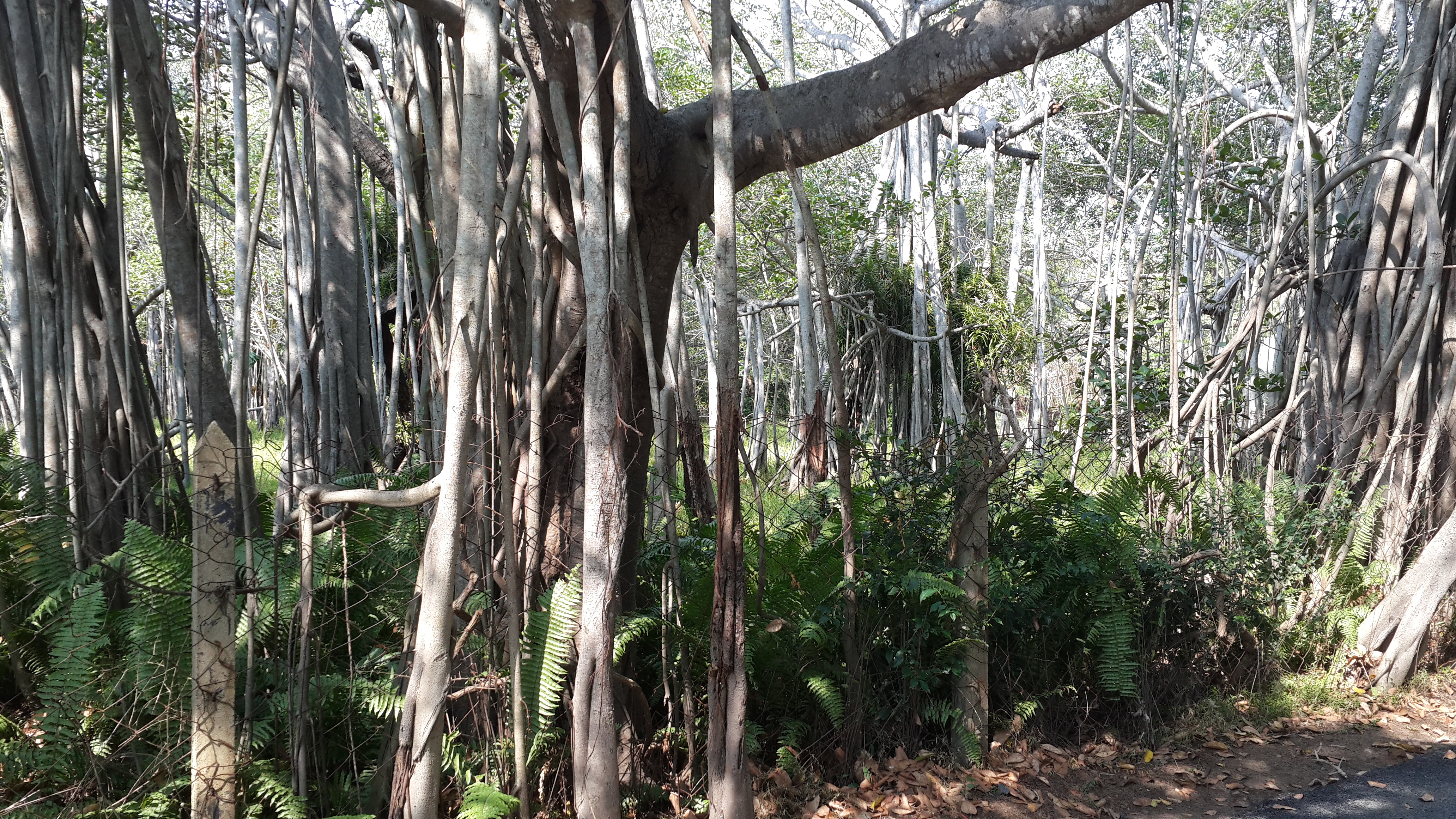
 The Theosophical Society was founded in New York in 1857 by Helena Blavatsky with several others. Madame Blavatsky was a widely travelled, spiritually inclined, well-read Russian emigre. She came from a privileged, aristocratic background but reputedly had a strong egalitarian streak and eschewed any notions of superiority based on birth or race. The Society aimed to foster the universal brotherhood of humanity, without distinction of race, creed, sex, caste or color. In 1875 the Theosophical Society moved its headquarters to the present campus that lies alongside the banks of the Adyar river in Chennai, about a mile before it reaches the sea.
Although largely unknown, the Theosophical Society has had major impact on world affairs. For example, the Indian National Congress, today one of the two major political parties in India, was started by, among others, AO Hume, a Scotsman and prominent member of the society. The New Age movement reflects many of its characteristics, including holism and eclecticism. In 1902 Rudolf Steiner became General Secretary of the Austrian/German branch of the Society. Philosophical differences between this branch and the international leadership under Annie Besant arose and the faction under Rudolf Steiner founded the Anthroposophical Society, an attempt to bridge the gap between science and spirituality. The movement is better known today as the philosophical underpinning of the Steiner/Waldorf school system.
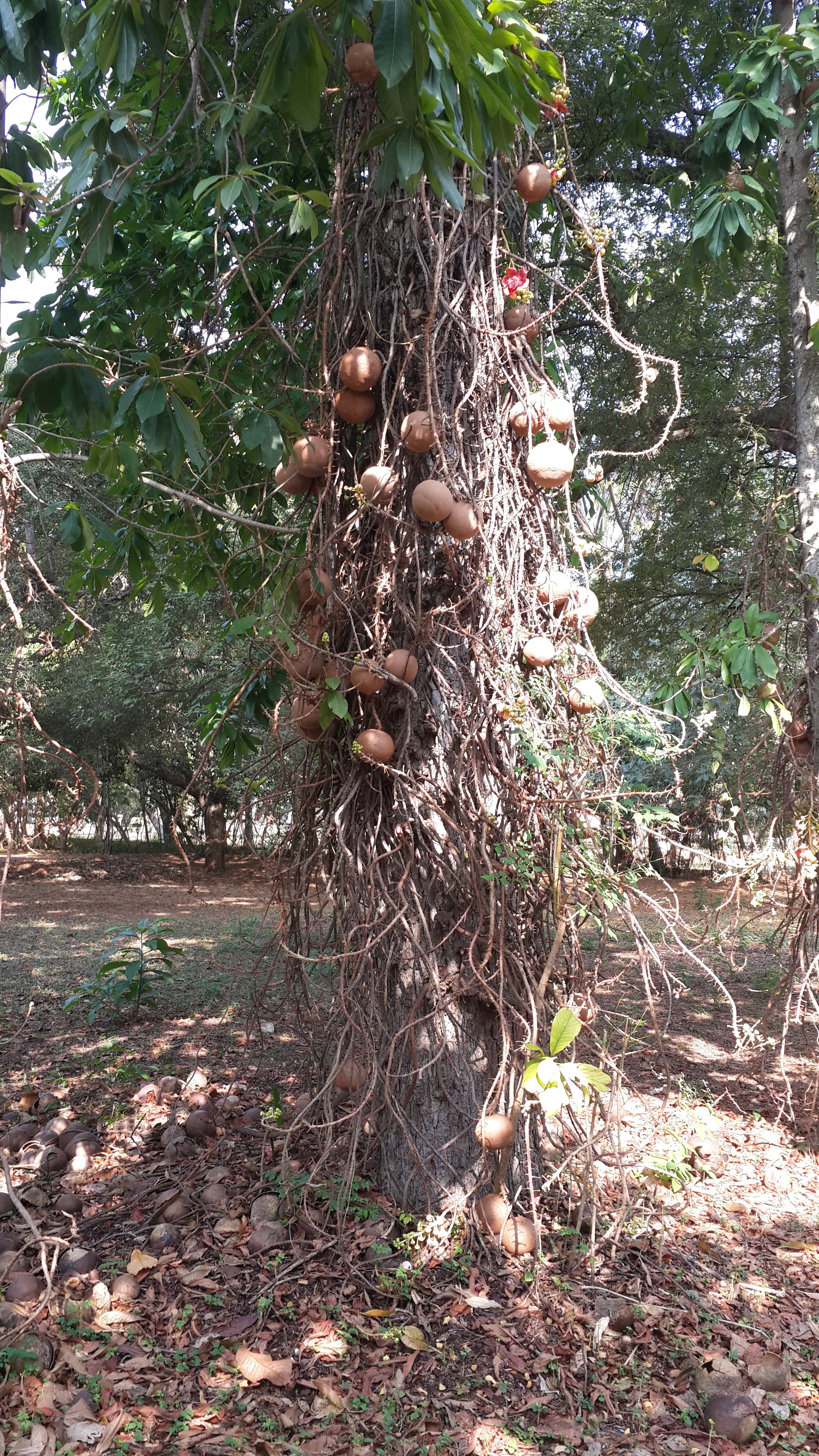 The extensive gardens of the Theosophical Society and the nearby estuary where the Adyar River meets the sea are home to a wealth of plants and birds, including pipits, lapwings, curlews, golden orioles and parakeets. There are more than 100 tree species, including several cannonball trees (above) with their spectacular fruit that grow straight off the trunk and are hard and heavy enough to kill anyone thoughtless enough to sit under one. The tree is considered sacred in India because the flower petals (click on the image above to enlarge it) resemble the hood of a Naga, a sacred snake.
 The Common Hawk-Cuckoo
Badami: 7th Century Cave Temples
There are 4 cave temples on a rocky hill above the town, all carved out of the giant rocks that form the hillside. The first two caves are dedicated to Shiva, the third (and grandest) cave is dedicated to Vishnu. Shiva and Vishnu are the second and third members of the Brahmanical Trinity, the first being Brahma, who is traditionally accepted as the creator of the entire universe.

 The fourth cave is a Jain temple, adorned with an image of Mahavira, the last of twenty-four teerthankaras, or spiritual role models in Jainism. Mahavira was born into a royal family around 540 BC somewhere in today’s Bihar state in India and he reputedly lived till around 468 BC. This makes him a contemporary of Gautama, the Buddha, who lived from around 563 to 483 BC according to the latest reckoning of historians and scholars. Further coincidences in their lives abound. They were both born into princely families. They both lived traditional family lives until they left their homes at the ages of 30 (Mahavira) and 29 (Gautama) and wandered in search of spiritual truths. Interestingly, although Gautama was born in today’s Nepal, he reputedly achieved enlightenment while meditating under a pipal tree in Bodh Gaya, in Bihar, where Mahavira was born. The present day state of Bihar is relatively poor, but was a great center of learning and spirituality at the time. One of the earliest universities in the world existed at Nalanda, from the 5th to the 11th century AD.and lies just 90 km from Bodh Gaya. The Badami cave temples are in Karnataka state, not far from the scattered ruins of Vijayanagar in Hampi.
Hampi: On the banks of the Tungabadhra
A city of well-preserved temples, palaces, elephant stables and elevated viewing points; the remains of a wealthy 14th-16th century empire scattered over 350 square kilometers of sparsely populated countryside; the vibrant Virupaksha temple, still being used and worshipped in by thousands every year. All this lies on the banks of the Tungabhadra river that flows, deceptively serene, nearby. Swimming in the still flowing waters is strongly discouraged by large signs that warn of treacherous whirlpools and undertows caused by the rocks in the water. The signs forget to mention a further disincentive, the occasional crocodile that floats sluggishly by.
Domingo Paes was a Portuguese traveller who visited the Vijayanagara Empire around the year 1520.
About the ports under the rule of Vijayanagara, Paes writes: “The said kingdom has many places on the coast of India; they are seaports with which we are at peace, and in some of them we have factories, namely, Amcola, Mirgeo, Honor, Batecalla, Mamgalor, Bracalor, and Bacanor.
Writing about the irrigation, “The land has plenty of rice and Indian-corn, grains, beans, and other kind of crops which are not sown in our parts; also an infinity of cotton. Of the grains there is a great quantity, because, besides being used as food for men, it is also used for horses, since there is no other kind of barley; and this country has also much wheat, and that good. This country wants water because it is very great and has few streams; they make lakes in which water collects when it rains, and thereby they maintain themselves.”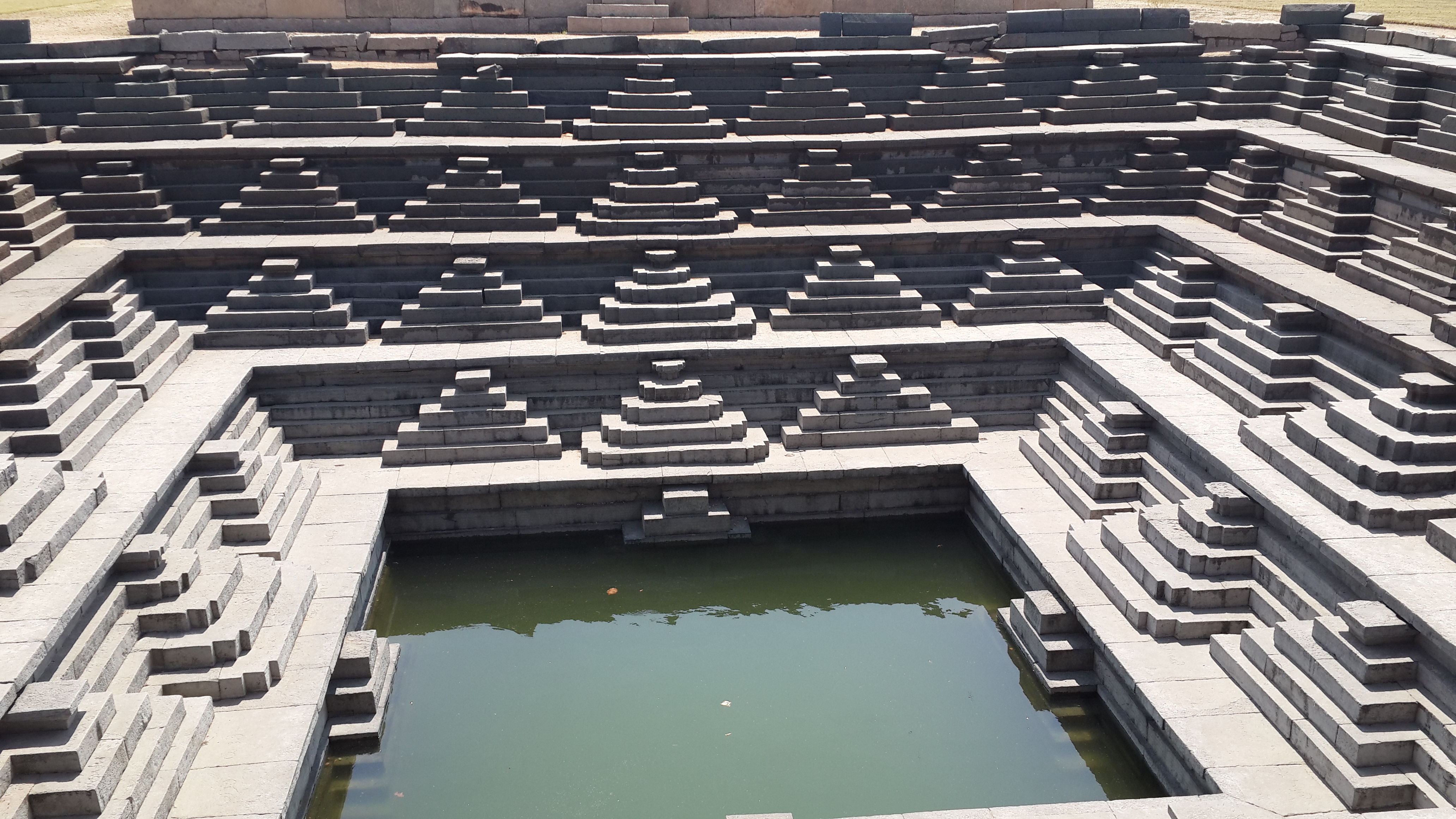
About the marketplace, he writes “Going forward, you have a broad and beautiful street, full of rows of fine houses and streets of the sort I have described, and it is to be understood that the houses belong to men rich enough to afford such. In this street live many merchants, and there you will find all sorts of rubies, and diamonds, and emeralds, and pearls, and seed-pearls, and cloths, and every other sort of thing there is on earth and that you may wish to buy. Then you have there every evening a fair where they sell many common horses and nags, and also many citrons, and limes, and oranges, and grapes, and every other kind of garden stuff, and wood; you have all in this street.”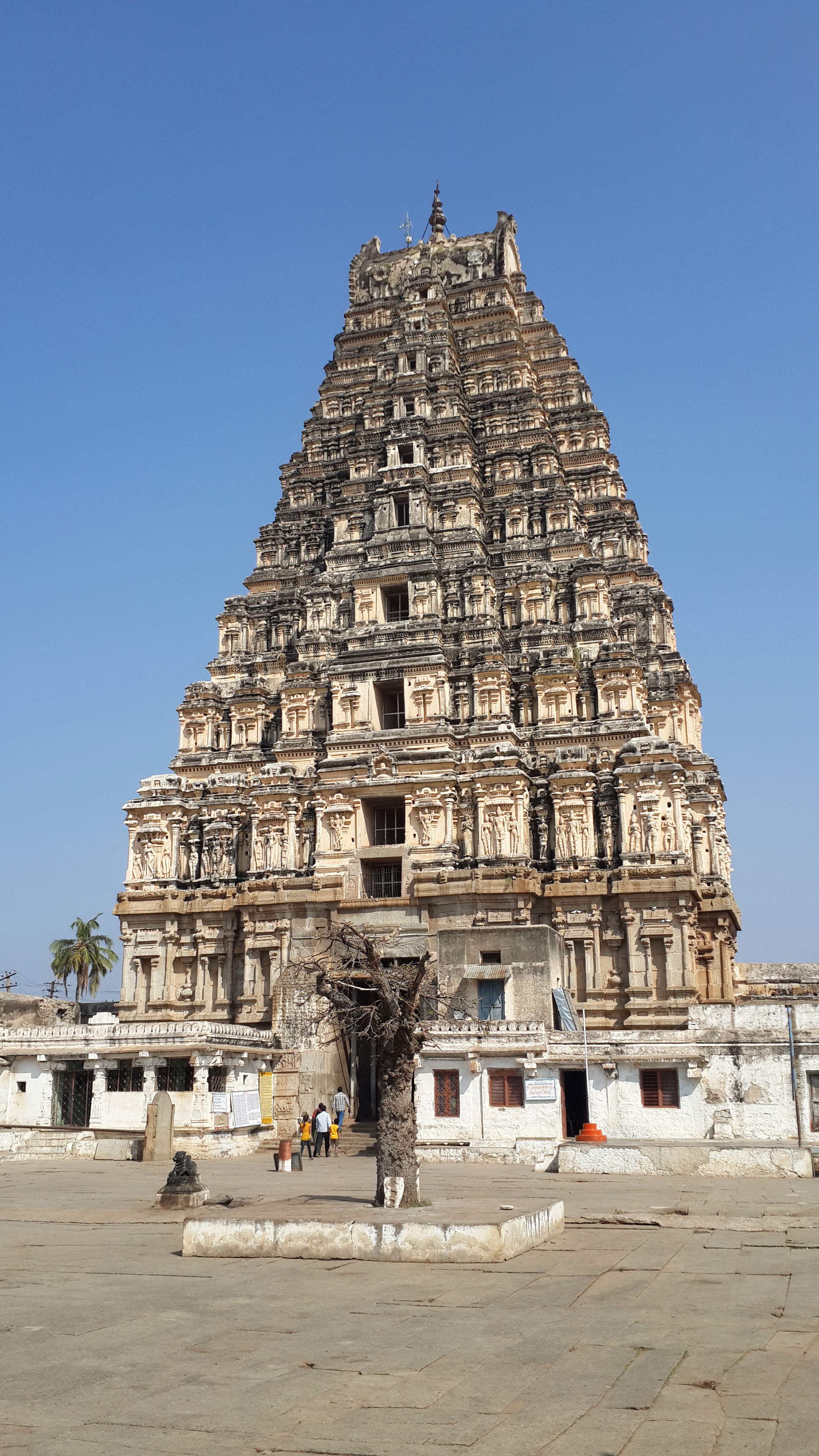
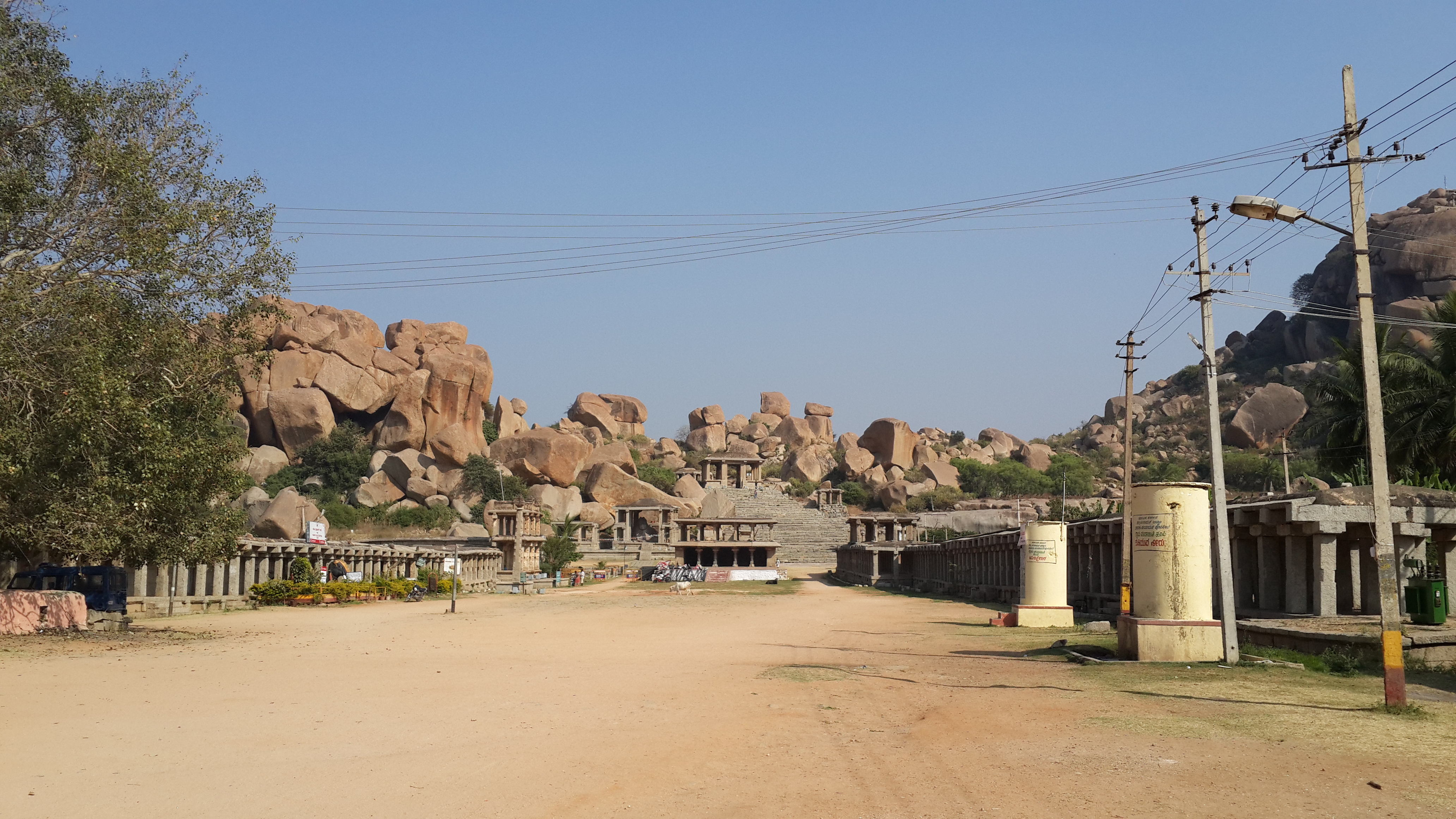 About the city “The size of this city I do not write here, because it cannot all be seen from any one spot, but I climbed a hill whence I could see a great part of it; I could not see it all because it lies between several ranges of hills. What I saw from thence seemed to me as large as Rome, and very beautiful to the sight; there are many groves of trees within it, in the gardens of the houses, and many conduits of water which flow into the midst of it, and in places there are lakes; and the king has close to his palace a palm-grove and other rich-bearing fruit-trees.”
“This is the best provided city in the world, and is stocked with provisions such as rice, wheat, grains, Indian-corn, and a certain amount of barley and beans, MOONG, pulses, horse-gram, and many other seeds which grow in this country which are the food of the people, and there is large store of these and very cheap; but wheat is not so common as the other grains, since no one eats it except the Moors.”
Hampi’s ruins are today a UNESCO World Heritage site and well worth a visit. It might be best to reserve 2 or 3 days for the visit, because of the extent of the site, the magic of the rocky landscape, and the many beautiful views along the river. There is also a sloth bear sanctuary nearby. Coracles and small boats are available for tourists who wish to cross the river to see the ruins on the far side.
Sravanabelagola: Stairway to Heaven
Ask any mountain climber why they climb mountains and there is often a touch of the mystic in their replies. Although their replies might be couched in intellectual terms, or even though they might write whole books to explain why, the reason can often be condensed into a short sentence; to be closer to God; to feel an overwhelming sense of peace; to transcend the self for a brief moment,or; it’s simply out of this world.
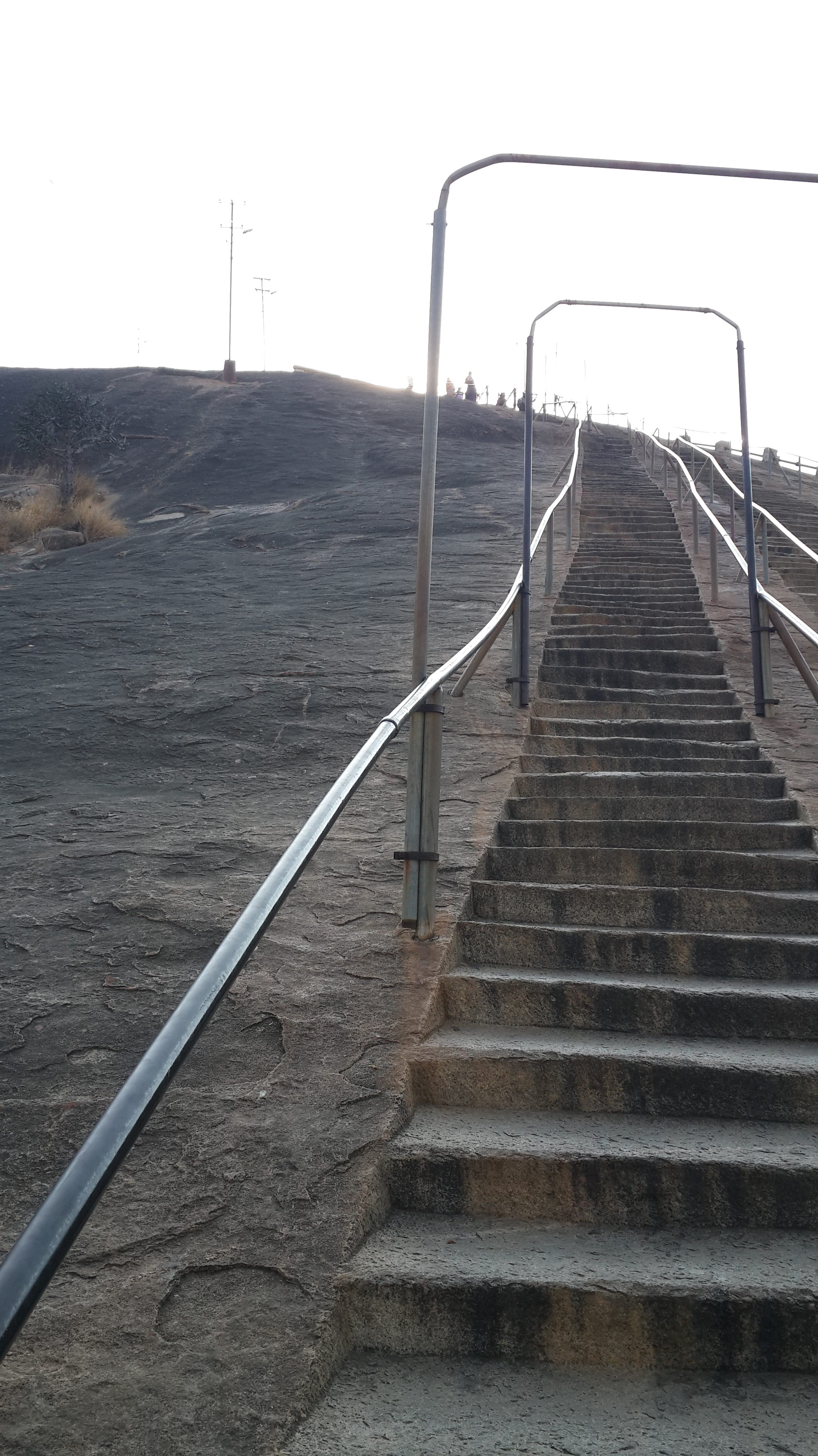 The impulse is an ancient one. Emperor Chandragupta Maurya is said to have meditated here after abdicating the throne in 298 BC. Sravanabelagola, the white pond of the Sravana (the colossal monolithic statue on the hilltop), is a site that exudes an undoubted sense of peace and sanctity, some of it induced no doubt by the need to rest after the strenuous climb to the top.
 Various inscriptions have been found at this site and are dated from 600 to 1800. The statue itself was erected around 981 AD. Some of these inscriptions attest to the rise and power of a succession of regional empires, including that of the Vijayanagar kings who ruled in nearby Hampi from around the 1300s to mid-1500s. More about Hampi in the next post.
Dial 0 for Operator
Visited my old office yesterday and read excerpts from “The Ironwood Poacher” to a small gathering of friends and well-wishers in the Library. Later, wandering through the hallowed halls of this Habsburg castle, I found an impressive red phone sitting on the desk of a former colleague. I wonder who waits at the other end of the line to receive her calls? Was this phone once used by Kruschev to call Kennedy?
 I hope to find an answer to this mystery one day. I will be sure to share it with you once I do.
Green China
Positive news about renewables is not often published in the popular news media, which gets more mileage from disasters and doom, hence the posting below, copied from Dave Elliott’s blog on Environmental Research Web. Here is a link to the entire article, excerpt below.
http://blog.environmentalresearchweb.org/2014/01/11/green-energy-in-china-2/
China will sharply boost renewable energy, the National Development and Reform Commission said in a 2013 report. It plans to increase hydropower generating capacity by 21 GW, wind by 18 GW and solar energy by 10GW. These figures are all higher than the annual average increase over the past five years of 20GW , 11.6 GW and 1.4 GW respectively, according to official data. See: http://www.globalpost.com/dispatch/news/afp/130305/china-boost-renewable-energy-2013 andwww.spiegel.de/international/business/chinese-leadership-announces-new-focus-on-green-energy-a-917389.html
At the end of 2012, hydro reached 249 GW, a 7.2% rise on 2011, on-grid wind 61.4 GW, a 33% rise, on-grid solar 3.4 GW, up 61%. Nuclear stayed at 12.6 GW. Non-fossil capacity including nukes was 29% of the total, 4.2% up on 2005, and it supplied 21.4% of grid electricity.http://en.ndrc.gov.cn/newsrelease/P020131108611533042884.pdf
Although there are major grid challenges and other bottlenecks, according to China’s 12th Five-Year Renewable Energy Development Plan 2011-15, China’s installed wind capacity connected to the grid is on track to reach 100 GW by 2015, including installed offshore wind power capacity of 5 GW, while annual electricity generation is projected to exceed 190 TWh. By 2020, the country’s combined installed grid-connected wind power capacity is expected to reach 200 GW, including installed offshore wind power capacity of 30 GW, while annual electricity generation is forecasted to surpass 390 TWh.
What a Nice Idea! Public Bookcases
Seen today in Vienna’s 9th district. Glass-fronted concrete bookcases that are protected from the weather but open for any passerby to use.
 Another place to hand in books that have been read but one no longer wishes to keep is the Library of the thermal baths in Oberlaa. But no junk please.
 The sign on the second photograph says: take or deposit books here; no registration, no cost. Unfortunately I can’t read the small print on the pillar, but it seems to be a private initiative of one or two individuals. More details at the following website (text in German)
Stories to Go: Flash Fiction
Flash fiction is, like speed chess, something I’ve never been really interested in trying although I’ve come across several good ones among the blogs I read. I recently submitted a short story to an online competition and on the organisers’ website found an additional category for flash fiction, with a length limit of 250 words. Here’s a first attempt.
The Sad Demise of George Gorgonzola
He awoke with a start and quickly shrugged into a dressing gown. Knotting the belt tight, he padded to the living room. Someone was picking his front door lock. It was a Snead and Baker burglar-proof model, so he knew he had three minutes to get away. He slipped on a pair of loafers, grabbed a shoulder bag kept packed and ready beside the bed and retreated to the back door of his third floor flat.
He stood on the narrow fire escape landing and locked the door, another minute gained, and scurried down the metal ladder as fast as his stubby legs would take him. He ran down the street, keeping to the shadows. He ran a long time, heading for the garconniere registered under his mother’s maiden name. They would never find him there. He shook off two staggering drunks, entered a nondescript building, and ran swiftly up three flights of stairs. He stopped at the door in dismay. The lock was broken. No safety here! He scurried down the stairs again and ran into the night.
The picture appeared on the front page of the tabloids next morning. George Gorgonzola, a thief and extortionist with a long criminal record, was found dead in a London alleyway early today. His green and white striped silk dressing gown was torn and bloody. He had been shot twice in the head at close range. Mr. Gorgonzola was a well-known underworld figure and went by the nickname of Wee Willie Winkie.
Sacher Cake in Vienna, etc.
Justification, or Apology
There is Verse and Worse, the cliche goes
Don’t say, please bring back your prose.
This is a New Year gift and,
I hope, no cause for rift
Between me and you
Sacher Cake in Vienna
Untasted I always equated Sacher Torte
With chocolate surfeit, and Nirvanesque
Whipped-cream-topped coffee of heaven
Strong, and water glass brimful cold
Served by patient unattached waiters in
Parody of Paradise Lost they also serve
And wait.
To the attic of memory banished old
Desires fade till we nuzzle kakao
The frictional delights of our skins
Burnt to Mocca rapture the smoky taste
Mocking really of any other torte but
After the meal I wake to its loss
And wait.
Meanwhile the angry traffic snarls
The streets outside and pays homage
Base to that celestial hole ozonic
(heavenliest orifice known to man except
In the stratosphere of my dreams)
Fuming waiting for the lights to change
And wait.
This then is my ode to joy of life
The myriad facets of it all revealed
In wondrous encounters with the minds
Or spinning bodies in a path ordained
Ignoring what the popular censure shuns
There is but one right choice to make
And wait.
Revolutionary Progress
Some blood was spilt in the wadi
The night the warlord fled.
He left behind joyous slaves, a hundred asses,
Sixty-six horses, forty goats, numerous sheep,
Palaces and princely dwellings,
Liberated concubines,
A jewelled sword, and one grieving wife.
The usurper freed the slaves, watered the asses,
Rode the horses and the concubines,
Princely feasted in the palace,
Presenting the grieving wife the jewelled sword
With which to prove her undying love.
Humpty-Dumpty Paraphrased
On high wall fragile perched
Breeched, well-shod rotundity.
Smooth-surfaced, bland, white, and searched
The heedless throng for serendipity
Scurrying by, egg-blind and unaware of terminal
Sentiment that raged above their heads.
Gravity caught hold of gravitas
And splattered golden yolk
Among the common folk
An unfulfilled embryo
Dreams of chickenhood dashed
On unforgiving flagstones crashed.
He was a right good egg the princess thought
And she the king besought:
Father, use your divine right
To raise the fallen from their plight,
And restore to me this faithful vassal
So he may abide forever in my castle.
At this the king his men despatched
With steed, buckle and armour all attached
They toiled for hours and hours in vain
To make the noble egg whole again
Failing, they fetched a monk, a Benedictine,
A devout man, a Florentine.
The monk determined the egg was truly dead
And made a dish of it, immortal, instead.
Latest Posts
-

December 2021 Newsletter
Originally posted on The Forest Way: A photo essay Most wonderful wishes and best regards to all, for the start of a fresh, healthy, environmental…
-

A Tree Planting Update
I begin this post with an apology. I have posted only sporadically this past year, and the reason is not Covid as one might think.…
-
The Standoff explained: Modi government vs. Indian Small Farmers
The is basically a battle for the future of Indian agriculture. It is also a battle of two opposing philosophies: Small is Beautiful vs. Big…
-

The True Source of Wealth
Many years ago an economist friend told me to invest in stock index funds rather than property. He pointed out charts comparing property prices and…
 aviott