Home » Posts tagged 'energy futures' (Page 2)
Tag Archives: energy futures
Advice to a Billionaire
Michael Liebreich of Bloomberg New Energy Finance calls you one of three Black Swans in the world of energy and transportation this century; the other two being Fracking and Fukushima. You are often compared to Henry Ford, Thomas Edison, Nikola Tesla, the Iron Man, and shades of Einstein. You have advised Presidents. Heads of state visit your factories to see how they could improve the lives of their citizens. You stepped in without fanfare to donate money and provide power to a hospital in Puerto Rico after the devastation of Hurricane Maria. You issue audacious challenges to yourself and to others and sometimes miss deadlines, but ultimately deliver on your promises. Thousands, perhaps millions of people, speculate against you in the stock markets, hoping to make a quick profit from your failure. So far, they’ve been disappointed. But you put your money where your mouth is, so for every one of these speculative sharks, there are a thousand eager customers for your products and millions of well-wishers who hope you can help save the planet.
And yet you feel alone and unloved. You search for a soul mate and are willing to fly to the ends of the earth to find true love. You must know that love is like a butterfly. Be still and perhaps it will land on you. There are no guarantees, but the chances are infinitely greater if you cultivate stillness. And while you wait, exchange your loneliness for the wealth of solitude. As Hannah Arendt and Plato observed: Thinking, existentially speaking, is a solitary but not a lonely business.
As the father of five children, know also that their childhood is a precious and finite resource that you could use to your benefit and theirs. Childhood ends all too soon, so help them in whatever way you can to make good choices. You seem to have done so for yourself. In the meantime, millions of people around the world wish you well, as I do.
Carbon Countdown Clock

Image:courtesy usgs
Ah, Trump. Has pulled the world’s second largest greenhouse gas emitter out of the Paris Accord. Was promised. Was to be expected. The one campaign promise that this prevaricating president did keep. The Guardian newspaper has usefully provided an online carbon countdown clock to show the world how time is running out. I believe Trump’s action might provoke the rest of the world to come together to save our common future.
https://interactive.guim.co.uk/embed/aus/2017/carbon-embed
Click on the link above to see how much time we have left.
Fossil Fuels are for Dinosaurs II
Wake up, Donald et al.! According to the Guardian of 6 January 2017,
China now owned:
- Five of the world’s six largest solar-module manufacturing firms
- The largest wind-turbine manufacturer
- The world’s largest lithium ion manufacturer
- The world’s largest electricity utility
“At the moment China is leaving everyone behind and has a real first-mover and scale advantage, which will be exacerbated if countries such as the US, UK and Australia continue to apply the brakes to clean energy,” he said.
“The US is already slipping well behind China in the race to secure a larger share of the booming clean energy market. With the incoming administration talking up coal and gas, prospective domestic policy changes don’t bode well,” Buckley said.
For more by this author, see his Amazon page here, or links to his 4 books on the Google Play store.
The Decline of the Rest.
 Oswald Spengler published the first volume of his two-volume life’s work, The Decline of the West, in 1918. Seventy-four years later, speaking at the Earth Summit, Rio de Janeiro in 1992, 41st US President George HW Bush, a decent man, declared, “The American way of life is not up for negotiation. Period.” This pre-emptive declaration by the leader of the world’s most powerful nation essentially castrated the noble intentions of the summit, to limit humankind’s exploitation of the earth’s resources to sustainable levels. The result of the Rio summit was Agenda 21, a non-binding, voluntarily implemented action plan for the 21st century. This was the paltry outcome of a nine-day meeting representing 172 countries attended by 116 heads of state, 2400 NGOs and 17,000 other representatives of indigenous peoples and ordinary ‘you and me’ types.
Twenty-one years after the US President’s declaration in Rio, the WWF designated the 20th of August 2013 as “Earth Overshoot Day;” the day that humanity has used as much renewable natural resources as the planet can regenerate in one year. In 2016, Earth Overshoot Day is estimated to have fallen on August 8th, after which date we’re drawing down the planet’s renewable resources for the rest of the year. Pity the poor planet! The American way of life is still not up for negotiation, and the rest of the world is rushing to catch up. If ever populous countries like China and India get there, the planet will be sucked dry and we’ll all have to follow Elon Musk to Mars! So are we condemned to a two-track planet where some countries (or some sections of society within countries) corner material resources and the rest go a-begging? This is the scenario being projected by right wing demagogues worldwide and this is the reason for their recent successes at the ballot box.
Economists and philosophers have tried to redefine human well-being to reflect planetary limits, most notably in recent years by Tim Jackson’s book Prosperity without Growth, which acknowledges that the current definition of economic success is fundamentally flawed. Prosperous societies today increasingly recognize that increased material wealth does not increase well-being. However, most people the world over, regardless of their economic condition, still aspire to some version of the American way of life. This aspiration is reflected in the respect automatically accorded to wealthy people in the world today. A look at the Who’s Who of practically any country includes the names of its wealthiest citizens, together with lists of eminent physicians, lawyers, sportspeople and so on.
Gandhi pithily articulated this state of affairs decades ago when he said: The world has enough for every man’s need but not for every man’s greed. For each according to her needs would be the ideal but, as always, messy reality intervenes. One man’s need is another man’s greed. So it is that millions of well-meaning, virtuous, affluent people the world over would never dream of giving up hard-won creature comforts for the sake of other planetary denizens who are less well off. The spiral of technology has historically been to continuously improve human life, and to continuously create problems at the same time. These problems in turn needed infusions of new technology to solve its problems. So right now, the choices seem to be to outer-planetary colonization, or to invest in defences (gated communities, wealthy enclaves, security guards, border walls) to hold on to material gains. Technology offers a third alternative. The idea of a sharing economy has recently gained a lot of traction. Who needs ownership when mobility and services are seamlessly available? Indeed, ownership becomes a bit of a burden in comparison to the convenience of superb services available on demand with little or no delay.

A gated community safely behind bars
Even if all this is achieved, humankind’s basic inner restlessness will ensure that we keep wanting more and better, with one eye on the people next door. Global contentment is a moving target. Enter mystic and philosopher Sadhguru and his lectures on inner engineering. His most memorable anecdote in the video (begins at minute 16) is a reminder that all is not lost in the midst of this doom and gloom if we can take the time to laugh at ourselves and the posturings that have brought us to this point.

Sadhguru, irreverent mystic
For more writing by this blogger, see his Amazon page here, or the Google Play Store
The Flood – after the vote on Brexit
The story below was written in 2010, long before the idea of Britain or Greece opting out of the EU was anywhere on the political horizon. The European Union is an unprecedented, brave and bold experiment by thirty-odd countries venturing into uncharted territory. Many economists have predicted that the experiment is doomed, and there is no shortage of possible reasons for failure.
Critics fail to recognise that any bold experiment can fail. For example, the dollar was chosen to become the monetary unit of the United States in 1785, nine years after the declaration of independence. The coinage act helped put together an organised monetary system in 1792. The Federal Reserve Act was passed only in 1913, organising a national banking system and a central bank, nearly one hundred and thirty years after the dollar was chosen as its currency. And this delay occurred in a vast country only slightly smaller than the area of the European experiment. Friends of mine have fiercely criticised the above comparison between the EU and the US. Of course they’re right. Unlike the EU, the US was a single political entity with a common government, it had a common language and a single currency. Nevertheless, the analogy is valid, despite limitations. Some of the problems faced by the federal union of US states in the past two centuries is similar to the divisive forces that plague the EU today.
Small wonder that populations in EU countries have misgivings about the wisdom of their leaders’ attempts to stabilise the common currency and dispute the need to support the economically weakest members of the union. The Flood is a parable on the need for myths to weld communities together. In the case of Europe, the common roots doubtless lie in ancient Greece and Rome, ironically two of the most economically troubled states in the current union.
The Flood

Image: courtesy YouTube
“Every culture that we know of has one,” said the professor in conclusion, as the electrically operated curtains in the auditorium silently parted and the audience blinked at the flood of grey, fogbound afternoon light. Professor Paravant fumbled for a moment with the switches that remotely controlled the power point projector and then looked up in preparation for questions. He stole a quick glance at his watch. Two thirty-eight! He’d been at it for fifty-seven minutes precisely, which was seven minutes longer than intended. Where had he lost those seven minutes? Two certainly, while waiting for the technician to correct a problem with the projection. But he had continued his talk while waiting for the glitch to be fixed and then had briefly run over the same ground when the slides appeared.
And the other five? He had digressed a bit over the possible alternative interpretations to the new archaeological finds in the Sahel. Yes, yes. He had certainly got into deep water over there. That was stupid, he said very severely to himself (not the least because it was an arid zone! he added to himself). You should not inject conjecture into your talks, at least, not at this stage when it is not supported by a sizeable body of circumstantial evidence. As for certainty, forget it. There is no certainty in our profession. Some theories are in phase with popular belief and some are not. Archaeological truth could perhaps be defined as current conjecture backed by circumstantial evidence and hallowed by the concurrence of many. Professor Paravant himself was constantly and keenly aware of this limitation, therefore his talk was loaded with hedged statements. But did this come across to his listeners? Had they heard him out in rapt attention, or was it merely silent boredom? He was never sure.
Professor Paravant shot his cuff and looked at his watch again, this time openly. “Any questions?” he asked looking up. The nervous conference organiser interrupted with half-raised hand and an apologetic glance at the visiting professor.
“Dr. Paravant, please forgive.” He raised his quavery voice and climbed to the first step of the podium. “Ladies and gentlemen, before the questions, please, I have an announcement to make. There’s been a small change in program. We’ll have the coffee break before the next session. Secondly, Professor Paravant has to catch the four o’clock flight to Brussels where he is to testify before the European Commission. So please understand that he can answer only a few questions. Shall we say, until two forty-five, Professor?”
“Until three, if you like,” said Paravant generously. “My luggage is already packed and waiting. If you could be so kind as to ensure that a taxi is available…”
“But of course, Professor. The faculty car will take you to the airport when you are ready to leave.”
“Very well, then.” He raised his head, stood with toes out, jacket pushed back and thumbs tucked into the waistband of his trousers.
“Questions? Questions?” he asked the still-blinking audience.
There was silence as the group of forty-odd academics looked at each other, wondering who was going to be the first to ask. This was a multi-disciplinary group, and although each of the attendees was a specialist in his (or her: there were six women present) own field, Paravant was the only archaeologist present.
“Professor Paravant,” this was one of the six women and she flushed as the entire auditorium turned to face the last row where she sat. “Professor Paravant, I have a question that’s unrelated to your talk today. When are you going to tell us about your finds in Northern Thailand and Cambodia?”
“Dear lady, I will talk about them when I have something to say. Right now we have no idea what we’re turning up at the site. We can only say that the artefacts are of enormous significance, all man-made, fashioned between five thousand five hundred and seven thousand years before our time.”
The organiser raised his hand for attention once again. “I must request you, ladies and gentlemen. Professor Paravant’s time here is very short. Please restrict your questions to today’s talk. Otherwise I know the professor will never catch the four o’clock plane, not even tomorrow’s four o’clock plane.” There was a murmur of polite laughter to greet this humorous sally, a murmur which almost drowned the protest: I only asked because no one else was saying anything, from the woman in the back row.
Paravant’s sharp ears picked up her protest, however, and he rapidly scanned the list of registered attendees that lay beside his notes on the lectern before him. “Dr. Clark,” he called to the woman in the back row. “You are Dr. Clark aren’t you? From… East African Uhuru University? I have your email address here on my list and I’ve made a note to send you a summary of findings till date as soon as I return to Thailand. Is that all right?”
“Oh, thank you. Very kind of you, Professor,” Dr. Clark flushed and beamed from the back row, completely won over by this unexpected kindness.
“Professor, I’d like to question your concluding remark. You said every culture that we know of has one. Now, I’m an anthropologist and specialise in theories of life in different cultures, the interface between myth and reality in various societies, do you see?’
“Yes, indeed,” said Professor Paravant, who did not.
“Now what I want to ask you is: how can you say that every culture has one? Did, for example, the tenth century kingdom of Mali have one? Did the late eighteenth century empire of Shaka in present day South Africa have one? Did the ancient Greeks have one?”
“Well,” said Paravant, rolling up his mental sleeves. He liked questions like these, ones he could get his teeth into and deal with specifics. “First, let me address the three concrete examples you have chosen. Briefly, the answers are: yes to the first and third, no to the second. But these one word answers need qualifications which I will provide before going on to answer the first part of your question, namely, how I can say that every culture has one?
“First, the kingdom of Mali. It was a flourishing empire from the early part of the ninth century onwards and lasted for more than two centuries until a combination of circumstances, chiefly world climatic and trade shifts, moved the focus of civilization on the continent southeastwards. They had a rich oral tradition, most of which is naturally lost, but some writings on clay tablets persist, which are conjectured to be a thousandth or even a millionth part of the original rich whole. Deducing from these, we find traces of the legend, minute indications of a great deluge, a cataclysmic event that occurred long before the kingdom of Mali was founded. This is your first example.
“For our second example you again chose Africa, the empire of Shaka. Now Shaka was a great general, one of the world’s great quintet, together with Alexander the Macedonian, Julius Caesar, Hannibal and Napoleon. He created an empire that was a fusion of many tribes, many language groups, many cultures. There was no cultural unity among the Zulu tribes for many decades after Shaka welded them together into a political whole. The oral traditions of the various tribes were completely lost, therefore it is impossible to state that the flood myth existed among the Zulu. But the converse is equally true. It is, by the same measure, impossible to prove that it did not exist among them. I personally believe it did, although I have no proof.
“Now your third example is straightforward. The answer is a simple, unqualified yes. We have hundreds of texts to fall back upon, a rich gleaning of writings from other sources as well, Persian, Latin and Arabic among others. Let me give you a concrete illustration. You all might know or have heard of Philemon and Baucis, Ovid’s charming story of an old couple who showed hospitality to the gods. This story is a variation of the flood myth…” Professor Paravant was firmly settled upon his theme and would have missed his plane had not his host, the conference organizer, interrupted at three o’clock.
“Excuse me, Professor. But I really think you must go.”
“Oh!” Paravant looked around him, then at his watch and gasped.
“My goodness. It’s nearly three. I must run. I will write to you,” he glanced up at the anthropologist. “You’re…?”
“I’m Thompson from Sussex.”
“Yes, Dr. Thompson.” Paravant made a mark on his conference list and fled from the room, leaving the participants sighing with relief and hurrying towards toilets and coffee.
More than two hours later, wedged between an overstuffed matron and a pimply youth on the plane to Brussels Professor Paravant found time to think about the conference he had just attended. He reached for the briefcase at his feet and pulled out a copy of the paper he had presented.
The Flood Myth: an analysis of its existence in cultures around the world. A myth is a traditional story originating in a preliterate society, the paper began. After defining myth and its principal characteristic (it continues to influence the thought and behaviour of people living in the present time), it went into scholarly detail about the finds of various expeditions and researchers through the centuries, principally in the nineteenth and the twentieth. He skimmed over the listing of the flood myth in various continents, knowing them all by heart; the Sumerian, Babylonian, Chaldean, Biblical, Roman, Greek, Persian, Chinese, Finno-Ugric, American Indian and Tamil.
Professor Paravant’s meditation upon myths was interrupted by the arrival of two flight attendants, the first with refreshing hot towels (which he welcomed) and the second with drinks and plastic-wrapped sandwiches, the usual airline fare (which he hated because, although not hungry, he ate and drank it all). However, he could meditate further while he chewed, and he did, until the plump woman on his right stood up to go to the toilet before the drinks had been cleared. Paravant stood in the aisle gingerly balancing both paper cups of hot liquid in his hands while she squirmed in emulation of a camel’s progress through the needle’s eye between seats. He was thus powerless to fend off the pimply youth’s attempts at conversation. The flight attendants were still busy serving food and brushed by with indignant glances. The indignant glances were slightly more welcome than the pimply youth’s topic of conversation. He had been to a football match between two rival national teams and tried to convey the violent emotion of the encounter to his captive audience. The Professor would have been much happier if he had kept his mouth shut and offered to hold the hot cup of tea.
The woman finally returned looking greatly relieved and plumped into her seat without so much as a word of thanks for the cup holding. Her ingratitude put Paravant in such a foul mood that he was unable to think constructively on the flood myth and this inability further worsened his mood. It was past ten by the time he collected his luggage, found a taxi and finally checked into his hotel, so he went straight to sleep without attempting to find a meal or prepare notes for the following day.
He was up late the next day and the shepherd from the European Commission arrived early, so after a very hurried breakfast Paravant was ensconced in the back seat of the chauffeur-driven limousine by eight. The shepherd was middle-aged. In place of a crook, he carried a bulging brief-case under his arm. Paravant’s entire week had been very rushed, so he’d not yet had time to read the briefs that they had sent him. However, he was also an eminent scholar quite accustomed to being asked profound questions on subjects he hadn’t prepared for, so he faced the forthcoming interview with equanimity.
Not so the shepherd who kept pulling official documents out of the brief case and hurriedly scanning them to refresh his memory. At one point in their journey across the city, he caught Professor Paravant’s eye and smiled.
“What do you think, Professor? What are you going to tell them?”
“About what?” The shepherd raised his eyebrows, marvelling at the professor’s acumen.
“Oh, nothing. I shouldn’t have intruded on your thoughts.”
“Now, really, do tell me. What am I going to tell who about what?”
“They told you, didn’t they?” asked the shepherd tentatively. Paravent generously gave him the right.
“Yes, they did. What am I going to tell who about what?”
“The cultural commission. What are you going to tell them about their question?”
”Which question?”
“Your prognosis on the cultural fallout to be expected after the European Union becomes a single political entity in 2020. What kind of national traumas can be expected? What are the possible consequences for the collective psyches of the various european nations? Which national clichés are most likely to survive, and which national traits can one expect to be aggravated after the merger, and so on?”
“Ah, was that the question?” asked Paravant, with a sigh of relief.
He stole a quick glance at his watch. With luck and a traffic jam, he might have thirty or forty-five minutes to prepare.
“That’s the only question I know of. If there was anything classified I wouldn’t know,” said the shepherd humbly. “I’m not eligible to know anything classified. Not yet, not for a year or two.”
“Of course not,” said Paravant, hoping to silence the shepherd by his lofty and detached manner. The ploy worked and for the next half hour, Paravant’s mind ground busily while he thought of what he could say about the cultural future to be expected for Western Europe in the years after complete economic and political fusion took place in 2020.
The building he was driven to was not the headquarters building, but one of the many subsidiary offices of the various commissioners which are scattered throughout the city of Brussels. The limousine pulled up at the nondescript entrance of a tall building and the shepherd alighted first.
“This way, if you please, Professor.”
The limousine slid away and Paravant followed his guide into the foyer of what looked like a large and busy hotel. The shepherd walked confidently to the bank of elevators and pressed a button marked AUTHORIZED PERSONNEL ONLY. Once inside they rode to the thirtieth floor and walked along a windowless, indirectly lit, crimson carpeted corridor to a door labelled CONFERENCE ROOM. He led the way into an outer office with three smartly dressed young women in almost identical white blouses and dark skirts, indicating the professor with a flourish.
“Professor Paravant,” he announced, “to testify before the joint cultural commission.”
“Ah yes,” said the petite brunette with the red-rimmed slash of a smile. “But you are early, Maurice. The commission meets only at nine-thirty.”
Maurice reddened. “The commission meets at eight forty-five!”
“Ah, you have forgotten. This week we have a new chairman. He is British, and wishes to begin at nine-thirty after his cup of tea.” Maurice crumbled and began to stammer apologies.
“No problem at all, Maurice,” Paravant beamed jovially at the EU underling. “If you could only arrange for me to have a desk in a quiet corner with a cup of coffee, I can use the time to go over my notes.” Maurice marvelled at the Professor’s grace and charm as he hastened to comply.
The commission sat at ten. They were a working group of cultural commissioners from twelve of the thirty one EU states (or was it thirty two this week?), and they treated Professor Paravant with great respect. The British commissioner was an erudite giant named Bartlett, an Oxbridge intellectual, who swallowed sentence endings to the point of unintelligibility.
“Right then, let’s get started, shall we?” he slurred. “Perhaps we can begin straightaway with questions to Professor, er…” he looked down at his notes, “Professor Paravant.”
“I would like,” said the German slowly, “to first hear Professor Paravant’s own synopsis before we go on to questions.”
“What do you say Professor?” asked Bartlett.
“I have no objection,” said Paravant pleasantly. “Perhaps one of you would care to put the question again so that I know exactly what you wish to know.”
“Didn’t you read the briefs we sent you?” asked Bartlett bluntly.
“Of course,” said Paravant, who had left them in the hotel room in the morning’s rush. “But we are going to dwell in the realm of conjecture for the next few hours, drawing on my knowledge of the past to make prognoses about the future. So it would help me to have a clear idea of your own perceptions of the dimensions of the problem.”
“Yes, yes. I see that,” said Bartlett. “And since I’m the chairman, I’m the one who should do it, I suppose… unless someone else here wants to.” There was deep silence. Paravant broke it cheerfully.
“It needn’t be too long, Mr. Chairman. Just a sentence or two will suffice.”
“The EU is going to eliminate all national barriers beginning in 2020, introducing a common passport, a single parliament, and so on. We already have the Euro which has, as of this week, been adopted by all thirty-one member countries.
“You know all this. The newspapers are full of it, with horror stories of the possible repercussions. Well the problem is this in a nutshell. How is some unemployed lad from Liverpool going to feel if the Merseyside is invaded by a bunch of Spanish speaking dandies in tight trousers? Cultural shock with bells on! We need to know how this boy’s going to react.”
“This is only a hypothetical question, Professor, not a likely probability. We’ll let it stand for the moment.” This was Jose Carreras, the Spanish commissioner, a tall man with a suffering El Greco face.
“Sorry, Carreras,” grinned Bartlett, who obviously wasn’t. “Didn’t mean to cast ethnic slurs. Let bygones be bygones. This is 2015 after all, and it’s time we forgot about the defeat of your armada four centuries ago.”
“Our armada was defeated by the winds off Falmouth, not by the British,’ said Carreras stiffly. “Your own historians write that when the storm arose that blew us off the map, the great Sir Francis Drake had only one round of ammunition left.”
“Gentlemen, I think I am ready to begin my scenario synopsis of the expected situation,” Paravant interrupted, now quite certain of what he was going to say. “There is a lot to be said in favour of preserving national identities even after the merger. Indeed, we can and must do everything in our power to encourage this. Going by past experience, once the process of integration is started, everything can be expected to proceed remarkably quickly. Integration will take place without a hitch, provided we allow for a period of cultural overflow and overlap. By this I mean a period of preparation to cope with different value systems and even workaday habits.” Through the corner of his eye he saw Bartlett and El Greco smile mockingly at one another.
“City dwellers in the EU countries are already truly cosmopolitan. The libraries of the great cities of Europe have for centuries garnered much of the wisdom of the world. Her museums are filled with treasures of art and culture from every corner of our planet. This immense cultural wealth has been cemented by the incredible fusion of art, music, film, entertainment and intellectual advance fuelled by the internet.”
“What does this have to do with 2020?’ slurred Bartlett impatiently.
“Everything and nothing. One the one hand, the exhibits from the museums are lifeless artefacts, showcases pure and simple. On the other hand, many of the objects displayed are symbolic of the internationalisation of knowledge. The scholar, for instance always knew that every single bit of technology available in eighteenth century Europe had already existed in eleventh century China, that the Greeks enhanced and transmitted the knowledge of ancient Egypt and that the Arabs translated, added to and handed down the wisdom of the Greeks to Europe in the Middle Ages.”
Constantin Anantapoulos, Costas, was of medium height with softly rounded features and reddish brown nut-thatch hair.
“Professor Paravant, forgive me for interrupting. You’re being impractical. These things happened hundreds or thousands of years ago and cannot have the immediate impact we need on the populations of our respective countries.”
“Yes,” agreed the Spaniard. “The Beatles, Elvis, Jay-Z, they all cross national and cultural boundaries today. There are others…’ he groped for names and found none.
“The Rolling Stones, Rod Stewart, Elton John…,’ Bartlett smiled expansively as he came to El Greco’s aid. “They all happen to be British.”
“Thank you for the examples,” said El Greco. “Costas is right, Mr. Paravant. We need examples from today, from our recent past and not from bygone ages.”
“There is a real danger in that approach, which I will point out to you presently. Apart from the fact that it is short-sighted and wrong. But if you restrict unifying examples to recent decades in the present century, then you are denying yourselves the chance to use the integrative powers of sublime music, to give just one example. Think of Bach, Beethoven, Mozart, Tchaikovsky, Smetana…”
“Wrong side of the fence, Paravant,” interrupted Bartlett briskly, wagging a school-masterish forefinger. “Tchaikovsky is a no-no. Beyond EU borders.’
“There you make the same mistake,’ protested Paravant with some heat. “It is just as dangerous to draw a dividing line in space as it is in time. The two questions I then put to you gentlemen are: how recent is recent, and where do we set the geographic boundaries?”
“Let’s say, within the physical confines of the European Union as we know it today and… the last two decades.” The Dutch commissioner Maartens spoke for the first time and looked around for approval. He was greeted by nods of agreement.
“All right, let’s start with physical boundaries.” Paravant adopted his most persuasive voice. “Where do we draw the line? If Tchaikovsky is out as an integrative factor because his birthplace is in Russia, then so are several Western cultural heroes. Pianist Vladimir Ashkenazy, Nobel Prize winning poet Joseph Brodsky, Mohammed Ali, who was the most popular public figure on the planet during his lifetime. The contemporary list is endless. Need I elaborate?’
“But we have to draw a line somewhere,” insisted Bartlett, speaking clearly for the first time that day. The sudden clarity startled the other eleven commissioners into agreement.
“Yes,” said Carreras. “We have to have these geographic boundaries. But what about time?’
“Equally impossible to find a sensible or logical cut-off point,” said Paravant stubbornly, although he knew the tide of opinion was turning against him. “If we can go back a half century to the Beatles, what is to stop us moving another quarter century back to Hitler’s time? Two decades before that lies the destruction of the first world war. And in the two centuries before that there were seven major wars between France and Britain alone.” There was silence round the table.
“The myths of bygone ages live on in us,” said Paravant softly, with a smile. “We need new myths for a brave new tomorrow, but myths are an oral tradition and take time to create. Yes, it takes time to create them even today, in the age of instant diffusion of knowledge through electronic means. For this reason, we will always need the old myths. If we want a unifying factor, gentlemen, we will have to go back through the ages, all the way back through the common history of mankind to the flood.”
The above story was published as part of The Ironwood Poacher and Other Stories in 2013. This parable seems more relevant than ever today. I sincerely hope Britain votes today to remain in the EU.
For more by this author see his Amazon page here.
Hinkley. Oh no!
The political decision to power ahead with Hinkley Point C nuclear power station is the energy equivalent of appointing a tone deaf musical director to the London Symphony Orchestra. How much more evidence do Cameron and Co. need? A short litany of anti-Hinckley arguments should suffice.
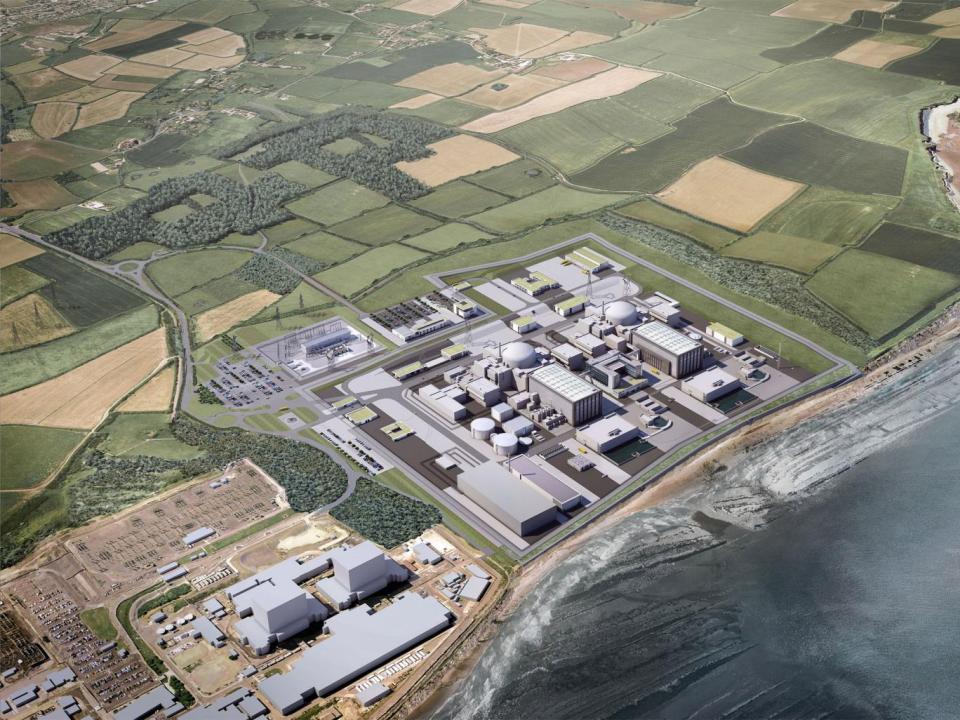
Hinkley 1
In a case of economics speaking truth to power, the OECD’s 2010 World Energy Outlook quietly increased the average lifetime of a nuclear power plant to 45-55 years, up 5 years from its 2008 edition.
It’s Raining Electrons in Small Spaces
Four recent reports on new breakthroughs in renewable energy generation and storage technology reinforce the promise that was once made for nuclear power: abundant energy for all, including the poorest in society, even though it may never be “too cheap to meter.”
High Performance Flow Batteries The promise of renewable energy technologies will be fully realized when battery storage becomes reliable enough and cheap enough to even out intermittent flows. Today the problem is partly solved by feeding energy from rooftop panels into the grid and then receiving compensation from the energy utility for the power supplied either in cash or in the form of reduced electricity bills. Looking at a typical electricity bill in Euroland (my own) I see the following charges. The unit price (per KWh) is between 6.5 and 7.3 Eurocents, but after grid charges, network costs and taxes are added, I pay 26 cents per KWh. Ironically, bulk consumers (factories, office blocks and large companies) pay lower rates, around 8 to 15 cents per KWh, depending on level of consumption. Now the whole picture is changed with the advent of low cost storage systems that make home batteries affordable and economical. Imagine home systems that can deliver electricity for all your needs at no cost for twenty to thirty years, once installed, barring the onetime cost of the system. Coming soon, to an affordable home near you.
Silicon cones inspired by the architecture of the human eye. The retina of the human eye contains photoreceptors in the form of rods and cones. Rods in the retina are the most sensitive to light, while cones enhance colour sensitivity. Modelling photovoltaic cells based on the makeup of the retina, researchers have been able to enhance the sensitivity of solar cells to different colours in the sunlight that falls on each cell and thereby increase electricity output by “milking the spectrum” closer to its theoretical maximum. Increasing efficiency of the average rooftop PV cells from the current 18-20 to 30% would make such systems cheaper by far than grid electricity mostly anywhere in the world, even in temperate countries. Coming soon, to a rooftop near you.
Modular biobattery plant that turns biowaste into energy. Biogas plants are old hat. They have undeniable benefits, turning plant, animal and human waste into energy (methane) while leaving behind a rich sludge that is excellent fertiliser. However, good designs are not common and they are sometimes cumbersome to feed and maintain. Now comes an efficient German design that promises to be modular and economically viable even at a small scale. In another development, the University of West England at Bristol has developed a toilet that turns human urine into electricity on the fly (pardon the pun) and the prototype is currently undergoing testing, appropriately enough, near the student union bar. Coming soon, to a poo-place or a pee-place near you.
New electrolyte for lithium ion batteries. Lithium ion batteries using various electrolytes have already become the workhorse of the current crop of electric cars and for medium-sized storage requirements. New electrolyte chemistry discovered at PNNL Labs shows that reductions of upto ten times in size, cost and density are feasible and various electrolyte/electrode combinations are being further tested for production feasibility. Coming soon, to a battery storage terminal near you.
So what should you do, as a concerned global citizen, until you can lay your hands on one of these devices (or all of them) for your own use? Tread lightly on the earth, don’t buy bottled water, reduce energy use, walk when you can instead of driving your car (your arteries will love you for it), buy local produce, eat less meat (your grateful arteries again), think twice before flying off to that conference (think teleconferencing), buy an electric car if you need a new one, and remember that every liter or gallon of petrol you fill into your old one not only fuels your car but potentially also the conflicts in the Middle East and/or lines the deep pockets of Big Oil which definitely does not want your energy independence.
The Flea on the Behind of an Elephant
Scroll backwards in time to the early 1970s. US President Richard Nixon appointed the Atomic Energy Commission (AEC) to produce a study of recommendations on “The Nation’s Energy Future” based on advice from the National Science Foundation (NSF). Requesting the AEC for energy prognoses is akin to asking a tiger for dietary recommendations; there will surely be no vegetables on the menu! Dr. Dixy Lee Ray, chair of the AEC, predicted in her summation of the report that “solar would always remain like the flea on the behind of an elephant.” In the early 1980s I knew another eminent researcher, Dr. Thomas Henry Lee, a Vice President for research under Jack Welch at General Electric, who often stated that nuclear power would produce “energy that is too cheap to meter,” essentially free.
The AEC study, when it was published, proposed a $10 billion budget for research and development with half going to nuclear and fusion, while the rest would be spent on coal and oil. A mere $36 million was to be allocated to photovoltaics (PV). Dr. Barry Commoner, an early initiator of the environmental movement, was intrigued that the NSF had recommended such a paltry amount for solar. In the 1950s he had successfully lobbied for citizen access to the classified results of atmospheric nuclear tests and was able to prove that such tests led to radioactive buildup in humans. This led to the introduction of the nuclear test ban treaty of 1963.
Dr. Commoner’s own slogan (the first law of ecology is that everything is related to everything else) prompted him to question the AEC’s paltry allocation for solar PV, especially since he knew some of the members of the NSF panel who advised on the recommendations. He discovered the NSF panel’s findings were printed in a report called “Subpanel IX: Solar and other energy sources.” This report was nowhere to be found among the AEC’s documents until a single faded photocopy was unexpectedly discovered in the reading room of the AEC’s own library. The NSF’s experts had foreseen in 1971 a great future for solar electricity, predicting PV would supply more than 7% of the US electrical generation capacity by the year 2000 and the expenditure for realising the solar option would be 16 times less than the nuclear choice.
Clearly, the prediction of 7% solar electric generation has not yet happened, but current efficiency improvements in photovoltaics and battery storage technologies point the way to an energy future far beyond what the NSF predicted in 1971. Fifty years from now, it is nuclear power that is likely to be the flea on the behind of a solar elephant.
Molybdomancy
I started off intending to write about the Austrian New Year’s Eve custom of Bleigiessen and learnt several things today. First, the posh name for the practice is molybdomancy: the art of divining the future from the shapes of molten metal that is quickly thrown into cold water. Second, this is not only an Austrian custom, but is widely practiced in Germany and in the Nordic countries as well. Apparently in Finland, the practice goes by the name of uudenvuodentina and is quite popular. According to this source, the practice originated in ancient Greece and later travelled to the Nordic and Central European countries where the custom is still followed today, although the results are interpreted more in a spirit of fun rather than being taken seriously. No wonder the word molybdomancy has been quite forgotten!
Originally made from tin, nowadays bleigiessen sets are sold in the streets in the week preceding New Year in small bags consisting of half a dozen pieces of tin or lead alloy mixed with cheaper metal. The pieces are molded into shapes associated with good luck; horseshoes, pigs, chimneysweeps, toadstools or 4-leaf clovers. I bought a bag for New Year’s Eve and settled down with six of my nearest and dearest to see what 2015 has in store for us.

What 2015 has in store for the family.
As you can see, the results are outstanding! 2015 is going to be a wonderful year for the family; two of them will perform exceptional deeds, while the rest will be merely brilliant. I wish all my readers a similarly uplifting prognosis.
Love Oil, Hate Oil
The story of oil begins more than 2,500 years ago. Reliable indicators show that in China people were drilling a mile deep with bamboo pipes to recover natural gas and liquid hydrocarbons that were used as a source of fuel for fires. This was before the start of the Han dynasty in 400 BC. See this fascinating slide presentation on the progress of drilling technology by Allen Castleman, a self-confessed oil redneck.
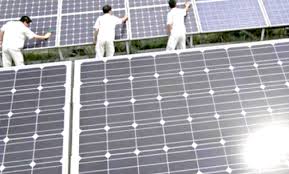
Image: courtesy ecowas.com
The modern oil age is popularly considered to have started in the 19th century with the use of internal combustion engines for everything from pumping water to transportation. A glorious age, but now it’s time to move on (pun intended) to other fuels. As Saudi oil minister Sheikh Zaki Yamani predicted more than three decades ago, “the Stone Age did not end for lack of stones, and the Oil Age will end long before the world runs out of oil;” a statement at once prescient, rueful and flippant. In today’s lugubrious world, they don’t make oil ministers like that any more.
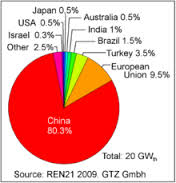
As a reminder that the world turns and turns and comes full circle in more ways than one, here’s a parting thought; an article from the Guardian of 30 January 2014. In 2013 alone, China installed more solar power than the entire installed capacity in the US, the country where the technology was invented. There is a caveat to the article that some of this newly installed capacity is not yet connected to the grid but, once installed, connections are only a matter of time.
 aviott