Home » Posts tagged 'tourism' (Page 2)
Tag Archives: tourism
Monsoon Wedding
The wedding was in Kerala, a state in India whose advertising blurb labels it “God’s Own Country.” Argentinians and Brazilians also make rival claims to have been similarly favoured by the Creator, while each runs the others’ country down “Yeah, God gave your country everything, but then he created you people to compensate!” In the case of Kerala, the affable people of neighbouring Tamil Nadu harbor no such pretensions, laughingly noting that several million people from Kerala prefer to live with them rather than in their own home state. The wedding eve reception and reception were at holiday resorts at Kumarakom.
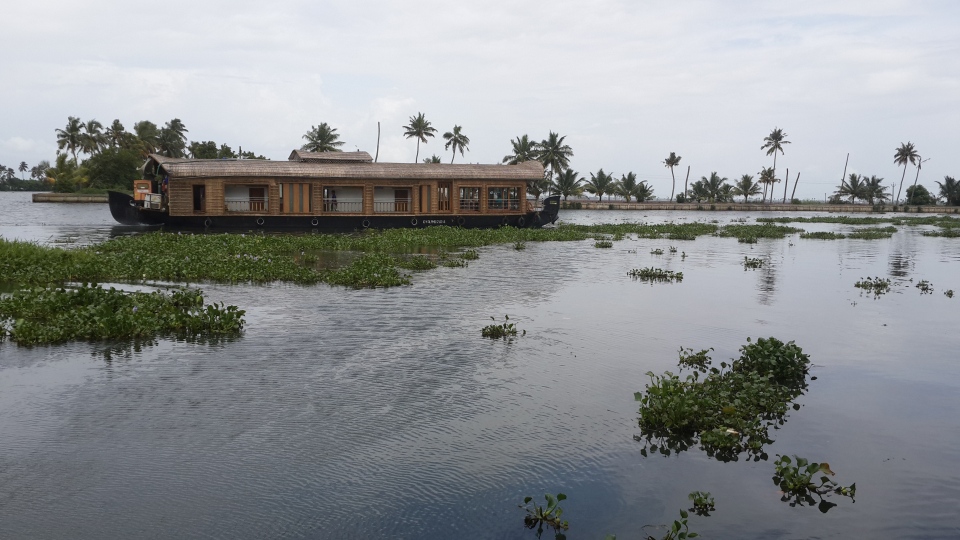
“Kettuvallam,” (Houseboat) on Vembanad lake amidst clumps of water hyacinth.
Kumarakom is situated on the banks of Vembanad lake, apparently the longest lake in India, whose wetland system covers an area of two thousand square kilometers. Much of Kerala’s claim to God’s bounty comes from the backwaters, large estuarine stretches of brackish water that gives rise to a very rich ecosystem. Part of the lake holds the fresh water that drains into it from several rivers, and this fresh water section is separated from the brackish portion by mudflats. The lake is at the heart of ‘backwater tourism’ in the state, with hundreds of “kettuvallams,” floating homes on motorized traditional boats. The riverboat network spans 200 km from north to south and the lake teems with giant prawns and several other types of freshwater fish.
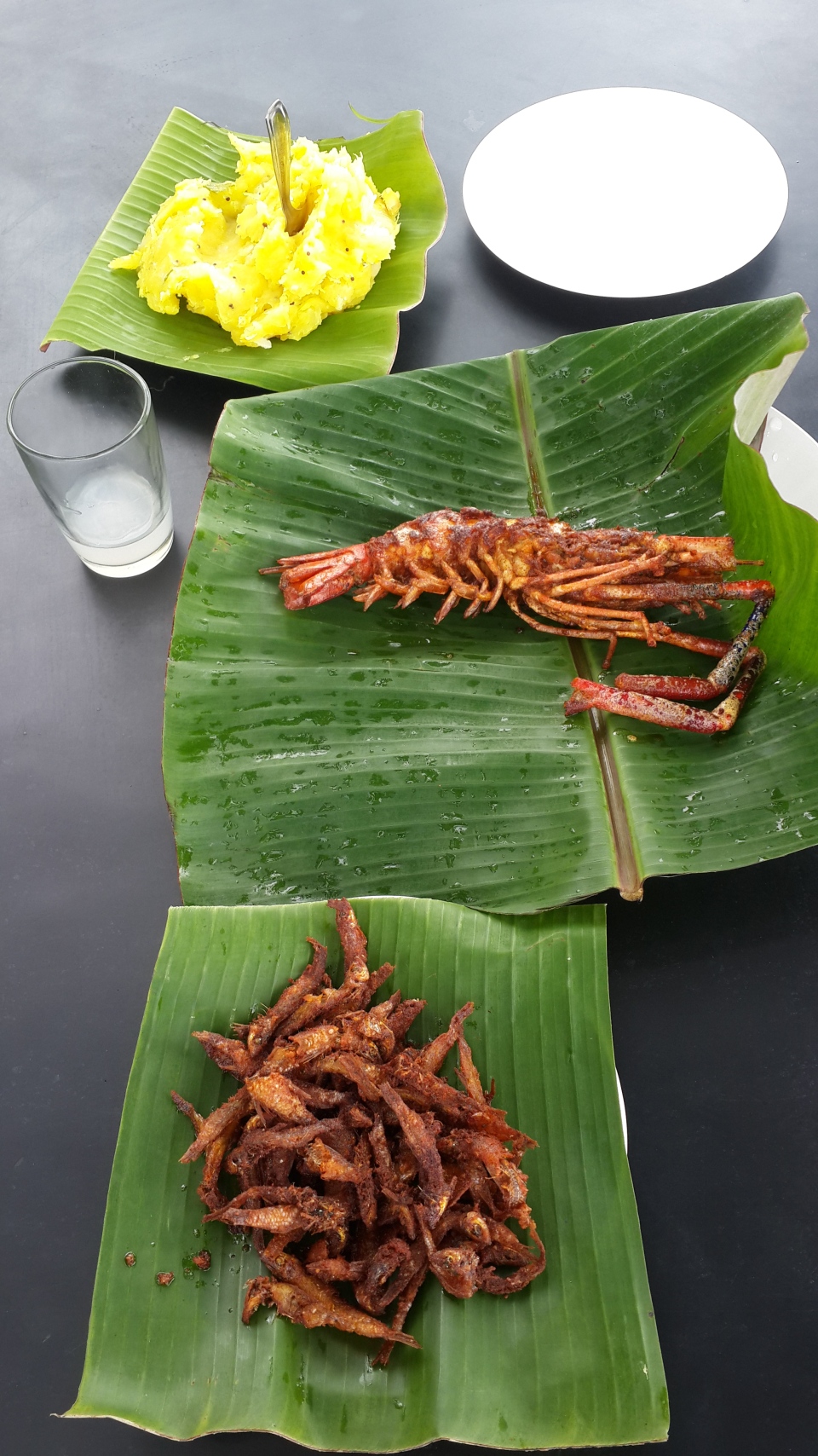
freshly prepared seafood lunch with tapioca and a glass of toddy

Fish await a fiery fry. Pearl spot, prawn and anchovies…
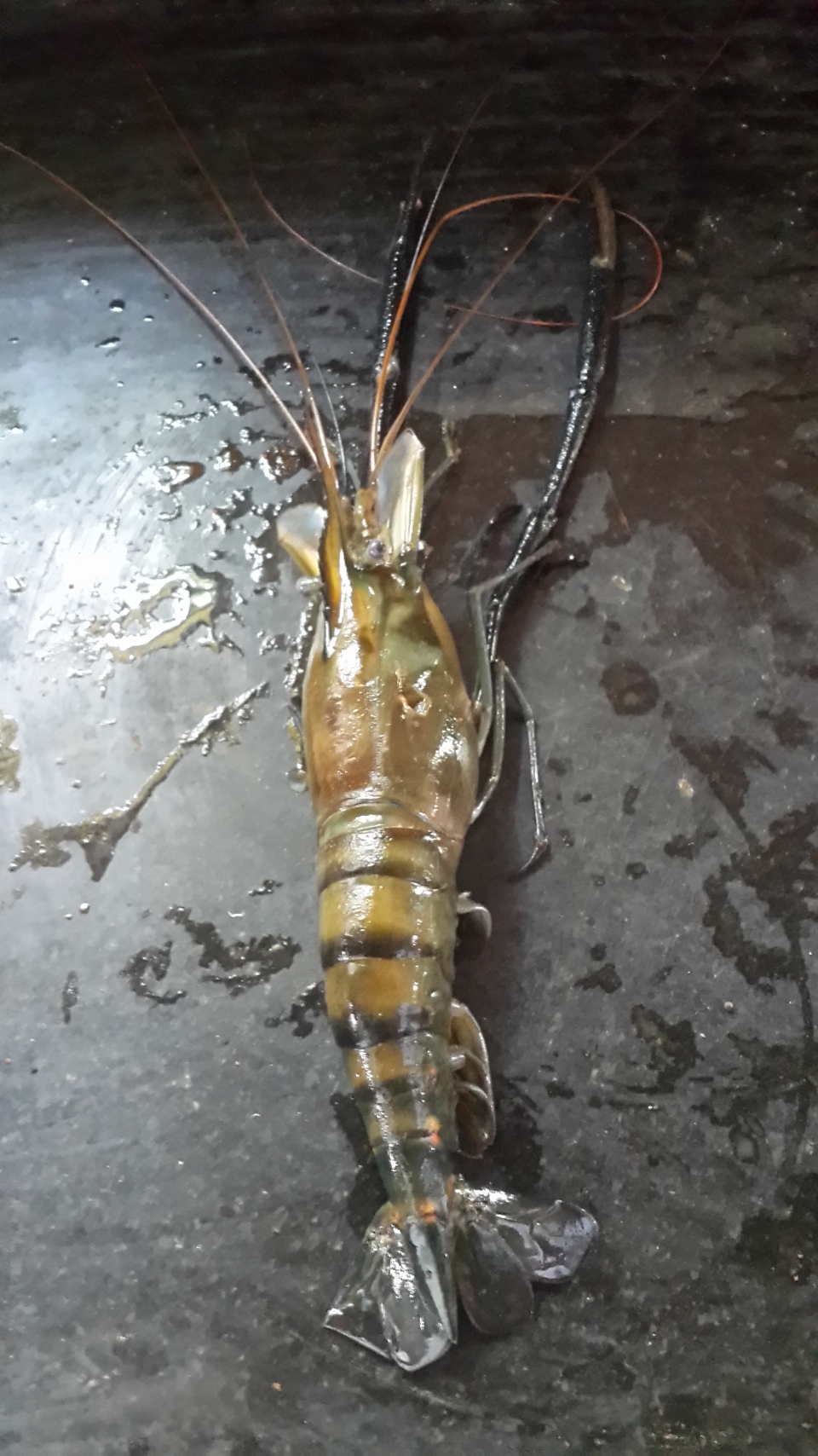
fresh caught prawn
Meanwhile, the bride and groom were happily united at a church in neighboring Kottayam town. It was a glorious wedding with guests travelling from around the world to attend. The groom wore a kilt, befitting his antecedents, and the bride wore a matching tartan sari, designed by the groom’s mother. All in all, a fitting Kerala wedding for the 21st century. The wedding photos belong in a family album rather than this blog, so none appear here. But if you ever are invited to a wedding in Kerala, my advice to you is, go!
For more by this author, see his Amazon page here or on Google Play
The White Temple – Ajarn Chalermchai’s Dream
Fifteen kilometers southwest of Chiang Rai stands a surreal, snowy white temple. It is known as the Wat at Rong Khun, but tourists simply call it the white temple and flock there in the thousands. Entrance is free, from around 9 to 5 every day, and tourists arrive in groups, large and small, or privately in a taxi, as we did. Apart from its natural beauty spots, half of the most important tourist sites in Thailand are palaces and temples, or Wats. Some of the beautiful palaces have Wats attached to them, and some of the Wats look like beautiful palaces. So much so that a friend warned me, it’s easy to have your fill and get wat-ed out. So I was reluctant to make a detour to see another temple, but we heard so much about it that we decided to go.

The entrance to the temple over a small bridge
To begin with, the parking lot itself was dauntingly huge for such a small village so close to the Thai-Myanmar border. There were large groups of mostly Chinese and Thai tourists at the temple; smaller groups from a smattering of nearby Asian countries and a few Europeans. Picking up a free brochure available in several languages, one learns that the temple is a work in progress begun 16 years ago, that it was conceived and built by Ajarn Chalermchai Kositpipat, an artist who was born in Chiang Rai. “I want to be good and valuable to my country. I want to create arts in my own style and to develop Thai Buddhist arts to be developed internationally. I want people of all nations to come and admire my works, like when they want to visit the Taj Mahal or Angkor Wat.”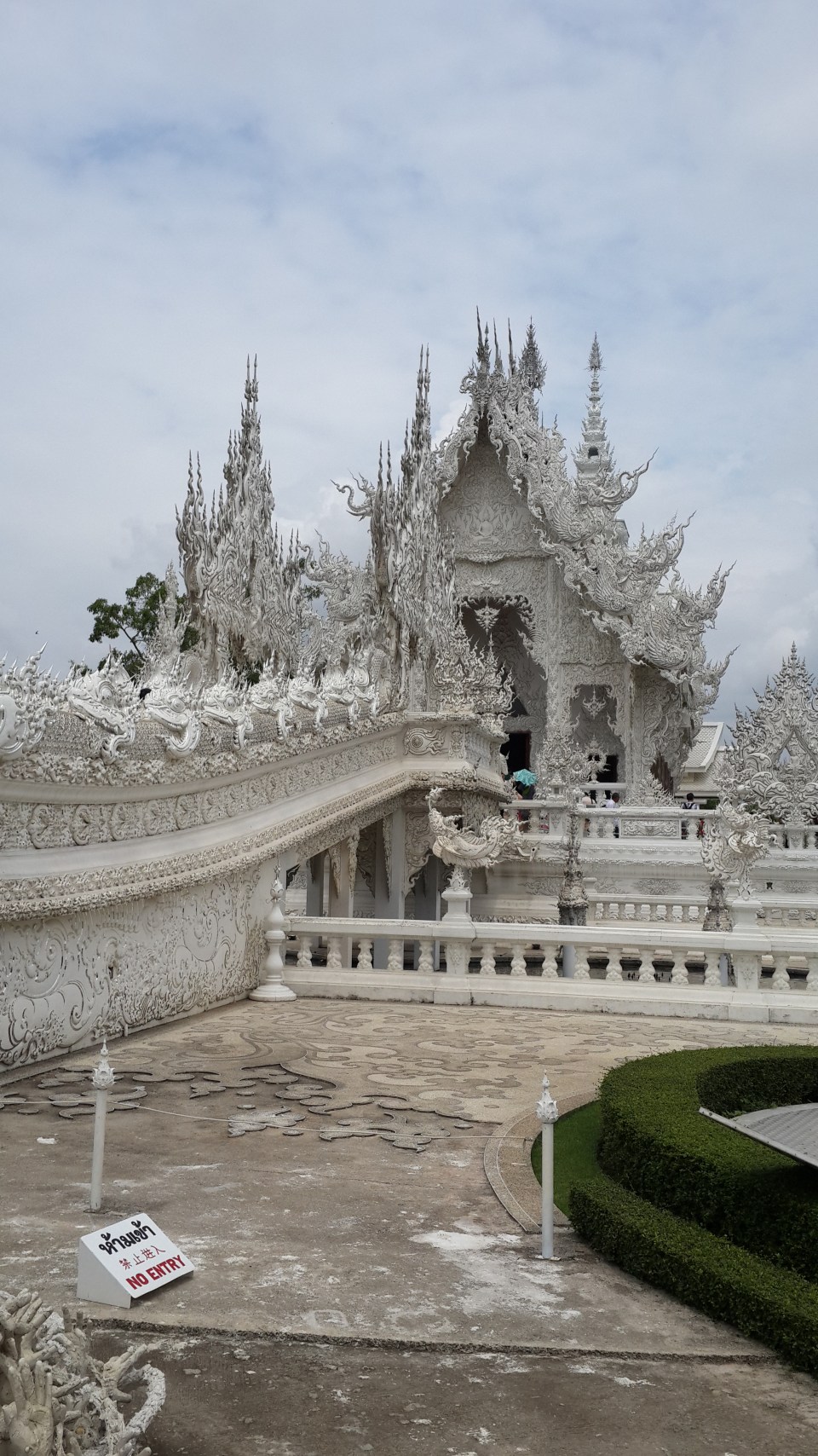

shapes reminiscent of mudras…
The art and architecture of the temple certainly is distinctly Thai. One sees shapes reminiscent of mudras made by the flowing hand movements of a Thai dancer. Chalermchai says he takes themes from ancient Thai murals, trying to create a modern synthesis that is recognizably and uniquely Thai. If the number of visitors is taken as a measure, then his ambition has certainly been realized. Within the temple are modern murals that face a statue of the Lord Buddha. “I want people to feel peace and happiness and to envision the kindness of the Lord Buddha to all beings,” says Chalermchai. “The mural shows the final conflict of the Lord Buddha’s own demon before he received enlightenment and freedom from immoral thoughts.” When asked about the images of George Bush and bin Laden in the demon’s eyes, the artist replies. “I want everyone to know that our world is being destroyed by those who crave to build weapons that kill. They segregate and therefore cannot find peace….”
Chalermchai expects to complete the temple in 90 years.He begins each day at 2 a.m. with an hour of meditation, then creates and sculpts. An artist whose wealth stems from the roughly 200 artworks he produced every year, he now devotes most of his time to the completion of the temple and currently produces around ten paintings a year. The entire site is kept spotlessly clean and supervised by zealous volunteers who ensure that tourists are modestly attired before they enter the temple. The toilets are guarded by a bronze hermaphrodite keeper.
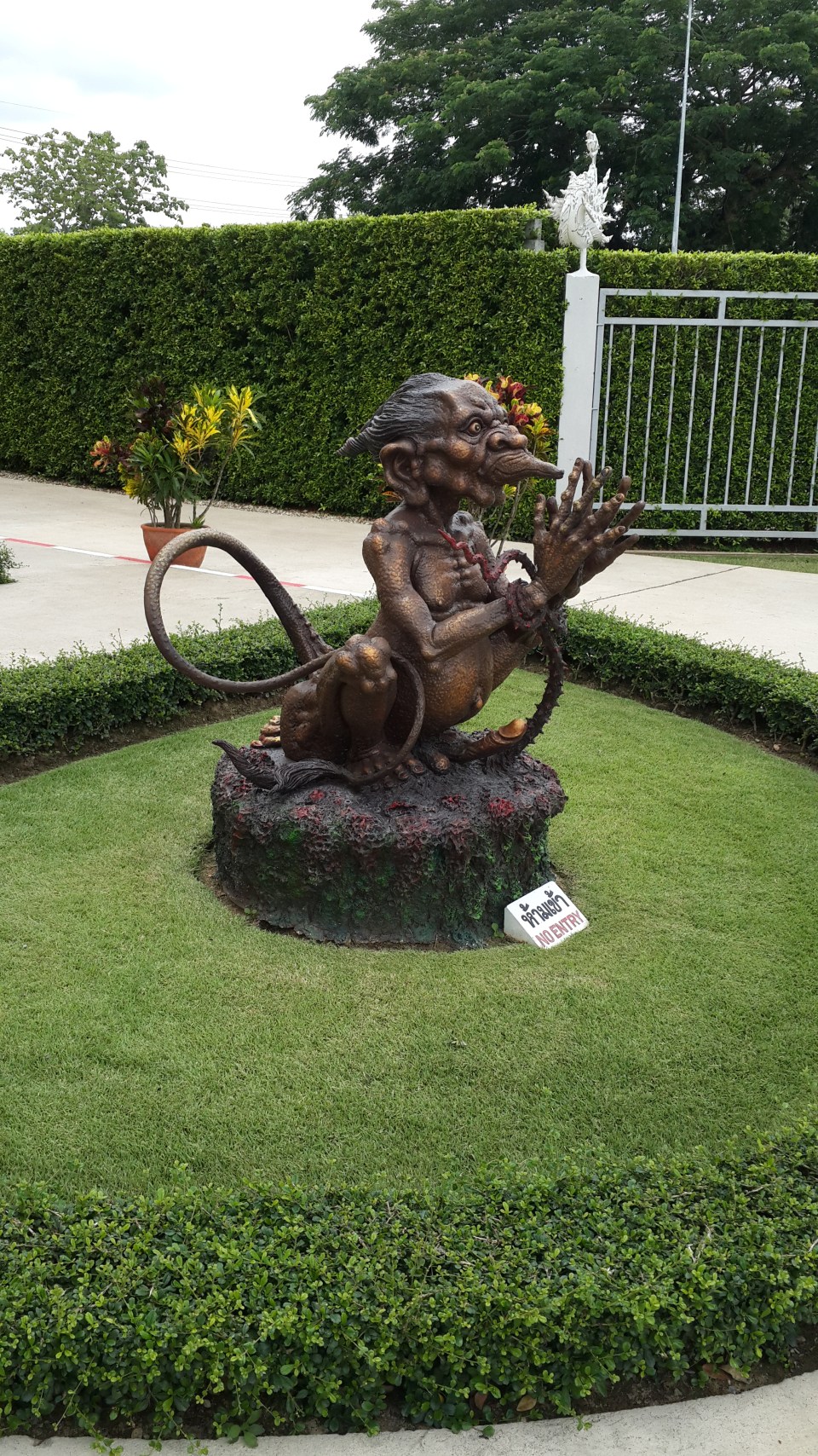
The bronze hermaphrodite custodian of the toilet, front…

…and rear
Concluding with the artist’s own words: “I want to discipline the mind to train me toward being a good person with clear thinking, speaking well and doing good deeds. We are all human and I want to give goodness to people. If we have love and forgiveness in our hearts, it will come out naturally. You need to practice patience before you can control your own mind.”

…I want to give goodness to people.
For more by this author, see his Amazon page here.
Saving the Tiger
Ranthambore National Forest and Tiger Reserve is a stunningly beautiful place that spreads over 450 sq. km. Writers like Jim Corbett and Rudyard Kipling have painted vivid portraits of Indian jungles for readers in the English speaking world. On a recent visit to Ranthambore, sitting in an open jeep, slowly winding its way along rutted jungle trails, tales of Mowgli, Bagheera and Balu the bear seemed to come alive. She expected to see a barefoot boy in a loin cloth peering out from among the tall grasses. Instead, she came face to face with …Shere Khan.
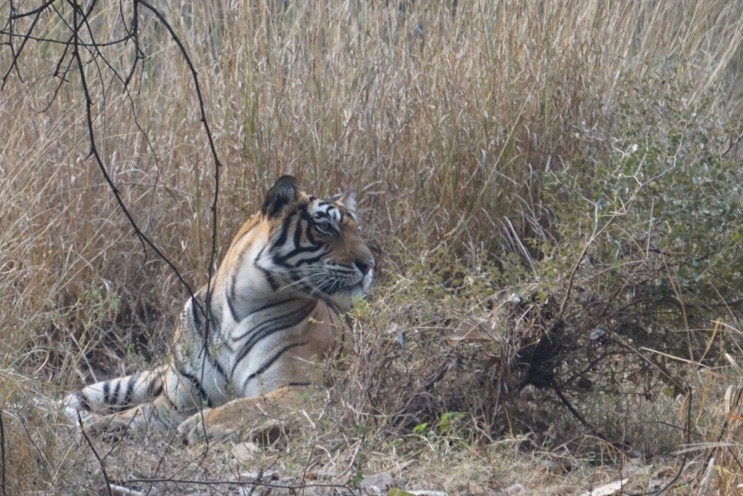
Shere Khan. Her real name, said the guide, is Noor…

…or Mala, or more prosaically, T-39, the mother of 3 healthy cubs
The moment was so unexpected, so pure, so anti-climactic that there seemed to be magic in the air. Noor is also known to the park rangers as Mala, a name that means ‘necklace‘ for the decorative, beadlike stripes on her flank. She had apparently just fed at dawn, the remains of the kill lay somewhere in the grasses nearby, her belly was full, and she was tired and too sleepy to investigate the little open jeep with three occupants parked at a respectful distance.
These magnificent animals are under threat from us humans. Ironically, one way to save them might be to bring more humans to visit them in their natural surroundings, just like the passenger in the jeep who watched her in awed silence for nearly two hours. For every tourist who comes to see them here, there are perhaps two or three locals who earn a livelihood, people who have been displaced from their own natural habitat in the jungle, displaced by the need to preserve wildlife. The villagers who used to live in Ranthambore forest were relocated when the tiger reserve was set up. These displaced people had to carve out a new existence in small settlements surrounding the jungle that was once their home.
We met one of the displaced people, a Rajput by the name of Dharamveer. He was proud of his forbears who had built forts and castles in these hills and jungles, and today he was one of the lucky ones; someone who had done well by doing good. When he was displaced from the forest, Dharamveer had trained as a tiger painter, painting iconic portraits of Shere Khan with the finest of strokes using delicate brushes that were a mere three or four hairs thick. This fine work gave the tigers in the paintings a lustrous lifelike glow that seemed to move as they caught the light. Buoyed by this success, he assisted widowed women to retrain in other handicrafts and has created a thriving business selling their work.

A Rufous Treepie
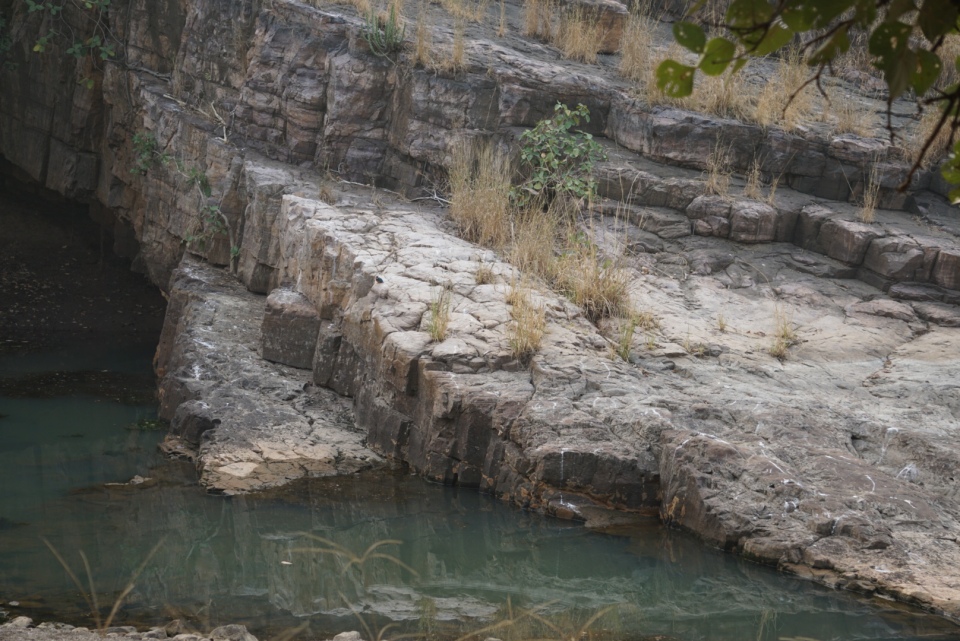
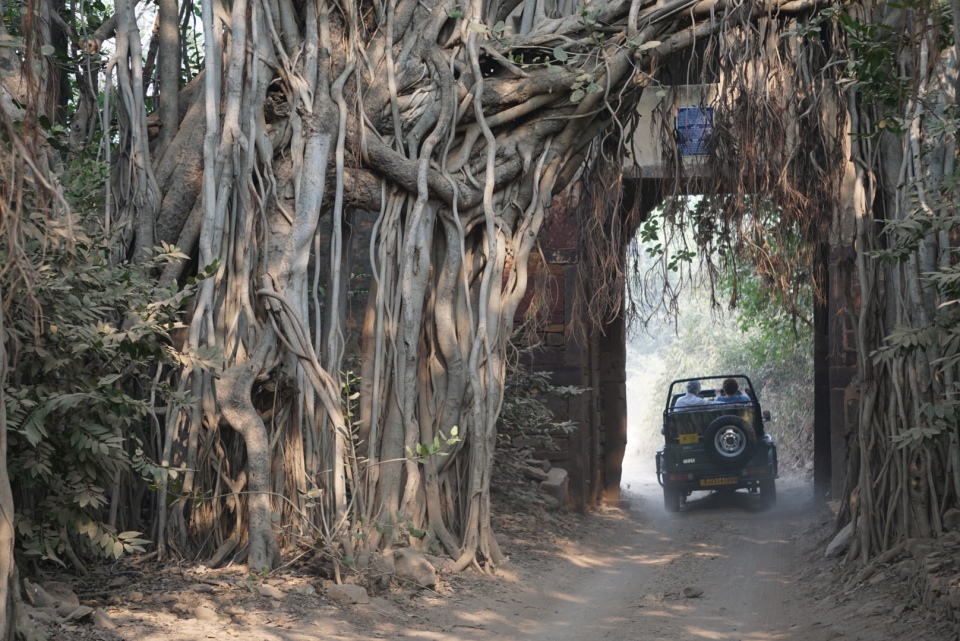
the entrance to the reserve is through the old Ranthambore fortress gate…
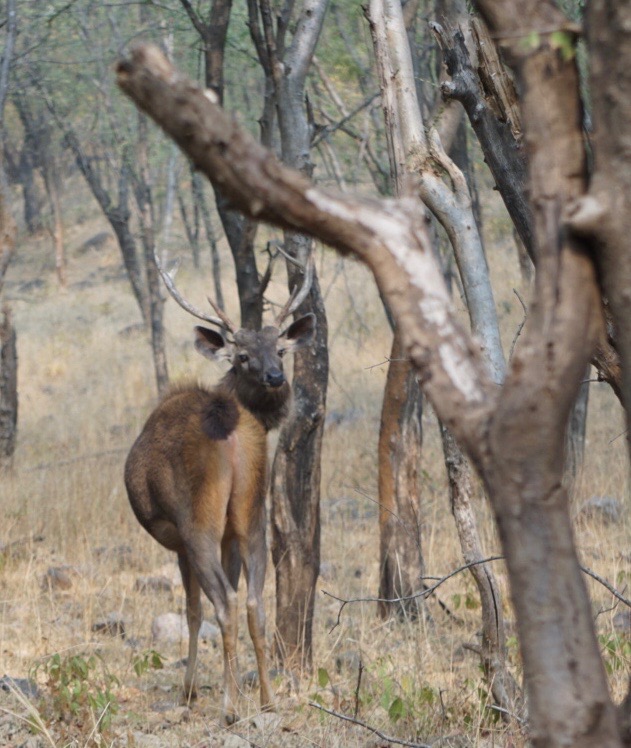
…the sambhur belled, once, twice, and again… (Hunting Song of the Seonee Pack)
We visited his store after the safari and were welcomed by the artisans who proudly showed us their wares. There was exuberant patchwork art, as well as many other fabrics, woven on rural handlooms, carvings, tribal paintings and animal protraits. As usual, there was more than one person could buy, but an American friend is exploring the market for these attractive products outside India. More on that will follow in a later posting.
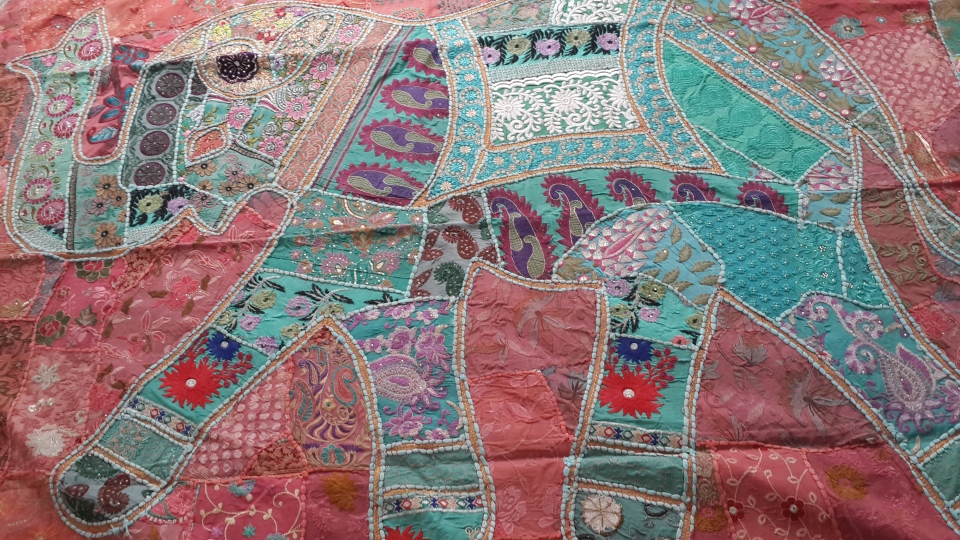
An exuberant patchwork of Hathi the elephant; handloom fabrics, carvings and nature paintings
For more by this author, see his Amazon page here.
Monkey Business at an Indian Wedding
We were privileged to attend a traditional Indian wedding at a marriage hall in Agra, just a stone’s throw away from the Taj Mahal. The chief cook was busy with two assistants in a couple of small enclosures adjacent to the main hall. They labored over a gas cooking fire, preparing sweetmeats and the main meal for the 300 guests expected to attend. Watching over the cooking fires perched on an adjacent wall were two handsome gray langurs who occasionally bared their teeth at someone or something in the distance.
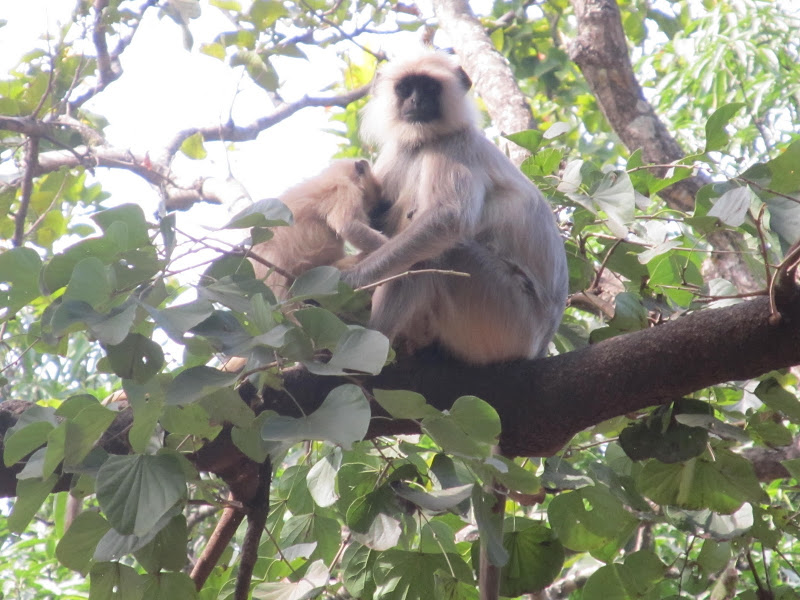
Watching over the cooking fires: Hanuman Langurs
They were watching over the cooking fires and keeping a troop of a dozen marauding rhesus macaques at bay. The two langurs belonged to the cook who kept them as pets for this very purpose.
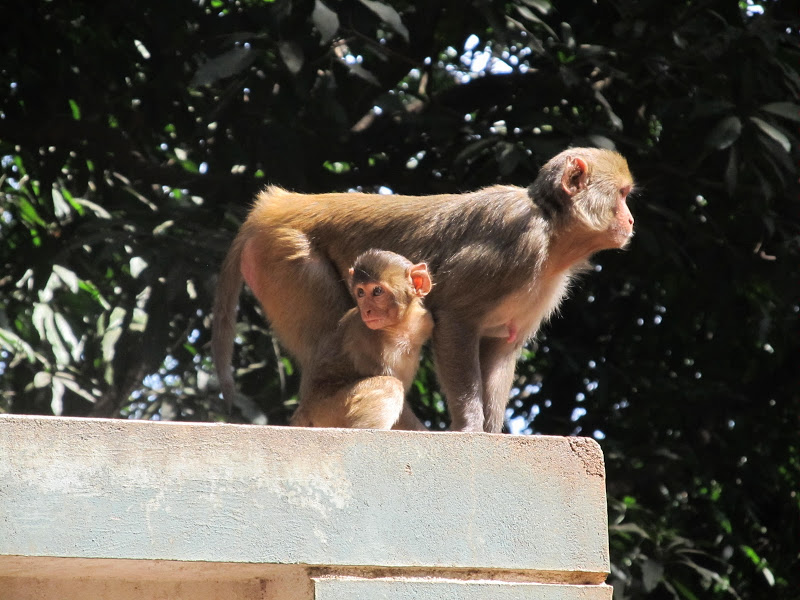
Not invited to the banquet: Rhesus Macaques
These itinerant cooks are specialists who travel around during the wedding season carrying their large cast-iron vats, giant ladles and woks. They are in great demand during the wedding season from November till July, and are often booked out months in advance. They can churn out meals for hundreds at a couple of days notice. A preliminary tasting convinced us it would be a meal to look forward to. More details after tonight’s banquet.
Two Old Friends
No, this is not a short story. I met two old friends yesterday, to the left of the path to the Power Station Beach on Lamma, both of whom I hadn’t met in years. The first was a Greater Coucal (centropus sinensis), also known as the crow pheasant. Its haunting call is heard everywhere on this island, so there must be scores of them here if not hundreds, but this is the first time in two years that I’ve seen one. Here’s a link to a YouTube video that someone posted from Thailand.
The second was a bittern, whose European cousin I used to frequently meet among the reeds at the edge of a pond on the outskirts of Vienna, usually in late autumn. Here’s a mobile camera photo of the bittern that may be distinguishable if you can enlarge it on your screen.
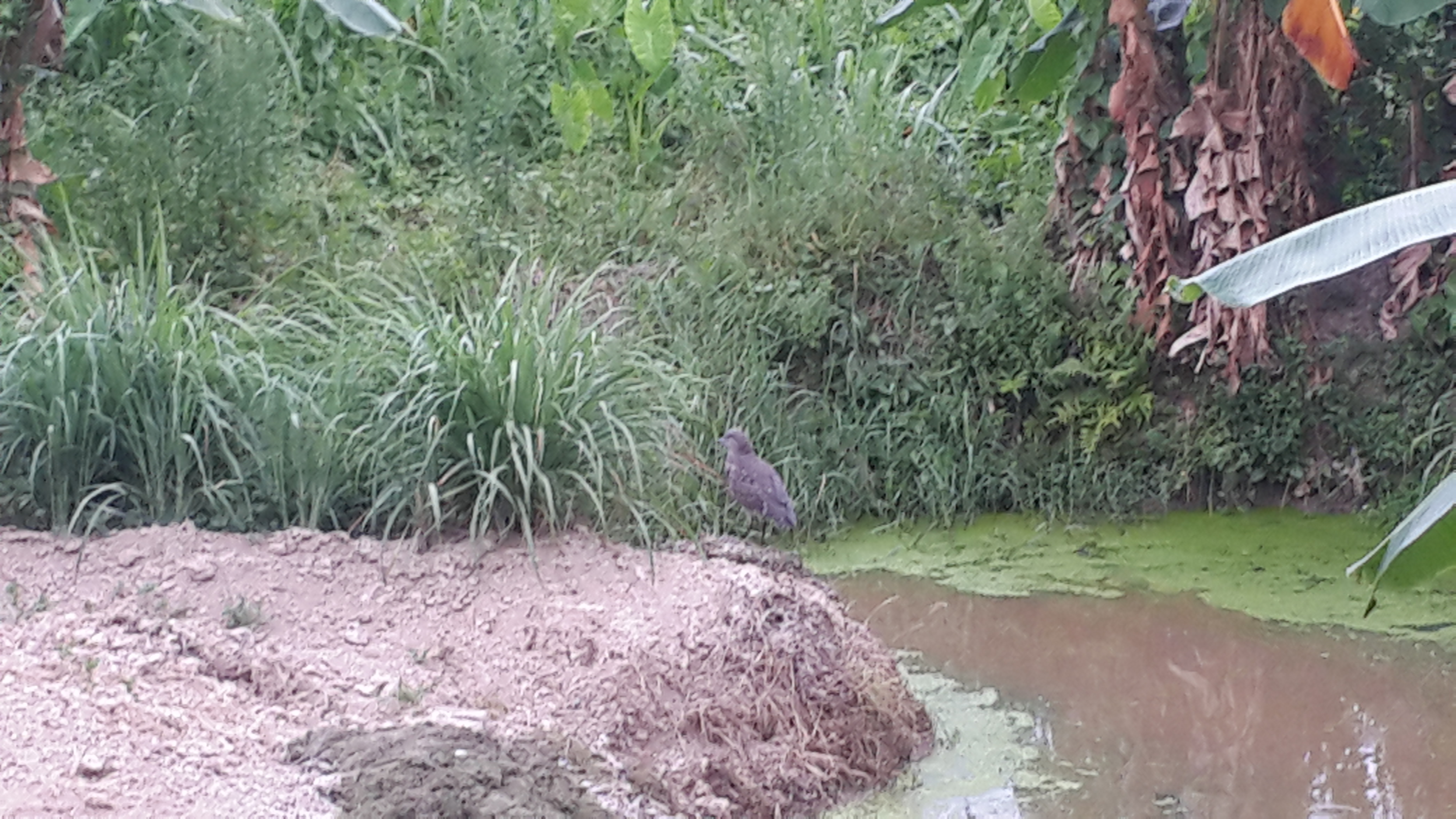
Bitterns are facing habitat loss worldwide
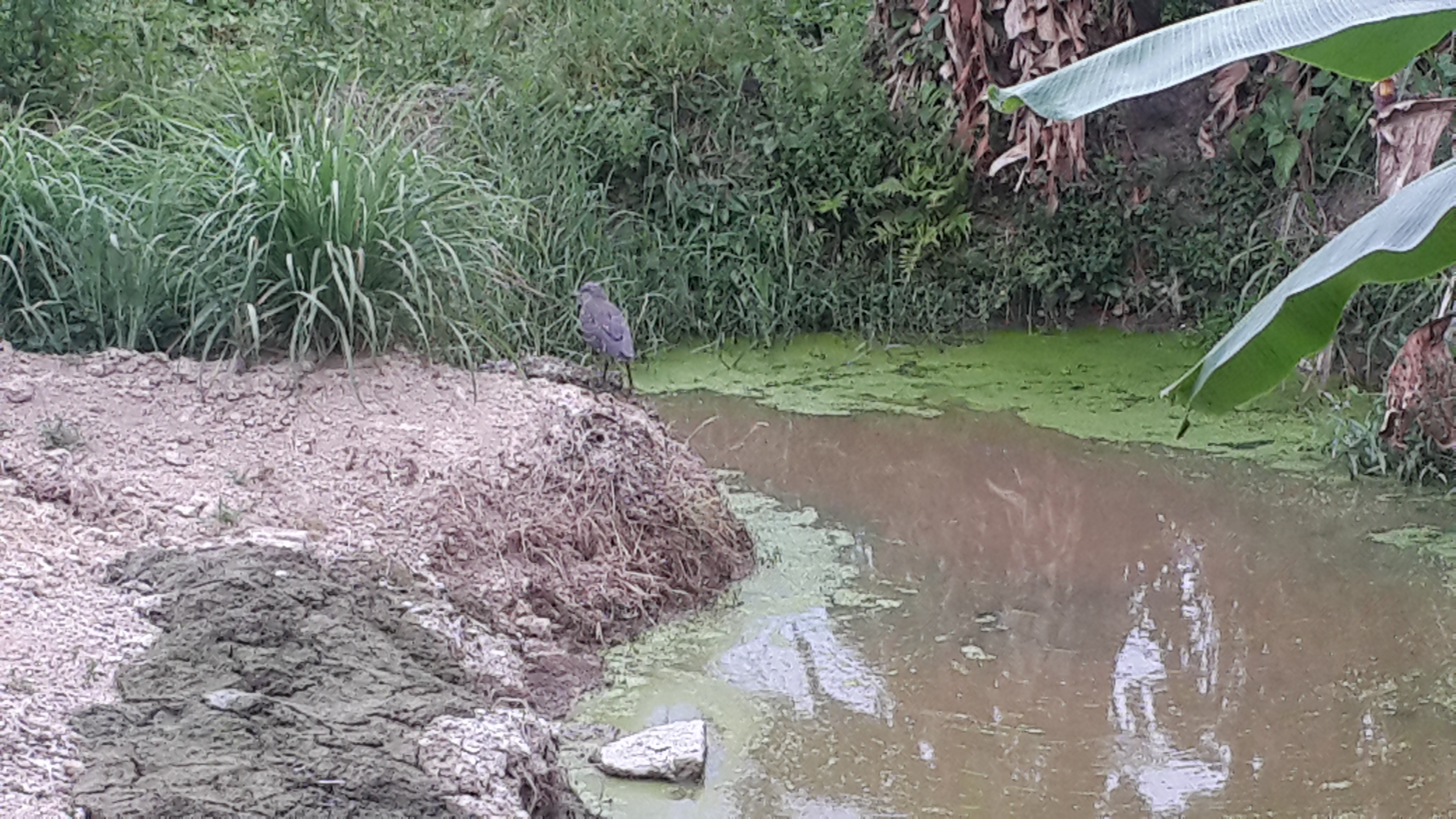
Bitterns, and thousands of other species, are being endangered by habitat loss, so it looks like rethinking ‘development’ may be an idea whose time has finally come.
Jesus on a Lotus, Whispers in Nandi’s Ears
Christianity came to India before it came to most of Europe. It was probably (and plausibly) brought by Thomas the Apostle in 52 AD, the name being derived from the Aramaic Toma, meaning twin. St. Ephrem the Syrian writes in the 4th century that the Apostle was put to death in India and that his remains were brought to Edessa (fairly close to Antioch – Antakya – in modern-day Turkey) by a devout merchant by the name of Khabin. British historian Vincent A. Smith (1848 – 1920) says, “It must be admitted that a personal visit of the Apostle Thomas to South India was easily feasible in the traditional belief that he came by way of Socotra, where an ancient Christian settlement undoubtedly existed. I am now satisfied that the Christian church of South India is extremely ancient.”
According to tradition, Thomas landed on the Malabar coast, where his skill as a carpenter won him the favour of the local king. He was allowed to preach the Gospel and convert believers to Christianity. Thereafter, he moved across southern India for the next 20 years before he was finally killed near the coastal city of Madras, present-day Chennai, in AD 72 apparently because a local king grew jealous of his increasing popularity. Marco Polo, writing in the 13th century, states that the apostle was accidentally killed by a bird hunter who was shooting at peacocks in Mylapore. More recent interpretation of inscriptions found on the Pehlvi cross, near present-day St. Thomas Mount, by the Portuguese in 1547, suggest that the legend of Thomas’ martyrdom was based on mis-translations of the middle Persian script. Whatever the truth of the Apostle’s death, at this point in time, the legend of his martyrdom has been firmly established to a degree that makes it a fact, and there is a basilica built on the site of the tomb at San Thome, one of only three in the world directly associated with the 12 Apostles. (The other two are St. Peter’s in Rome, and Santiago de Compostela in Spain, dedicated to James). Since India is a land of syncretism, the tomb and St. Thomas Mount have been a pilgrimage site for Christians, Hindus and Muslims since at least the 16th century. The Indian church has adapted in India and adopted some of this syncretism by introducing certain Hindu rites (such as the tying of the thali at weddings). Knowing this, one is not surprised to find that the image of Christ on the cross at the cathedral of San Thome is flanked by two peacocks and that his feet rest on a lotus.

lotus feet flanked by peacocks
The area around the San Thome basilica belonged to the ancient city of Mylapore, or the city of peacocks. A temple was built in the 7th century AD in Mylapore. According to legend, Shakthi, the divine embodiment of the female, worshipped Siva in the form of a peacock, giving its Tamil name (Mylai) to the city. The temple was built to commemorate this, and is dedicated to Siva. Inside the temple is a statue of Nandi, the bull, which is Siva’s favourite mount, and also a gatekeeper to Siva and his consort Parvati. For this reason, it is believed that whispering one’s secret wishes in Nandi’s ear is as good as a direct request to Siva himself.
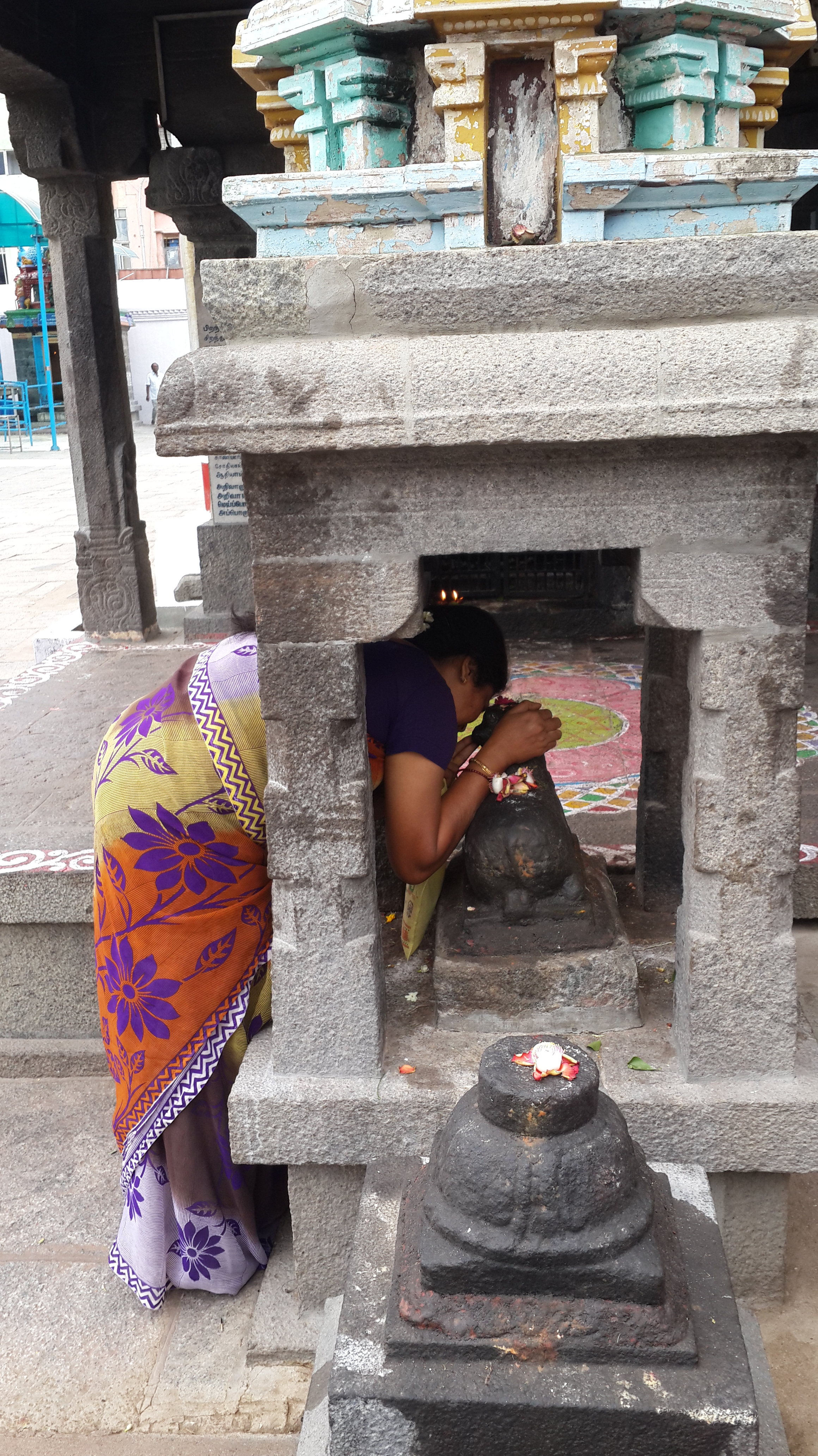
her word in God’s ear…

the temple courtyard is a relaxed and friendly space
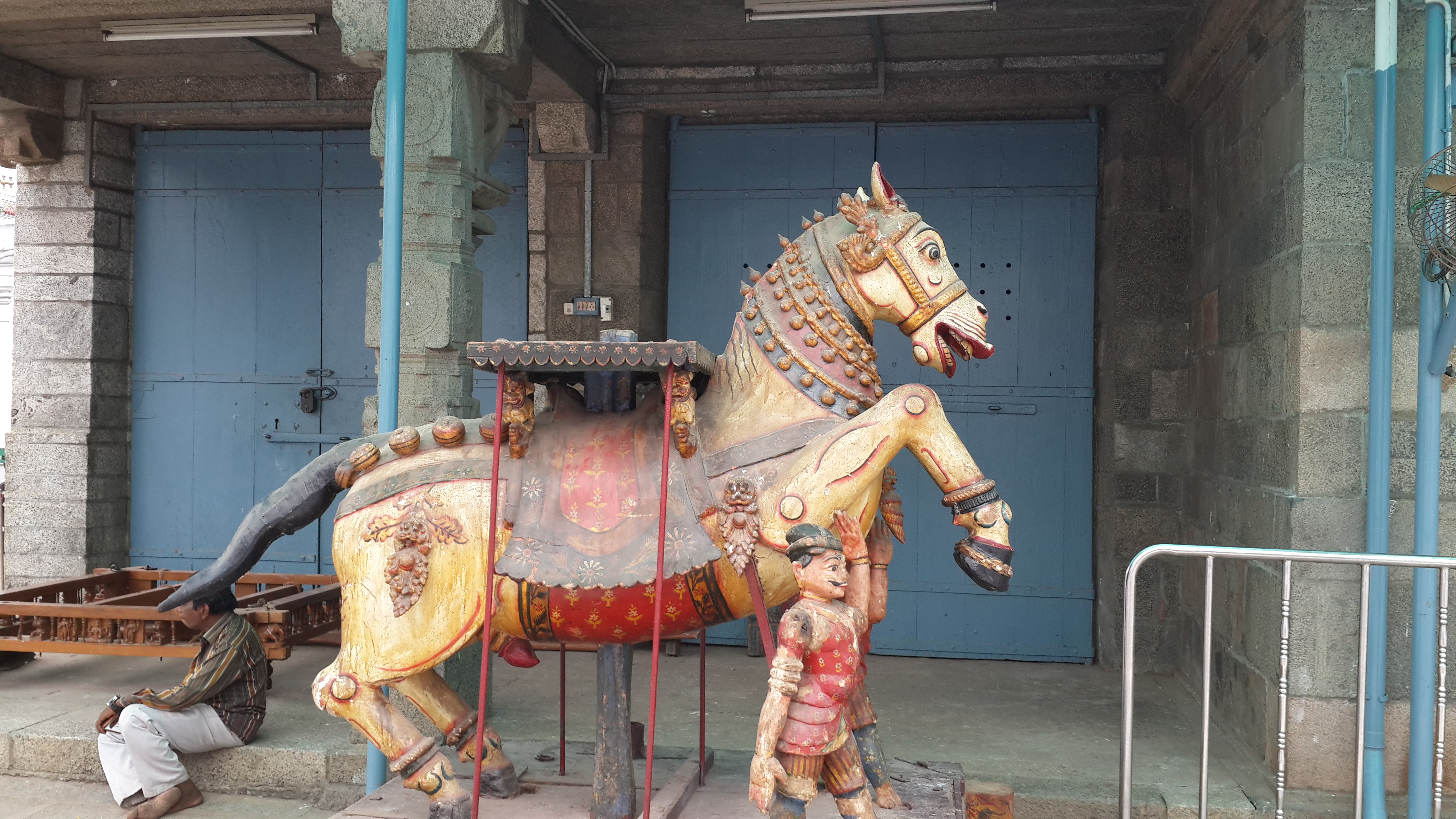
and splashes of colour
Being a good tourist, and wishing to hedge my bets in the afterlife, I prayed at the lotus feet of Jesus and whispered my innermost wishes in Nandi’s ear. Choose the link to follow this blog for updates on how well this strategy works in the coming months…
Facebook for the Gods: Phads and Puppets
William Dalrymple, in his fine book “Nine Lives” writes about the Phad singers of Rajasthan. As in traditional arts and crafts everywhere, the few remaining Phad singers and puppeteers are struggling to find audiences and sustain their livelihoods. There is a great danger that these rich traditions will soon be lost. Performances for tourist groups can help these artists survive, but to be really appreciated, the audiences need to be educated about the background to these stories (which are well-known to most traditional rural audiences) and this happens only with the most knowledgeable tourists, such as academics or researchers studying language and culture.

Pabuji ki Phad: Image courtesy Rajasthan Textiles
The Phad is a religious scroll painting of deities, a kind of a portable temple. As representations of the divine, these Phads, or painted scrolls, are treated with great reverence by the Bhopas (traditional singers) who carry them from village to village and fair to fair. The bhopas are bards, singers of epics, and perform prodigious feats of memory. The most popular epic is that of Pabuji. In the old days, when this 4000 line courtly poem was recited from beginning to end, something that rarely happens today, it took a full five nights of eight-hour performances to complete the narration. The art of the bhopa was handed down in families, from father to son. Sadly, the bards with their traditional accompanying musical instruments, called Ravannahatta, are disappearing from both town and country today.
Another dying art tradition is that of puppetry performances. Scholars believe that the tradition is thousands of years old. The puppets are called “kathputli” and fashioned from fabric, wood, wire and threads. In a desperate attempt to attract foreign tourists, puppeteers have “dumbed down” their elaborate plays based on the classic Indian epics, and developed contemporary five-minute local variations that neither do justice to the original, nor do they attract the tourists as they are meant to do. As Janis Joplin presciently sang in the 1960s, the sentiment behind Lord, can I have a Mercedes-Benz and the pursuit of material wealth has eclipsed the spiritual quest even in this land of 33 million gods.* There are several standard figures in the line-up of modern Rajasthani puppets. One of them is called Anarkali, who is modelled as a temptress and courtesan.
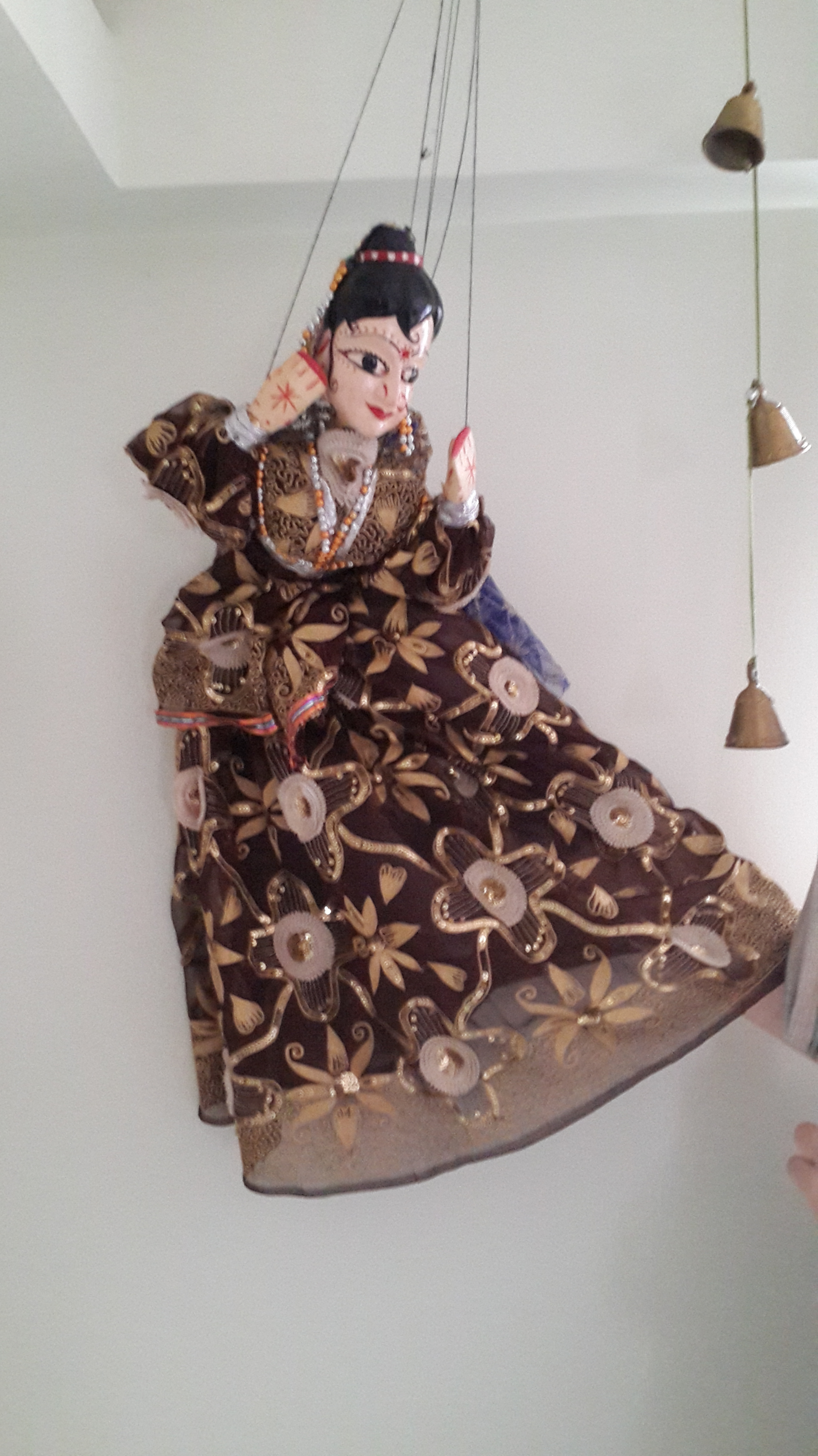
Anarkali: The temptress at her seductive best
The second standard modern puppet figure is a Rajasthani version of Michael Jackson, who struts his stuff on the portable wooden stage and manages a passable moonwalk. The highlight of this 2-minute skit is when he raises his detachable head.

Michael Jackson disguised as a Rajput
The third modern set piece is a snake charmer and his cobra, which begins to chase him around the stage after initially swaying to the charm of the flute in the background. Another character who often appears is a demure bride who suddenly is flipped over and becomes a male singer. Sometimes these puppets are handled with considerable skill, all the while accompanied by an ektara, a single stringed violin, and a shrill-voiced male singer who speaks through a bamboo reed.

Yin..

…and Yang
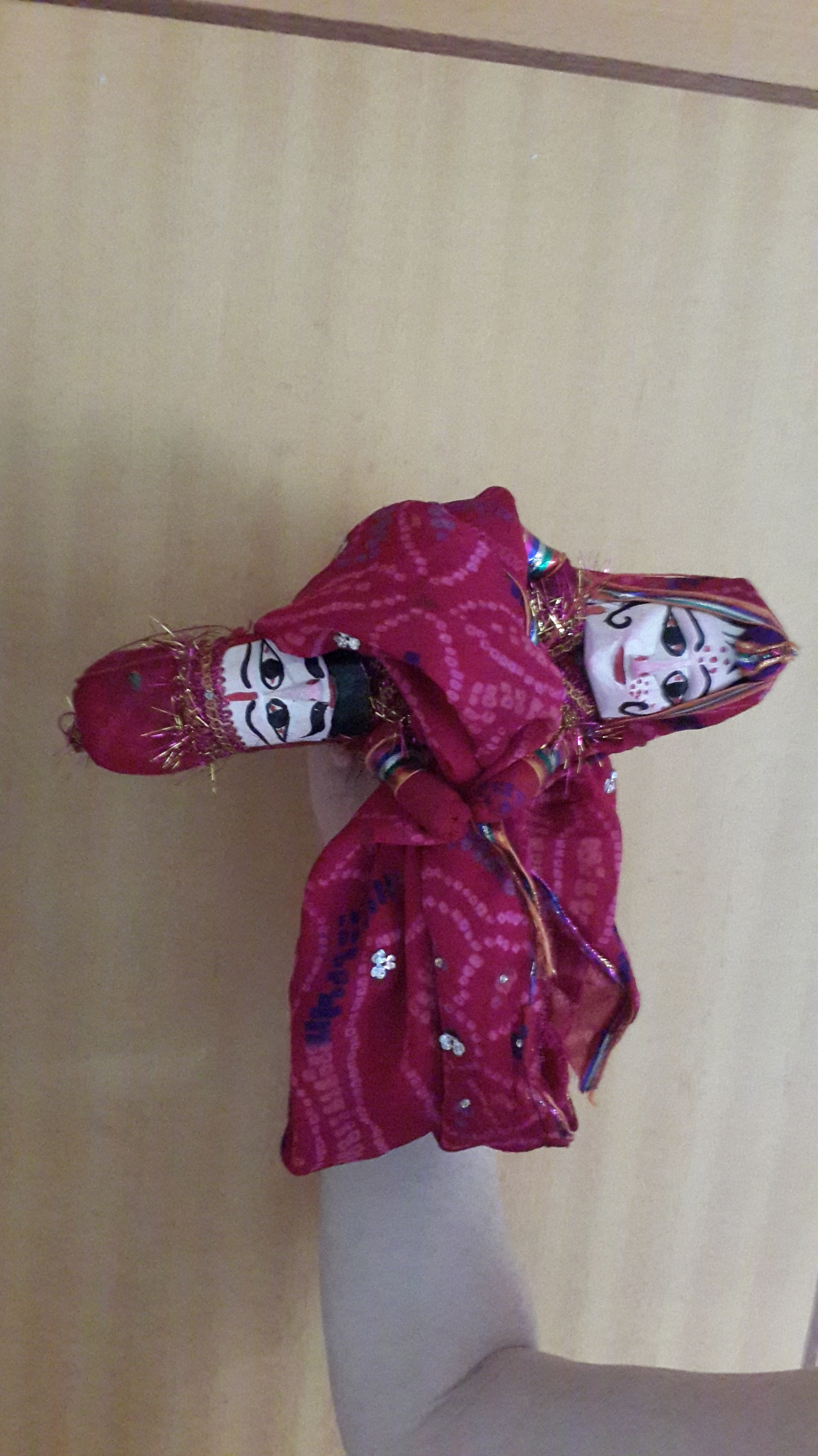
…or a bit of both.
*The figure of 33 million was pulled out of a hat after many discussions of the number of gods, where the count ranged from 3000 to 330 million, the last figure based on the reasoning that almost every third person in the country has his or her own personal deity. This seemed rather far fetched, but it is true that in every small village and town there are local version of the principal gods and lesser deities of the Hindu pantheon. If it all seems too foreign and confusing, look at it this way. There is but one god, Brahma, the creator of all things, and all the numerous deities are but one way of approaching him, just as Catholics pray to their favourite saint to intercede for them before the one God.
Blue City: britches, brahmins and battlements
Our tour guide showed us around the impressive Mehrangarh fort and indicated the blue-washed houses in the valley below. All those blue houses, he said, belong to Brahmin families. Further enquiry found many other explanations for the blue coloring, so the jury is out on this one. Other possible reasons: as in the case of imperial yellow in Austrian Habsburg palaces, the color could have been chosen because it was the least expensive. Whatever the real reason, Jodhpur is commonly described as the “blue city” of Rajasthan and, together with Jaisalmer and Jaipur, make up a trio of colored cites in the state. Jaisalmer really is a golden city; golden sands of the Thar desert that spread from its outskirts and the golden sandstone of which the city is built. Seen from the fort, the city of Jodhpur is speckled with blue, the afore-mentioned allegedly brahmin houses. Jaipur is called the pink city mainly because of the iconic Hava Mahal, and because its royal family preferred the colour on all their buildings. But in today’s Jaipur, bustling with handicrafts and industry and bursting at the seams with people, the pink color is lost unless one wanders among the historic buildings and older parts of the city.
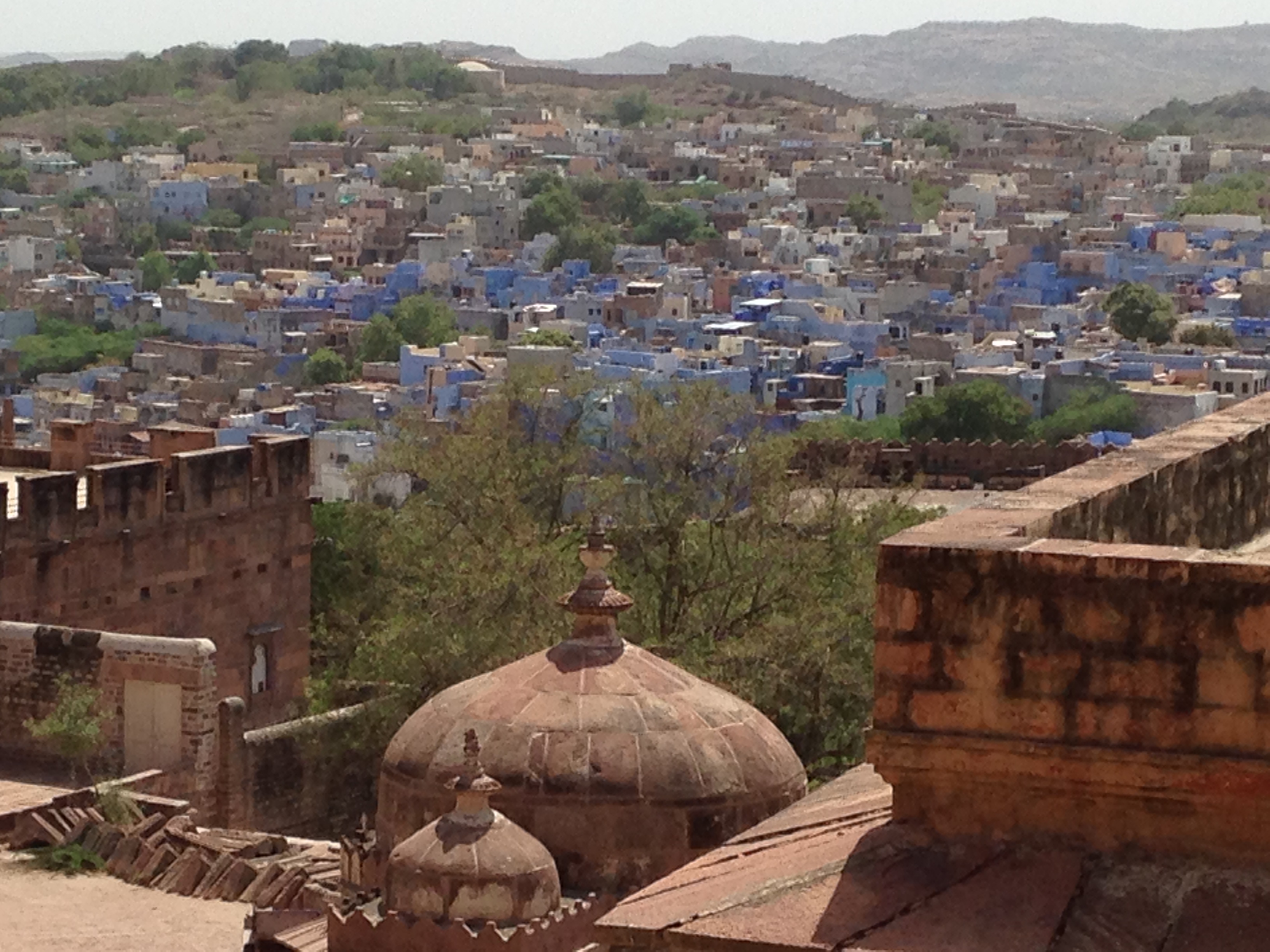
Blue-speckled city of Jodhpur seen from Mehrangarh Fort
Mehrangarh fort in Jodhpur is probably the most impressive in Rajasthan and well worth a visit of 2 or 3 hours (there’s more than three hours worth to see if you can take it in at a stretch), from royal palanquins to a beautiful collection of swords, and finery worn by royalty in centuries past. A tip: the audio guides available in the fort are excellent and provide concise commentary at every important object on display. In addition to its blue-painted houses, the dominating fort, and riding breeches named after the city, Jodhpur was also famed for its Marwari horses. They are a hardy breed with distinctive ears that point towards each other. They have a regal gait and are descended from local ponies interbred with Arabian and Mongolian horses beginning in the 12th century.Close to Jodhpur lies Mihir Garh, a boutique hotel with only 9 rooms that Lonely Planet listed in 2014 as the most unique hotel in the world.
A well-paved road leads from Jodhpur to Udaipur, again a city named after its founder Udai Singh in the 1530s, although this dynasty has ruled in the area for more than a thousand years, and represents the world’s longest unbroken ruling line, from the 9th century to the mid-twentieth. More on Udaipur and Pushkar in the next post.
The World is a Book: St. Augustine
Saint Augustine of Hippo (present-day Algeria) lived from 354 to 430 CE and is the source of one of the most well-known quotes about travel. “The world is a book, and those who do not travel read only one page.” The grand-daddy of all famous travel quotes is Lao Tzu’s eminently quotable “The journey of a thousand miles begins with a single step.” Of course, at the times these quotes were made, travel was expensive and perilous. Today hordes of innocents travel far afield armed with little more than a credit card and, perhaps most hazardous, an overdraft on their bank accounts at home. Paradoxically, the hazards of travel are global and impersonal. A single intercontinental jet flight can cause as much CO2 emissions (1 ton) as a year of driving (around 12,000 km) an average car.
However, in today’s interconnected world, it simply won’t do to live life on a single page. Recently, when contemplating an intercontinental journey from Europe to Asia, I explored the possibility of taking ‘a slow boat to China,’ and discovered that travel on an assortment of cargo ships was possible, only the journey would take three months and cost around US $10,000 instead of 15 hours and $1000 by plane. So what is a globally responsible citizen to do? The incipient wanderlust of early childhood was stimulated decades ago by my grandfather’s collection of bound volumes of National Geographic Magazine filled with travel descriptions and black and white photos from the 1920s and 1930s; from that glorious age when there were still many unknown parts of the world and when the bulk of humanity still lived a single-page existence. Today, billions of people live confused and deracinated lives because the bulk of their multi-page wisdom and experience comes from, or is filtered by, television.
Around the turn of the millenium (that was only 15 years ago), National Geographic offered a 110-year archive of issues on CD that was bought by aspiring world (armchair) travellers. The software was clunky and time-consuming to use, and the operating systems quickly became outdated (anyone with a Windows NT operating system is welcome to my 1999 NatGeo CD collection). The email offer from National Geographic received today for online access to 125 years of the magazine holds the promise of longer accessibility than the CD-ROM version. As the quote on the desk of a professional archivist I know says: Electronic archives are good for eternity or five years, whichever comes first.
Here is the link. The archive is free for a limited time.
Badami: 7th Century Cave Temples
There are 4 cave temples on a rocky hill above the town, all carved out of the giant rocks that form the hillside. The first two caves are dedicated to Shiva, the third (and grandest) cave is dedicated to Vishnu. Shiva and Vishnu are the second and third members of the Brahmanical Trinity, the first being Brahma, who is traditionally accepted as the creator of the entire universe.

 The fourth cave is a Jain temple, adorned with an image of Mahavira, the last of twenty-four teerthankaras, or spiritual role models in Jainism. Mahavira was born into a royal family around 540 BC somewhere in today’s Bihar state in India and he reputedly lived till around 468 BC. This makes him a contemporary of Gautama, the Buddha, who lived from around 563 to 483 BC according to the latest reckoning of historians and scholars. Further coincidences in their lives abound. They were both born into princely families. They both lived traditional family lives until they left their homes at the ages of 30 (Mahavira) and 29 (Gautama) and wandered in search of spiritual truths. Interestingly, although Gautama was born in today’s Nepal, he reputedly achieved enlightenment while meditating under a pipal tree in Bodh Gaya, in Bihar, where Mahavira was born. The present day state of Bihar is relatively poor, but was a great center of learning and spirituality at the time. One of the earliest universities in the world existed at Nalanda, from the 5th to the 11th century AD.and lies just 90 km from Bodh Gaya. The Badami cave temples are in Karnataka state, not far from the scattered ruins of Vijayanagar in Hampi.
 aviott