Home » global warming (Page 5)
Category Archives: global warming
Spreading the Sunshine 1: A New Year Message
Even today, in the first half of the twenty-first century, thousands of villages in Africa and Asia (mainly in India) remain off-grid and have no access to electricity. Ever since a three-month stay in Kenya and Tanzania in 1985, I have dreamt of bringing solar lighting to the smallest villages on these two continents. In Kenya I was astounded to see that, as early as 1985, a few rural families had bought individual solar panels connected to used car batteries to power a single light bulb and the occasional television set. They did this because they had no hope of access to grid electricity in their lifetimes. It’s even more astounding to think that in affluent countries today, the majority of people who drive $ 20,000 cars consider solar power unaffordable without government subsidies. No wonder the world is hotting up! Such economic calculations show how skewed our thinking is.
Of course it was obvious that this journey of a thousand miles begins with a single step. Less obvious was what this first step should be. Mhairi made the first step on a recent (November 2015) visit to a village on the outskirts of a tiger sanctuary in Rajasthan. She made contact with the owner of a handicrafts shop on the edge of the Ranthambore national forest and tiger reserve who helps village craftswomen earn a living by marketing the beautiful tiger paintings, patchwork quilts with mirror designs and appliqué fabrics they make. Dharamveer was thrilled to hear about the idea of installing solar lighting for the nearby villages. He immediately took us to visit three of the 10 surrounding villages. These villagers have limited or no access to electricity. Even the few homes connected to the grid have power only 2 or 3 days a week, so they end up spending 2 to 3 hundred rupees a month on electricity bills or on kerosene for inadequate lighting with lamps. The proposal to pre-finance solar lamps for each household in the village was met with much enthusiasm. They were quite willing to pay 200 to 300 rupees a month for reliable solar lighting. And they were delighted to hear that, at a price of just 499 rupees (US $ 7 at current exchange rates), the lamps would belong to them within three months. Apart from the environmental costs of burning kerosene, the biggest drawbacks are cost and inadequate light for children studying or doing homework.

The Pico lamp, US $ 7 with a 2-year guarantee.
The idea we propose is quite simple. We plan to finance around one hundred of these solar lamps initially, to be distributed to a number of households in the ten target villages. Presumably they will be paid for in 3 months from the money the villagers save from their kerosene and electricity bills. We will request voluntary contributions for another 2 months and use the extra money to expand the circle of recipients till all households in the villages are covered. After which one can think of more elaborate systems, for example, like the model shown here that costs 7000 rupees or US $ 100 at today’s exchange rates. Greenlight is a for-profit company started in the US by three engineers, two American and one Indian. Their products have received good reviews in the international press.

The Sun King Home 120 is priced at approx US $ 100, can power USB devices and mobile phones.
We have decided on Greenlight’s Sun King model range, based only on our own internet research and news reports. Readers of this blog are invited to give feedback or share their own experiences with different models. I can envisage offering a range of different systems based on cost and reliability. I look forward to hearing from you.
For more by this author, see his Amazon page here.
Two Old Friends
No, this is not a short story. I met two old friends yesterday, to the left of the path to the Power Station Beach on Lamma, both of whom I hadn’t met in years. The first was a Greater Coucal (centropus sinensis), also known as the crow pheasant. Its haunting call is heard everywhere on this island, so there must be scores of them here if not hundreds, but this is the first time in two years that I’ve seen one. Here’s a link to a YouTube video that someone posted from Thailand.
The second was a bittern, whose European cousin I used to frequently meet among the reeds at the edge of a pond on the outskirts of Vienna, usually in late autumn. Here’s a mobile camera photo of the bittern that may be distinguishable if you can enlarge it on your screen.

Bitterns are facing habitat loss worldwide
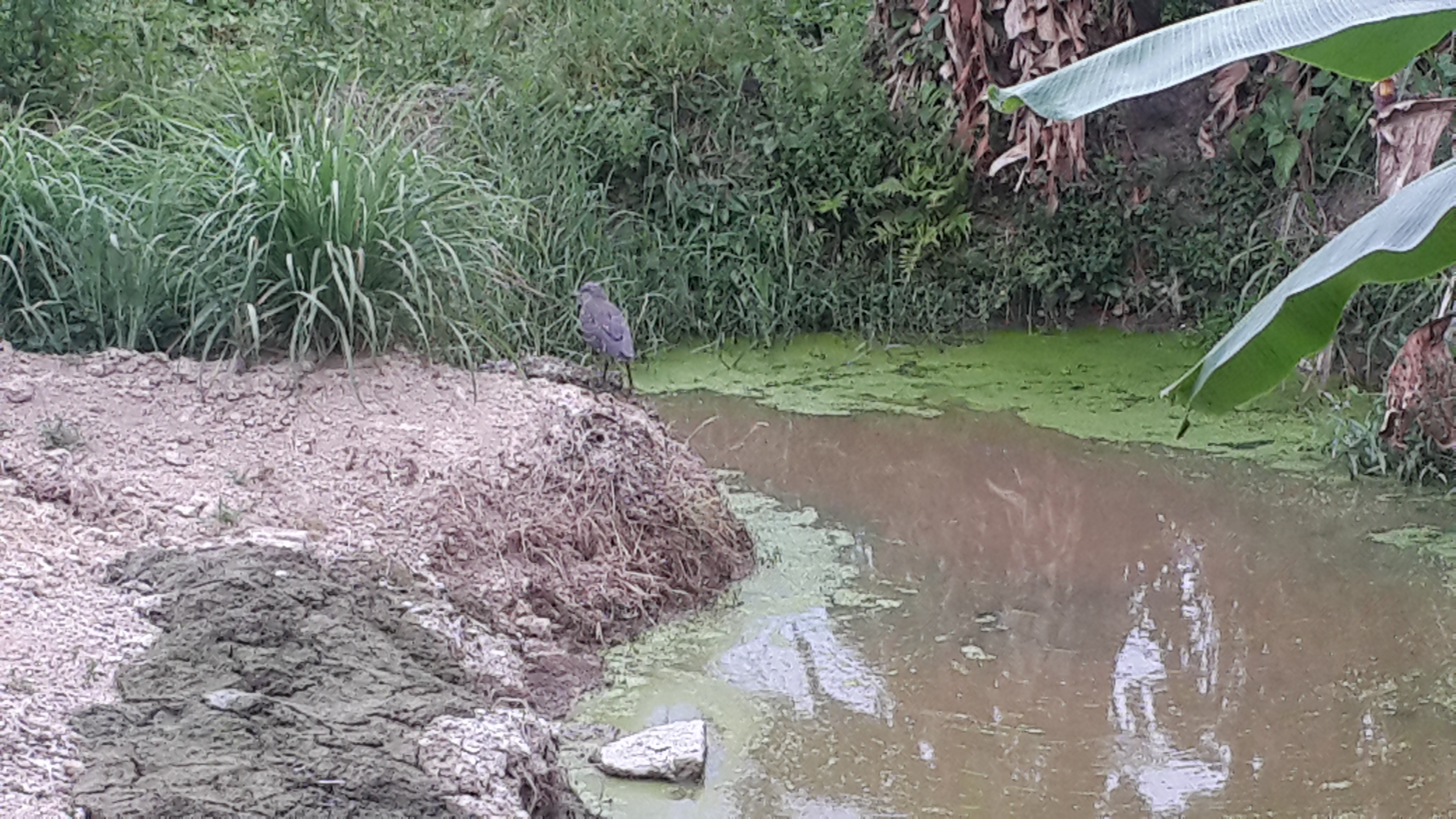
Bitterns, and thousands of other species, are being endangered by habitat loss, so it looks like rethinking ‘development’ may be an idea whose time has finally come.
It’s Raining Electrons in Small Spaces
Four recent reports on new breakthroughs in renewable energy generation and storage technology reinforce the promise that was once made for nuclear power: abundant energy for all, including the poorest in society, even though it may never be “too cheap to meter.”
High Performance Flow Batteries The promise of renewable energy technologies will be fully realized when battery storage becomes reliable enough and cheap enough to even out intermittent flows. Today the problem is partly solved by feeding energy from rooftop panels into the grid and then receiving compensation from the energy utility for the power supplied either in cash or in the form of reduced electricity bills. Looking at a typical electricity bill in Euroland (my own) I see the following charges. The unit price (per KWh) is between 6.5 and 7.3 Eurocents, but after grid charges, network costs and taxes are added, I pay 26 cents per KWh. Ironically, bulk consumers (factories, office blocks and large companies) pay lower rates, around 8 to 15 cents per KWh, depending on level of consumption. Now the whole picture is changed with the advent of low cost storage systems that make home batteries affordable and economical. Imagine home systems that can deliver electricity for all your needs at no cost for twenty to thirty years, once installed, barring the onetime cost of the system. Coming soon, to an affordable home near you.
Silicon cones inspired by the architecture of the human eye. The retina of the human eye contains photoreceptors in the form of rods and cones. Rods in the retina are the most sensitive to light, while cones enhance colour sensitivity. Modelling photovoltaic cells based on the makeup of the retina, researchers have been able to enhance the sensitivity of solar cells to different colours in the sunlight that falls on each cell and thereby increase electricity output by “milking the spectrum” closer to its theoretical maximum. Increasing efficiency of the average rooftop PV cells from the current 18-20 to 30% would make such systems cheaper by far than grid electricity mostly anywhere in the world, even in temperate countries. Coming soon, to a rooftop near you.
Modular biobattery plant that turns biowaste into energy. Biogas plants are old hat. They have undeniable benefits, turning plant, animal and human waste into energy (methane) while leaving behind a rich sludge that is excellent fertiliser. However, good designs are not common and they are sometimes cumbersome to feed and maintain. Now comes an efficient German design that promises to be modular and economically viable even at a small scale. In another development, the University of West England at Bristol has developed a toilet that turns human urine into electricity on the fly (pardon the pun) and the prototype is currently undergoing testing, appropriately enough, near the student union bar. Coming soon, to a poo-place or a pee-place near you.
New electrolyte for lithium ion batteries. Lithium ion batteries using various electrolytes have already become the workhorse of the current crop of electric cars and for medium-sized storage requirements. New electrolyte chemistry discovered at PNNL Labs shows that reductions of upto ten times in size, cost and density are feasible and various electrolyte/electrode combinations are being further tested for production feasibility. Coming soon, to a battery storage terminal near you.
So what should you do, as a concerned global citizen, until you can lay your hands on one of these devices (or all of them) for your own use? Tread lightly on the earth, don’t buy bottled water, reduce energy use, walk when you can instead of driving your car (your arteries will love you for it), buy local produce, eat less meat (your grateful arteries again), think twice before flying off to that conference (think teleconferencing), buy an electric car if you need a new one, and remember that every liter or gallon of petrol you fill into your old one not only fuels your car but potentially also the conflicts in the Middle East and/or lines the deep pockets of Big Oil which definitely does not want your energy independence.
The Flea on the Behind of an Elephant
Scroll backwards in time to the early 1970s. US President Richard Nixon appointed the Atomic Energy Commission (AEC) to produce a study of recommendations on “The Nation’s Energy Future” based on advice from the National Science Foundation (NSF). Requesting the AEC for energy prognoses is akin to asking a tiger for dietary recommendations; there will surely be no vegetables on the menu! Dr. Dixy Lee Ray, chair of the AEC, predicted in her summation of the report that “solar would always remain like the flea on the behind of an elephant.” In the early 1980s I knew another eminent researcher, Dr. Thomas Henry Lee, a Vice President for research under Jack Welch at General Electric, who often stated that nuclear power would produce “energy that is too cheap to meter,” essentially free.
The AEC study, when it was published, proposed a $10 billion budget for research and development with half going to nuclear and fusion, while the rest would be spent on coal and oil. A mere $36 million was to be allocated to photovoltaics (PV). Dr. Barry Commoner, an early initiator of the environmental movement, was intrigued that the NSF had recommended such a paltry amount for solar. In the 1950s he had successfully lobbied for citizen access to the classified results of atmospheric nuclear tests and was able to prove that such tests led to radioactive buildup in humans. This led to the introduction of the nuclear test ban treaty of 1963.
Dr. Commoner’s own slogan (the first law of ecology is that everything is related to everything else) prompted him to question the AEC’s paltry allocation for solar PV, especially since he knew some of the members of the NSF panel who advised on the recommendations. He discovered the NSF panel’s findings were printed in a report called “Subpanel IX: Solar and other energy sources.” This report was nowhere to be found among the AEC’s documents until a single faded photocopy was unexpectedly discovered in the reading room of the AEC’s own library. The NSF’s experts had foreseen in 1971 a great future for solar electricity, predicting PV would supply more than 7% of the US electrical generation capacity by the year 2000 and the expenditure for realising the solar option would be 16 times less than the nuclear choice.
Clearly, the prediction of 7% solar electric generation has not yet happened, but current efficiency improvements in photovoltaics and battery storage technologies point the way to an energy future far beyond what the NSF predicted in 1971. Fifty years from now, it is nuclear power that is likely to be the flea on the behind of a solar elephant.
Love Oil, Hate Oil
The story of oil begins more than 2,500 years ago. Reliable indicators show that in China people were drilling a mile deep with bamboo pipes to recover natural gas and liquid hydrocarbons that were used as a source of fuel for fires. This was before the start of the Han dynasty in 400 BC. See this fascinating slide presentation on the progress of drilling technology by Allen Castleman, a self-confessed oil redneck.

Image: courtesy ecowas.com
The modern oil age is popularly considered to have started in the 19th century with the use of internal combustion engines for everything from pumping water to transportation. A glorious age, but now it’s time to move on (pun intended) to other fuels. As Saudi oil minister Sheikh Zaki Yamani predicted more than three decades ago, “the Stone Age did not end for lack of stones, and the Oil Age will end long before the world runs out of oil;” a statement at once prescient, rueful and flippant. In today’s lugubrious world, they don’t make oil ministers like that any more.
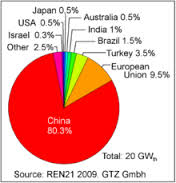
As a reminder that the world turns and turns and comes full circle in more ways than one, here’s a parting thought; an article from the Guardian of 30 January 2014. In 2013 alone, China installed more solar power than the entire installed capacity in the US, the country where the technology was invented. There is a caveat to the article that some of this newly installed capacity is not yet connected to the grid but, once installed, connections are only a matter of time.
Terrorism and Climate Change: A Single Solution

Two thirds of the world’s electricity is generated by burning fossil fuels.
Much of the world’s wars and terrorism occur in the Middle East where, not so coincidentally, much of the world’s oil also originates. A lot of the world’s climate change problem (the majority of the world by now admits that there is a problem) is due to burning fossil fuels. In 2013, oil provided around 33% of global primary energy consumption* (i.e. energy contained in fuels used to generate electricity, heating, industry, transportation or other end users). This amounts to nearly 87 million barrels of oil per day. One third of this oil came from the Middle East.
The World Coal Association states that (in 2013): Coal provides around 30.1% of global primary energy needs, generates over 40% of the world’s electricity and is used in the production of 70% of the world’s steel. Coal is more democratically distributed around the world than oil, and there is not much likelihood of wars being fought over coal reserves. Coal is also a relatively “dirty” fuel and produces more CO2 (ca. 200) per unit of energy delivered than oil (ca. 150) or natural gas (117).
A listing of principal terror groups in the world includes ISIS, Boko Haram, Al-Shabaab, Al-Qaeda, Al-Nusra, Ansar al-Sharia, Hezbollah and Hamas. Al-Jazeera news notes that the United Arab Emirates published this week a list of 80 organisations worldwide, including the foregoing, that it formally identified as terrorists. Some of the organisations on that list perhaps do not belong there, but the larger point to be made in this article still holds. When great wealth flows from all parts of the world into the hands of a few, great disparities ensue; injustice and violence occur. The world needs to get off its greed for oil and move to renewable sources of energy. Of course the transition will be painful; but less disruptive than continued terror. Reduced global oil consumption can lessen the flow of disproportionate wealth that the world directs into the coffers of a few by 20 to 30% in the next ten years.
Is the transformation do-able within this time frame? The world’s experts are divided fairly equally between yes and no. Why? Because it hasn’t been done before. But here is an indirect answer. The Paris-based International Energy Agency (IEA) has revised its estimates for deployment of renewables worldwide upwards several times in the past decade. The forecasts made in 2002 for the year 2020 were exceeded by the year 2010. So perhaps the correct answer is not to be found among energy experts but in a quote from Spanish poet Antonio Machado (1875 – 1939) who said:
Caminante, no hay camino
Se hace camino al andar.
Traveller, there is no path
The path is made by walking.
Paraphrased less poetically into modern business-speak: walk the walk, don’t simply talk! We have to make choices as individuals before nations and governments follow in our footsteps.
*For more background, see Energy Trends Insider, with links to BP’s widely used Statistical Review of World Energy 2014. Oil accounted for 33 percent of all the energy consumed in the world in 2013. This amounts to 86.8 million barrels per day. Of this, roughly 32% came from the Middle East.
http://www.ren21.net/Portals/0/documents/activities/gfr/REN21_GFR_2013.pdf
The Demoiselle Cranes of Khichan
The town of Phalodi lies halfway between Jodhpur and Jaisalmer on the Rajasthan tourist circuit. Phalodi is an unremarkable town that one drives through in a couple of minutes on the good highway that links the two larger cities. Phalodi is known as the salt city of India and was an important trading post in the days of camel caravans travelling along the overland silk route. Six kilometers away from here, driving along a narrow dirt road, is an even more unremarkable and dusty village called Khichan. The village has been a traditional stop for decades on the annual migratory route of Demoiselle Cranes between September and March each year. Sometime during the 1970s, after a series of droughts, a local Jain merchant decided to help the few dozen migrant visitors and began to feed them grain. The following year, the number of visiting birds doubled and more volunteers stepped in to contribute grain or funds for the feeding of the birds. By 1996, Otto Pfister writes in a despatch of the Oriental Bird Club, that 6000 cranes were visiting and being fed half a ton of grain per day (mainly sorghum) for six months every year. By 2012, there were an estimated 20,000 of these elegant birds in Khichan every year, on their way back from breeding sites in Mongolia and Eurasia. After crossing the steppes of Central Asia, where they are hunted by predators like the golden eagle, these delicate-looking birds fly at heights of 5000 to 10,000 meters to cross the Himalayas. This is an incredible feat at oxygen-starved altitudes and along the way are other dangers; the wars in Afghanistan, or human disruption of their habitats.

Image: courtesy birdingblogs.com
The crane is known as Koonj in Hindi, and there are many stories told about why the village community decided to feed the birds. One villager, when asked, speaks of the birds as auspicious symbols. “As long as the birds come, the future of our village is assured.” In the epic Mahabharata, the disciplined flight formation of the family groups of these birds is imitated when forming battle lines (Krauncha Vyuha) in the Kurukshetra war. In the crane-shaped formation of infantry units, forces are distributed to imitate the cranes’s wingspan, with a formidable, penetrating centre depicting the crane’s head and beak.
Through the power of the media, what was once a small local custom has attracted a large international following. The village of Khichan is now on the tourist map of Rajasthan and bird lovers from all over the world visit the place. What started forty years ago as a gesture to help a small flock of 150 migrant birds now attracts over 20,000 cranes annually. There are several amateur videos of the remarkable spectacle on You Tube. Here is one example https://www.youtube.com/watch?v=YSWEWdp-X_k
One observer writes: The most amazing thing during the morning feeding sessions perhaps is how disciplined the cranes are. They fly into specially created enclosures, walled fields of around an acre each. When one batch has fed, the next batch flies in for their turn. If the field is full, they land outside the field and patiently wait their turn.
Beginning in the 1970s, several remarkable people have transformed the face of Rajasthan. One of these, Rajendra Singh, mentioned in an earlier blog (Stepwells and Johads:digging into the past) as the man who restored the flow of seven dried up rivers in Rajasthan, now finds his expertise in demand at international meetings like the Economist Water Forum in early November where he advised property owners in the UK about methods to prevent flooding in Northumberland and elsewhere. For more, see The driest part of India offers a solution to Britain’s floods, from the Telegraph of 7 November 2014.
A lot has been written in recent years about mitigation and adaptation measures to counter AGW (anthropogenic global warming) and climate change. It is to mankind’s own long-term benefit to protect biodiversity. Ecological studies show that biologically diverse communities are more productive and stable. Traditional communities have long followed this wisdom, hard-won through years of observation and patience. Modern science confirms their wisdom. Positive actions usually come full circle, but when the circles are on a global scale they so large that we often do not see it.
 aviott